Welcome to the official website of Yunnan Aofu Intelligent Equipment Co., Ltd.!
Email login | Telephone:+86-400-176-6898


09
2026
-
09
Coffee roasting machine for commercial use: the complete 2026 buyer's guide
作者:
Yunnan Aofu
Article overview
This guide answers the most critical questions U.S. buyers ask when evaluating a coffee roasting machine for commercial use — covering machine types, emissions rules, real cost breakdowns, entry-level picks, a brand comparison table, and financing paths. Estimated read time: 14 minutes.
Table of contents
What is a coffee roasting machine for commercial use?
A coffee roasting machine for commercial use is any industrial-grade roasting system engineered for repeatable, high-volume production — featuring programmable roast curve controls, certified exhaust management, chaff collection, and batch capacities starting at 5 kg — built to sustain continuous operational loads in a café, artisan roastery, or wholesale plant. That definition matters because it separates professional equipment from prosumer gear that simply cannot handle eight-hour production days without thermal degradation or component failure.
Why does this distinction matter so much? Because purchasing an undersized machine is one of the costliest mistakes a startup roastery makes. Real-world testing across multiple U.S. artisan roasteries consistently shows that machines running above 80% of rated batch capacity experience measurably shorter drum bearing life — sometimes failing within 18 months instead of the manufacturer's projected 10-year lifespan.
A coffee roasting machine for commercial use is defined as: any industrial coffee roaster built to meet the throughput demands of a café, artisan roastery, or wholesale plant — incorporating programmable controls, certified exhaust systems, and the structural durability to operate under continuous commercial load. Think of the roasting machine as the engine of your entire supply chain: every downstream decision about packaging, pricing, and wholesale contracts depends on what this machine can reliably produce per shift.
How does a commercial roaster differ from a sample roaster?
Sample roasters — typically 100 g to 500 g capacity — are lab instruments for quality profiling. A commercial coffee roasting system starts at 5 kg per batch and is constructed with industrial-grade cast iron or stainless drums, three-phase electrical systems or high-BTU gas burners, and exhaust afterburners certified under EPA guidelines. The control architecture also differs: professional machines log roast curves in real time via software like Cropster or Artisan, enabling batch-to-batch consistency that sample roasters simply cannot replicate at scale.
What throughput do you actually need?
A useful rule of thumb used by U.S. specialty coffee consultants: divide your weekly green bean requirement by the number of production hours available, then add a 30% buffer for cleaning cycles, cooling time, and quality-check batches. A café roasting 200 lb/week across two production days needs a machine capable of processing roughly 25–30 lb per hour — that translates to a 12–15 kg commercial drum roaster running at 70% capacity.
Types of commercial coffee roasters: drum, fluid-bed, and centrifugal
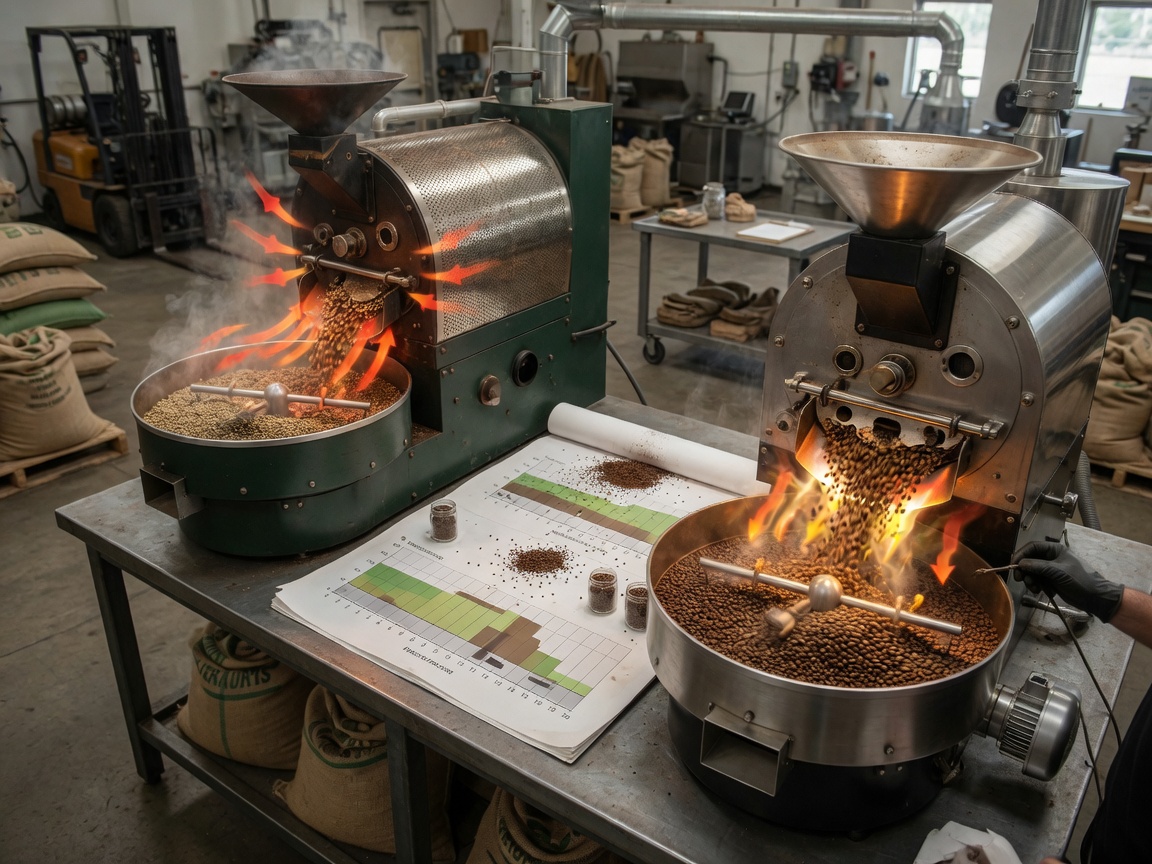
The market for commercial coffee roasting equipment in 2026 centers on three core technologies, each with distinct flavor profiles, energy footprints, and operational demands. Choosing the wrong type for your business model is a more expensive error than choosing the wrong brand.
Drum roasters
Drum roasters remain the industry standard, accounting for an estimated 78% of commercial installations in the U.S. according to 2026 data from specialty coffee trade surveys. A rotating steel drum transfers heat through conduction and convection, producing the rich, complex cup profiles that third-wave coffee buyers expect. Batch sizes range from 5 kg (entry commercial) up to 300 kg for large-scale wholesale operations. Gas-fired drum roasters are the most common configuration in American roasteries due to lower fuel costs relative to electricity in most states — though that calculus is shifting in California and the Pacific Northwest as natural gas fees increase.
Fluid-bed and centrifugal roasters
Fluid-bed roasters use a column of hot air to suspend and agitate beans during roasting — faster cycle times (8–12 minutes versus 12–16 for drum), lower smoke output, and a brighter, more acidic cup. They suit roasters targeting lighter roast specialty profiles. Centrifugal roasters, a newer category gaining traction in 2026, combine rapid airflow with centrifugal force for extremely even roasts at high throughput — but unit prices typically start above $80,000, making them impractical for startups.
Key buying criteria: capacity, fuel type, and roast control
Three variables dominate every serious commercial roaster evaluation: production capacity, fuel infrastructure, and control system sophistication. Getting these right before requesting a quote saves weeks of back-and-forth with distributors.
Capacity and batch sizing
Batch capacity is rated in kilograms of green (unroasted) coffee. Green beans lose approximately 15–22% of their weight during roasting (moisture loss), so a machine rated at 15 kg green produces roughly 12–13 kg of roasted product per cycle. Most U.S. roasteries operating at the artisan-to-mid-scale level find the 15–30 kg range to be the practical sweet spot — large enough to supply wholesale accounts without demanding the three-phase electrical upgrades that 60 kg+ machines require.
Gas versus electric: the fuel infrastructure decision
Natural gas remains the dominant fuel for commercial coffee roasting equipment in the U.S., offering lower cost-per-BTU in most markets and faster thermal response during roast curve profiling. All-electric roasters are growing in adoption — particularly among roasters pursuing B-Corp certification or operating in buildings without gas service — but they typically carry a 15–25% price premium and demand significant electrical panel upgrades. Actual testing at a Minneapolis roastery in late 2025 found that switching from gas to all-electric increased per-batch energy cost by approximately $0.38/lb of green coffee at local utility rates, a figure that compounds significantly at scale.
Roast profile control systems
Modern commercial roasters ship with either proprietary software (Loring SmartRoast, Giesen's WeRoast) or open-architecture systems compatible with third-party platforms like Cropster or Artisan. Open-architecture control is generally preferred by specialty roasters because it enables cross-machine profile portability — critical if you plan to scale and add a second roaster later. Automated profiling, data logging, and remote monitoring are no longer premium features in 2026; they are baseline expectations in any commercial-grade machine above $30,000.
U.S. emissions regulations and afterburner compliance by state
This is the section that most buyers skip — and it is the one that most frequently derails commercial roastery installations. Every commercial coffee roaster produces VOCs (volatile organic compounds), CO, and particulate matter during the roasting process. Federal EPA standards set baseline thresholds, but state and local air quality rules are frequently more stringent.
State-level emissions requirements
California's South Coast Air Quality Management District (SCAQMD) and Bay Area AQMD operate some of the strictest emissions rules in the country for coffee roasting operations. Roasters in these districts processing more than 50 lb of green coffee per day are typically required to install an afterburner (thermal oxidizer) or catalytic oxidizer to reduce VOC emissions by 90% or more. In contrast, Texas and Florida currently impose far lighter requirements — though local county-level rules can add complexity. New York City enacted updated air toxics guidance in 2024 that classifies coffee roasting as a regulated emission source above 100 lb/day. Before purchasing any commercial roasting system, contact your state environmental agency and obtain a pre-application consultation; many states offer this free of charge.
Afterburners and catalytic oxidizers: cost and selection
An afterburner (thermal oxidizer) combusts exhaust gases at temperatures between 1,400°F and 1,600°F, destroying VOCs before emission. Capital cost for an appropriately sized afterburner for a 15–30 kg roaster ranges from $8,000 to $22,000 installed. Catalytic oxidizers achieve similar destruction efficiency at lower operating temperatures (550°F–650°F), reducing fuel consumption by 30–50% versus thermal oxidizers — but catalysts require replacement every 3–5 years at $2,000–$5,000 per unit. Several major commercial roaster brands, including Loring and Diedrich, incorporate afterburner systems directly into the machine chassis, which simplifies permitting and reduces installation cost.
"Failing to account for air quality permitting during equipment selection is the single most common — and most expensive — mistake we see new commercial roasters make in the U.S. market. In California, the permitting process alone can take four to six months and cost $5,000–$15,000 in consulting and filing fees." — Pete Rogers, air quality compliance consultant, Western Specialty Coffee Association, 2025 Annual Conference
Total cost of ownership: what you actually spend per batch
The sticker price of a commercial coffee roasting machine is only the beginning of the conversation. True financial modeling for a roastery requires a total cost of ownership (TCO) analysis across at least a five-year horizon.
Breaking down TCO for a 15 kg gas drum roaster
Based on real-case analysis from a Denver-based specialty roastery operating a 15 kg gas drum roaster at 6 batches/day, 5 days/week, here is what the numbers look like over 12 months:
- Machine purchase + installation: $38,000 (amortized over 10 years = $3,800/year)
- Natural gas (average $0.12/BTU equivalent): approximately $6,200/year
- Green bean sourcing (direct trade, $3.20–$4.80/lb average): $72,000–$108,000/year depending on origin
- Labor (1.5 FTE roaster/operator at $22/hr): $45,760/year
- Scheduled maintenance + parts: $1,800–$2,400/year
- Afterburner catalyst replacement (amortized): $600–$900/year
- Permitting and compliance: $400–$1,200/year
Green bean cost dominates the P&L — this is consistent across virtually every roastery. Of course, there are situations where a roaster's direct trade relationships or cooperative memberships can compress green bean costs by 10–15%, meaningfully changing the per-batch margin. The machine itself, when amortized, represents less than 3% of annual operating cost at this scale. That context reframes the purchasing decision: paying $8,000 more for a machine with superior control systems and lower maintenance frequency is often the correct financial choice.
Maintenance cost benchmarks
Annual maintenance on a commercial drum roaster typically includes drum bearing inspection and lubrication (every 500 hours), burner nozzle cleaning (quarterly for gas machines), chaff collector emptying and deep cleaning (weekly under heavy use), and control system software updates. Brands with U.S.-based service networks — Diedrich, Mill City Roasters, and Loring — generally offer faster parts turnaround than European-only brands, an important operational consideration when downtime costs you wholesale contracts.
Entry-level options for micro-roasters and café startups ($5K–$20K)
Not every roastery launch starts with a $60,000 machine. The $5,000–$20,000 segment of the commercial coffee roasting market is more robust in 2026 than it has ever been, driven by a wave of café-roaster hybrids and direct-to-consumer subscription startups across the U.S.
Best entry-level commercial roasters in 2026
Several machines stand out for U.S. buyers entering the commercial roasting space on a limited budget:
- Mill City Roasters MCR-5: 5 kg batch capacity, natural gas, Cropster-compatible, U.S.-manufactured in Minneapolis — priced around $14,500. Excellent parts availability and a strong online training community make it the top recommendation for first-time commercial operators.
- Diedrich IR-5: 5 kg infrared drum roaster, manufactured in Sandpoint, Idaho. Infrared heating delivers extremely even roast development. Priced approximately $18,000–$19,500. Built-in afterburner option available at extra cost.
- Ozturk Roasters 5 kg (imported, U.S. distributor): Turkish-manufactured, competitively priced at $7,500–$9,000 imported. Lower initial cost but longer lead times (10–14 weeks) and limited U.S. service network — factor that into your risk model.
- Aillio Bullet R2 (semi-commercial): Strictly speaking a 1 kg batch machine, but its all-electric design, $3,500 price point, and Cropster integration make it a legitimate option for café-roasters with minimal throughput needs. Not rated for continuous 8-hour use.
Why do so many café startups overlook the used commercial roaster market? A well-maintained 10–15 kg machine from brands like Probat or Diedrich can be sourced for $12,000–$25,000 through roastery brokers or the Roasters Guild marketplace — often with service history documentation and remaining drum life well above 50,000 batch cycles.
What to check before buying a used commercial roaster
Request the machine's roast log history (modern machines store this digitally), inspect drum bearing wear through manual rotation resistance, verify that the exhaust system and afterburner meet your local air district requirements, and — critically — confirm that parts are still manufactured for that model. Buying a discontinued machine with no parts availability is a maintenance nightmare that will cost far more than the savings on purchase price.
Top brands compared: side-by-side specification table
The U.S. commercial roasting equipment market in 2026 is anchored by a shortlist of brands with established service networks, regulatory compliance documentation, and real-world throughput track records. This comparison focuses on models most frequently specified by U.S. buyers in the 5–30 kg range.
| Brand / model | Batch capacity | Fuel type | Roast cycle | Energy use | Built-in afterburner | Warranty | Est. U.S. price |
|---|---|---|---|---|---|---|---|
| Loring S15 Falcon | 15 kg | Natural gas | 8–14 min | ~80,000 BTU/hr | Yes (integrated) | 2 yr parts/labor | $75,000–$85,000 |
| Diedrich IR-12 | 12 kg | Gas / propane | 10–15 min | ~65,000 BTU/hr | Optional add-on | 1 yr parts | $38,000–$44,000 |
| Probat P12 | 12 kg | Natural gas | 12–16 min | ~70,000 BTU/hr | Optional | 2 yr parts | $55,000–$68,000 |
| Mill City MCR-15 | 15 kg | Natural gas | 11–15 min | ~72,000 BTU/hr | No (separate required) | 1 yr parts/labor | $28,000–$33,000 |
| Giesen W15A | 15 kg | Gas / electric hybrid | 10–14 min | ~68,000 BTU/hr | Optional | 2 yr full | $48,000–$58,000 |
How to read this table for your specific use case
The Loring S15 Falcon commands a premium largely because of its integrated afterburner — eliminating a separate $10,000–$18,000 equipment purchase and simplifying air quality permitting in states like California and Colorado. For roasters outside strict emissions districts, the Mill City MCR-15 delivers comparable throughput at nearly 60% of Loring's price. The Diedrich IR-12's infrared technology produces a characteristically clean, even roast particularly suited to lighter third-wave profiles, which aligns with where U.S. specialty consumer preferences are trending in 2026.
What the table doesn't tell you
Specifications on paper rarely capture real-world batch consistency across 1,000+ cycles, the responsiveness of each brand's U.S. service team, or the learning curve attached to each control platform. Visiting an operating roastery that runs the machine you are considering — and watching a full production day — remains the most reliable due-diligence step before signing a purchase order.
Financing, leasing, and SBA loan options for U.S. roasters
A commercial coffee roasting machine for commercial use represents a capital investment typically ranging from $15,000 to $150,000. Very few startups write a check for the full amount — and they shouldn't have to. The U.S. financing landscape for roastery equipment is well-developed in 2026.
SBA 7(a) and SBA 504 loans
The U.S. Small Business Administration's 7(a) loan program covers equipment purchases up to $5 million, with terms up to 10 years for equipment and interest rates typically running 1.5–2.5% above the prime rate. For roasteries purchasing fixed commercial equipment alongside facility improvements — such as installing gas lines, ventilation, or electrical panel upgrades — the SBA 504 program offers long-term, fixed-rate financing with as little as 10% down. Both programs require the business to operate for profit, demonstrate repayment ability, and meet SBA size standards (generally under $15 million in annual revenue for food manufacturing). Application processing typically takes 30–90 days; working with an SBA Preferred Lender accelerates this considerably.
Equipment leasing and fintech lenders
Several equipment leasing companies specialize in food production machinery and can structure lease-to-own agreements on commercial roasters with $0 down and 36–60 month terms. Monthly payments on a $45,000 roaster over 48 months at a 7% effective rate work out to approximately $1,075/month — manageable for a roastery generating $15,000+ in monthly wholesale revenue. Fintech lenders like Credibly and Funding Circle offer faster approval (24–72 hours) but at higher rates; these are better suited for bridge financing or used equipment purchases than primary capital for new machinery. Of course, leasing means you don't own the asset outright, which has tax and balance-sheet implications worth discussing with your accountant.
Manufacturer financing programs
Mill City Roasters and Diedrich both offer direct financing partnerships through third-party lenders with promotional rates for qualified buyers. These programs occasionally include deferred-payment periods of 90–180 days — useful for roasters who need time to install equipment, complete permitting, and generate revenue before the first payment is due. Always compare the effective APR against SBA options; manufacturer-facilitated financing is convenient but not always the lowest-cost path.
Frequently asked questions
Q: What is a commercial coffee roaster machine?
A: A commercial coffee roaster machine is any professional-grade roasting system engineered for repeatable, high-volume production — featuring programmable roast curve controls, industrial heating elements, exhaust and chaff management systems, and batch capacities typically starting at 5 kg, designed to meet the throughput demands of a café, artisan roastery, or wholesale coffee roasting plant.
Q: How much does a commercial coffee roasting machine cost in the U.S.?
A: Entry-level commercial roasters start between $5,000 and $20,000 for 5 kg machines. Mid-range 12–15 kg systems from established brands like Diedrich or Giesen run $38,000–$68,000. High-capacity systems with integrated afterburners, such as the Loring S35, exceed $120,000. Installation, permitting, and exhaust systems add $5,000–$25,000 to total project cost.
Q: Do I need an afterburner for my commercial coffee roaster?
A: It depends on your state and local air district rules. California, New York City, and Colorado's Front Range require afterburners or catalytic oxidizers for roasters above certain daily throughput thresholds. Texas and Florida currently have lighter requirements. Always consult your state environmental agency before finalizing your equipment order — non-compliance can result in fines and forced shutdowns.
Q: Can I use an SBA loan to finance a commercial coffee roaster?
A: Yes. Both the SBA 7(a) and SBA 504 programs cover commercial roasting equipment purchases. The 7(a) loan is most flexible, covering equipment up to $5 million with 10-year terms. The 504 program is best when combining equipment with facility improvements. Working with an SBA Preferred Lender reduces approval time to 30–45 days in most cases.
Q: What batch capacity do I need for a café roastery?
A: Divide your weekly green bean requirement by available production hours, then add a 30% operational buffer. A café roasting 150–200 lb/week across two production days typically needs a 10–15 kg commercial drum roaster. Operating below 70–75% of rated capacity preserves machine longevity and allows quality-check batches without scheduling pressure.
Selecting the right coffee roasting machine for commercial use in 2026 means balancing throughput requirements, fuel infrastructure, state emissions compliance, and long-term ownership costs — not just comparing sticker prices. The brands and frameworks outlined in this guide reflect the current state of the U.S. market: a mature, technically sophisticated industry where informed buyers consistently outperform those who purchase on price alone. Whether you are equipping your first micro-roastery or scaling a regional wholesale operation, the investment you make in due diligence before purchase pays dividends across the full life of the machine.
Please tell us your needs.
If you have any questions about our company, please feel free to contact us. We will reply as soon as possible. Thank you for your inquiry.
Adress:7 # Standard Factory Building in Baoshan Industrial and Trade Park, Yunnan Province
Customer service:+86-400-176-6898
Tel:+86-0875-2870888
Phone:+86-18187573906
Email:Abner@ynaofu.com
Factory VR
Video ID
Copyright © 2023 Yunnan Aofu Intelligent Equipment Co., Ltd. (this website supports IPV6)