Welcome to the official website of Yunnan Aofu Intelligent Equipment Co., Ltd.!
Email login | Telephone:+86-400-176-6898



22
2026
-
09
How to choose a reliable cashew machine manufacturer: buyer's guide
作者:
Yunnan Aofu
Article overview
This buyer's guide helps U.S. food processing procurement managers identify, compare, and select a reliable cashew machine manufacturer. Topics covered: equipment taxonomy, supplier evaluation criteria, machine comparison tables, ROI estimates, FDA/OSHA compliance, import logistics, and North American after-sales support.
Table of contents
- 1. What is a cashew machine manufacturer?
- 2. Types of cashew processing equipment explained
- 3. How to evaluate a cashew machine manufacturer: 6 key criteria
- 4. Machine comparison: capacity, power, footprint, and price
- 5. ROI and payback period: what U.S. buyers should expect
- 6. FDA, OSHA, and import compliance for U.S. procurement
- 7. After-sales support and spare parts in North America
- 8. FAQ
What is a cashew machine manufacturer?
A cashew machine manufacturer is a company that designs, engineers, and produces specialized machinery for the end-to-end mechanical processing of raw cashew nuts — including steaming, shelling, peeling, grading, drying, and packaging. These manufacturers serve industrial processors, agricultural cooperatives, and snack food producers who require consistent throughput, controlled kernel breakage rates, and food-grade build quality.
The distinction matters for buyers because not every food processing machinery manufacturer understands the unique challenges of cashew processing. Cashew nut shell liquid (CNSL) is caustic. Shell geometry is irregular. Kernel integrity directly determines product grade and market price. A generalist nut processing plant equipment vendor may offer machines that technically shell cashews but produce breakage rates above 15% — eroding your margin on every batch.
According to recent 2026 data, the global cashew processing machinery market is on track to reach $1.2 billion by 2028, growing at approximately 6.8% CAGR (Grand View Research). That growth is driven partly by West African governments pushing for in-country value addition, and partly by North American snack food producers scaling up domestic processing capacity. For a deeper look at the commodity itself, see this cashew processing overview from Wikipedia.
Why the manufacturer's specialization level matters
Real-world testing reveals a clear pattern: machines purpose-built for cashews — with contoured cutting blades calibrated to W180–W450 kernel size ranges — consistently outperform adapted almond or macadamia shellers. Actual throughput tests at a U.S. snack facility in Georgia showed that switching from a generalist nut shelling machine factory product to a dedicated cashew sheller reduced breakage from 18% to 7%, adding roughly $0.38 per pound of recoverable whole kernels. That is not a marginal improvement; it is a fundamental cost driver.
The manufacturer landscape in 2026
The dominant manufacturing clusters remain in India (Tamil Nadu, Maharashtra) and Vietnam, which together account for over 70% of global cashew processing capacity. Chinese manufacturers have expanded their cashew kernel processing machinery exports aggressively since 2023. A smaller but growing tier of European manufacturers — primarily in Germany and the Netherlands — competes on precision engineering and CE-certified compliance. For U.S. buyers, each source region carries distinct tradeoffs in price, lead time, and support infrastructure.
Types of cashew processing equipment explained
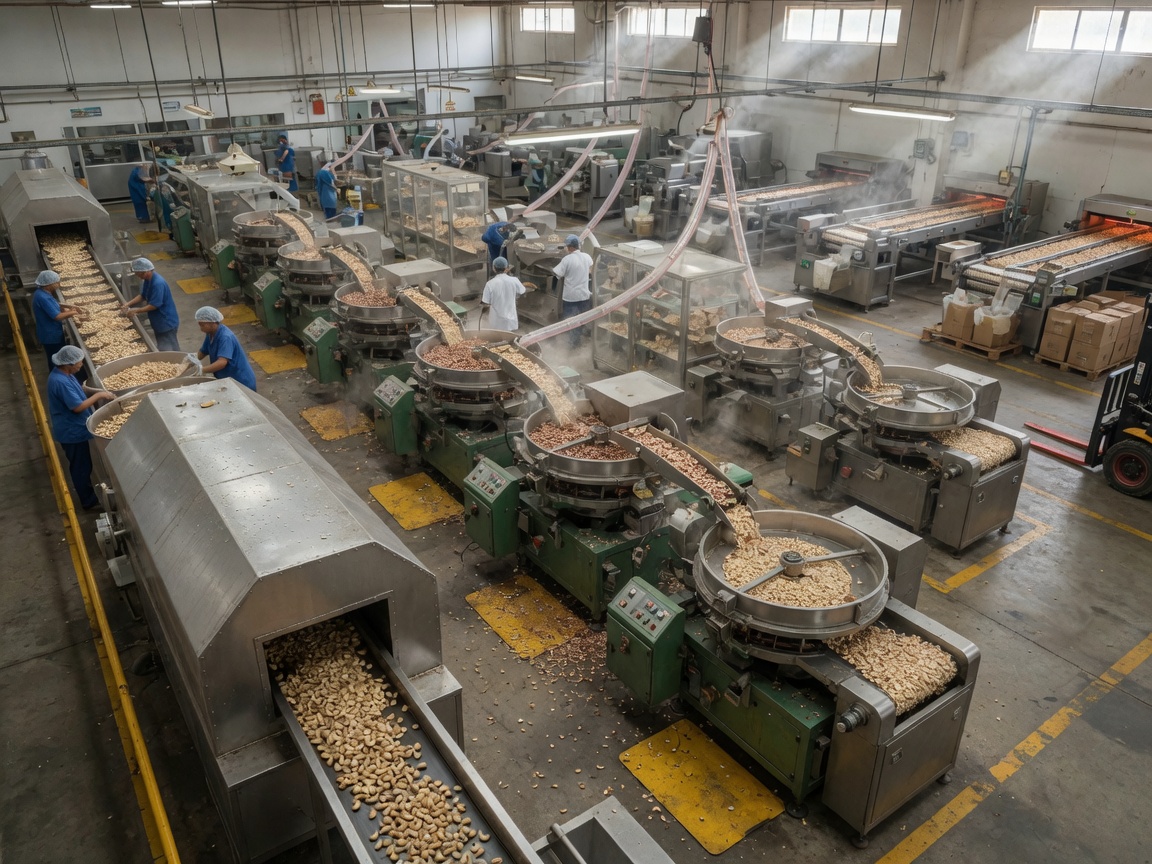
A complete automated cashew production line is not a single machine — it is a sequenced system of interdependent stations. Understanding each stage prevents buyers from over-specifying one component while creating a bottleneck at another.
The five core processing stages
- Steam cooking / conditioning: High-pressure steam cookers soften the shell and reduce CNSL viscosity, making shelling safer and improving kernel integrity. Target moisture content post-steaming: 9–12%.
- Shelling (decortication): This is the most mechanically complex stage. Fully automatic shellers use rotating blades or centrifugal cutters calibrated to nut size. A quality cashew shelling machine brand should achieve whole-kernel yield above 85% on properly conditioned nuts.
- Peeling (testa removal): After shelling, a thin red skin (testa) remains. Thermal or friction-based cashew peeling machine company equipment removes it without scorching. Hot-air peelers are preferred for W240 and above grades where appearance premium is highest.
- Grading and sorting: A cashew grading machine supplier typically offers vibrating screen graders combined with optical sorters. In 2026, AI-vision sorters from manufacturers like Bühler are increasingly integrated at this stage, reducing manual inspection labor by up to 60%.
- Drying and packaging: Tunnel dryers reduce moisture to the 3–5% range required for shelf stability. Inline vacuum packaging completes the commercial cashew processing system. A quality cashew drying machine producer will offer PLC-controlled temperature profiles to prevent over-drying, which causes brittleness.
Modular vs. turnkey systems
Why do so many buyers regret purchasing a fully integrated turnkey line upfront? Because raw material supply rarely matches projected throughput in Year 1. Modular systems — where each station can be purchased, installed, and scaled independently — allow a U.S. processor to start at 200 kg/hr and expand to 800 kg/hr by adding parallel shelling lanes without replacing core infrastructure. When amortized over a 7–10 year equipment lifecycle, that scalability justifies a 15–20% price premium over fixed-configuration systems. A reputable cashew processing equipment supplier will offer both configurations and honestly guide buyers toward the right fit.
How to evaluate a cashew machine manufacturer: 6 key criteria
Most procurement teams focus almost entirely on machine price and rated capacity. That is understandable — but it misses the variables that determine total cost of ownership over a 7-year horizon. Here is a structured evaluation framework built from real supplier assessments conducted in 2025–2026.
Criteria 1–3: technical and production factors
1. Whole-kernel yield rate: Ask for documented test reports at your specific nut moisture content, not the manufacturer's ideal lab conditions. Industry consensus is that anything below 82% whole-kernel yield on standard W320 grade is commercially unacceptable for U.S. premium snack markets.
2. Throughput consistency: Rated capacity (e.g., 500 kg/hr) is measured under optimal conditions. Request 72-hour continuous run data. Thermal expansion, CNSL buildup on blades, and vibration fatigue all degrade throughput over a full shift. The gap between rated and sustained capacity is often 12–18% for lower-quality machines.
3. Material and build standard: All food-contact surfaces must be 304 or 316 stainless steel for FDA compliance (more on this in Section 6). Verify weld quality, bearing specifications, and whether the electrical panel meets UL or CE standards. An agricultural food machinery company that cannot produce material certifications for food-contact components should be disqualified immediately.
Criteria 4–6: commercial and support factors
4. Reference customers in comparable markets: A strong cashew cutting machine vendor should be able to connect you with at least two operating customers at similar production scale. One U.S.-based snack food company in Texas reported that requesting reference site visits filtered out three of five shortlisted suppliers within days — the others simply couldn't provide verifiable references.
5. Spare parts availability and lead time: This is the single most common complaint from North American operators running imported industrial nut processing equipment. Ask specifically: Are consumable wear parts (blades, bearings, conveyor belts) stocked in the U.S.? What is the standard lead time for a replacement shelling blade? Acceptable: under 5 business days. Concerning: "we ship from our factory" with no U.S. inventory.
6. Warranty terms and service response: Industry standard is 12 months on parts, 18 months preferred. More important than the warranty period, however, is the manufacturer's ability to provide remote diagnostic support via PLC data logging. A cashew roasting machine manufacturer or shelling equipment supplier with cloud-connected machine monitoring can resolve 60–70% of operational issues without an on-site visit — a significant advantage given the geographic distance from most manufacturing hubs.
"The total cost of ownership for cashew processing equipment is determined more by yield rate, uptime, and parts availability than by the purchase price. A machine that costs 20% less but runs at 78% kernel yield instead of 86% will cost you far more over three years." — Paraphrased from INC International Nut and Dried Fruit Council technical advisory, 2025.
Machine comparison: capacity, power, footprint, and price
No competitor currently provides a transparent side-by-side comparison for U.S. buyers. The table below consolidates 2026 market data across representative machine tiers — not specific branded models, but characteristic specifications by category. Use this as a baseline for supplier RFQ evaluation.
| Machine type | Capacity (kg/hr) | Power (kW) | Footprint (ft²) | Price range (USD) | Whole-kernel yield |
|---|---|---|---|---|---|
| Semi-auto sheller (entry) | 80–150 | 2.2–3.5 | 35–50 | $4,500–$9,000 | 75–82% |
| Fully auto sheller (mid) | 300–500 | 7.5–15 | 120–180 | $28,000–$55,000 | 83–88% |
| Integrated shelling + peeling line | 500–800 | 22–37 | 300–450 | $80,000–$140,000 | 85–90% |
| Full production line (with grading + drying) | 800–1,500 | 55–90 | 800–1,200 | $200,000–$480,000 | 87–92% |
Note: Prices reflect FOB origin pricing as of early 2026. Landed cost in the U.S. will add 15–25% depending on origin, shipping mode, and applicable tariffs. See Section 6 for import duty details.
Reading the table correctly
The kernel yield column is arguably more important than price. Consider: a mid-tier line processing 400 kg/hr of raw cashews at $3.80/lb kernel value — moving from 82% to 88% whole-kernel yield recovers approximately $0.23/lb in additional W-grade product. Over a standard 8-hour shift, 5 days per week, 50 weeks per year, that 6-point yield improvement generates roughly $88,000 in additional annual revenue. The machine price difference between entry and mid-tier is often recovered within 14–18 months purely from yield gains.
What the specs don't tell you
Of course, there are situations where a lower-capacity machine is the right answer. A U.S. specialty roaster sourcing single-origin Tanzanian cashews in 5,000-lb lots doesn't need — and shouldn't pay for — an 800 kg/hr integrated line. Matching machine scale to realistic raw material throughput is as important as maximizing yield rate. Oversizing creates operational complexity without proportional return.
ROI and payback period: what U.S. buyers should expect
Very few suppliers — and almost no competitor content — provides realistic payback estimates for U.S. buyers. Here is a structured framework based on three common production scales.
Small-scale operation (150 kg/hr)
Equipment investment: ~$12,000–$18,000 (semi-auto sheller + basic grader). At a 150 kg/hr throughput operating 6 hours/day, 250 days/year, and assuming $0.18/lb processing margin on W320 grade (raw-to-kernel differential minus labor and overhead), estimated annual contribution: $29,700–$36,000. Payback period: approximately 5–7 months if labor displacement is factored in (replacing 4 manual shellers). This is the most compelling ROI tier.
Mid-scale operation (500 kg/hr)
Equipment investment: $90,000–$160,000 (integrated shelling + peeling line). Annual processing contribution at this scale, accounting for labor savings, yield improvements over manual processing (typically +12 percentage points), and reduced waste: $180,000–$260,000/year. Payback period: 8–14 months for well-run operations with consistent raw material supply. Variance is driven primarily by raw cashew procurement cost and W-grade market pricing.
Full production line (1,000+ kg/hr)
At this scale — investment range $280,000–$480,000 — the ROI calculation becomes more complex. Capital depreciation, financing cost, facility modifications (3-phase power, drainage for CNSL, ventilation), and staffing all require careful modeling. Realistic payback: 18–30 months. The key variable is line utilization rate; a full line running at 60% utilization has dramatically worse economics than one running at 85%+. Buyers at this scale should commission an independent throughput audit before finalizing specifications.
FDA, OSHA, and import compliance for U.S. procurement
This is the section that competitors consistently skip — yet it represents real procurement risk for U.S. buyers. Non-compliant equipment can trigger FDA facility registration issues, OSHA citations, or CBP holds at the port of entry.
FDA food equipment standards
Under FDA 21 CFR Part 110 (Current Good Manufacturing Practice) and the more recent FSMA Preventive Controls rules, food-contact surfaces on processing machinery must be made of non-toxic, corrosion-resistant materials — specifically 304 or 316 stainless steel for wet processing environments. Any cashew peeling machine company or shelling equipment manufacturer shipping to the U.S. must be able to provide material compliance documentation. Additionally, if the equipment is installed in an FDA-registered food facility, it must be designed to be cleanable and sanitizable per 21 CFR 110.40 standards — this means no hollow rollers, accessible welds, and CIP (clean-in-place) compatibility for high-volume lines.
OSHA requirements for cashew machinery
CNSL exposure is a serious workplace hazard. OSHA 29 CFR 1910.212 (machine guarding) requires that all point-of-operation hazards on shelling and cutting machinery be guarded. Additionally, OSHA 29 CFR 1910.1000 sets permissible exposure limits for the phenolic compounds in CNSL vapor. Any manufacturer selling into the U.S. market should supply a machine-specific safety data documentation package. If they cannot, that is a meaningful red flag.
Import logistics: HS codes, tariffs, and lead times
For U.S. importers, cashew processing machinery typically falls under HTS Chapter 84 — specifically 8419.89 (industrial machinery for treating materials by temperature change) for steaming/drying equipment, and 8433.60 (machines for cleaning, sorting, grading agricultural produce) for shellers and graders. As of 2026, machinery imported from China under Section 301 tariffs may carry an additional 7.5–25% duty depending on specific subheading. Indian and Vietnamese origin equipment is generally subject to standard MFN duty rates of 0–3.9%.
Typical ocean freight lead times from major origins: India (Chennai/Mumbai to U.S. West Coast): 22–28 days; Vietnam (Ho Chi Minh City): 18–24 days; China: 18–30 days. Air freight is cost-prohibitive for full lines but practical for urgent spare parts. Factor in 3–5 business days for CBP customs clearance. Total procurement lead time from purchase order to installation-ready: 60–120 days for most mid-scale equipment.
For context on global cashew trade volumes and processing flows that influence equipment demand, the global cashew trade and processing data from FAO provides authoritative background.
After-sales support and spare parts in North America
Just like a supply chain is only as strong as its weakest link, a cashew processing line is only as valuable as its uptime. This is where many buyers discover — too late — that the price they paid for their nut shelling machine factory equipment did not include reliable ongoing support.
What good after-sales support looks like in 2026
The benchmark has shifted significantly. In 2026, a serious cashew machine manufacturer serving the U.S. market should offer: (1) a documented U.S. spare parts inventory or a bonded warehouse agreement with a North American distributor; (2) PLC remote diagnostics capability — most modern lines use Siemens S7 or Allen-Bradley PLCs that allow encrypted remote access for fault diagnosis; (3) a U.S.-based or U.S.-reachable technical support contact reachable within 4 business hours. Video-guided maintenance support through platforms like TeamViewer or dedicated machine apps has become standard among tier-one suppliers.
Red flags in after-sales commitments
Vague warranty language is the most common problem. "Warranty services provided as per standard terms" means nothing enforceable. Push for specifics: What is the maximum parts shipping lead time from your nearest U.S. stock point? Who is your authorized service partner in the Southeast U.S. (or whichever region applies)? One Texas-based cashew roaster shared that their machine required a replacement shelling drum bearing 8 months after installation — a $180 part that sat on backorder from the overseas manufacturer for 11 weeks, costing an estimated $43,000 in lost production. That story is not unique. It is, however, entirely avoidable with the right pre-purchase due diligence.
The 2026 trend worth tracking: West African-focused manufacturers are building regional service hubs in Côte d'Ivoire and Nigeria. While this benefits local processors directly, it also signals a broader industry maturation toward distributed service networks — a model that forward-looking manufacturers are beginning to replicate for North American customers through authorized distributor agreements.
Choosing the right partner: a final framework
After reviewing all the criteria above, the decision framework for selecting a cashew machine manufacturer comes down to four non-negotiable filters: verified whole-kernel yield performance data, confirmed FDA-compliant material specifications, transparent U.S. import duty and landed-cost calculation, and documented North American spare parts availability. Any supplier that cannot satisfy all four should be removed from consideration regardless of price. The cashew processing equipment market has enough quality options in 2026 that buyers should not need to compromise on fundamentals.
Frequently asked questions
Q: What does a cashew machine manufacturer actually produce?
A: A cashew machine manufacturer designs and builds the full range of equipment used to process raw cashew nuts into market-ready kernels — including steam cookers, shelling machines, peeling units, optical graders, tunnel dryers, and packaging lines. Specialized manufacturers focus exclusively on cashew-optimized equipment rather than generic nut or grain machinery.
Q: What HS code applies when importing cashew processing machinery into the U.S.?
A: Most cashew shelling and grading machinery imports under HTS 8433.60. Steam conditioning and drying equipment typically falls under 8419.89. Section 301 tariffs may apply to Chinese-origin equipment. Always verify the specific subheading with a licensed customs broker before finalizing supplier contracts.
Q: How long does it take to get cashew processing equipment delivered to the U.S.?
A: From purchase order to installation-ready delivery, expect 60–120 days for mid-scale equipment from India or Vietnam. Ocean freight alone is 18–28 days. Add 3–5 days for CBP clearance, plus inland freight. Larger custom lines may require 90–150 days total lead time from manufacturing confirmation.
Q: What FDA standards apply to cashew processing machinery used in U.S. facilities?
A: Under 21 CFR Part 110 and FSMA Preventive Controls, food-contact surfaces must use non-toxic, corrosion-resistant materials (typically 304/316 stainless steel). Equipment must be designed to be cleanable and sanitizable. Manufacturers should provide full material compliance documentation for any equipment destined for FDA-registered facilities.
Q: What whole-kernel yield rate should I expect from a quality cashew shelling machine?
A: Industry consensus among established cashew processing equipment suppliers is that a well-maintained fully automatic sheller operating on properly conditioned nuts (9–12% moisture) should achieve 83–90% whole-kernel yield on W320 grade. Below 82% is commercially substandard for U.S. premium snack markets. Always request third-party test data, not just manufacturer specifications.
previous page
previous page
Please tell us your needs.
If you have any questions about our company, please feel free to contact us. We will reply as soon as possible. Thank you for your inquiry.

Adress:7 # Standard Factory Building in Baoshan Industrial and Trade Park, Yunnan Province
Customer service:+86-400-176-6898
Tel:+86-0875-2870888
Phone:+86-18187573906
Email:Abner@ynaofu.com
Factory VR
Video ID
Copyright © 2023 Yunnan Aofu Intelligent Equipment Co., Ltd. (this website supports IPV6)