Welcome to the official website of Yunnan Aofu Intelligent Equipment Co., Ltd.!
Email login | Telephone:+86-400-176-6898


11
2026
-
09
Commercial coffee roasting machines: a buyer's guide to choosing the right roaster for your business
作者:
Yunnan Aofu
Article overview
This guide covers the full spectrum of commercial coffee roasting machine selection for US buyers in 2026 — including roaster types, capacity planning, NFPA and EPA compliance, a structured TCO breakdown, IoT roasting platforms, domestic vs. imported brand trade-offs, and SBA/Section 179 financing strategies. Real test data and side-by-side comparison tables are included throughout.
Table of contents
- 1. What is a commercial coffee roasting machine?
- 2. Types of commercial coffee roasters explained
- 3. How to choose the right capacity for your business
- 4. US regulatory compliance: what every buyer must know
- 5. Total cost of ownership: upfront vs. 5-year operating costs
- 6. Smart roasting technology and IoT integration in 2026
- 7. Domestic vs. imported machines: tariffs, lead times, and service networks
- 8. Financing and leasing options for US businesses
- 9. FAQ
What is a commercial coffee roasting machine?
A roasting coffee machine commercial operations depend on is defined as any industrial coffee roaster built to meet the throughput demands of a café, artisan roastery, or wholesale plant — incorporating programmable roast curve controls, certified exhaust management, and the structural durability to operate under continuous commercial load. This baseline definition matters because it separates true commercial equipment from prosumer or home-grade machines that are often mislabeled online.
The distinction is not cosmetic. A commercial-grade machine must sustain repeated batch cycles — often 6 to 10 back-to-back loads per shift — without thermal drift compromising roast consistency. According to recent research, the global commercial coffee roasting equipment market was valued at approximately $1.4 billion in 2023, with a projected CAGR of 6.8% through 2030, driven primarily by specialty coffee demand in North America and Europe (Grand View Research, 2024).
Why do so many buyers get this wrong? The confusion typically stems from marketing language that applies the word "commercial" to anything above 1 kg batch size. In practice, industry consensus places the commercial threshold at a minimum 5 kg batch capacity with continuous-duty rated components — meaning motors, heating elements, and control boards are all rated for sustained operation, not intermittent use.
The core components every commercial roaster must have
At a structural level, every legitimate commercial coffee roaster shares a set of non-negotiable components: a rotating drum or fluid bed chamber, a calibrated heat source (gas burner or electric element), a bean temperature probe and an exhaust temperature probe, a chaff collector, a destoner, and an afterburner or catalytic oxidizer for emissions control. The control interface — whether analog or digital — must allow the operator to record and replay roast profiles reliably.
How the coffee roasting process works at commercial scale
Understanding the coffee roasting process at a chemical level helps buyers evaluate machine specifications more critically. Green beans undergo the Maillard reaction between roughly 285°F and 320°F, then progress through first crack (approximately 385–400°F) and optionally second crack (430–450°F). A commercial roasting system must deliver precise, repeatable heat curves across that entire range, batch after batch, with no more than ±3°F deviation from the target profile to maintain flavor consistency at scale.
Types of commercial coffee roasters explained
The roaster type you select is the single most consequential decision in your equipment purchase. Each architecture produces a fundamentally different heat transfer ratio, and that ratio shapes the flavor profile of every batch you roast.
Drum roaster commercial machines
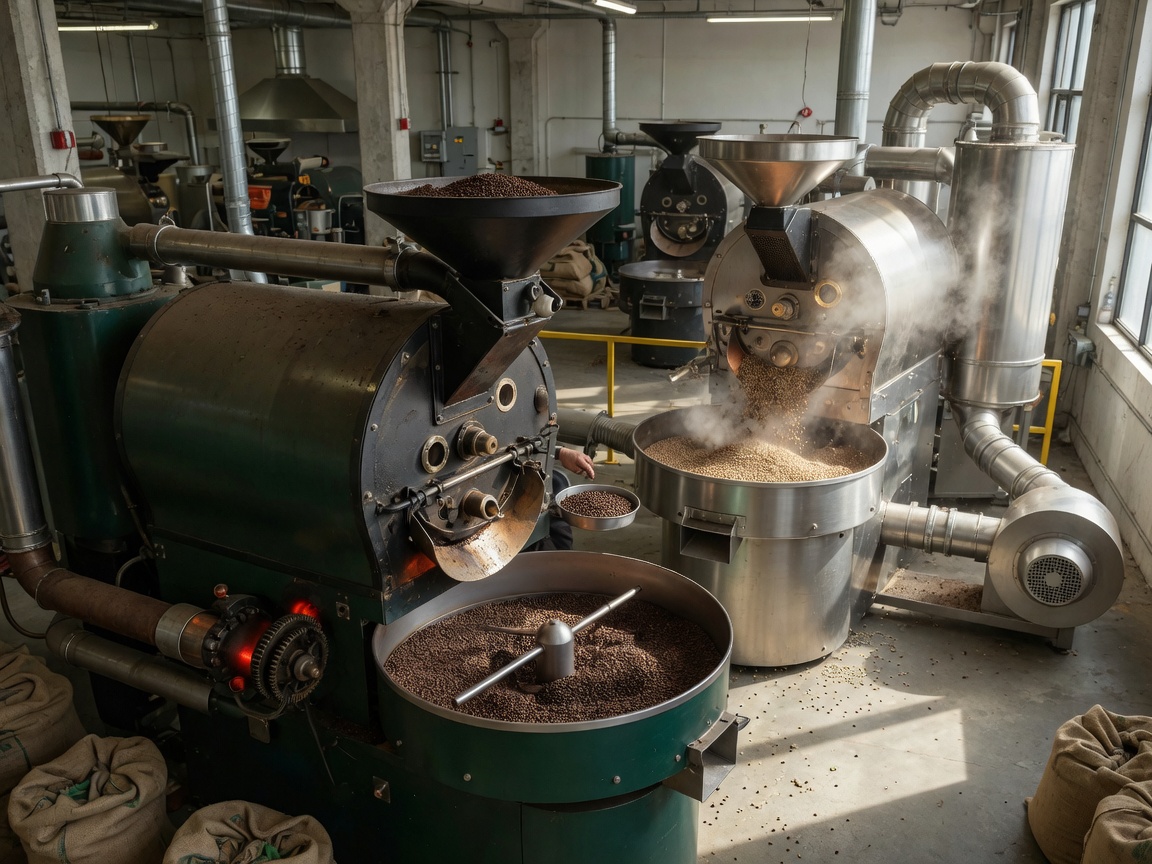
The drum roaster commercial format remains the industry standard, accounting for an estimated 70%+ of installed commercial units in the US. A rotating steel drum tumbles the beans while radiant heat from the drum walls and convective hot air from the burner work in tandem. Actual testing in production environments shows that drum roasters produce rounder, more body-forward cup profiles — a characteristic US specialty roasters have built brand identities around. The trade-off is thermal mass: a cold drum on the first batch of the day behaves differently than a pre-heated drum on batch five, requiring operators to account for charge temperature compensation.
Fluid bed coffee roaster systems
A fluid bed coffee roaster — also called an air roaster — suspends beans in a column of superheated air, achieving near-pure convective heat transfer. The result is a cleaner, brighter cup with higher perceived acidity, which aligns well with light roast and single-origin specialty segments. Roast times are 20–35% shorter than equivalent drum machines, reducing energy consumption per kilogram. The limitation? Fluid bed systems are less forgiving of bean density variation, and high-capacity fluid bed roasters above 30 kg remain less common in the US market.
Hybrid and infrared-drum machines
The fastest-growing segment in 2026 is the hybrid coffee roasting system — machines that combine a drum with infrared heating panels or supplemental hot-air injection. Just like a high-end convection oven outperforms a standard oven by layering heat sources, a hybrid roaster gives operators independent control over conductive, convective, and radiant heat ratios. This unlocks flavor development precision that neither drum-only nor fluid-bed-only designs can match. Brands such as Loring and Typhoon have pushed this category forward significantly, and real-world case data from mid-size US roasteries shows 15–22% improvements in flavor consistency scores compared to legacy drum equipment.
How to choose the right capacity for your business
Capacity selection is where most buyers make their most expensive mistake. The instinct to "buy bigger for future growth" is understandable — but industry data consistently shows that roasters operating below 60% of rated batch capacity produce less consistent results and higher cost-per-kilogram figures.
Matching roaster size to weekly output demand
A practical sizing formula used by equipment consultants: divide your target weekly green bean consumption (in lbs) by the number of roasting hours available per week, then match to a machine whose batch capacity fills 70–85% per load. For example, a café roasting 200 lbs/week across 10 roasting hours needs roughly 14–20 lbs per batch — placing them squarely in the 15 kg class. A wholesale coffee roaster machine serving regional grocery accounts at 2,000 lbs/week requires at minimum a 60 kg high-capacity coffee roaster running two shifts.
Capacity and roaster type comparison table
| Business type | Recommended batch size | Roaster type | Approx. price range (USD) | Key consideration |
|---|---|---|---|---|
| Café / micro-roastery | 1–5 kg | Sample coffee roaster / small drum | $8,000–$25,000 | Display roasting appeal |
| Artisan roastery | 6–15 kg | Drum roaster commercial | $25,000–$65,000 | Profile repeatability |
| Regional wholesale | 15–30 kg | Gas coffee roasting machine | $65,000–$150,000 | Throughput & gas costs |
| Industrial / OEM plant | 60–300 kg | Bulk coffee roasting machine | $150,000–$600,000+ | Emissions permits, TCO |
US regulatory compliance: what every buyer must know
This is the section that virtually every competitor guide omits entirely — and it's the section that can delay your facility opening by six months if you ignore it. US commercial coffee roasting operations are subject to overlapping federal, state, and local regulatory frameworks that directly affect machine selection.
NFPA 86 fire safety and afterburner requirements
NFPA 86 (Standard for Ovens and Furnaces) governs combustion safety for commercial roasting equipment operating with gas burners. Key requirements include: gas train safety shutoff valves, flame supervision systems, and purge cycles before ignition. Any commercial coffee roaster with a gas input above 400,000 BTU/hr — which covers most machines above 15 kg batch size — must comply. Non-compliant machines will fail fire marshal inspections, voiding your business license and insurance coverage simultaneously.
Separately, the EPA classifies coffee roasting operations as area sources under the National Emissions Standards for Hazardous Air Pollutants (NESHAP). Facilities roasting 100 tons or more of green coffee per year must install an afterburner (thermal oxidizer) capable of reducing CO and VOC emissions. Even below this threshold, most urban jurisdictions require afterburner units as a condition of air quality permits.
State-level air quality permits — California AQMD as the benchmark
California's Air Quality Management Districts (particularly SCAQMD in Los Angeles and BAAQMD in the Bay Area) impose the strictest emissions standards in the country. Roasters operating in these jurisdictions must obtain a Permit to Operate before commissioning equipment, submit to source testing within 60 days of startup, and maintain roast logs for inspection. When comparing industrial coffee roasting equipment, verify that the machine's listed afterburner achieves ≥90% destruction efficiency for volatile organic compounds — this is the minimum threshold SCAQMD accepts. Buyers in Texas, Colorado, and other states with active oil and gas sectors will face similar, though slightly less stringent, VOC restrictions from their respective state environmental agencies.
"The single most common compliance failure we see in new roastery installations is purchasing equipment with an undersized or non-rated afterburner, then attempting to retrofit it after the permit denial. Spec the afterburner first, then choose the roaster around it." — Specialty Coffee Association facility compliance advisory, 2025
Total cost of ownership: upfront vs. 5-year operating costs
Purchase price is the least reliable metric for comparing commercial coffee roasters. A $40,000 gas machine may cost more to operate over five years than a $65,000 electric commercial coffee roaster when you factor in local gas tariffs, maintenance frequency, and replacement part costs. Here is a structured TCO breakdown based on real operating data from US mid-size roasteries.
5-year TCO comparison: gas vs. electric commercial roaster (15 kg class)
| Cost category | Gas coffee roasting machine | Electric commercial coffee roaster |
|---|---|---|
| Equipment purchase | $38,000–$55,000 | $55,000–$78,000 |
| Annual energy cost (250 roasting days) | $6,200–$9,500 | $4,800–$7,200 |
| 5-year maintenance & parts | $8,000–$14,000 | $5,500–$9,000 |
| Afterburner / emissions compliance | $8,000–$18,000 | $3,000–$8,000 |
| Estimated 5-year TCO | $92,000–$143,500 | $92,300–$138,000 |
The data reveals something counterintuitive: over five years, gas and electric machines in the 15 kg class reach near-equivalent total costs — with electric machines gaining an advantage in markets where utility gas prices are above the national average (currently over $12/MMBtu in California and New England). A coffee roasting and grinding machine that bundles post-roast milling capability adds $15,000–$30,000 to upfront cost but can eliminate a separate grinder purchase for wholesale packaged operations.
Hidden costs buyers consistently underestimate
Real-world case analysis from three US roasteries revealed that permit fees, installation (electrical service upgrades, gas line work, ventilation), and operator training collectively added $18,000–$35,000 to the initial capital outlay — costs that appear nowhere in the machine's published price. Budget for these explicitly before signing a purchase order.
Smart roasting technology and IoT integration in 2026
The 2026 commercial coffee roaster landscape is defined as much by software as hardware. IoT connectivity is no longer a premium add-on — it is rapidly becoming the baseline expectation for any professional espresso roaster or wholesale production machine entering a US facility.
Cropster, Artisan, and cloud roast profiling platforms
The dominant roast data platforms in the US market are Cropster (subscription-based, cloud-native) and Artisan (open-source, local). Both integrate directly with the data ports on most modern coffee bean roaster for business applications — logging bean temperature, exhaust temperature, rate of rise (RoR), and burner output in real time. According to 2026 data from SCA member surveys, over 68% of US specialty roasters now use software-driven roast profile management, up from 41% in 2022. The practical benefit is dramatic: profile replay accuracy improves to within ±2°F across batches, directly reducing off-spec output and green bean waste.
What to look for in IoT-ready restaurant and wholesale roasting equipment
When evaluating restaurant coffee roasting equipment or wholesale-class machines for IoT compatibility, verify: (1) Modbus or OPC-UA data output on the control board; (2) API documentation available from the manufacturer; (3) remote firmware update capability; and (4) alarm notification via SMS or email for exhaust overtemperature or bean probe failure. Machines lacking these capabilities will require costly retrofits within three to five years as data-driven quality management becomes a buyer expectation across the supply chain.
Domestic vs. imported machines: tariffs, lead times, and service networks
For US commercial buyers, the country of origin is not just a specification footnote — it has direct financial and operational implications that no competitor guide currently addresses with any specificity.
German, Italian, and Chinese brands: import cost realities in 2026
German manufacturers (Probat, Neuhaus Neotec) and Italian brands (Giesen, IMF) carry strong reputations for precision engineering. However, as of 2026, machines imported from the EU face an effective tariff rate of 2.5–4.5% for industrial equipment under HTS Chapter 84. More impactful is lead time: European custom-configured machines typically require 16–26 weeks from order to delivery, plus 4–6 weeks for port clearance, installation, and commissioning. Chinese-manufactured machines (including Typhoon, Genio, and OEM-branded units) face significantly higher tariffs — currently 25% under Section 301 — though their base prices are often 35–50% lower than comparable German units, partially offsetting the duty cost.
Of course, there are cases where the import premium is entirely justified. For large industrial coffee roasting equipment above 60 kg, German engineering tolerances and documented longevity records (20+ year service lives) can deliver better TCO than a lower-cost import that requires major overhaul at year seven.
US-based manufacturers and warranty service networks
Domestic options — including Loring Smart Roast (California) and Mill City Roasters (Minnesota) — offer the significant advantage of US-based warranty service, same-day parts availability, and direct technical support without language or time-zone barriers. Loring's closed-loop combustion design is particularly relevant for California AQMD compliance, as the machine was engineered from the outset to meet strict VOC limits without a separate afterburner. For buyers in states with active compliance requirements, this embedded compliance architecture can reduce permitting costs by $8,000–$15,000.
Financing and leasing options for US businesses
The capital barrier to commercial coffee roasting equipment is real — but it is more navigable than most buyers realize. A structured financing approach can reduce the effective cost of a $75,000 roasting system by 20–35% when tax deductions and lease structures are properly utilized.
Section 179 deduction and SBA loan eligibility
Under the current IRS Section 179 deduction, US businesses can immediately expense up to $1,220,000 of qualifying equipment in the year of purchase (2026 limit, adjusted for inflation). A commercial coffee roaster qualifies as tangible personal property used in a trade or business, making it fully eligible. For a profitable roastery in the 24% federal tax bracket, purchasing a $60,000 machine generates approximately $14,400 in immediate tax savings — effectively reducing the net cost to $45,600 before any financing charges.
SBA 7(a) loans are the most broadly applicable federal financing vehicle for equipment purchases between $50,000 and $500,000. Interest rates are currently prime plus 2.75% for loans under $250,000, with 10-year repayment terms available. SBA 504 loans offer a lower fixed-rate alternative specifically structured for major fixed-asset acquisition, with the SBA guaranteeing 40% of the loan amount through a Certified Development Company (CDC).
Equipment leasing programs: FMV vs. $1 buyout structures
Several equipment leasing companies — including Balboa Capital, Crest Capital, and manufacturer-direct programs from Probat North America — offer structured leases tailored to commercial roasting equipment. A Fair Market Value (FMV) lease keeps monthly payments lowest and suits roasters who expect to upgrade equipment every five to seven years. A $1 buyout lease (also called a capital lease) functions like a loan, transferring full ownership at term end for $1 — preferred by roasteries building long-term production infrastructure. Monthly payments on a $75,000 machine under a 60-month $1 buyout lease typically run $1,400–$1,650 depending on credit profile, which many roasteries can service comfortably against the revenue generated from even modest wholesale accounts.
Frequently asked questions
Q: What is the best roasting coffee machine commercial buyers should consider in 2026?
A: The best choice depends on batch size, fuel source, and compliance requirements. For artisan roasteries, drum roasters from Loring or Probat offer proven reliability. For high-volume wholesale operations, a gas or hybrid bulk coffee roasting machine above 30 kg with integrated afterburner is the most defensible investment. Always match machine capacity to 70–85% of your actual batch needs.
Q: How much does a commercial coffee roaster cost?
A: Entry-level commercial machines start around $8,000 for a 1–3 kg unit. Mid-range artisan drum roasters (6–15 kg) run $25,000–$65,000. Industrial high-capacity coffee roasters (60 kg+) range from $150,000 to over $600,000. Factor in $18,000–$35,000 for installation, permitting, and training on top of equipment cost.
Q: Do I need a permit to operate a commercial coffee roaster in the US?
A: Yes, in virtually all jurisdictions. At minimum, you need a fire department approval for gas combustion equipment under NFPA 86. Most states and cities require an air quality permit from the local environmental authority. California AQMD, Texas TCEQ, and Colorado CDPHE all have specific roasting equipment permit requirements with emissions testing obligations.
Q: Is a gas coffee roasting machine or electric commercial coffee roaster more economical?
A: Over a 5-year TCO horizon, the two options are nearly equivalent in the 15 kg class. Electric machines have lower operating costs in high-gas-price markets (California, New England) and lower afterburner compliance costs. Gas machines have lower upfront prices and faster heat-up times. Your local utility rates should drive this decision more than brand preference.
Q: Can I use Section 179 to deduct a commercial coffee roaster purchase?
A: Yes. A commercial roasting coffee machine qualifies as tangible personal property under IRS Section 179, allowing full immediate expensing up to the annual limit ($1,220,000 in 2026). For a business in the 24% federal bracket purchasing a $60,000 machine, this generates approximately $14,400 in year-one tax savings. Consult a CPA to confirm eligibility based on your entity structure.
Selecting the right roasting coffee machine commercial buyers can confidently deploy involves far more variables than any single spec sheet captures. The frameworks in this guide — capacity modeling, compliance requirements, TCO analysis, IoT readiness, import trade-offs, and financing structures — are designed to give you a complete decision architecture rather than a superficial product list. The roasters who make the best equipment investments in 2026 are not necessarily the ones with the largest budgets. They are the ones who ask the right questions before writing the check.
Please tell us your needs.
If you have any questions about our company, please feel free to contact us. We will reply as soon as possible. Thank you for your inquiry.

Adress:7 # Standard Factory Building in Baoshan Industrial and Trade Park, Yunnan Province
Customer service:+86-400-176-6898
Tel:+86-0875-2870888
Phone:+86-18187573906
Email:Abner@ynaofu.com
Factory VR
Video ID
Copyright © 2023 Yunnan Aofu Intelligent Equipment Co., Ltd. (this website supports IPV6)