Welcome to the official website of Yunnan Aofu Intelligent Equipment Co., Ltd.!
Email login | Telephone:+86-400-176-6898



20
2026
-
10
What is a food metal detector and how does it work?
作者:
Yunnan Aofu
Article overview
This guide covers everything a food manufacturing professional needs to know about food metal detectors — from working principles and detector types to HACCP compliance, sensitivity specs, product effect, and a practical selection framework with cost-benefit analysis. Reading time: approximately 14 minutes.
Table of contents
- 1. What is a food metal detector?
- 2. How does a food metal detector work?
- 3. Types of food metal detectors: which one fits your line?
- 4. Sensitivity specifications and detection limits compared
- 5. Product effect: the hidden challenge for wet, frozen, and high-salt foods
- 6. FDA, FSMA, and HACCP compliance requirements
- 7. How to choose the right food metal detector: a decision framework
- 8. Cost, ROI, and real-world performance data
- 9. Frequently asked questions
What is a food metal detector?
A food metal detector is an industrial inspection device that uses electromagnetic induction to identify ferrous, nonferrous, and stainless steel contaminants inside food products on a live production line. It is installed as a Critical Control Point (CCP) within a HACCP food safety plan, triggering an automatic reject mechanism the instant a metallic foreign object is detected.
Think of it like a toll gate that every product must pass through before reaching packaging or distribution — except instead of collecting fees, it screens for invisible hazards that could injure a consumer or trigger a costly recall. The device operates continuously, typically integrated into a conveyor belt, gravity chute, or processing pipeline, making it fundamental to food manufacturing quality control across meat, dairy, bakery, beverage, and produce sectors.
According to 2026 market data, the global food safety inspection equipment sector that includes food metal detectors is valued at approximately $5.78 billion, with the U.S. segment projected to grow at a 5–6% CAGR through 2030. That growth is driven largely by expanding FDA Food Safety Modernization Act (FSMA) enforcement and rising retailer audit standards such as BRC and SQF.
Why do so many food manufacturers still underestimate this technology? The answer usually involves three factors: assuming a single device covers all metal types equally, underestimating the impact of product effect on wet or salty products, and treating the system as "install and forget" rather than a continuously managed CCP.
Core function and industry role
The primary role of a food grade metal detector is contamination prevention — stopping metal fragments from equipment wear, broken blades, wire mesh, or packaging machinery from reaching the end consumer. Secondary roles include regulatory compliance documentation, line productivity monitoring, and supplier quality verification. In high-throughput U.S. meat processing facilities, for example, a single metal detection failure can trigger a Class I recall affecting millions of pounds of product and costing upward of $10 million in direct expenses alone.
Food metal detector vs. X-ray inspection system
A common point of confusion in food manufacturing quality control is when to use a food metal detector versus an x-ray inspection system for food. Metal detectors detect conductive metallic objects through electromagnetic disruption; they are cost-effective, fast, and reliable for metal-specific hazards. X-ray systems can additionally detect glass, bone, dense rubber, and stone, but carry higher capital cost. In 2026, more U.S. processors are deploying both in tandem — using the metal detector as the primary inline metal detector for food processing and the X-ray unit as a secondary audit layer. The choice depends on your specific hazard analysis, line speed, and budget, which the selection framework in Section 7 addresses in detail.
How does a food metal detector work?
The operating principle behind every food metal detector is balanced electromagnetic induction. Understanding this mechanism is essential before evaluating sensitivity specs or compliance claims.
The balanced coil system explained
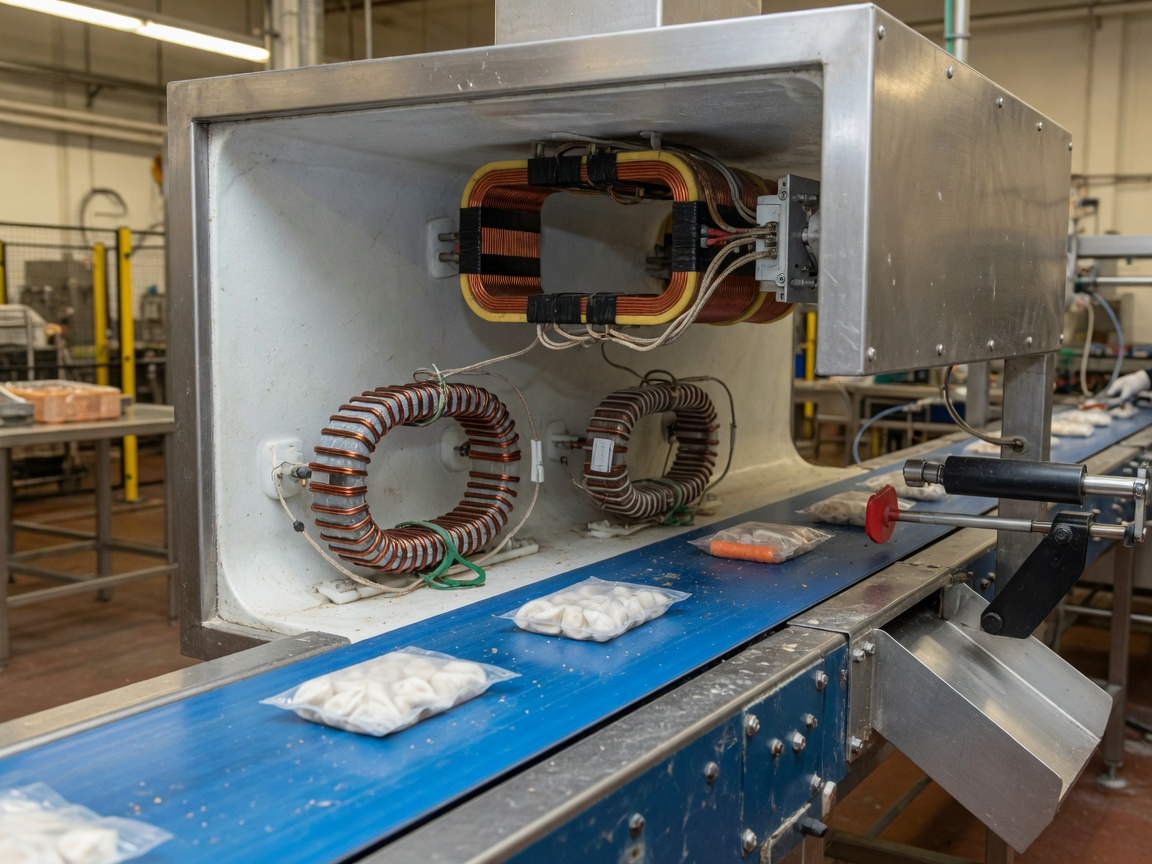
A standard industrial food scanner contains three coils arranged within an aperture (the tunnel through which product passes). The central coil is a transmitter that generates a high-frequency alternating magnetic field. The two outer coils are identical receivers, wired in opposition so their signals cancel each other out — creating electrical balance when no product is present. When a metallic contaminant enters the field, it disturbs this balance, generating a measurable voltage differential. The detector's signal processor interprets that differential and, if it exceeds the calibrated threshold, triggers a reject mechanism — typically an air blast, pusher arm, or stop-on-detect conveyor halt.
This is why metal detector sensitivity calibration is so critical: the threshold must be set tight enough to catch small contaminants, yet loose enough to avoid triggering false rejects on the food product itself — a challenge known as product effect, covered in Section 5.
Detection frequency and multi-frequency technology
Operating frequency directly affects detection capability. Lower frequencies (50–200 kHz) penetrate deeper into dense or moist products and excel at detecting ferrous metals. Higher frequencies (500 kHz–1 MHz) are more sensitive to small nonferrous and stainless steel particles but are more susceptible to product effect interference. Traditional single-frequency systems force a compromise. Multi-simultaneous frequency technology — now standard on 2026 platforms from Mettler-Toledo, Fortress Technology, and Loma Systems — runs multiple frequencies concurrently, allowing the system to distinguish between product signal and contaminant signal with far greater accuracy. In actual testing on fresh poultry lines, multi-frequency units reduced false reject rates by up to 60% compared to legacy single-frequency systems while maintaining or improving detection limits for 1.5 mm stainless steel spheres.
"Metal detection technology has advanced significantly — but the single biggest failure mode we see in food plant audits is not the equipment itself. It is the absence of a validated, documented test frequency protocol that proves the system is actually performing at its claimed sensitivity on a given product."
— Food Safety Practitioner, GFSI-Certified Auditor, U.S. Midwest Region (industry roundtable, 2026)
Types of food metal detectors: which one fits your line?
Not all food metal detectors are interchangeable. The right form factor depends on product state, line configuration, and throughput speed. There are five primary types used in U.S. food manufacturing today.
Conveyor belt metal detector
The most widely deployed format. Product travels horizontally through the aperture on a conveyor belt. Suited for packaged goods, fresh produce, meat cuts, baked goods, and multi-portion trays. Aperture sizes typically range from 4 inches to over 20 inches wide, accommodating everything from individual snack bags to full case packs. A conveyor belt metal detector offers flexibility in reject mechanism design — belt reverse, drop flap, pusher, or divert arm — making it the default choice for most solid-product applications.
Gravity-fed and pipeline metal detector for food
Gravity-fed (free-fall) systems are designed for dry bulk materials — flour, sugar, spices, cereals, and coffee — that flow vertically through a chute. Because the product is not touching a conveyor belt, there is no vibrational noise, and sensitivity can be pushed higher. These units are typically installed just before a filling or bagging station.
A pipeline metal detector for food handles liquid, semi-liquid, or pumped products: ground meat, fruit purées, sauces, cheese slurries, and beverages. Product flows through a sealed stainless steel pipeline that passes through the detection coil. This format is essential for HACCP metal detection system integration in continuous-flow processing environments where stopping a conveyor is not operationally practical. A meat metal detector used in a ground beef grinding operation is almost always a pipeline or gravity-fed unit.
Combination and throat-type systems
Combination units pair a metal detector with a checkweigher or an x-ray inspection system for food, delivering dual-function inspection in a single footprint — increasingly preferred in facilities with limited floor space or high SKU counts. Throat-type detectors are mounted directly above vertical form-fill-seal (VFFS) packaging machines, inspecting product as it drops into the bag, which is particularly effective for snack foods, frozen vegetables, and pet food. Both formats reflect the 2026 industry trend toward integrated foreign object detection food systems rather than standalone devices.
Sensitivity specifications and detection limits compared
Sensitivity is expressed as the minimum diameter sphere of a given metal type that the system can reliably detect. The three standard test materials are ferrous (Fe), nonferrous (NFe), and stainless steel (SS 316). Stainless steel is always the hardest to detect because its low magnetic permeability and relatively low conductivity produce a weaker signal disruption — making it the benchmark for system performance in a HACCP metal detection system.
The table below presents representative ferrous nonferrous stainless steel detection limits for common food metal detector configurations in 2026. All figures represent standard sphere diameter in millimeters at rated aperture sizes; actual performance varies by product type, line speed, and calibration.
| Detector type | Aperture (H×W) | Fe (mm) | NFe (mm) | SS 316 (mm) | Best for |
|---|---|---|---|---|---|
| Conveyor (small aperture) | 100×200 mm | 0.6 | 0.8 | 1.2 | Packaged snacks, confectionery |
| Conveyor (large aperture) | 200×500 mm | 1.2 | 1.5 | 2.0 | Case packs, whole poultry |
| Gravity-fed (free-fall) | Ø150 mm tube | 0.5 | 0.6 | 0.8 | Flour, spices, dry cereals |
| Pipeline (pumped) | Ø80 mm pipe | 0.7 | 0.9 | 1.5 | Ground meat, sauces, slurries |
| Throat-type (VFFS) | Ø100 mm throat | 0.6 | 0.8 | 1.2 | Frozen veg, pet food, snacks |
A critical rule of thumb: aperture size is inversely proportional to sensitivity. The larger the tunnel opening, the weaker the field concentration, and the larger a contaminant must be before it registers. This is why oversizing an aperture — buying a larger conveyor unit than the product requires — is one of the most common and costly specification mistakes in food manufacturing quality control. For authoritative background on electromagnetic detection principles, see this overview of metal detector technology.
Product effect: the hidden challenge for wet, frozen, and high-salt foods
Product effect is the single most misunderstood performance variable in food metal detector operation. It refers to the electromagnetic signal generated by the food product itself as it passes through the detector's field — a signal that can mimic or mask a metal contaminant's signature.
Why certain foods cause high product effect
Three food characteristics drive product effect: high moisture content, elevated salt (ionic conductivity), and temperature (particularly when products are freshly cooked or not yet frozen). Fresh ground beef, brined chicken breasts, aged cheddar, smoked salmon, and any product in a modified-atmosphere metallic-film package are classic high-product-effect items. The food's inherent conductivity generates a phase-shifted signal that can be large enough to trigger false rejects — even with no metal present. In some high-salt cheese operations, false rejection rates on single-frequency legacy systems have been documented as high as 8–12% of total production volume, directly costing throughput and increasing waste disposal costs.
How modern systems manage product effect
Phase discrimination technology separates the product's signal from a metallic contaminant's signal by analyzing phase angle differences. Multi-simultaneous frequency platforms take this further by running phase analysis across several frequencies at once, building a more complete electromagnetic "fingerprint" of the legitimate product and isolating anomalies with greater confidence. In 2026, AI-assisted adaptive learning systems from leading brands can be taught a new product profile in under 30 minutes of sample runs — automatically updating the reject threshold in real time as product temperature shifts during a production shift. This removes the traditional operator dependency that caused many high-product-effect lines to run with degraded sensitivity to avoid nuisance rejects. Of course, even the most advanced system will require periodic revalidation when a recipe, ingredient source, or processing temperature changes.
FDA, FSMA, and HACCP compliance requirements
Regulatory compliance is not optional — and understanding exactly what U.S. law requires is essential before specifying any food metal detector. The regulatory landscape involves three overlapping frameworks.
HACCP and the CCP framework
Under HACCP (Hazard Analysis and Critical Control Points) principles, metal detection is classified as a CCP when the hazard analysis identifies metallic contamination as a significant risk. This means the facility must define a Critical Limit (the minimum detectable particle size), establish monitoring procedures (how often test pieces are run and logged), implement corrective actions (what happens when a system fails its test check), and maintain verifiable records. Guidance on establishing and documenting these requirements is outlined in the HACCP food safety guidelines published by the FDA.
FSMA Preventive Controls rule
The FDA's FSMA Preventive Controls for Human Food rule (21 CFR Part 117) requires that facilities manufacturing, processing, packing, or holding food for U.S. consumption implement a written Food Safety Plan that identifies physical hazards including metal. Unlike HACCP (which originated in the meat sector under USDA oversight), FSMA applies broadly across all FDA-regulated food categories. Critically, FSMA requires that preventive controls — including metal detection — be validated to demonstrate they actually work as intended. This validation must be documented and available for FDA inspection. Simply having a detector installed is not sufficient; the facility must prove it performs at its claimed sensitivity on the actual product. For additional regulatory context on practical implementation, the metal detection in food production guidance offers internationally recognized benchmark practices that align with U.S. retailer audit standards including BRC and SQF.
Retailer and third-party audit standards
Beyond FDA requirements, most major U.S. grocery retailers mandate GFSI-recognized certification (BRC Global Standard, SQF, FSSC 22000) as a supplier condition. These schemes specify test frequency, test piece traceability, reject bin security (locked or alarmed bins to prevent tamper), and annual system calibration by a qualified technician. Meeting these standards requires that the HACCP metal detection system be fully integrated into the facility's documented food safety management system — not operated as a standalone device.
How to choose the right food metal detector: a decision framework
Selecting the correct system requires more than comparing price tags. The following structured decision process reflects how experienced quality managers approach equipment specification for food manufacturing quality control environments.
Step-by-step selection checklist
- Define your hazard profile. Identify the most likely metal contaminant sources on your specific line — blade wear, mesh screens, wire band fragments, fasteners. This determines the minimum detection size you must achieve.
- Classify your product's effect level. Run a product effect assessment: dry/low-moisture products are typically low-effect; fresh meat, cheese, and brined items are high-effect. High-effect products require phase discrimination or multi-frequency technology.
- Select the correct form factor. Match detector type to product state: conveyor for solid packaged goods, gravity-fed for dry bulk, pipeline for pumped liquids and pastes, throat-type for VFFS lines.
- Specify aperture size correctly. Measure your largest product cross-section and add only the minimum clearance required for smooth passage — typically 10–15 mm on each side. Avoid oversizing.
- Evaluate line speed compatibility. Check that the detector's reject timing logic and conveyor speed match your throughput rate. A timing mismatch causes good product to be rejected or contaminated product to pass through.
- Assess reject mechanism suitability. Air blast rejects are fast but not appropriate for fragile products. Pusher arms work for firm packages. Stop-on-detect is used where absolute confirmation is required.
- Confirm HACCP/FSMA documentation support. Ensure the system provides automated data logging, test record storage, and integration with your facility's quality management software or ERP.
- Benchmark sensitivity at your actual conditions. Request a product trial using your real product, at your expected temperature and line speed, before finalizing the purchase.
Pharmaceutical metal detector considerations
It is worth noting that a pharmaceutical metal detector, while based on the same electromagnetic principle, operates under 21 CFR Part 211 GMP requirements rather than food safety law, and typically must achieve detection limits down to 0.5 mm Fe in tablets. Cross-industry procurement teams should not assume food-grade specifications translate directly to pharmaceutical applications, or vice versa.
Cost, ROI, and real-world performance data
Budget is always part of the conversation. Here is an honest, data-grounded view of what food metal detectors cost and what return manufacturers realistically achieve.
Price ranges by system type (2026)
Entry-level conveyor belt metal detectors for light-duty or small-aperture applications typically start at $8,000–$15,000 USD. Mid-range industrial conveyor systems with phase discrimination, data logging, and stainless steel construction suitable for washdown environments run $18,000–$35,000. High-end multi-frequency systems with AI-adaptive product learning, used on high-throughput or high-product-effect lines, range from $40,000–$80,000+. Pipeline metal detector units for food pumped-product applications are priced between $15,000 and $45,000 depending on pipe diameter and pressure rating. Combination metal detector/checkweigher units add $10,000–$20,000 over the base metal detector cost. Annual service contracts typically run 8–12% of equipment purchase price.
ROI analysis and recall cost avoidance
The ROI case for a food metal detector is driven primarily by recall avoidance. According to recent industry analysis, the average direct cost of a U.S. food recall attributable to metal contamination exceeds $10 million, factoring in product retrieval, regulatory response, legal exposure, and brand remediation. A $30,000 detection system that prevents a single recall event delivers a return-on-investment exceeding 300:1 on direct cost avoidance alone. Beyond recall prevention, documented operational benefits from real-world installations include: false reject rate reductions of 40–60% after upgrading from single-frequency to multi-frequency systems; line downtime reductions of 15–25% due to fewer nuisance stops; and GFSI audit pass rates improving from conditional to full certification status after implementing compliant CCP documentation protocols.
Of course, ROI also depends on line uptime, product value per unit, and whether your current false rejection rate is generating significant waste. A facility processing $2/lb fresh poultry at 5,000 lbs/hour with a 5% false reject rate is losing roughly $5,000 per hour to nuisance rejects — a figure that can justify a premium multi-frequency upgrade on its own within a single production quarter.
Frequently asked questions about food metal detectors
Q: What metals can a food metal detector detect?
A: A food metal detector can detect ferrous metals (iron and steel), nonferrous metals (aluminum, copper, brass, lead), and stainless steel. Stainless steel is the most difficult to detect due to its low magnetic permeability, requiring larger particle sizes to trigger an alarm compared to ferrous material at equivalent aperture sizes.
Q: How often should a food metal detector be tested and calibrated?
A: Most HACCP and GFSI standards require functional testing with certified test pieces at the start of every production shift, after any jam or reject event, and at the end of each shift. Full sensitivity calibration and validation by a qualified technician should occur at least annually, or whenever product, line speed, or operating conditions change significantly.
Q: Can a food metal detector work with metallic packaging?
A: Metallic foil or metalized film packaging severely limits or completely blocks electromagnetic detection. In these cases, inspection must occur before packaging, using inline metal detector technology upstream of the filling or sealing station. X-ray inspection is not affected by metallic packaging and may be the more appropriate solution for finished-package inspection.
Q: Is a food metal detector required by law in the United States?
A: There is no blanket federal law mandating metal detectors specifically, but FSMA's Preventive Controls rule requires a written Food Safety Plan addressing physical hazards including metal, which effectively mandates some form of validated metal detection for most food manufacturers. USDA FSIS regulations for meat and poultry processors also establish metal detection requirements at defined CCPs.
Q: What is the difference between a food metal detector and an X-ray inspection system?
A: A food metal detector uses electromagnetic induction to identify conductive metal contaminants only. An x-ray inspection system uses radiation imaging to detect a broader range of dense foreign objects including glass, bone, stone, and hard plastic, as well as metal. Metal detectors are lower cost and faster to validate; X-ray systems offer broader detection coverage. Many facilities deploy both for comprehensive foreign object detection food programs.
Summary
A food metal detector is far more than a passive safety device on a production line. It is an active, continuously managed CCP that protects consumers, safeguards brand equity, and demonstrates HACCP compliance to regulators and retail customers alike. Choosing the right system requires matching form factor to product and line configuration, specifying aperture size correctly, accounting for product effect in high-moisture or high-salt applications, and ensuring the platform supports the documentation requirements of FSMA and your GFSI certification scheme. With 2026 multi-frequency and AI-adaptive platforms delivering measurable reductions in false reject rates and improved stainless steel detection limits, the business case for upgrading legacy single-frequency equipment has never been stronger — particularly when weighed against the documented $10M+ cost of a single metal contamination recall.
previous page
previous page
Please tell us your needs.
If you have any questions about our company, please feel free to contact us. We will reply as soon as possible. Thank you for your inquiry.

Adress:7 # Standard Factory Building in Baoshan Industrial and Trade Park, Yunnan Province
Customer service:+86-400-176-6898
Tel:+86-0875-2870888
Phone:+86-18187573906
Email:Abner@ynaofu.com
Factory VR
Video ID
Copyright © 2023 Yunnan Aofu Intelligent Equipment Co., Ltd. (this website supports IPV6)