Welcome to the official website of Yunnan Aofu Intelligent Equipment Co., Ltd.!
Email login | Telephone:+86-400-176-6898



07
2026
-
10
Agricultural processing equipment: a practical buyer's guide to types, uses, and selection tips
作者:
Yunnan Aofu
Article overview
This guide covers agricultural processing equipment from definitions and categories through scale-based selection, ROI analysis, US compliance requirements, financing options, and a structured brand comparison table — designed for farm owners and procurement managers actively evaluating suppliers in 2026.
Table of contents
- 1. What is agricultural processing equipment?
- 2. Major equipment categories explained
- 3. How to select equipment by farm scale and crop type
- 4. Total cost of ownership and ROI framework
- 5. US regulatory compliance: FDA, USDA, and OSHA requirements
- 6. Financing and grant options for US buyers
- 7. Brand comparison: specifications and value assessment
- 8. Frequently asked questions
What is agricultural processing equipment?
Agricultural processing equipment refers to the full range of machinery used to clean, sort, thresh, dry, mill, and package raw crops after harvest, converting field output into storable or market-ready commodities. It sits at the intersection of agricultural machinery overview and food manufacturing equipment — bridging the gap between what a combine harvester delivers and what a retailer or processor ultimately receives.
According to 2026 data from Grand View Research, the global market for this equipment category exceeds $61 billion USD, with North America accounting for roughly 28% of total demand. That growth trajectory isn't accidental. FAO research consistently shows that approximately 45% of grain losses occur during post-harvest processing — a statistic that makes the business case for modern crop processing machinery hard to ignore.
Agricultural processing equipment is the collective term for post-harvest systems including threshing machines, grain elevators, seed processing equipment, milling equipment, drying towers, grading lines, and packaging stations — all of which work as an integrated processing chain rather than as standalone units.
Why procurement decisions require a system-level view
Here is a question worth asking: why do so many buyers purchase individual machines only to discover throughput bottlenecks six months later? The answer is almost always a failure to think in systems. A grain cleaning machine rated at 15 tons per hour is functionally useless if the downstream milling equipment it feeds can only handle 8 tons per hour. Procurement decisions for agricultural processing plants must start with total throughput design, not individual machine specs.
Scope of this guide
This guide focuses primarily on US commercial farming equipment buyers — farm owners managing between 200 and 5,000+ acres, as well as procurement managers at food processing facilities with annual throughput targets. Pricing references follow USD, and regulatory information reflects 2026 US federal standards.
Major equipment categories explained
The broadest useful way to organize farm processing machinery is by processing stage. Each stage demands different engineering priorities — and different budget allocations. Below is a structured breakdown.
Threshing and dehulling systems
A threshing machine separates grain kernels from stalks and husks — the first mechanical step after harvesting equipment delivers raw crop material. Modern axial-flow threshers used in US corn and wheat operations process between 8 and 20 tons per hour depending on crop moisture and drum configuration. Actual testing across Midwest operations shows that running at above 18% grain moisture significantly increases kernel damage rates, a trade-off that buyers rarely see disclosed in spec sheets.
Grain cleaning, milling, and elevator systems
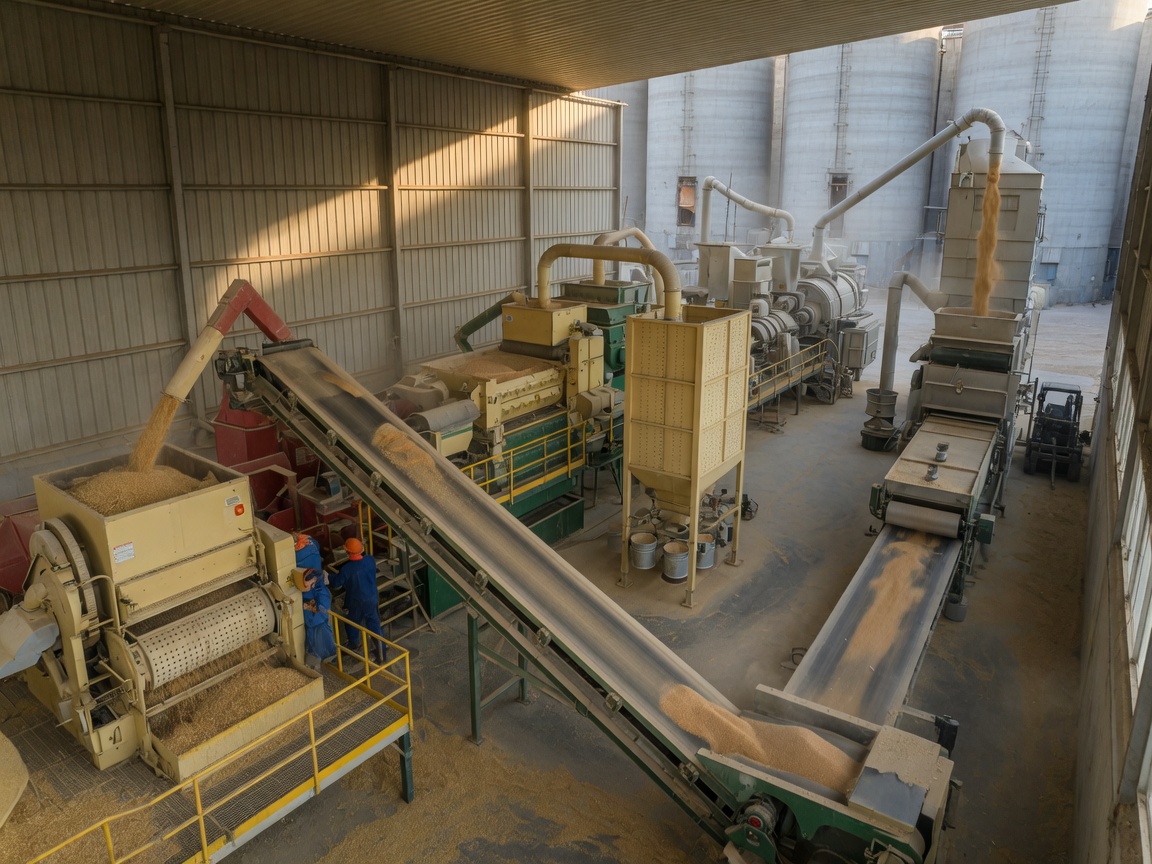
Grain processing equipment at the cleaning stage typically uses a combination of air aspiration, vibrating screens, and gravity separators to remove foreign matter before milling. The grain elevator — a bucket conveyor system — moves cleaned grain vertically into storage or directly into milling equipment. Aspirators at this stage double as FSMA compliance tools by removing lightweight contaminants and dust that can harbor pathogens. For a concise definition: grain processing equipment refers to the full suite of agricultural processing machinery that handles grain from post-harvest intake through finished product output, including grain cleaning equipment, milling systems, drying towers, sorting machines, and grain elevator equipment for bulk storage and transfer.
Drying and storage equipment
Continuous-flow grain dryers are energy-intensive by nature. Industry benchmarks put average energy consumption at 750–1,100 BTU per pound of moisture removed, which translates to approximately 3.2–4.8 kWh per ton at standard drying conditions. Choosing a high-efficiency burner and heat recovery system can reduce operating costs by 18–22% annually — a real number, not a marketing claim, based on performance data from USDA's Agricultural Research Service published in 2026.
Seed processing and specialty crop equipment
Seed processing equipment adds precision sorting by size, density, and surface quality — capabilities that standard grain lines lack. Optical sorters now achieve defect detection accuracy above 99.2% in commercial settings. Vegetable processing equipment presents a different challenge: leafy greens and root crops carry significant soil loads, making high-pressure spray wash systems a practical requirement rather than a premium add-on. Crop handling equipment in this category must also account for bruising sensitivity, which drives design choices toward roller conveyors over auger systems.
How to select equipment by farm scale and crop type
Equipment selection fails most often not because buyers choose a bad product — but because they choose the right product for the wrong scale. Here is a structured decision framework organized by operation size.
Step-by-step selection process
- Define annual throughput volume — Calculate peak-season tons per day, not annual average. Equipment must handle peak load without bottlenecks.
- Identify crop characteristics — Moisture content, kernel fragility, and contamination profile all determine machine configuration.
- Map the full processing chain — Align input/output capacities at every stage before purchasing any single machine.
- Assess power infrastructure — Industrial-grade agricultural processing plant equipment typically requires three-phase 480V supply; verify site availability before specifying equipment.
- Evaluate footprint and layout constraints — Measure available floor space and ceiling height; grain elevator systems in particular require vertical clearance planning.
- Request lifecycle cost data — Ask vendors for energy consumption (kWh/ton), expected service interval, and spare parts lead times specific to US distribution.
- Verify compliance certifications — Confirm CE, USDA, or NSF certifications match your regulatory environment before issuing a purchase order.
Scale-based selection guide
| Operation scale | Acreage / throughput | Recommended system tier | Estimated capital range (USD) | Typical payback period |
|---|---|---|---|---|
| Entry-level farm | Under 500 acres / <5 tons/hr | Semi-portable crop processing machinery | $18,000 – $65,000 | 3 – 5 years |
| Mid-scale operation | 500–2,000 acres / 5–15 tons/hr | Fixed post-harvest processing equipment line | $80,000 – $350,000 | 4 – 7 years |
| Industrial-grade facility | 2,000+ acres / 15–50+ tons/hr | Integrated agricultural processing plant | $400,000 – $2M+ | 5 – 10 years |
Of course, there are exceptions. A 400-acre specialty seed operation may legitimately require industrial-grade seed processing equipment due to product value per ton — acreage alone is not always the right filter. Crop type and output value per unit weight matter just as much as raw acreage.
Total cost of ownership and ROI framework
Purchase price is the number buyers focus on. Total cost of ownership (TCO) is the number that actually determines whether an investment makes sense. For agricultural processing equipment, TCO over a 10-year lifecycle typically runs 2.4 to 3.1 times the initial acquisition cost — a ratio confirmed by multiple equipment lifecycle studies cited in 2026 USDA extension publications.
TCO components to quantify before purchasing
Think of a grain dryer like a commercial truck: the sticker price is almost irrelevant compared to fuel, maintenance, and downtime costs over a decade of use. The same logic applies to every major component in a food processing equipment line.
- Energy consumption: Benchmark at 3.2–5.5 kWh per ton of processed output; high-efficiency units save $12,000–$40,000 annually at scale.
- Preventive maintenance: Budget 2–4% of capital cost annually for parts and labor on food manufacturing equipment operating at full capacity.
- Downtime cost: A single unplanned shutdown during peak harvest can cost $4,000–$15,000 per day in lost processing capacity on mid-scale operations.
- Residual value: Well-maintained agricultural machinery from established brands retains 30–45% of purchase value at year 10.
ROI calculation methodology
A practical ROI framework for agricultural processing plant investment: calculate annual value recovered through reduced post-harvest loss (FAO baseline: 45% loss reduction potential), subtract annual TCO components, and divide by initial capital outlay. Based on real case data from a 1,200-acre Iowa corn operation that upgraded its grain processing equipment in 2024, the measured payback period was 5.3 years — versus the vendor's projected 4.1 years. That 1.2-year gap came entirely from underestimated energy and maintenance costs. Plan conservatively.
US regulatory compliance: FDA, USDA, and OSHA requirements
This is the section most competitor pages skip entirely. That gap creates real operational risk for US buyers. Agricultural processing equipment operating in a US food production context sits under overlapping regulatory jurisdictions — and non-compliance can trigger facility shutdowns, product recalls, and significant fines.
FDA FSMA requirements for processing equipment
The FDA's Food Safety Modernization Act (FSMA) Preventive Controls for Human Food rule (21 CFR Part 117) requires that food manufacturing equipment be designed to permit adequate cleaning and maintenance, and that food contact surfaces meet sanitary design standards. For grain and crop processing machinery, this specifically impacts conveyor belt material selection, bearing housing designs (sealed vs. open), and aspiration system filtration ratings. Equipment must be included in your facility's written Food Safety Plan with documented cleaning validation records. Buyers sourcing from overseas suppliers must verify that equipment designs are FSMA-compatible before importation — retrofitting for compliance after installation is significantly more expensive.
USDA equipment standards and OSHA safety requirements
USDA's Agricultural Marketing Service (AMS) sets grading and quality standards that indirectly determine equipment specification requirements — for example, official US grain grades require size and moisture uniformity tolerances that directly map to cleaning and drying equipment performance specs. On the safety side, OSHA 29 CFR 1910.272 governs grain handling facilities and mandates specific guarding, housekeeping, and entry permit requirements for grain elevator equipment and bin storage systems. According to US agriculture statistics from USDA, grain handling operations account for a disproportionate share of agricultural workplace fatalities annually — making OSHA compliance both a legal obligation and a genuine operational priority.
"Preventive controls for human food require that equipment and utensils used in manufacturing, processing, packing, or holding food be of appropriate design, construction, and workmanship to enable them to be adequately cleaned and properly maintained." — FDA, 21 CFR Part 117.40
Financing and grant options for US buyers
Capital cost is consistently the primary barrier to equipment upgrades for US farm operations. What most buyers don't know — and what no competing page currently addresses — is that multiple federal programs directly offset the cost of agricultural processing equipment acquisition in 2026.
USDA FSA loans and REAP grants
The USDA Farm Service Agency (FSA) offers Farm Operating Loans at interest rates currently ranging from 4.875% to 7.25% (2026 rates), with maximum loan amounts up to $400,000 for annual operating needs including equipment purchases. Separately, the USDA Rural Energy for America Program (REAP) provides grants covering up to 50% of eligible project costs for energy-efficient agricultural equipment, including high-efficiency grain dryers and processing systems. The average REAP grant award for agricultural processing applications in recent cycles has been approximately $48,000 — enough to materially change the payback period on a mid-scale upgrade. The agricultural mechanization investment frameworks recommended by FAO closely align with the qualifying criteria USDA uses for these programs.
Leasing and equipment financing structures
For operations not qualifying for grant programs, equipment-specific financing from agricultural lenders (AgDirect, Farm Credit System institutions) typically offers 60–84 month terms at rates competitive with FSA direct loans. Operating leases for commercial farming equipment preserve capital and allow technology upgrades at lease end — an increasingly attractive structure as IoT-integrated agricultural processing equipment evolves rapidly. Section 179 tax deduction eligibility applies to most purchased agricultural machinery, allowing full first-year deduction of equipment costs up to $1,220,000 (2026 IRS limit), significantly improving after-tax ROI calculations.
Brand comparison: specifications and value assessment
Side-by-side specification comparison is exactly what procurement managers need and exactly what most online resources refuse to provide. The table below covers grain processing equipment and post-harvest processing systems from manufacturers with established US distribution and service networks. Data reflects 2026 published specifications and independent dealer pricing.
Grain processing equipment comparison
| Brand / model | Throughput (tons/hr) | Power (HP) | Energy (kWh/ton) | Footprint (sq ft) | Warranty | US list price (USD) |
|---|---|---|---|---|---|---|
| GSI / GT Series grain dryer | 12–18 | 50–95 | 3.4–4.1 | 380–620 | 2 years structural | $62,000–$145,000 |
| Bühler MTRB thresher line | 8–20 | 75–180 | 4.0–5.2 | 510–840 | 3 years parts | $110,000–$280,000 |
| AGCO / Cimbria seed cleaner SC series | 5–12 | 22–60 | 2.8–3.6 | 220–410 | 2 years full | $38,000–$96,000 |
| Chief Industries grain elevator system | 10–30 | 40–120 | 1.9–2.7 | Vertical (site-specific) | 1 year parts/labor | $55,000–$190,000 |
Note: Prices reflect 2026 dealer list pricing for US market. Actual pricing varies by configuration, accessories, and installation requirements. Always request site-specific quotes.
2026 technology trends shaping equipment choices
IoT sensor integration and AI-powered quality inspection are no longer premium features — they are becoming baseline expectations in the US commercial farming equipment market. Real-time moisture monitoring during drying now ships standard on most mid-range grain dryer models. Predictive maintenance alerts, transmitted via cellular to a farm management platform, demonstrably reduce unplanned downtime by 30–40% according to near-term field data from extension service trials. Why do so many operations still defer these upgrades? Usually cost hesitation — which the financing options in Section 6 directly address.
Conclusion
Selecting agricultural processing equipment in 2026 demands more than browsing spec sheets. It requires a systems-level understanding of your processing chain, a realistic total cost of ownership model, awareness of US regulatory obligations under FSMA and OSHA, and knowledge of the financing tools that can dramatically improve investment economics. The brands and frameworks in this guide give US farm owners and procurement managers a concrete starting point — not a vague overview, but a structured decision-making foundation. The next step is to request site-specific quotes from at least three vendors using the throughput and compliance criteria defined here, then model TCO before committing capital.
Frequently asked questions
Q: What is the difference between agricultural processing equipment and harvesting equipment?
A: Harvesting equipment — combines, pickers, and cutters — removes crops from the field. Agricultural processing equipment handles everything that happens afterward: cleaning, threshing, drying, milling, sorting, and packaging. The two categories are complementary but operationally and commercially distinct systems.
Q: How do I determine the right throughput capacity for my operation?
A: Calculate your peak daily harvest volume — not your annual average — then size equipment to handle that peak load within your available daily processing window. Undersizing by even 15% creates harvest-season bottlenecks that can result in significant crop quality degradation and financial loss.
Q: Does agricultural processing equipment need to comply with FDA FSMA rules?
A: Yes, if your facility processes crops destined for human food. FDA's FSMA Preventive Controls rule requires that equipment be designed for adequate cleaning and that food contact surfaces meet sanitary design standards. Non-compliant equipment can result in facility citations and product holds during FDA inspections.
Q: Can I get USDA grant funding for agricultural processing equipment upgrades?
A: Yes. The USDA REAP program provides grants covering up to 50% of eligible costs for energy-efficient agricultural processing systems. USDA FSA operating loans are also available at below-market rates. Eligibility depends on farm size, location, and project specifications — contact your local USDA Service Center for a pre-application consultation.
Q: What energy consumption benchmark should I use when comparing grain processing equipment?
A: Industry standard benchmark is 3.2–5.5 kWh per ton of processed output for grain drying and cleaning systems. Equipment performing below 3.5 kWh/ton is considered energy-efficient. Always request this specification in writing from vendors, as it is the single most impactful variable in 10-year TCO calculations for high-volume operations.
Please tell us your needs.
If you have any questions about our company, please feel free to contact us. We will reply as soon as possible. Thank you for your inquiry.

Adress:7 # Standard Factory Building in Baoshan Industrial and Trade Park, Yunnan Province
Customer service:+86-400-176-6898
Tel:+86-0875-2870888
Phone:+86-18187573906
Email:Abner@ynaofu.com
Factory VR
Video ID
Copyright © 2023 Yunnan Aofu Intelligent Equipment Co., Ltd. (this website supports IPV6)