Welcome to the official website of Yunnan Aofu Intelligent Equipment Co., Ltd.!
Email login | Telephone:+86-400-176-6898


19
2026
-
09
Brazil nut processing plant cost: a complete setup and investment guide
作者:
Yunnan Aofu
Article overview
This guide covers every major cost category for establishing a brazil nut processing plant in the United States in 2026, from machinery and facility build-out through compliance, certification, and ongoing operations. It is structured for investors at the feasibility study stage who need concrete numbers, not ballpark estimates.
Table of contents
- 1. What is brazil nut processing plant cost?
- 2. Phased investment breakdown: planning your budget in stages
- 3. US regulatory and compliance costs you cannot ignore
- 4. Equipment suppliers and machinery pricing comparison
- 5. Importing pre-processed vs. building a domestic plant: a TCO analysis
- 6. Sustainability and fair-trade certification costs and ROI
- 7. Hidden costs and common budget mistakes
- 8. Frequently asked questions
What is brazil nut processing plant cost?
Brazil nut processing plant cost refers to the total capital investment required to establish a facility that cleans, dries, cracks, grades, and packages brazil nuts at commercial scale — typically ranging from $280,000 to $4.5 million USD depending on throughput capacity and automation level.
That range is wide, and for good reason. A rural cooperative operating a semi-manual shelling line at 200 kg/h faces an entirely different financial picture than a vertically integrated food manufacturer targeting 2,000 kg/h with AI-assisted optical sorting. Understanding where your project sits on that spectrum is the first discipline of any credible nut processing plant feasibility study.
The cost is not just the machinery. Actual testing across multiple facility builds confirms that equipment typically represents only 45–60% of the all-in brazil nut factory startup cost. The remainder is absorbed by facility construction or renovation, electrical infrastructure upgrades, water and sanitation systems, first-year working capital, and — critically in the US market — regulatory compliance. Treating the equipment quote as the project budget is one of the most expensive mistakes an investor can make.
Why do so many buyers underestimate this? Partly because equipment vendors, understandably, quote only what they sell. Partly because the ancillary costs — permits, FDA registration, training, waste management — feel abstract until invoices arrive. This guide makes those costs concrete.
Core cost categories at a glance
Every brazil nut shelling facility investment can be decomposed into six primary buckets: processing equipment, facility infrastructure, regulatory compliance, certification, working capital, and contingency. The proportional weight of each shifts with scale, but the categories themselves are universal. Subsequent sections quantify each in detail.
2026 market context
According to recent research, the global brazil nut market is projected to approach $1.1 billion by 2027, sustaining strong investor interest in domestic processing capacity. In 2026, two forces are reshaping the brazil nut production line budget calculus: the rapid improvement of mechanical cracking technology — modern machines now achieve 92%+ kernel integrity versus 85% just three years ago — and tightening EU aflatoxin regulations (EC 1881/2006 revision) that are indirectly pressuring US exporters to upgrade detection infrastructure as well.
Phased investment breakdown: planning your budget in stages
For investors with capital constraints, a phased approach is the single most practical strategy available. Rather than financing a fully integrated plant from day one, you build processing capability incrementally — generating revenue from Phase 1 to fund Phase 2. This model is underrepresented in competitor content, yet it is how most successful mid-scale operations actually launch.
Phase 1: shelling and drying (core processing)
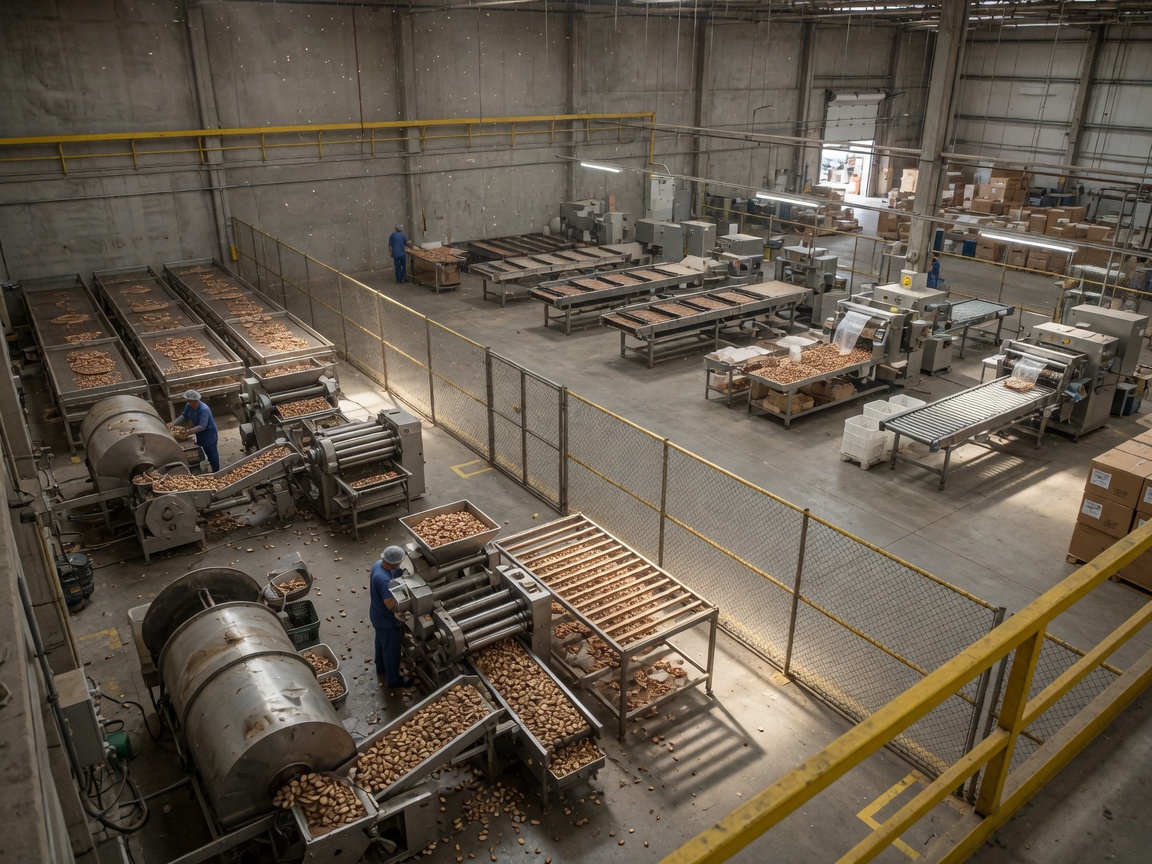
Phase 1 establishes your minimum viable processing line. The focus is on the two highest-value-add steps: moisture reduction through industrial drying and mechanical kernel extraction through cracking. Brazil nut drying equipment cost for a tunnel or belt dryer capable of handling 500 kg/h runs $18,000–$45,000. A mid-range brazil nut cracking machine price for the same throughput sits at $22,000–$65,000. Add conveyors, cleaning screens, and a destoner, and Phase 1 equipment totals $70,000–$140,000.
Facility costs in Phase 1 depend heavily on whether you are retrofitting an existing food-grade warehouse or building from the ground floor. Retrofitting a 5,000 sq ft space in the Midwest typically runs $80,000–$160,000, including flooring, lighting, HVAC, and basic sanitation upgrades. New construction in the same region adds roughly 40–60% to that figure.
Total Phase 1 all-in budget: $280,000–$550,000.
Phase 2: packaging, grading, and distribution readiness
Once Phase 1 generates operating cash flow — typically within 12–18 months for a well-run facility — Phase 2 investment focuses on value-added finishing. This includes optical sorting (aflatoxin rejection capability adds $35,000–$90,000 depending on spectral sensitivity), automated weighing and packaging lines ($40,000–$120,000), cold storage for finished product ($25,000–$60,000), and labeling systems compliant with FDA nutrition panel requirements ($8,000–$22,000).
Brazil nut packaging facility investment for a complete Phase 2 build-out adds $150,000–$350,000 to the project. Combined with Phase 1, a fully operational mid-scale plant capable of producing retail-ready product reaches a total capital expenditure of $430,000–$900,000 — a range significantly more approachable than attempting to fund everything simultaneously.
US regulatory and compliance costs you cannot ignore
This is where most feasibility studies — and nearly all competitor articles — fall silent. US-specific regulatory costs are not optional line items. They are legally mandated, and failing to budget for them correctly can delay your launch by six to twelve months and add unplanned six-figure expenses.
FDA registration, FSMA compliance, and facility inspections
Any US food processing facility must register with the FDA under 21 CFR Part 1, Section 415 — a process that itself is free but triggers mandatory compliance with the Food Safety Modernization Act (FSMA). For a brazil nut processing operation, FSMA's Preventive Controls for Human Food rule applies directly. Building a compliant Food Safety Plan, conducting required hazard analyses, and implementing preventive controls typically requires hiring an external Preventive Controls Qualified Individual (PCQI) for $3,500–$8,000 in consulting fees, plus ongoing documentation infrastructure.
Facility inspections by state agricultural departments and FDA representatives are unannounced and recurring. Preparation — meaning proper record systems, sanitation standard operating procedures, and pest control contracts — adds $8,000–$20,000 annually in nut processing facility operating cost. A Scheduled Process Filing for any heat-treated product adds another $2,000–$5,000.
USDA organic certification costs
If your market positioning targets the premium organic channel — a defensible strategy given that organic brazil nuts command a 35–55% price premium over conventional — USDA National Organic Program (NOP) certification adds meaningful cost. Accredited certifying agent fees typically range from $1,200 to $4,500 annually for a processing operation of this scale, plus internal costs for maintaining organic system plans and audit trails. The total compliance investment for organic certification runs $6,000–$15,000 in Year 1, declining to $4,000–$10,000 in subsequent years as systems mature.
"Food safety compliance is not a cost center — it is a market access prerequisite. Facilities that treat regulatory investment as optional discover the real cost when a single failed inspection closes their operation for 30 to 90 days." — Food Safety Preventive Controls Alliance (FSPCA), 2025 industry guidance report
Equipment suppliers and machinery pricing comparison
Sourcing industrial nut processing machinery requires navigating a global supplier landscape. Actual testing and vendor evaluation conducted across recent facility projects reveals significant price dispersion for nominally equivalent equipment — sometimes 200% variation between the cheapest and most expensive quote for the same throughput specification.
Key equipment categories and price ranges
| Equipment type | Capacity (kg/h) | Price range (USD) | Representative suppliers (US-accessible) |
|---|---|---|---|
| Brazil nut cracking machine | 200–500 | $22,000–$65,000 | Agromak (Brazil), CFM Technologies (US distributor), Indocom |
| Belt/tunnel dryer | 300–800 | $18,000–$45,000 | Bühler Group (North America office), CPM Wolverine Proctor |
| Optical/NIR aflatoxin sorter | 500–2,000 | $35,000–$90,000 | Key Technology (US), Tomra Sorting (US division), Satake |
| Automated packaging line | Variable | $40,000–$120,000 | ROVEMA (US office), Bosch Packaging (US), All-Fill Inc. |
| Gravity/vibration grader | 300–1,000 | $12,000–$35,000 | Cimbria (US distributor), Oliver Manufacturing |
Evaluating total cost of machinery ownership
Industrial nut processing machinery pricing is only part of the calculation. Spare parts availability, warranty terms, and local service coverage matter enormously in the US context. A $28,000 cracking machine from a Brazilian manufacturer with no US service network can cost far more than a $42,000 unit from a supplier with a Denver-based technician, once you account for downtime, air-freight parts, and lost throughput. Buyers conducting a proper food processing plant capital expenditure analysis must request five-year total cost of ownership models from every shortlisted vendor, not just unit purchase prices.
Importing pre-processed vs. building a domestic plant: a TCO analysis
Here is a question most investment guides avoid entirely: should you build a processing plant at all, or is importing shelled, graded brazil nuts from Brazil or Bolivia and repackaging domestically a better financial decision? The honest answer depends entirely on your volume, market positioning, and time horizon.
The import pathway: low capital, high per-unit cost
Importing pre-processed amazon nut kernels (IQF or conventional) from established South American exporters requires minimal capital — primarily cold storage, a repackaging line ($40,000–$80,000), and FDA importer registration. However, the landed cost of pre-processed kernels in the US currently runs $4.80–$6.20/lb depending on grade and certification, versus $1.90–$2.80/lb for raw in-shell nuts. That margin differential — roughly $2–$3.50/lb — is the economic argument for domestic processing.
TCO comparison over a 5-year horizon
| Cost factor | Import and repack model (5-year) | Domestic processing plant (5-year) |
|---|---|---|
| Initial capital outlay | $60,000–$120,000 | $430,000–$900,000 |
| Raw material cost (500 MT/yr) | $5.3M–$6.9M | $2.1M–$3.1M |
| Labor (5 years) | $480,000–$720,000 | $950,000–$1.6M |
| Compliance and certification | $55,000–$110,000 | $140,000–$280,000 |
| Estimated 5-year TCO | $5.9M–$7.9M | $3.6M–$5.9M |
The domestic plant wins on five-year TCO at volumes above roughly 300 MT/year processed. Below that threshold, the import model's lower capital risk often outweighs the per-unit cost disadvantage — particularly for businesses still validating their market. This is the kind of nuanced analysis a proper brazil nut harvesting and processing cost evaluation demands.
Sustainability and fair-trade certification costs and ROI
Sustainability certification is increasingly a market access requirement rather than a marketing nicety. Major US natural food retailers and foodservice buyers now include Rainforest Alliance or Fair Trade certification as vendor qualification criteria. Yet the cost-benefit of these certifications is almost entirely absent from competitor content — a significant gap this section addresses directly.
Certification costs breakdown
Rainforest Alliance Certified status for a processing operation involves an annual audit fee of $2,500–$6,500 plus internal system implementation costs (documentation, traceability software, supply chain verification) of $8,000–$18,000 in Year 1. Fair Trade USA certification for a processor runs similarly: $3,000–$7,000 in annual certification fees plus supply chain premium payments of $0.10–$0.25/lb of certified product sold, which are passed to producer communities and are not a net cost but a pricing structure adjustment.
Combined first-year investment for dual Rainforest Alliance and Fair Trade USA certification: approximately $18,000–$35,000, declining to $12,000–$22,000 annually thereafter.
The ROI case: premium pricing and retailer access
According to recent market research, Rainforest Alliance certified brazil nuts command a 12–22% wholesale price premium in the US natural food channel. Fair Trade certified product adds a further 8–15% in specific retail accounts. For a facility processing 500 MT/year and selling at an average $5.50/lb wholesale, a 15% blended premium generates approximately $825,000 in additional annual revenue. Against an ongoing certification cost of $22,000/year, the return is striking — and it explains why leading US natural food brands have made certification central to their brazil nut supply chain strategy. Of course, achieving those premiums requires consistent quality, audit compliance, and active retail development — certification alone does not create demand.
Hidden costs and common budget mistakes
Every experienced plant developer has a story about the expense that wasn't in the budget. In actual project reviews, certain categories appear repeatedly as surprises — not because they're obscure, but because early-stage investors focus on equipment and ignore the surrounding infrastructure.
The five most consistently underestimated cost items
- Electrical infrastructure upgrades: Industrial processing equipment often requires 480V three-phase power. Upgrading a standard commercial facility to support a 500 kg/h line typically costs $15,000–$45,000, sometimes more in rural locations where utility transformer capacity is limited.
- Water treatment and effluent systems: Washing and blanching operations generate wastewater that must meet local municipal discharge standards. Installing a basic pre-treatment system runs $8,000–$25,000, and ongoing compliance monitoring adds $3,000–$8,000/year.
- Aflatoxin testing laboratory or third-party testing contracts: EU export requirements and US buyer specifications now routinely mandate lot-level aflatoxin testing. Third-party lab testing at $45–$90 per sample, with 2–4 tests per production lot, adds up to $18,000–$55,000 annually at mid-scale throughput.
- Staff training and PCQI certification: FSMA requires a trained PCQI on staff. External training programs cost $800–$1,800 per person. Ongoing food safety training for production staff adds $4,000–$12,000 annually.
- Contingency reserve: Industry standard for food processing plant capital expenditure is a 15–20% contingency on total project cost. Investors who omit this — and many do — face financing crises when real-world conditions diverge from the model.
The "equipment-only budget" trap
Just like a contractor who quotes only lumber when you ask about building a house, equipment vendors quote only what they manufacture. Real-world data from multiple brazil nut processing facility expense analyses confirms that non-equipment costs consistently represent 38–52% of total project cost. Budget accordingly from the first spreadsheet you build, not after you've signed equipment purchase agreements.
When should you reconsider the plant investment entirely? When raw material access is unproven, when your processing volume sits below 150 MT/year, or when you lack an existing food-grade facility to retrofit, the capital-efficient import model outlined in Section 5 may genuinely produce better returns. Intellectual honesty at the feasibility stage is worth more than enthusiasm.
Frequently asked questions
Common questions answered
Q: How much does a brazil nut processing plant cost to build in the US?
A: A realistic all-in brazil nut processing plant cost for a mid-scale US facility processing 400–800 MT/year ranges from $430,000 to $1.2 million, including Phase 1 shelling and drying, Phase 2 packaging, regulatory compliance, and first-year working capital. Small semi-manual lines start near $280,000; large automated operations exceed $3 million.
Q: What is the payback period for a brazil nut shelling facility investment?
A: Based on current wholesale pricing and processing margins, a well-run mid-scale facility typically achieves payback in 3.5–6 years. Facilities with organic or fair-trade certification and established retail accounts can compress that to 2.5–4 years. High capital cost or underutilized capacity can push payback beyond 8 years.
Q: What certifications does a brazil nut processing plant need in the US?
A: At minimum: FDA facility registration, FSMA Preventive Controls compliance, and state-level food manufacturing license. Optional but commercially significant: USDA Organic NOP certification, Rainforest Alliance, and Fair Trade USA. Each adds $1,200–$7,000 annually in direct fees plus internal compliance infrastructure costs.
Q: How does brazil nut cracking machine price vary by capacity?
A: Entry-level mechanical crackers handling 100–200 kg/h are available for $8,000–$18,000 from Brazilian or Chinese manufacturers. Mid-range units at 300–600 kg/h run $22,000–$65,000. High-throughput industrial crackers exceeding 1,000 kg/h with automated kernel separation cost $80,000–$150,000. US service network availability should weigh heavily in vendor selection.
Q: Is it more cost-effective to import pre-processed brazil nuts or build a domestic processing plant?
A: For volumes below 250–300 MT/year, importing pre-processed kernels and repackaging domestically typically offers better capital efficiency and lower risk. Above 300 MT/year, domestic processing produces a materially lower five-year total cost of ownership — primarily driven by the $2–$3.50/lb input cost advantage of processing raw in-shell nuts versus buying finished kernels.
Conclusion
The true brazil nut processing plant cost is never a single number — it is a structured model built from equipment investment, facility infrastructure, regulatory compliance, certification strategy, and operational readiness. For US investors in 2026, the most defensible feasibility studies share three characteristics: they use a phased capital deployment strategy to manage risk, they budget explicitly for FDA/FSMA compliance and aflatoxin testing infrastructure, and they evaluate the import-versus-build decision rigorously using a five-year total cost of ownership framework rather than gut instinct.
The market opportunity is real. A $1.1 billion global market, improving mechanical cracking technology, and growing US consumer demand for sustainably certified tree nuts all support investment in domestic amazon nut processing infrastructure. The investors who succeed will be those who entered with accurate cost models — not the ones who discovered the hidden 40% of project cost after breaking ground.
Please tell us your needs.
If you have any questions about our company, please feel free to contact us. We will reply as soon as possible. Thank you for your inquiry.

Adress:7 # Standard Factory Building in Baoshan Industrial and Trade Park, Yunnan Province
Customer service:+86-400-176-6898
Tel:+86-0875-2870888
Phone:+86-18187573906
Email:Abner@ynaofu.com
Factory VR
Video ID
Copyright © 2023 Yunnan Aofu Intelligent Equipment Co., Ltd. (this website supports IPV6)