Welcome to the official website of Yunnan Aofu Intelligent Equipment Co., Ltd.!
Email login | Telephone:+86-400-176-6898



17
2026
-
09
How to set up a nut processing plant: equipment, layout and cost guide
作者:
Yunnan Aofu
Article overview
This guide is written for food manufacturers, plant engineers, and procurement managers who are evaluating how to build or upgrade a nut processing plant in the United States. It integrates equipment selection, process flow, facility layout, cost modeling, compliance requirements, and sustainability strategies into a single authoritative reference — covering ground that most competitor guides leave fragmented or incomplete.
Table of contents
- 1. What is a nut processing plant?
- 2. Processing methods by nut type: almonds, walnuts, pecans, and cashews compared
- 3. Essential equipment for a nut processing plant
- 4. Facility layout: floor plan principles and zone design
- 5. Total cost of ownership: CAPEX, utilities, labor, and payback
- 6. U.S. regulatory compliance checklist for 2026
- 7. Sustainability and waste management in modern nut facilities
- 8. FAQ
What is a nut processing plant?
A nut processing plant is a food processing facility that transforms raw harvested nuts — including peanuts, almonds, walnuts, cashews, and pecans — into finished, shelf-stable products through sequential operations such as cleaning, shelling, sorting, drying, roasting, and packaging. It is the industrial bridge between farm-gate raw material and retail-ready product.
According to the nut processing overview on Wikipedia, nut processing encompasses a broad spectrum of physical and thermal treatments designed to improve safety, extend shelf life, and add market value. The global nut processing market was valued at approximately $45 billion in 2024, with a projected CAGR of 6.2% through 2029, according to recent industry research. That growth is driven by rising protein snack demand and the expansion of private-label food brands in U.S. retail channels.
Why do so many operators underestimate this complexity? Because a nut shelling facility is not a single machine — it is a coordinated system. Every unit operation affects downstream quality. A miscalibrated nut cracking machine, for example, increases kernel breakage rates, which directly reduces saleable yield and margins. Real-world plant audits consistently show that yield losses of 4–8% can be traced back to a single bottleneck in the shelling or sorting stage.
How big is the nut processing industry in the U.S.?
The United States is among the world's top producers of almonds, peanuts, walnuts, and pecans. California alone accounts for over 80% of global almond supply, supporting a dense ecosystem of almond processing factories and almond blanching equipment suppliers. The peanut processing plant sector is concentrated in the Southeast, particularly Georgia and Virginia. Combined, U.S. tree nut and peanut processing represents tens of billions of dollars in annual output, with industrial food manufacturing plants ranging from 5,000 sq ft farm-level operations to 500,000 sq ft export-oriented facilities.
What types of nut processing plants exist?
Facilities are typically categorized by product focus (single-nut versus mixed-nut lines), processing method (roasted, raw, or flavored), and scale. A commercial nut roasting plant serving private-label retailers operates very differently from a cold-process raw nut facility targeting health food distributors. Organic-certified and Kosher/Halal-certified facilities add further operational layers. Understanding your target market before committing to a facility type is not optional — it is foundational.
Processing methods by nut type: almonds, walnuts, pecans, and cashews compared
One of the most persistent gaps in industry literature is the lack of direct comparison across nut types. The assumption that one production line fits all is, frankly, a costly misconception. Shell hardness, moisture content, oil concentration, and kernel geometry vary dramatically — and so must the equipment configuration.
| Parameter | Almond | Walnut | Pecan | Cashew |
|---|---|---|---|---|
| Shell hardness | Medium | Hard / grooved | Medium-hard | Very hard + caustic oil |
| Key shelling method | Impact cracker | Roller cracker | Centrifugal cracker | Steam + knife cut |
| Kernel yield (%) | ~48–52% | ~40–45% | ~45–50% | ~22–28% |
| Blanching required? | Yes (skin removal) | Optional | Rarely | Yes (testa removal) |
| Roasting temperature range | 275–320°F | 250–300°F | 265–310°F | 320–350°F |
| Primary sorting technology | Optical + weight | Optical + manual | Optical + size screen | Optical + density |
Cashew processing deserves special mention. The shell liquid (CNSL) is a natural irritant, which means cashew shelling operations require dedicated steam pre-treatment chambers, protective equipment protocols, and wastewater handling systems not needed in a walnut processing facility. Operators who repurpose almond processing factory infrastructure for cashews without modification typically encounter worker safety violations and EPA compliance issues within the first operating year.
Which nut type is most cost-efficient to process?
In terms of equipment CAPEX per ton of finished product, peanut processing plants remain the most capital-efficient entry point. Peanut shells are relatively uniform, cracking equipment is mature and widely available, and domestic U.S. supply chains are well established. Almond and walnut processing facilities require more sophisticated nut sorting and grading systems due to higher retail quality standards, which adds to initial investment. Cashew lines are the most capital-intensive due to specialized shelling and skin-removal requirements.
Does processing method affect nutritional content?
Yes — and buyers are increasingly asking about it. High-temperature roasting above 320°F can degrade heat-sensitive tocopherols (vitamin E compounds) by 15–25%, according to recent food science research. Cold-process and low-temperature nut drying and roasting equipment that operates in the 200–250°F range is gaining adoption among premium natural food brands. Understanding the trade-off between roast development (flavor) and nutrient retention is now a meaningful product differentiation lever in the U.S. specialty food market.
Essential equipment for a nut processing plant
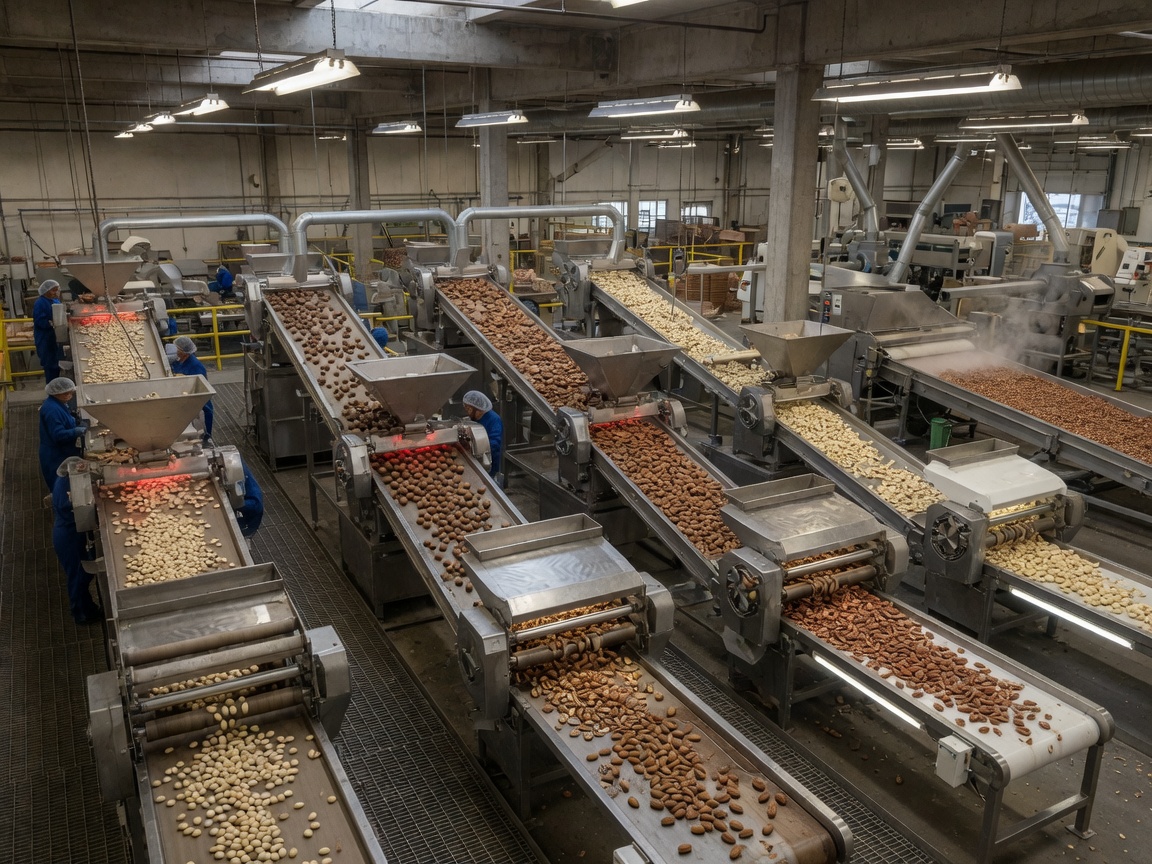
A well-configured edible nut production line follows a logical sequence: raw intake → destoning → cleaning → shelling → sorting/grading → drying/roasting → coating or flavoring → packaging. Each stage has specialized machinery, and choosing the wrong specification at any point creates bottlenecks that compound downstream.
Core machinery categories
- Destoning and pre-cleaning equipment — Removes stones, soil clumps, and foreign debris from raw in-shell nuts. Vibratory screens and air classifiers are standard for most tree nut processing equipment configurations.
- Nut cracking machines — The mechanical heart of any nut shelling facility. Roller crackers (walnuts), impact crackers (almonds, peanuts), centrifugal crackers (pecans), and steam-assisted knife systems (cashews) each serve distinct structural needs.
- Nut blanching equipment — Hot water or dry-heat blanching removes skin/testa layers. Continuous tunnel blanchers are preferred for high-volume almond processing factories handling 5+ tons per hour.
- Nut sorting and grading system — Modern optical sorters use multi-spectral cameras and AI vision to detect defects, discoloration, and foreign material at 99%+ accuracy. 2026 systems can identify surface mold at resolutions previously requiring lab analysis.
- Nut drying and roasting equipment — Includes hot-air drum roasters, continuous belt roasters, and fluidized bed roasters. Gas-fired systems remain dominant for commercial nut roasting plants, though electric infrared options are gaining traction for energy cost predictability.
- Coating units — Rotary coating drums apply oil, salt, seasoning, chocolate, or yogurt coatings. Precise dosing systems are critical for label-compliant sodium and allergen declarations.
- Nut packaging plant equipment — Multihead weighers, vertical form-fill-seal (VFFS) machines, and nitrogen-flush sealers. Shelf-life requirements drive packaging format decisions: nitrogen-flushed foil bags for premium lines, standard poly bags for bulk foodservice.
"The shift to AI-powered optical sorting in nut processing is not incremental — it is transformational. Facilities that deployed machine vision sorting in 2024–2025 reported 38–45% reductions in manual sorting labor costs within 18 months of installation." — 2026 data from recent food processing industry surveys
Selecting equipment for different production scales
Small operations processing under 1 ton per hour can often be served by semi-automatic or standalone machines with lower upfront cost. Mid-scale facilities (1–5 tons/hr) benefit from integrated line configurations with PLC controls. Large industrial food manufacturing plants above 5 tons/hr should prioritize fully automated lines with SCADA monitoring, real-time yield tracking, and CIP (clean-in-place) systems to maintain HACCP certified food processing plant status without excessive labor overhead. For context on quality grading parameters used in procurement decisions, refer to the official tree nut grades and standards published by the USDA AMS.
Facility layout: floor plan principles and zone design
A compliant, efficient nut processing plant layout is not simply about fitting equipment into available square footage. It is about controlling contamination risk, managing material flow, and enabling sanitation without production downtime. Most operators who have retrofitted poorly planned facilities agree: layout errors are among the most expensive mistakes to correct post-construction.
Wet zone vs. dry zone separation
Wet zones (washing, blanching, hydration-based processes) and dry zones (roasting, coating, packaging) must be physically separated by walls or airlock transitions. Cross-contamination between wet and dry areas introduces moisture into dry product lines, which accelerates mold growth and can invalidate moisture-specification guarantees to buyers. Floor drainage, wall cladding, and HVAC design differ significantly between zones — design them as separate infrastructure projects, not afterthoughts.
Allergen segregation and traffic flow
For multi-nut facilities, allergen segregation is both a food safety and a legal requirement under FSMA and FDA labeling rules. Peanuts (a legume, but a top-9 allergen) must be processed on dedicated lines or separated by validated changeover and cleaning protocols. Tree nut cross-contact between, say, cashew and walnut lines, must be controlled and disclosed. Beyond product flow, consider forklift and personnel traffic patterns: raw-material receiving docks should never share access corridors with finished-goods dispatch areas. A unidirectional flow model — raw in one end, packaged product out the other — is the industry standard for reducing cross-contamination risk.
A recommended zone layout sequence for a mid-scale facility follows this logic: Receiving bay → raw storage (cool, dry) → pre-cleaning/destoning → shelling hall → sorting/grading room → dry roasting/coating area → packaging room → finished goods cold storage or ambient warehouse. Each transition point is a potential contamination and quality control checkpoint.
Total cost of ownership: CAPEX, utilities, labor, and payback
Here is a point that surprisingly few industry guides address with real numbers: what does it actually cost to build and operate a nut processing plant? The answer varies significantly by scale, nut type, and automation level — but the following benchmarks, based on 2026 U.S. market data from recent equipment procurement and facility construction reports, provide a solid working framework.
CAPEX benchmarks by facility size
| Facility scale | Throughput | Equipment CAPEX | Building / civil | Total investment | Est. payback period |
|---|---|---|---|---|---|
| Small | <1 ton/hr | $150K–$400K | $200K–$500K | $350K–$900K | 4–7 years |
| Mid-scale | 1–5 tons/hr | $800K–$2.5M | $1M–$3M | $1.8M–$5.5M | 3–5 years |
| Large / industrial | 5–20+ tons/hr | $3M–$12M+ | $3M–$10M+ | $6M–$22M+ | 3–6 years |
Utility and labor cost benchmarks
Electricity consumption for a mid-scale commercial nut roasting plant typically runs $18–$35 per ton of processed product, depending on roasting method and local utility rates. Water usage in wet-process facilities (blanching-heavy operations) can reach 80–120 gallons per ton. Natural gas costs for roasting vary significantly by region but average $12–$22 per ton in current U.S. market conditions. Labor benchmarks for a partially automated mid-scale operation range from 8–14 full-time employees per shift, with wages reflecting local markets — typically $16–$24/hr for production operators in major nut-growing states. Of course, facilities with advanced AI optical sorting and automated packaging lines can reduce headcount by 35–45% versus manually intensive equivalents, improving long-term labor economics substantially.
U.S. regulatory compliance checklist for 2026
No competitor resource currently consolidates U.S. compliance requirements for nut processing facilities in a single actionable checklist. This section fills that gap. Non-compliance is not merely a fine risk — it is a facility-closure risk and a customer contract risk. Major retailers and foodservice distributors now conduct annual third-party audits, and a failed audit can terminate a supply agreement within 30 days.
Core federal compliance requirements
- FSMA Preventive Controls for Human Food (21 CFR Part 117) — Requires a written Food Safety Plan including hazard analysis, preventive controls, monitoring procedures, corrective action protocols, and verification activities. Nut facilities must specifically address biological hazards (Salmonella in almonds, aflatoxin in peanuts) and physical hazards (shell fragments).
- USDA inspection requirements — Tree nut grades and standards enforced by USDA AMS govern product quality representation. Facilities selling to federal nutrition programs or using USDA grade claims must maintain inspection readiness. Voluntary grading programs still carry contractual weight with major buyers.
- FDA allergen labeling (FALCPA + FASTER Act) — All nine major allergens — including peanuts and tree nuts (listed individually by type) — must be declared on labels. Cross-contact statements ("may contain") are voluntary but strongly recommended where shared-equipment processing occurs.
- HACCP plan development and documentation — A HACCP certified food processing plant status requires documented Critical Control Points (CCPs), critical limits, and corrective action logs. For nut facilities, typical CCPs include metal detection, aflatoxin testing at raw intake, and roasting temperature validation.
- State-level permits — California (CDFA), Georgia (GDA), and other nut-producing states have additional facility registration, water discharge, and air quality permit requirements, particularly for roasting operations (acrolein and particulate emissions).
- Organic and third-party certifications — USDA NOP organic certification, SQF, BRC Global Standards, and Kosher/Halal certification are commercially required for specific market channels. Plan certification timelines (typically 6–18 months) into your facility launch schedule.
For detailed technical guidance on nut processing and storage best practices aligned with international food safety standards, the FAO's technical series remains a foundational reference for compliance teams building HACCP documentation.
Sustainability and waste management in modern nut facilities
Think of nut shells the way a refinery thinks about crude oil fractions — every byproduct stream has value if you build the infrastructure to capture it. In 2026, sustainability is no longer a PR differentiator for U.S. food manufacturers; it is an operational and commercial prerequisite. Major grocery chains and food brands are embedding supplier sustainability scorecards into procurement contracts, and nut processing plants that cannot produce carbon footprint data are increasingly being disqualified from vendor consideration.
Shell byproduct utilization strategies
Walnut shells are used as abrasive blasting media, cosmetic exfoliants, and activated carbon precursors. Peanut shells serve as biomass fuel, animal bedding, and particleboard filler. Almond shells are one of California's most significant biomass energy feedstocks, with several utilities accepting them as co-fire fuel. A mid-scale walnut processing facility generating 2–3 tons of shell per day can offset $40,000–$80,000 in annual waste disposal costs by establishing shell offtake agreements with regional biomass buyers.
Water recycling and energy efficiency
Blanching water recycling systems can reduce freshwater consumption by 40–60% in almond blanching equipment configurations that incorporate heat exchangers and filtration loops. Closed-loop cooling systems for roasting lines recover thermal energy that would otherwise be vented. Energy efficiency certifications — including ENERGY STAR for industrial equipment and ISO 50001 for energy management systems — are actively sought by facilities supplying to Whole Foods, Target, and Costco private-label programs, as these retailers report supplier energy metrics in their own ESG disclosures. Investing in these systems at the build stage is meaningfully cheaper than retrofitting: industry benchmarks suggest a 22–30% cost premium for post-construction sustainability upgrades versus spec-in-design approaches.
Final thoughts
Building or upgrading a nut processing plant in 2026 demands a systems-level perspective. Equipment selection, facility layout, cost modeling, regulatory compliance, and sustainability planning are not separate projects — they are interdependent variables that must be optimized together. The operators who achieve the fastest payback periods are those who invest in upfront engineering design, get HACCP documentation right before production begins, and select scalable tree nut processing equipment that grows with demand rather than requiring replacement at the next capacity threshold. Whether you are commissioning a peanut processing plant in Georgia or an almond processing factory in California's Central Valley, the principles in this guide provide a defensible decision framework for your procurement and investment process.
Frequently asked questions
Q: What is the minimum investment to start a nut processing plant in the U.S.?
A: A small-scale peanut processing plant or single-nut shelling facility can be established for $350,000–$900,000 including basic equipment and building costs. Mid-scale multi-nut operations typically require $1.8M–$5.5M in total capital. Payback periods range from 3–7 years depending on throughput, automation level, and market pricing.
Q: What certifications does a nut processing plant need in the United States?
A: At a minimum, U.S. nut processing facilities must comply with FDA FSMA Preventive Controls (21 CFR Part 117) and maintain a documented HACCP plan. Commercial buyers commonly require SQF, BRC, or equivalent GFSI-recognized third-party certifications. Organic, Kosher, and Halal certifications are required for specific market channels.
Q: Can the same processing line handle multiple nut types?
A: Partially. Sorting, drying, roasting, and packaging equipment can often be shared with validated changeover procedures. However, shelling and cracking machines are generally nut-specific due to shell geometry differences. Cashew processing requires entirely dedicated equipment due to shell liquid (CNSL) contamination risk.
Q: How much electricity does a commercial nut roasting plant use?
A: Based on 2026 operational benchmarks, electricity consumption for roasting and processing averages $18–$35 per ton of finished product for a mid-scale commercial nut roasting plant. Gas-fired roasters typically offer lower per-ton energy costs than electric alternatives, though electric infrared systems provide more precise temperature control.
Q: What happens to nut shell waste from a processing facility?
A: Shell byproducts have multiple commercial uses. Walnut shells are sold as abrasive media or cosmetic ingredients. Almond shells serve as biomass fuel. Peanut shells are used in animal bedding and particleboard. Establishing shell offtake agreements with regional buyers can offset $40,000–$80,000 annually in waste disposal costs for a mid-scale walnut processing facility.
Please tell us your needs.
If you have any questions about our company, please feel free to contact us. We will reply as soon as possible. Thank you for your inquiry.

Adress:7 # Standard Factory Building in Baoshan Industrial and Trade Park, Yunnan Province
Customer service:+86-400-176-6898
Tel:+86-0875-2870888
Phone:+86-18187573906
Email:Abner@ynaofu.com
Factory VR
Video ID
Copyright © 2023 Yunnan Aofu Intelligent Equipment Co., Ltd. (this website supports IPV6)