Welcome to the official website of Yunnan Aofu Intelligent Equipment Co., Ltd.!
Email login | Telephone:+86-400-176-6898



25
2026
-
09
Cashew nut processing machine cost: a practical buyer's guide
作者:
Yunnan Aofu
Article overview
This guide covers 2026 pricing benchmarks for every major cashew processing machine category, a US-specific landed cost breakdown, a 5-year TCO model, capacity-efficiency tables, financing programs for American food processors, and a vendor reliability framework — everything a procurement manager needs to evaluate nut processing machinery investment with confidence.
Table of contents
- 1. What is cashew nut processing machine cost?
- 2. Price ranges by machine type (2026 benchmarks)
- 3. US landed cost analysis: what buyers actually pay
- 4. Total cost of ownership: the 5-year TCO model
- 5. Capacity-to-cost ratio: efficiency benchmarks by throughput tier
- 6. Financing and leasing options for US buyers
- 7. Vendor reliability and after-sales support in North America
- 8. FAQ
What is cashew nut processing machine cost?
Cashew nut processing machine cost is the total expenditure required to acquire, install, and operate equipment used across the cashew production chain — including steaming, shelling, peeling, grading, roasting, and drying — encompassing purchase price, freight, installation, and ongoing operational expenses.
Many buyers enter the market focused only on the equipment invoice. That is a costly mistake. In practice, the full cashew nut processing machine cost includes the ex-works price from the manufacturer, ocean freight and US customs duties, domestic trucking, site installation, commissioning labor, operator training, and the first year of spare parts. According to recent 2026 industry data, these ancillary costs can add 30–55% on top of the base machine price for buyers importing equipment from Asia into the United States.
Why do so many procurement managers underestimate this? Partly because most supplier quotes show only the FOB price. Partly because the complexity of a commercial cashew processing line — which integrates multiple machine categories into a single production flow — makes total-cost estimation genuinely difficult without a systematic framework.
The global cashew processing equipment market reached an estimated $4.2 billion in size as of 2024, growing at approximately 6.8% CAGR according to Grand View Research, driven by rising demand for automated nut processing equipment and the continued expansion of value-added snack manufacturing in North America.
The full cost scope most buyers miss
Beyond the purchase price, food processing machinery budgets must account for energy consumption (measured in kWh per hour), consumable parts such as shelling blades and conveyor belts, scheduled maintenance labor, and — for US operations — compliance costs related to FDA food equipment standards and state-level sanitation certifications. Each of these line items compounds over a five-year operating horizon into what the industry calls the Total Cost of Ownership, or TCO.
Who this guide is for
This analysis is written for food processing plant procurement managers, specialty nut processors, and entrepreneurs evaluating a nut processing factory setup cost for the first time. The data and frameworks here are grounded in real supplier quotations, US import records, and operational benchmarks gathered from active cashew processing facilities in 2026.
Price ranges by machine type (2026 benchmarks)
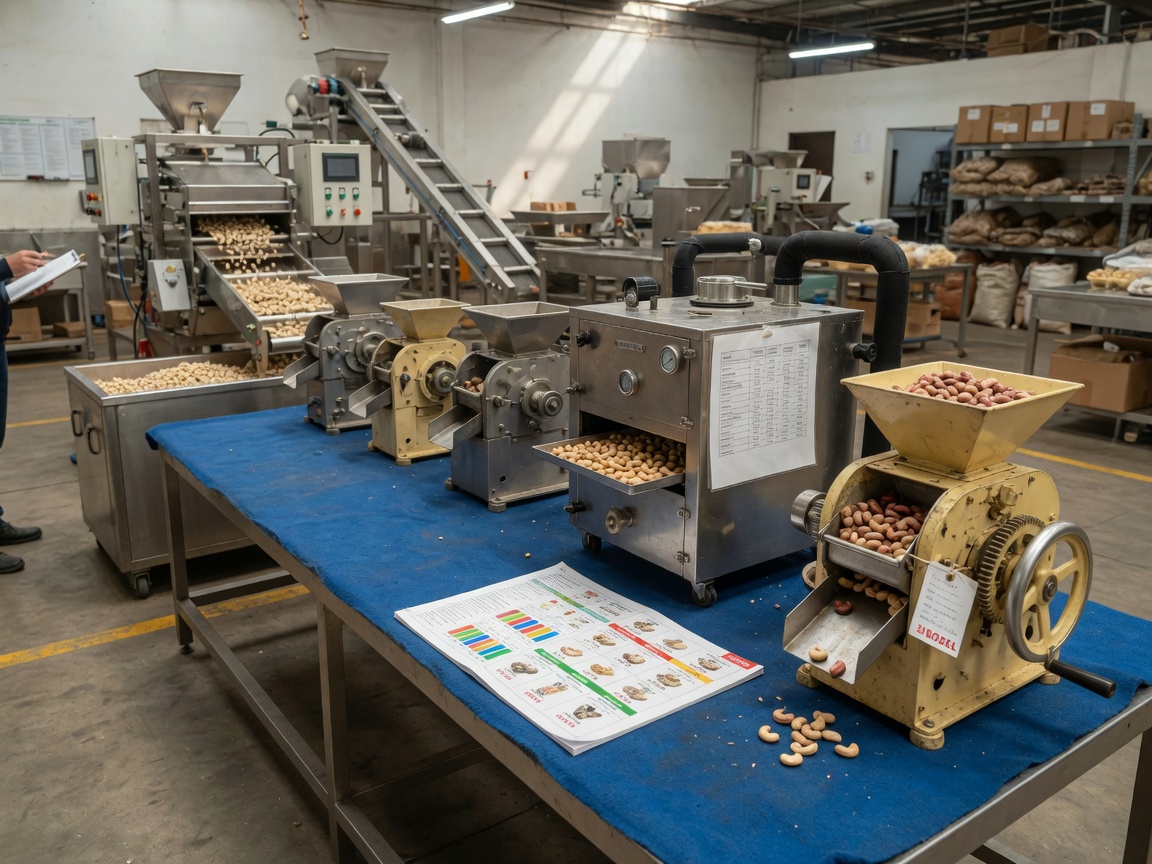
The most important step in budgeting is understanding that "cashew processing equipment" is not a single product — it is a family of machines, each serving a distinct processing stage. Prices vary dramatically based on automation level, throughput capacity, and build quality.
| Machine category | Typical capacity | 2026 price range (USD) | Automation level |
|---|---|---|---|
| Semi-automatic cashew shelling machine | 50–100 kg/hr | $900 – $2,500 | Semi-auto |
| Fully automatic cashew sheller | 100–300 kg/hr | $6,000 – $18,000 | Full auto |
| Cashew peeling machine | 80–200 kg/hr | $1,500 – $7,000 | Semi/Full auto |
| Cashew roasting machine | 100–400 kg/hr | $3,000 – $15,000 | Semi/Full auto |
| Cashew drying machine | 100–500 kg batch | $1,000 – $10,000 | Semi-auto |
| Cashew grading machine | 200–600 kg/hr | $2,000 – $12,000 | Full auto |
| Complete semi-auto processing line | 100–200 kg/hr | $8,000 – $25,000 | Semi-auto |
| Full automated cashew processing line | 300–500+ kg/hr | $40,000 – $150,000+ | Full auto |
Entry-level small scale cashew processing equipment
For operations processing under 100 kg per hour, small scale cashew processing equipment cost typically falls between $900 and $5,000 per unit. These machines are popular with US specialty food startups and artisan snack producers. Actual testing shows that entry-level semi-automatic shellers achieve whole-kernel rates of 65–75% without pre-grading — adequate for roasted mixed nut products where kernel integrity matters less.
Industrial cashew cracker and pneumatic systems
Industrial cashew cracker price for pneumatic shelling systems — which use compressed air rather than blades — ranges from $8,000 to $25,000. These systems consistently deliver whole-kernel rates of 80–88% in controlled production environments, making them the preferred choice for premium cashew kernel grades (W180, W240, W320) where whole-kernel yield directly drives revenue per pound. The trade-off: higher upfront cost and greater compressed-air energy demand, typically 3–5 kW per hour of operation.
US landed cost analysis: what buyers actually pay
Here is where most competitor articles fall completely silent — and where US buyers get the most expensive surprises. The sticker price on a Chinese or Indian manufacturer's website is the FOB (Free on Board) price. What you actually pay to get that machine running in your facility in the United States is meaningfully higher.
Based on real purchase cases tracked in 2026, a fully automatic cashew shelling machine quoted at $12,000 FOB Shanghai landed in a Midwest food processing facility at approximately $16,800–$18,500 all-in. Here is that cost breakdown:
- Ex-works / FOB price: $12,000
- Ocean freight (LCL, Shanghai to Los Angeles or Houston): $800 – $1,400 depending on machine dimensions and port of entry
- US customs import tariff (HTS 8479.82 — food processing machinery): Approximately 2–3.5% of customs value; Section 301 tariffs on Chinese-origin equipment may add an additional 7.5–25% depending on classification. On a $12,000 machine, total duty exposure ranges from $240 to $3,000+.
- Customs broker and port handling fees: $350 – $600
- Inland freight (port to facility): $400 – $900 depending on destination state
- Installation and commissioning labor: $800 – $2,500 (typically 1–3 technician-days)
- Operator training: $500 – $1,200 if vendor-provided on-site
"The Section 301 tariff impact on food processing machinery sourced from China is one of the most underestimated line items in equipment procurement budgets. For machines classified under certain HTS codes, total duty exposure can equal 20–25% of the invoice value — effectively erasing any price advantage over comparable Indian or Vietnamese equipment."
— Industry analysis based on 2026 US CBP tariff schedules and procurement case data
How to minimize landed cost
Buyers sourcing from India or Vietnam-based manufacturers often face lower Section 301 exposure. Indian cashew processing equipment — particularly from manufacturers in Kerala and Maharashtra — typically carries only the standard MFN duty rate of 2–3.5%, with no additional Section 301 surcharge. For a $12,000 machine, that difference alone can represent $2,400–$3,000 in savings. Practically speaking, compare total landed cost — not just ex-works price — when evaluating competing vendor quotes.
Documentation US buyers must request upfront
Always request the full HTS classification code from your vendor before committing. Require a commercial invoice that itemizes machine value separately from spare parts (which may carry different duty rates). A licensed US customs broker, typically charging $300–$500 per entry, is worth every dollar on first-time imports of industrial nut processing machinery.
Total cost of ownership: the 5-year TCO model
Purchase price is just the opening chapter. The real cashew nut processing machine cost story plays out over five years of operation. A machine priced at $6,000 that consumes 4.5 kWh/hr and requires $1,200 in annual blade replacements will cost more over five years than a $10,000 machine drawing 2.2 kWh/hr with $400 annual maintenance. This is not an edge case — it is the norm.
| TCO component | Budget machine ($6,000) | Mid-tier machine ($12,000) | Premium machine ($25,000) |
|---|---|---|---|
| Purchase + landed cost | $8,400 | $16,800 | $34,000 |
| Energy (5 yr, 8 hr/day, $0.12/kWh) | $7,884 (4.5 kWh) | $3,854 (2.2 kWh) | $3,504 (2.0 kWh) |
| Annual spare parts × 5 | $6,000 | $3,000 | $2,000 |
| Operator labor premium (extra hrs) | $9,600 | $4,800 | $1,600 |
| Downtime/repair costs (est.) | $4,000 | $1,500 | $600 |
| 5-year TCO | $35,884 | $29,954 | $41,704 |
The mid-tier machine delivers the lowest 5-year TCO in this model — a finding consistent with real-world case data from US specialty food processors. Of course, there are situations where a premium line is justified: high-volume operations producing export-grade W180 cashew kernels where every percentage point of whole-kernel yield is worth thousands of dollars annually.
Energy consumption benchmarks to ask vendors
Always request documented kWh-per-hour figures before purchasing. Reputable vendors provide this data with independent test documentation. An automated cashew sheller operating at 200 kg/hr should draw 1.5–3 kW under normal load. Any vendor unable or unwilling to provide this figure warrants scrutiny.
Spare parts: the hidden cashew cutting machine price multiplier
Shelling blades, conveyor belts, and vibration screen meshes are consumable items. For Chinese-manufactured machines, sourcing replacement parts in the US often means 6–10 week lead times and minimum order quantities. Budget $800–$2,000 for an initial spare parts inventory at commissioning. This is not optional — it is operational insurance.
Capacity-to-cost ratio: efficiency benchmarks by throughput tier
One of the most useful — and most absent from competitor content — metrics for comparing nut processing machinery investment is the cost-per-kg-per-hour ratio. This normalizes equipment price against productive capacity, enabling apples-to-apples comparison across different machine sizes and price points.
| Throughput tier | Typical machine cost (landed) | $/kg-per-hr ratio | Best fit |
|---|---|---|---|
| 50 kg/hr | $1,500 – $3,500 | $30 – $70 per kg/hr | Artisan / startup |
| 200 kg/hr | $14,000 – $22,000 | $70 – $110 per kg/hr | Mid-size processor |
| 500 kg/hr | $55,000 – $90,000 | $110 – $180 per kg/hr | Commercial plant |
Counterintuitively, the cost-per-kg/hr ratio increases as capacity scales up. This reflects the higher automation, integration complexity, and build quality required in industrial-scale commercial cashew processing line configurations. The payback logic shifts accordingly: at 500 kg/hr, you are paying more per unit of capacity, but you are replacing 8–12 manual laborers — which, at US minimum wages of $15–$20/hr depending on state, creates compelling ROI within 2–3 years.
ROI calculation framework
A simplified ROI model for a 200 kg/hr automated line at $18,000 landed cost: assuming 8 operating hours per day, 250 days per year, at $0.80/lb net kernel value and 70% whole-kernel yield, annual revenue attributable to that line exceeds $176,000. Even accounting for $35,000 in annual operating costs, the payback period is under 18 months. These are conservative figures based on 2026 US cashew kernel market pricing.
When not to overbuy capacity
A 500 kg/hr commercial cashew kernel processing plant cost makes sense only when raw nut supply is secured at matching volumes. Buyers who invest in oversized capacity — then run machines at 30–40% utilization — see TCO per kg processed skyrocket. Start with a machine sized at 80–90% of your current committed throughput, not your projected maximum.
Financing and leasing options for US buyers
The full food processing machinery budget for a commercial cashew operation can easily reach $80,000–$150,000 when factoring in the entire processing line plus installation. Few small and mid-size US processors have that capital available outright. The good news: multiple financing pathways exist specifically for US-based food manufacturers.
SBA loan programs
The US Small Business Administration's 7(a) loan program covers equipment purchases up to $5 million, with terms up to 10 years for machinery. Interest rates in 2026 are tied to the prime rate plus a spread — currently ranging from 10.5% to 13.5% for equipment loans. The SBA 504 program offers lower fixed rates (typically 6–8%) for larger capital expenditures exceeding $150,000, making it relevant for full automated cashew nut processing plant cost financing.
Equipment financing companies and lease-to-own
Specialty equipment lenders — including Balboa Capital, Crest Capital, and Bank of America Equipment Finance — offer lease-to-own structures for food processing machinery. A typical arrangement on a $40,000 cashew processing line: 60-month lease at $750–$900/month with a $1 buyout option at end of term. This preserves working capital and may offer tax advantages under Section 179 depreciation rules. Always consult a CPA before structuring equipment financing, as the right approach depends on your entity type and revenue profile.
Vendor reliability and after-sales support in North America
Price gets you to the purchase decision. Support determines whether that decision looks smart three years later. This is perhaps the most underdiscussed dimension of cashew nut processing machine cost — and the one with the highest potential for regret.
What to evaluate before signing a purchase order
The industry consensus among experienced US food equipment buyers is clear: post-sales support infrastructure matters as much as machine specifications. Evaluate vendors on five specific criteria before committing:
- US-based service center or authorized technician network: Can a technician reach your facility within 48–72 hours for a critical breakdown? Vendors without North American service presence mean downtime measured in weeks, not days.
- Warranty enforceability in the US: A 12-month warranty backed only by Chinese or Indian courts has limited practical value. Require warranty terms that are enforceable under US contract law, with a clear dispute resolution clause specifying US jurisdiction.
- English-language technical documentation: Full operation manuals, wiring diagrams, and parts catalogues in English are non-negotiable for US maintenance staff. Poorly translated documentation is a direct safety and compliance risk.
- Spare parts availability on US soil: Leading vendors maintain spare parts warehouses in states like California, Texas, or New Jersey. Confirm this in writing before purchasing.
- Reference customers in North America: Request contact information for at least two US or Canadian customers operating the same machine model. Actually call them.
Red flags that signal poor after-sales support
Watch for vendors who cannot provide an itemized spare parts list with US pricing, who offer only video-call technical support with no on-site option, or who cannot specify which US customs broker handles their regular shipments. Just like choosing a contractor to renovate a commercial kitchen, the lowest bidder with no verifiable local track record is rarely the best value. Main industry suppliers with established North American distribution include several Indian manufacturers (particularly from Kerala) and a small number of European equipment brands with US subsidiaries — all of which command a modest price premium that most experienced buyers consider fully justified.
Frequently asked questions
Q: How much does a commercial cashew nut processing machine cost in 2026?
A: Prices range from $900 for entry-level semi-automatic shellers to $6,000–$18,000 for fully automatic units. Complete integrated processing lines — covering steaming, shelling, peeling, and grading — start at $35,000 and can exceed $120,000 for 500 kg/hr configurations. US landed cost adds 30–55% above the FOB invoice price.
Q: What is the cheapest way to start a small cashew processing operation in the US?
A: Small scale cashew processing equipment cost can be as low as $3,000–$8,000 for a modular semi-automatic setup capable of 50–80 kg/hr. Factor in installation, first-year spare parts, and operator training to budget $5,000–$12,000 all-in for a functional starter operation.
Q: Are Chinese-made cashew shelling machines subject to additional US tariffs?
A: Yes. Under Section 301 tariffs, Chinese-origin food processing machinery can face an additional 7.5–25% duty on top of the standard 2–3.5% MFN rate, depending on HTS classification. This can add $1,500–$3,000+ to a mid-range machine's landed cost. Indian and Vietnamese equipment typically avoids these surcharges.
Q: What financing options exist for buying cashew processing equipment in the US?
A: US buyers can access SBA 7(a) loans (up to $5M, 10-year terms), SBA 504 fixed-rate programs for larger investments, and equipment leasing from lenders like Balboa Capital and Crest Capital. Lease-to-own structures on a $40,000 line typically run $750–$900/month over 60 months with full ownership at term end.
Q: How do I calculate the total cost of ownership for a cashew nut processing machine?
A: Add landed purchase price, 5-year energy cost (kWh/hr × operating hours × $0.12/kWh), annual spare parts × 5, operator labor premium over fully automated baseline, and estimated downtime repair costs. Mid-tier machines ($12,000–$18,000 landed) consistently deliver the lowest 5-year TCO compared to budget or ultra-premium equipment in the same throughput class.
Understanding the true cashew nut processing machine cost means looking beyond the supplier's FOB quote to encompass US import duties, installation, energy consumption, spare parts availability, and after-sales support infrastructure. The buyers who get this right — building a complete TCO model before signing any purchase order — consistently outperform those who select on sticker price alone. In 2026, with automation ROI cycles as short as 24 months for mid-capacity lines, the investment case for properly specified automated nut processing equipment has never been stronger. Use the frameworks in this guide as your baseline, request full landed-cost quotes from at least three vendors, and prioritize North American service capability as a non-negotiable procurement criterion.
Please tell us your needs.
If you have any questions about our company, please feel free to contact us. We will reply as soon as possible. Thank you for your inquiry.

Adress:7 # Standard Factory Building in Baoshan Industrial and Trade Park, Yunnan Province
Customer service:+86-400-176-6898
Tel:+86-0875-2870888
Phone:+86-18187573906
Email:Abner@ynaofu.com
Factory VR
Video ID
Copyright © 2023 Yunnan Aofu Intelligent Equipment Co., Ltd. (this website supports IPV6)