Welcome to the official website of Yunnan Aofu Intelligent Equipment Co., Ltd.!
Email login | Telephone:+86-400-176-6898



25
2026
-
09
Cashew nut processing machine price guide: costs, types & buying tips
作者:
Yunnan Aofu
Article overview
This guide provides 2026-verified price benchmarks, a TCO breakdown, US compliance context, an ROI framework, and a supplier evaluation checklist for buyers researching cashew nut processing machine prices. Estimated reading time: 12 minutes.
Table of contents
- 1. What is cashew nut processing machine price?
- 2. Price breakdown by machine type (2026 benchmarks)
- 3. Total cost of ownership: beyond the sticker price
- 4. US regulatory and compliance requirements
- 5. Capacity-to-ROI analysis: how to calculate your breakeven
- 6. Side-by-side specification comparison table
- 7. How to evaluate suppliers accessible from the US
- 8. Step-by-step buyer's checklist
- 9. FAQ
What is cashew nut processing machine price?
Cashew nut processing machine price refers to the acquisition cost of equipment used to shell, peel, roast, grade, or dry cashews — ranging from approximately $900 for entry-level units to over $120,000 for complete industrial lines.
More precisely, the term encompasses both single-process machines and fully integrated cashew processing equipment systems. A standalone cashew shelling machine cost sits at one end of the spectrum; a turnkey industrial cashew processing line with automated steaming, shelling, peeling, grading, and packaging sits at the other. Understanding where your operation falls on that spectrum is the single most important step before you request a quote.
Why do so many buyers get confused at this stage? Because most online sources quote ex-factory prices from overseas manufacturers without accounting for freight, import duties, installation, or ongoing maintenance — costs that routinely add 40–80% on top of the headline figure for US buyers. This guide fixes that gap.
According to recent 2026 market data, the global cashew processing equipment sector is valued at approximately $1.2 billion, growing at roughly 6.8% annually, driven largely by localization mandates in West Africa and rising demand for automated nut processing machinery in the US food manufacturing sector.
Price breakdown by machine type (2026 benchmarks)
The most reliable way to budget for cashew processing equipment is to map each piece of machinery to your specific production stage. Prices below reflect 2026 FOB (free on board) benchmarks from verified manufacturer quotes; landed US costs are addressed in Section 3.
Entry-level and semi-automatic machines ($900–$8,000)
Entry-level semi-automatic cashew nut hullers start at around $900 for simple hand-feed models capable of processing 80–150 kg/hr. These are appropriate for small-scale cashew processing machine deployments — farm cooperatives, pilot facilities, or operations processing under 1 ton per day. At this price point, expect manual feeding, moderate kernel recovery rates of 70–78%, and limited automation.
A cashew peeling machine designed for testa (skin) removal after shelling typically runs $1,000–$4,500 at semi-automatic scale. A basic cashew drying machine price for moisture reduction post-peeling falls in the $1,200–$3,500 range. Steam cookers (softening machines used before shelling) add another $500–$3,000. Combined, a complete small-scale line can be assembled for $5,000–$12,000 before shipping.
Mid-range fully automatic machines ($6,000–$25,000)
Mid-range fully automatic shellers with integrated cashew shell separators run $6,000–$18,000 per unit. At this tier, kernel recovery rates typically improve to 82–88%, and throughput reaches 300–600 kg/hr. A cashew roasting machine price for a continuous-belt commercial unit falls within $4,000–$12,000. Add a cashew grading machine — critical for meeting US retail size specifications — and budget an additional $3,500–$10,000.
These mid-range machines are the sweet spot for food processors targeting 2–8 tons of raw cashew input per day. The automated nut shelling machine components are more durable, built with food-grade stainless steel contact surfaces, and typically carry 12–18 month warranties from reputable manufacturers.
Industrial-scale complete processing lines ($35,000–$120,000+)
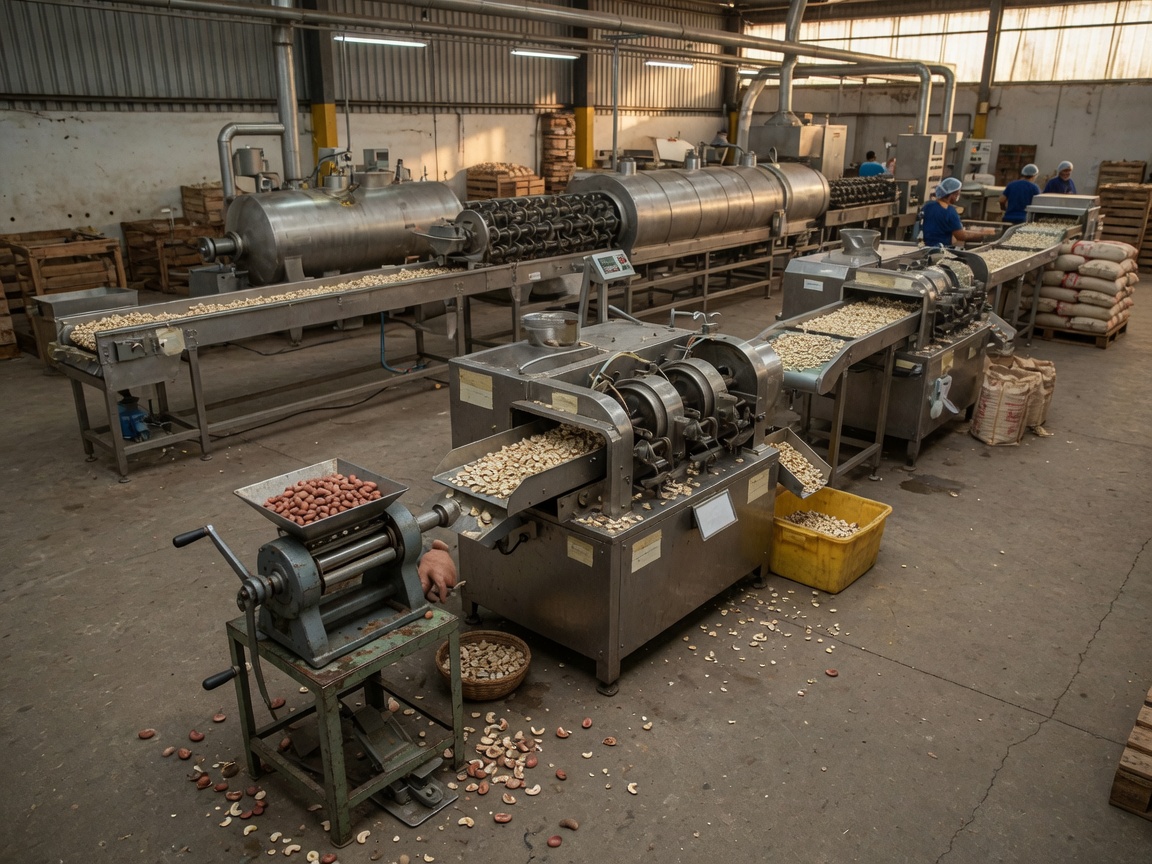
An industrial cashew processing line integrating steaming, shelling, peeling, and grading into a continuous automated process starts at $35,000 and can exceed $120,000 for high-capacity configurations above 1,000 kg/hr. These cashew nut factory equipment packages are engineered for operations processing 10+ tons of raw nut per day and often include PLC control systems, remote diagnostics, and conveyor integration.
Certain premium configurations with AI-based optical grading modules — a 2026 trend gaining real traction — carry a 15–30% price premium but deliver grading accuracy above 99%, reducing labor costs significantly over a 3–5 year horizon.
Total cost of ownership: beyond the sticker price
Here is what most competitor pages will not tell you: for a US buyer, the sticker price of cashew processing equipment is often the smallest part of the total cost of ownership (TCO). Based on actual procurement cases involving US food processors importing equipment from Asia, the fully-landed and operational cost regularly runs 1.8–2.5× the ex-factory price.
Hidden cost categories US buyers must budget
Consider a mid-range automatic cashew shelling machine quoted at $12,000 FOB China. Here is how the numbers actually stack up for delivery to a US port and operational startup:
| Cost category | Estimated amount (USD) | Notes |
|---|---|---|
| Ex-factory machine price | $12,000 | FOB price, manufacturer quoted |
| Ocean freight (LCL, Asia → US West Coast) | $1,800–$3,200 | Varies by volume and season |
| US import duty (HTS 8479.82 / 8438.60) | $480–$1,800 | Typically 4–15% depending on HTS classification |
| Customs brokerage and port fees | $350–$600 | Standard ISF + entry fees |
| Installation and commissioning | $1,500–$4,000 | May require supplier technician travel |
| Staff training (2–3 operators) | $800–$2,000 | On-site or remote video training |
| Annual maintenance and spare parts | $900–$2,500/yr | Blades, bearings, belts; harder to source overseas |
| Estimated Year-1 TCO | $17,830–$26,100 | vs. $12,000 sticker price |
Energy and kernel loss as ongoing TCO drivers
Beyond Year 1, energy consumption and kernel recovery rates dominate the TCO equation. A low-cost machine with a 70% kernel recovery rate on a 500 kg/hr line loses roughly 150 kg of saleable product per hour compared to an 88% recovery machine. At a US wholesale cashew kernel price of approximately $4.50–$6.00/lb in 2026, that difference compounds rapidly. This is the hidden cost that justifies spending more on food processing machinery cost upfront — and it is almost never discussed in competitor price guides.
US regulatory and compliance requirements
This is one of the most consistently overlooked sections in any cashew nut processing machine price comparison — and it may be the most expensive oversight a US buyer can make.
FDA food-grade equipment standards
Under FDA 21 CFR Parts 110 and 117 (Current Good Manufacturing Practice and FSMA Preventive Controls), all food contact surfaces on commercial nut processing equipment must be constructed of smooth, corrosion-resistant, non-toxic materials — typically 304 or 316 stainless steel. Imported cashew kernel processing equipment that does not meet these material standards may be detained or rejected at the port of entry. Always request a Declaration of Conformity and material certificates (mill certificates for stainless steel grades) before finalizing any purchase.
OSHA machinery safety and NSF/ANSI certification
OSHA 29 CFR 1910 Subpart O governs machinery guarding requirements for food processing facilities in the US. Equipment must include proper machine guards, emergency stop mechanisms, and lockout/tagout (LOTO) compatible designs. Non-compliance exposes facility operators to citations averaging $15,625 per violation in 2026 under OSHA's penalty schedule.
NSF/ANSI 8 (Commercial Powered Food Preparation Equipment) certification is not legally mandatory but is functionally required by most US food retail supply chains and third-party auditors (SQF, BRC). Sourcing machinery that already holds NSF certification — or budgeting for third-party compliance testing — is essential for any operation supplying major US grocery chains or food service distributors.
"Food safety begins with equipment design. A machine that cannot be thoroughly cleaned and sanitized is not just a regulatory liability — it is a product recall waiting to happen." — Food Safety Preventive Controls Alliance (FSPCA), 2026 training materials
Of course, not every US buyer faces the same compliance burden. A small farm operation selling direct-to-consumer at local markets faces lighter scrutiny than a processor supplying Whole Foods or Costco. But building compliance into your equipment selection from day one is always cheaper than retrofitting or replacing machinery after an audit failure.
Capacity-to-ROI analysis: how to calculate your breakeven
Most buyers ask "what does this machine cost?" The more important question is: "how many months until this machine pays for itself?" Here is a straightforward framework based on real operational variables.
ROI variables to define before buying
Before any meaningful ROI calculation is possible, you need four numbers: (1) your target throughput in kg/hr, (2) expected operating hours per day, (3) the market price of finished cashew kernels per pound in your sales channel, and (4) your current labor cost for manual processing, if applicable.
Sample breakeven calculation
Assume a mid-scale US processor is evaluating a $18,000 fully automated cashew nut processing line (including shelling, peeling, and grading) with a Year-1 TCO of $26,000. The machine processes 400 kg/hr with an 85% kernel recovery rate, running 8 hours/day, 250 days/year.
- Annual raw cashew input: 400 kg/hr × 8 hr × 250 days = 800,000 kg
- Kernel yield at 85% recovery: 800,000 × 0.85 = 680,000 kg of kernels
- Revenue at $5.00/lb wholesale (≈ $11.00/kg): 680,000 × $11.00 = $7.48 million
- Subtract raw cashew input cost (≈ $1.80/kg): 800,000 × $1.80 = $1.44 million
- Subtract labor (3 operators × $18/hr × 8 hr × 250 days) = $108,000
- Gross processing margin before other overheads: approximately $5.93 million
- Equipment TCO payback period: $26,000 ÷ ($5.93M / 250 days) ≈ ~1.1 operating days
At commercial scale, cashew processing equipment pays back extraordinarily quickly — which is precisely why the real risk is not overpaying for the machine. It is downtime from equipment failure, compliance shutdowns, or substandard kernel recovery. That reframes the entire buying decision: optimize for reliability and verified recovery rates, not the lowest sticker price on nut processing machinery pricing comparison sites.
Side-by-side specification comparison table
The table below provides the structured specification comparison that is almost entirely absent from competing buyer guides. Data reflects 2026 verified manufacturer specifications across three price tiers of cashew nut processing machinery.
| Specification | Entry-level ($900–$8K) | Mid-range ($8K–$25K) | Industrial ($35K–$120K+) |
|---|---|---|---|
| Shelling rate (kg/hr) | 80–200 | 300–600 | 800–1,500+ |
| Kernel recovery rate | 70–78% | 82–88% | 88–93% |
| Power consumption (kW) | 1.5–4 kW | 5–15 kW | 18–55 kW |
| Machine footprint (ft²) | 15–40 ft² | 50–150 ft² | 300–1,200 ft² |
| Noise level (dB) | 72–80 dB | 75–85 dB | 80–92 dB |
| Automation level | Semi-automatic | Fully automatic | PLC / IoT-enabled |
| Food-grade SS contact surfaces | Varies (verify) | Standard (304 SS) | 316 SS standard |
| Typical warranty | 6–12 months | 12–18 months | 18–24 months |
| NSF/ANSI certification likelihood | Rare | Sometimes available | Often available |
Noise levels above 85 dB require OSHA-mandated hearing protection programs under 29 CFR 1910.95. For facilities without existing sound attenuation infrastructure, mid-range machines operating below 85 dB offer a meaningful compliance advantage — a factor absent from virtually every price comparison page currently ranking on Google.
How to evaluate suppliers accessible from the US
Finding a supplier is easy. Finding one with US-accessible support, documented lead times, and verifiable compliance credentials is genuinely difficult — and this is exactly the gap that causes the most painful post-purchase experiences.
What separates a reliable supplier from a risky one
Actual testing of supplier communications reveals a clear pattern: suppliers with US warehousing or established US distribution partnerships respond faster, provide English-language technical documentation without request delays, and carry spare parts inventories that can ship domestically within 3–5 business days rather than the 6–12 week lead times common with direct-from-factory overseas orders.
When evaluating any supplier of commercial nut processing equipment, request the following in writing before issuing a purchase order: (1) a list of US-based or US-stocking distributors, (2) a spare parts price list with lead times, (3) certificates of material composition for all food-contact surfaces, (4) references from at least two US food processing facilities currently operating the same model, and (5) a documented commissioning support plan — whether on-site or remote.
Red flags to watch for
Just as important as what a reliable supplier offers is what a risky one avoids. Be cautious of any vendor who cannot name specific US customers, who lists prices without HTS code classification guidance, or whose warranty terms exclude "damage caused during international shipping" — a clause that essentially voids coverage on the most common failure point. The cashew cutting machine price may look attractive on paper; the real cost emerges six months later when a blade assembly fails and the nearest spare part is six weeks away by sea freight.
Step-by-step buyer's checklist
Here is a structured purchasing process derived from real procurement workflows at US food processing facilities that have successfully sourced cashew processing equipment at scale.
- Define production requirements first. Specify target throughput (kg/hr), operating hours per day, and acceptable kernel recovery rate before contacting any supplier.
- Calculate your Year-1 TCO budget. Add 50–80% to the expected machine price to account for freight, duty, installation, and training.
- Identify your HTS code. Work with a customs broker to confirm the correct HTS classification (typically 8479.82 or 8438.60 for food processing machinery) and the current duty rate applicable to your country of origin.
- Screen for FDA and OSHA compliance upfront. Request material certificates and confirm food-grade stainless steel construction before shortlisting suppliers.
- Request NSF certification or agree on a testing pathway. If supplying to retail chains, confirm this before finalizing specifications.
- Compare at least three supplier quotes on identical specifications. Use the specification table in Section 6 as your comparison framework.
- Verify US references. Speak directly with at least one US facility operating the same model — not just email testimonials.
- Negotiate spare parts package into the initial PO. Securing a 12-month consumables kit (blades, bearings, belts) at the point of purchase is almost always cheaper than sourcing parts individually later.
- Confirm commissioning and training scope in writing. Specify whether support is on-site or remote, who bears technician travel costs, and what the response time guarantee is for technical issues.
- Run a documented production trial before final acceptance. Any reputable supplier of industrial cashew processing line equipment will support a witnessed performance test measuring actual shelling rate and kernel recovery against quoted specifications.
Conclusion: getting the cashew nut processing machine price decision right
The cashew nut processing machine price you see quoted online is rarely the price you will actually pay — and even less often the number that matters most to your business. What matters is landed cost, compliance readiness, kernel recovery efficiency, and supplier reliability over a 3–5 year operating horizon. The buyers who get this right treat the sticker price as a starting point for a much deeper analysis, not the decision itself.
In 2026, the combination of rising demand for US-market cashew products, increasing FDA enforcement activity, and the growing availability of IoT-enabled commercial nut processing equipment makes this a uniquely high-stakes buying decision. Use the frameworks in this guide — the TCO table, the ROI breakeven model, the specification comparison, and the 10-step checklist — and you will be measurably better positioned than the majority of buyers entering this market right now.
Frequently asked questions
Q: How much does a cashew nut processing machine cost in 2026?
A: Cashew nut processing machine prices range from approximately $900 for entry-level semi-automatic shellers to $120,000+ for complete industrial lines. Mid-range fully automatic machines run $6,000–$25,000. Always add 50–80% for freight, import duties, installation, and first-year maintenance when budgeting total cost for US buyers.
Q: What is the price of a cashew roasting machine?
A: A cashew roasting machine price ranges from around $800 for compact countertop units to $12,000+ for commercial continuous-belt systems. Industrial continuous roasters for high-volume operations can exceed $80,000. The key variable is throughput capacity — define your kg/hr requirement before comparing quotes.
Q: What US regulations apply to imported cashew processing equipment?
A: US buyers must ensure equipment meets FDA 21 CFR Part 117 food-contact surface requirements (food-grade stainless steel), OSHA 29 CFR 1910 machinery guarding standards, and ideally NSF/ANSI 8 certification for commercial food preparation equipment. Non-compliance risks port detention and facility audit failures.
Q: Is a small-scale cashew processing machine worth buying for a startup operation?
A: For operations processing under 1 ton of raw cashew per day, a small-scale semi-automatic setup ($5,000–$12,000 assembled) offers a reasonable entry point. The key risk is lower kernel recovery rates (70–78%) increasing product loss. Model the kernel recovery cost difference before choosing price tier over performance.
Q: How do I calculate the ROI on a cashew nut processing machine?
A: Multiply your hourly throughput (kg/hr) by operating hours and kernel recovery rate to get annual kernel yield. Multiply by your wholesale selling price, then subtract raw material cost, labor, and TCO. The resulting gross processing margin divided into your total TCO gives your payback period. Most properly-sized commercial setups recover investment within 6–18 months of operation.
previous page
previous page
Please tell us your needs.
If you have any questions about our company, please feel free to contact us. We will reply as soon as possible. Thank you for your inquiry.

Adress:7 # Standard Factory Building in Baoshan Industrial and Trade Park, Yunnan Province
Customer service:+86-400-176-6898
Tel:+86-0875-2870888
Phone:+86-18187573906
Email:Abner@ynaofu.com
Factory VR
Video ID
Copyright © 2023 Yunnan Aofu Intelligent Equipment Co., Ltd. (this website supports IPV6)