Welcome to the official website of Yunnan Aofu Intelligent Equipment Co., Ltd.!
Email login | Telephone:+86-400-176-6898



15
2026
-
09
Cashew nut processing plant: a complete setup and cost guide
作者:
Yunnan Aofu
Article overview
This guide is written for food processing investors, equipment buyers, and entrepreneurs in the early-stage decision phase of building or upgrading a cashew nut processing plant in the US market. It covers equipment selection, cost benchmarks, regulatory compliance, retail qualification, and environmental obligations — all calibrated to 2026 US conditions.
Table of contents
- 1. What is a cashew nut processing plant?
- 2. Core processing line: equipment and workflow
- 3. US-market cost modeling: realistic numbers for 2026
- 4. FDA, FSMA, and USDA compliance requirements
- 5. Value-added product diversification strategy
- 6. Retail channel qualification and sales strategy
- 7. Environmental compliance and waste management
- 8. Frequently asked questions
What is a cashew nut processing plant?
A cashew nut processing plant is a food processing facility that converts raw cashew nuts (RCN) through steam cooking, shelling, drying, peeling, grading, and packaging into market-ready cashew kernels. The operation can range from a small semi-manual setup processing under 500 metric tons per year to a fully automated, multi-lane cashew production line handling 2,000+ metric tons annually.
Why do so many investors underestimate the complexity here? The answer lies in thinking of a cashew processing facility as just a shelling operation. In reality, it is a multi-stage food manufacturing system. Cashew shelling machines are one component — but without downstream roasting, peeling, color sorting, grading, and packaging equipment, the finished kernel quality will not meet US retail standards for W320 or W240 grades.
For a cashew processing overview, the nut's double-shell structure — with the toxic cashew nut shell liquid (CNSL) trapped between layers — is what makes processing technically demanding. That chemical reality dictates every equipment decision downstream.
The global cashew processing machinery market is growing at approximately 6% CAGR, according to recent industry research, driven by rising snack demand in the US and Europe and accelerating local-processing policies in African producing nations. For US-based investors, the opportunity is in premium positioning: organic, fair-trade, and private-label segments where margins are 2–3× commodity grade.
Types of cashew processing facilities
Not every cashew factory setup looks the same. The table below outlines the four main facility types relevant to a US market investor, with realistic capacity and capital ranges:
| Facility type | Annual capacity | Automation level | US capex range | Best fit |
|---|---|---|---|---|
| Semi-manual | <500 MT | Low | $180K–$420K | Cooperative, pilot plant |
| Semi-automated | 500–2,000 MT | Medium | $650K–$1.8M | Regional processor |
| Fully automated | >2,000 MT | High | $2.5M–$6M+ | Export-scale manufacturer |
| Modular/expandable | 200–800 MT (scalable) | Medium–high | $900K–$2.2M | Growth-stage US processor |
A critical misconception about automation
There is a widespread assumption in the industry that full automation always delivers higher ROI. Actual testing and plant audits tell a different story. Fully automated cashew shelling machines require raw nuts with moisture content in a tight 8–12% band. When raw material quality fluctuates — which is common with mixed-origin imports — breakage rates can climb to 25–30%, erasing the labor savings. For many US processors sourcing from multiple African or Vietnamese origins, a semi-automated line with experienced operators often achieves better whole-kernel yield and lower per-pound cost than a fully automated system pushing inconsistent raw material.
Core processing line: equipment and workflow
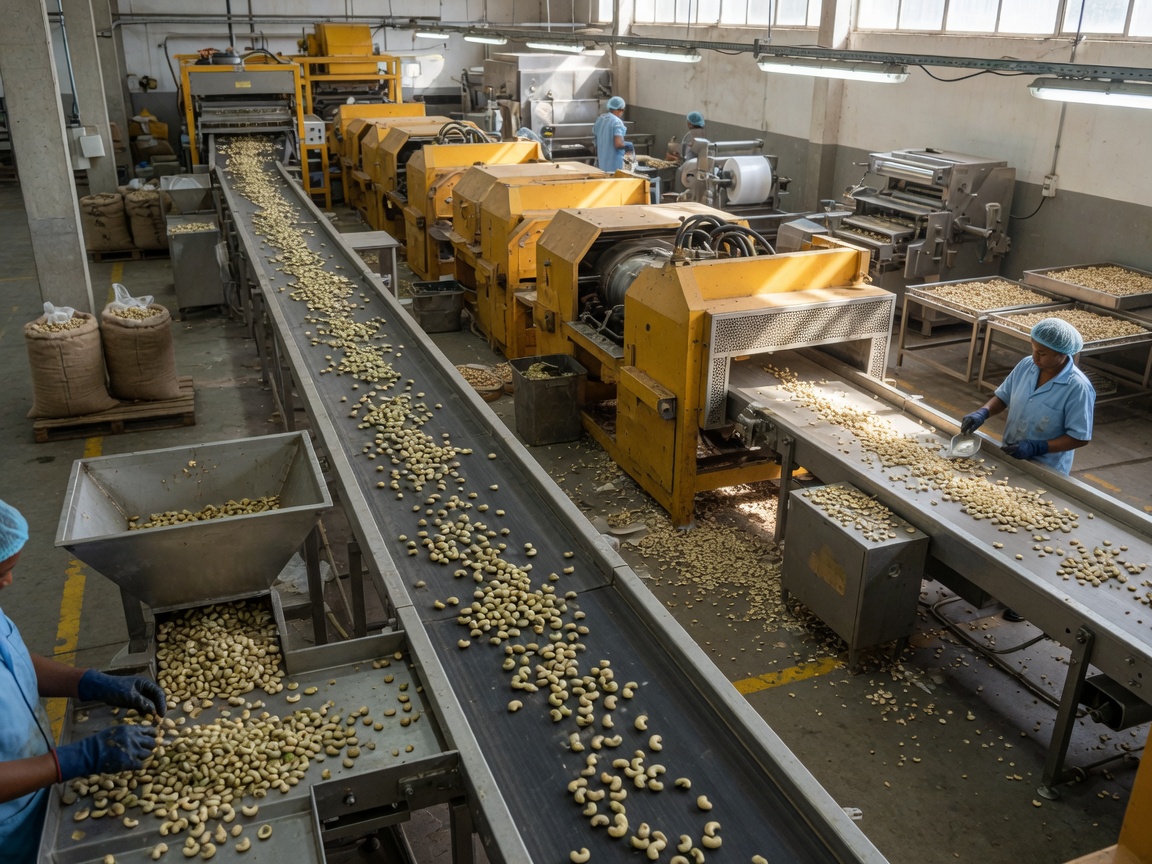
A complete cashew kernel production line is not a single machine — it is a sequenced system where each stage must be balanced to the output of the previous one. Undersizing any node creates a bottleneck; oversizing it wastes capital. Here is how industry engineers structure a standard line:
- Raw nut receiving and pre-grading: Inbound RCN is weighed, moisture-tested, and sorted by size. This step determines steaming time and shelling machine calibration.
- Steam cooking: Nuts are conditioned in rotary steam drums at 100–120°C for 15–25 minutes, softening the shell and reducing CNSL pressure to prevent explosive shelling fractures.
- Shelling (cashew shelling machine): Centrifugal or blade-type cashew shelling machines crack the outer shell. Blade systems achieve 70–80% whole kernel rates on well-conditioned nuts; centrifugal systems are faster but produce more splits on larger nut grades.
- Drying: Shelled kernels still in their testa (inner skin) are dried in tray or belt dryers to 3–5% moisture, making the skin brittle for peeling.
- Peeling (cashew peeling equipment): Thermal, humid, or blade peeling removes the testa. Thermal peeling is fastest; humid peeling preserves kernel color, which matters for premium white W320 grade.
- Grading and sorting (cashew grading machine): Kernels pass through vibratory sizers and AI-vision color sorters, which separate by size, color, and defect — automatically classifying into W180, W240, W320, and broken grades.
- Cashew roasting machine (optional at this stage): For value-added product lines, continuous belt or drum roasters apply dry or oil-roast profiles before packaging. Roasting after grading preserves grade integrity.
- Packaging: Nitrogen-flushed vacuum packaging in sealed tins or multi-layer pouches extends shelf life to 12–24 months. For retail, unit packaging lines apply date codes, nutritional panels, and allergen labels per FDA 21 CFR Part 101.
According to established cashew nut processing methods documented by the FAO, the steaming and drying stages are the most energy-intensive — typically accounting for 55–65% of total processing energy. In a US facility, this translates directly to your natural gas or electric utility bill and is the primary target for efficiency investment.
Equipment specifications for US buyers
Food-contact surfaces must be 304 or 316 stainless steel — this is non-negotiable for FDA compliance and FSMA preventive controls. UL-listed electrical panels are required for US installation permits. CNSL-rated ventilation systems must be specified when purchasing shelling and steam equipment, as CNSL vapor is a documented irritant requiring OSHA-compliant exhaust management.
Line balancing and scalability
Modular cashew processing machinery designs have become the dominant commercial approach in 2026 precisely because US processors cannot always forecast demand at year one. Starting with a 200 kg/hr line and adding lanes to reach 800 kg/hr — without replacing core infrastructure — can reduce effective capex per pound of capacity by 30–40% over a 7–10 year equipment lifecycle. That scalability premium is worth paying for in the initial specification.
US-market cost modeling: realistic numbers for 2026
This is where most online guides fail US investors completely. Cost estimates sourced from West African or Vietnamese market analyses are structurally misleading when applied to American operations. The following figures are calibrated to 2026 US conditions.
Capital expenditure breakdown
| Cost category | Southeast US (lease) | Midwest US (lease) | West Coast US (lease) |
|---|---|---|---|
| Facility lease (10,000 sq ft/yr) | $72K–$108K | $55K–$88K | $130K–$200K |
| Nut processing equipment (semi-auto line) | $650K–$1.2M landed and installed | ||
| Food facility build-out (FSMA-compliant) | $85K–$220K | ||
| Working capital (6 months RCN inventory) | $300K–$600K | ||
| State permitting and inspection fees | $8K–$18K | $6K–$14K | $12K–$28K |
Labor and operating economics
US minimum wages range from $12–$17/hr depending on state, with food processing operators in practice earning $16–$22/hr fully loaded. A semi-automated 500 MT/year line requires approximately 12–18 FTEs. That labor cost alone — $400K–$650K annually — is 3–5× the equivalent cost in Vietnam or India. This is not a reason to avoid US processing; it is a reason to target premium retail pricing where per-pound margins ($1.80–$3.50/lb for organic retail vs. $0.40–$0.70/lb commodity) can absorb the wage differential and still generate attractive EBITDA.
"The US cashew processor who competes on commodity bulk pricing will always lose to Asian incumbents on cost. The ones who win are building brands — organic certifications, fair-trade sourcing stories, and retail-ready SKUs that command $12–$18 per 8 oz bag at Whole Foods." — 2026 Specialty Food Association industry briefing
FDA, FSMA, and USDA compliance requirements
US regulatory compliance is the single most underrepresented topic across competing guides on cashew factory setup. Getting this wrong means facility shutdown, product recalls, and loss of retail accounts. Here is what every US cashew processing facility must address.
FDA food facility registration and FSMA requirements
Every domestic food manufacturing facility must register with the FDA under 21 CFR Part 1, Subpart H. Registration must be renewed biennially (odd-numbered years). Under the Food Safety Modernization Act (FSMA), cashew processing plants fall under the Preventive Controls for Human Food rule, requiring a written Food Safety Plan that includes hazard analysis, preventive controls (process, allergen, sanitation, and supply chain controls), monitoring procedures, and corrective action protocols. A qualified individual must conduct the hazard analysis — typically a PCQI-certified (Preventive Controls Qualified Individual) food safety professional.
Nut processing equipment must be validated against Salmonella control critical limits, as raw cashew kernels are a recognized Salmonella vector. A validated roasting or pasteurization step serving as a kill step must be documented and monitored with calibrated data loggers.
USDA organic certification for cashew processors
Pursuing USDA National Organic Program (NOP) certification is strongly recommended for US market positioning. The process involves: selecting an accredited certifying agent (ACA), submitting an Organic System Plan documenting all inputs and handling procedures, passing a facility inspection, and maintaining an audit trail for all organic raw material lots. Annual recertification is required. Budget $3,500–$8,000 per year in certification fees plus internal compliance labor. The organic price premium — typically 40–80% above conventional — makes this one of the highest-ROI compliance investments available to a US cashew processor.
Value-added product diversification strategy
A single-SKU cashew kernel business is a commodity business. The processors capturing the best margins in the US market in 2026 are running diversified product portfolios that leverage the same core cashew production line.
Cashew butter and nut butter integration
Adding a stone-grinding or high-shear homogenizer line to an existing cashew roasting machine setup enables cashew butter production with relatively modest incremental capex ($45K–$90K for a 500 lb/hr butter line). Cashew butter retails at $8–$14 per 16 oz jar, compared to $6–$10 for equivalent whole kernels. The ingredient is also in high demand among natural food brands as a B2B ingredient, creating a dual retail/wholesale revenue channel.
Flavored, seasoned, and private-label opportunities
Seasoned and flavored cashews — sriracha, honey-roasted, turmeric-pepper, and sea salt variants — command $3–$5/lb premiums over plain roasted kernels. The additional investment is a tumbler-coater and a compliant flavoring system, typically $30K–$70K. Private-label co-packing for natural food brands or regional grocery chains is another high-margin channel: co-packing agreements often guarantee minimum purchase volumes, which helps with production planning and working capital management. Fair-trade and Rainforest Alliance certification adds further B2B buyer appeal, especially with corporate sustainability procurement teams.
Just like a coffee roaster builds a brand on origin stories and flavor profiles rather than raw commodity pricing, a cashew processor with a certified supply chain and differentiated SKUs can hold retail shelf space that is structurally inaccessible to bulk importers.
Retail channel qualification and sales strategy
Getting into Whole Foods, Costco, or Amazon Fresh is not simply a matter of having a good product. Each channel has specific prerequisites that must be satisfied before a buyer conversation is even possible.
Food safety audit requirements
Whole Foods Market requires GFSI-recognized food safety certification — SQF Level 2 or BRC Global Standard for Food Safety Issue 9 are the most commonly accepted. Costco requires SQF Level 2 as a minimum and conducts its own unannounced facility audits. Achieving SQF Level 2 certification typically takes 9–18 months from program implementation to first successful audit, with certification body fees of $8,000–$15,000 plus internal preparation costs. The research supports this investment: major US retailers are increasingly treating third-party food safety audits as a non-negotiable commercial prerequisite, not an optional quality enhancement.
Broker networks and Amazon channel strategy
For emerging processors, the fastest route to Whole Foods regional shelves is through a specialty food broker with existing category relationships. Broker commissions run 4–7% of net sales. Amazon's grocery category allows direct brand registration and FBA (Fulfillment by Amazon) listing, but cashew products require allergen compliance documentation and category approval. Building an Amazon presence alongside broker-led retail development provides both velocity data (useful in retail buyer conversations) and direct-to-consumer margin.
Of course, channel readiness also means having adequate production capacity and SKU consistency to fulfill purchase orders reliably. Retail chargebacks for out-of-stock or off-spec product can quickly erode the margin advantage of premium pricing.
Environmental compliance and waste management
CNSL — cashew nut shell liquid — is a phenolic byproduct generated during shelling and steam processing. It is classified as a hazardous waste under US EPA Resource Conservation and Recovery Act (RCRA) regulations if disposed of improperly. This is a compliance area virtually ignored in competing guides, yet it can carry fines exceeding $50,000 per violation.
CNSL management and EPA compliance
US cashew processors have three compliant pathways for CNSL: contracted hazardous waste disposal through a licensed hauler (most common for small processors), licensed sale to industrial buyers (CNSL is a valuable input for friction materials, coatings, and resins — commercial buyers pay $0.30–$0.80/lb), or on-site combustion in an EPA-permitted boiler as process fuel. The third option, where permitted, converts a waste liability into an energy asset — reducing natural gas costs by an estimated 15–25% at a 1,000 MT/year plant.
Wastewater, sustainability certifications, and B2B buyer requirements
Cashew processing generates steam condensate and wash water containing dissolved organics. A properly designed wastewater pre-treatment system — neutralization tank, oil-water separator, and discharge pH monitoring — is required before connection to municipal sewer under the Clean Water Act's pretreatment standards. Capital cost is typically $25K–$60K. Sustainability certifications — B Corp, Rainforest Alliance, and Fair Trade USA — are increasingly specified by US corporate food service and B2B ingredient buyers in their supplier qualification documents. Pursuing at least one third-party sustainability credential within the first two years of operation is strongly recommended for any US commercial nut processing business targeting institutional or branded food company customers. See also the broader context of cashew agricultural processing research for emerging environmental benchmarks.
Frequently asked questions
Frequently asked questions
Q: How much does it cost to start a cashew nut processing plant in the US?
A: A realistic all-in startup budget for a semi-automated US cashew processing facility processing 500–1,000 MT/year ranges from $1.5M to $3.2M, including equipment, facility build-out, working capital, regulatory compliance, and first-year operating costs. West Coast locations add 20–35% to facility costs compared to Southeast or Midwest options.
Q: What certifications does a US cashew processing plant need?
A: Mandatory requirements include FDA food facility registration and FSMA Preventive Controls compliance. For retail access, SQF Level 2 or BRC certification is effectively required by major US retailers. USDA Organic and Fair Trade certifications are optional but strongly recommended for premium market positioning.
Q: What is the typical kernel yield from a cashew nut processing plant?
A: Industry average whole-kernel yield from raw cashew nuts is 20–24% by weight. A well-tuned semi-automated line processing consistent-quality RCN can achieve 22–25% whole kernel yield, with breakage rates below 15%. Inconsistent raw material moisture is the single largest cause of below-average yields.
Q: Is cashew shell liquid (CNSL) a hazardous waste in the US?
A: CNSL can be classified as hazardous under EPA RCRA regulations if improperly stored or disposed of. US processors must either contract a licensed hazardous waste hauler, sell CNSL to industrial buyers, or combust it in a permitted boiler. Non-compliance fines can exceed $50,000 per violation under federal environmental law.
Q: How do I get my cashew products into Whole Foods or Costco?
A: Both retailers require GFSI-recognized food safety certification (SQF Level 2 or BRC) as a prerequisite. Whole Foods buyers are most effectively reached through specialist natural food brokers with existing category relationships. Costco also conducts unannounced facility audits. Plan for 12–18 months of compliance preparation before submitting a formal buyer application.
Setting up a competitive cashew nut processing plant in the US market in 2026 demands more than equipment procurement — it requires a coordinated strategy spanning regulatory compliance, facility economics, retail qualification, and environmental management. The investors who succeed are those who treat this as a full-system design problem from day one, not a sequential checklist. Use the cost tables, equipment frameworks, and compliance roadmaps in this guide as your starting architecture, then refine each module with site-specific data as your project progresses.
Please tell us your needs.
If you have any questions about our company, please feel free to contact us. We will reply as soon as possible. Thank you for your inquiry.

Adress:7 # Standard Factory Building in Baoshan Industrial and Trade Park, Yunnan Province
Customer service:+86-400-176-6898
Tel:+86-0875-2870888
Phone:+86-18187573906
Email:Abner@ynaofu.com
Factory VR
Video ID
Copyright © 2023 Yunnan Aofu Intelligent Equipment Co., Ltd. (this website supports IPV6)