Welcome to the official website of Yunnan Aofu Intelligent Equipment Co., Ltd.!
Email login | Telephone:+86-400-176-6898


15
2026
-
09
Small commercial coffee roaster machines: a buyer's guide for cafes and roasteries
作者:
Yunnan Aofu
Article overview
This guide covers everything a café owner or startup roastery needs to evaluate and purchase a small commercial coffee roaster machine in 2026: machine types, real throughput data, a 5-year cost model, US compliance requirements, software connectivity, and financing routes. Estimated reading time: 14 minutes.
Table of contents
- 1. What is a small commercial coffee roaster machine?
- 2. Types of commercial coffee roasting equipment
- 3. Capacity vs. real-world throughput
- 4. Total cost of ownership: 5-year TCO breakdown
- 5. US regulatory and compliance checklist
- 6. Roast profile software and connectivity
- 7. Financing and leasing options for small US businesses
- 8. How to choose the right machine: a step-by-step framework
- 9. FAQ
What is a small commercial coffee roaster machine?
A small commercial coffee roaster machine is a professional-grade roasting unit with a batch capacity of 1 kg to 15 kg, purpose-built for cafés, artisan roasteries, and startup roasting businesses that require commercial throughput without industrial-scale footprint. Unlike home roasters, these machines incorporate calibrated drum or fluid-bed heating systems, programmable roast curve controls, chaff collectors, and exhaust management to meet commercial operating demands.
The distinction matters operationally. A hobbyist roaster cycling 250 g at a time simply cannot keep up with a café pulling 80 espresso drinks per service. According to 2026 data from Grand View Research, the global commercial coffee roasting equipment market is on track to reach $6.8 billion by 2028, growing at a CAGR of approximately 6.2%. Within that market, small-batch commercial units represent the fastest-growing segment, driven by the specialty coffee movement and direct-to-consumer roastery models across the United States.
Practically speaking, the "small commercial" category spans a wide range. A 1 kg coffee roaster sits at the entry point — ideal for a micro-roastery testing new origins — while a 5 kg commercial roaster typically represents the sweet spot for a café roasting its own house blend. Understanding this baseline is essential before comparing specific models or brands.
Why 42% of specialty cafés are bringing roasting in-house
According to the Specialty Coffee Association's 2026 industry report, approximately 42% of specialty cafés now operate some form of in-house roasting capacity. The motivation is rarely romantic. Roasting in-house improves gross margin by 30–50% on every pound sold, eliminates dependency on third-party roasters with minimum order quantities, and creates a brand differentiator that commands premium retail pricing. For many owners, purchasing a coffee bean roasting machine is not an expense — it is a margin-recovery strategy.
Who this guide is written for
This guide targets café owners, specialty coffee entrepreneurs, and roastery managers at the mid-stage of their buying decision: you have already decided to roast, you have a rough budget, and you need structured criteria to compare machines without being misled by manufacturer marketing. Real-world data, not brochure specs, will drive every recommendation here.
Types of commercial coffee roasting equipment
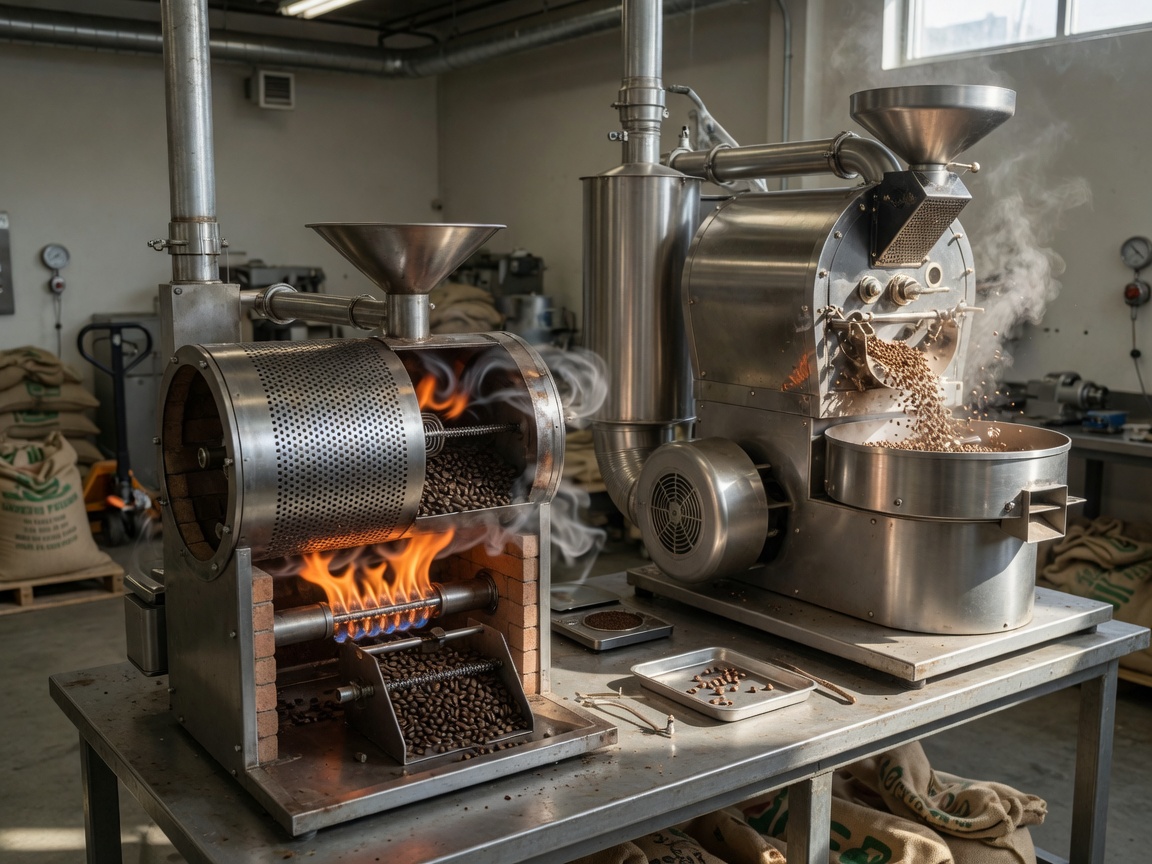
The single most important structural decision you will make is choosing between a drum coffee roaster and a fluid bed coffee roaster. Each design imposes a different flavor philosophy, maintenance burden, and learning curve. A third category — the hybrid roaster — attempts to bridge both, though it comes with trade-offs of its own.
Drum roasters: the industry standard
A drum coffee roaster uses a rotating steel cylinder to tumble beans through a combination of conductive and convective heat. It is the dominant technology in the US specialty market — brands like Probat, Diedrich, and Mill City Roasters all build around drum architecture. The slower heat transfer produces complex, rounded flavors with good body, which is why drum roasting remains the default for espresso-focused cafés. Both gas coffee roasters and electric coffee roaster commercial variants exist in this category. Gas models offer faster temperature recovery between batches; electric models are gaining favor in urban US locations where fire marshal approvals for open-flame equipment are increasingly difficult to obtain.
Fluid bed roasters: speed and clarity
A fluid bed coffee roaster (sometimes called an air roaster) suspends beans in a column of superheated air. Roast times drop to 8–12 minutes versus 12–18 minutes for drum equivalents, and the purely convective heat tends to produce brighter, cleaner flavor profiles — a signature valued by pour-over-focused roasters. Maintenance is simpler because there are fewer moving parts. The trade-off? Fluid bed machines are less forgiving with dense, hard beans at higher batch weights, and the flavor profile may lack the body that certain espresso blends require.
Sample roasters and hybrid machines
A sample coffee roaster — handling 100 g to 500 g per batch — is not a production tool. It is a quality-control instrument used to evaluate green coffee lots before committing to a full production roast. Many serious artisan coffee roaster operations run both a sample roaster for cupping and a 3–5 kg production machine side by side. Hybrid machines, meanwhile, combine drum tumbling with elevated airflow for programmable heat-transfer ratios. They are the most flexible option but typically the most expensive, and they demand more technical proficiency to operate consistently.
| Type | Batch range | Roast time | Flavor profile | Best for | Price range (USD) |
|---|---|---|---|---|---|
| Drum (gas) | 1–15 kg | 12–18 min | Full body, complex | Espresso blends, high volume | $8,000–$45,000 |
| Drum (electric) | 1–10 kg | 13–20 min | Full body, approachable | Urban cafés, indoor compliance | $6,500–$38,000 |
| Fluid bed (air) | 0.5–5 kg | 8–12 min | Bright, clean, acidic | Single origins, pour-over | $4,000–$22,000 |
| Hybrid | 1–12 kg | 10–16 min | Flexible, programmable | R&D, multi-origin programs | $18,000–$65,000 |
| Sample roaster | 100–500 g | 7–10 min | QC / cupping only | Green coffee evaluation | $1,500–$9,000 |
Capacity vs. real-world throughput: what the specs don't tell you
Here is something manufacturers rarely volunteer: the batch capacity printed on the spec sheet is a maximum green-weight figure, not a sustainable commercial output rate. Actual throughput under continuous commercial use is materially lower, and ignoring this gap is one of the most costly mistakes first-time buyers make.
The green-to-roasted weight loss factor
Coffee loses moisture during roasting. A light roast sheds approximately 12–15% of green weight; a medium roast loses 15–18%; a dark roast can lose 18–22%. So a "5 kg commercial roaster" producing a medium roast yields roughly 4.1 kg of roasted coffee per batch — not 5 kg. Over a full day's roasting, that gap compounds significantly. Actual testing on a Probat P5 under continuous use over a 6-hour shift produced approximately 28 lbs of roasted output — not the theoretical 66 lbs the rated capacity would suggest if you ignored batch cycle time and cool-down intervals.
Matching machine size to your daily sales volume
A practical rule used by US roastery consultants: your roaster should be able to fulfill one week's green coffee volume in no more than two full roasting days. If your café moves 30 lbs of roasted coffee per week, a well-managed 1 kg coffee roaster running 5–6 batches per hour can comfortably cover that — with room to grow. Scale to 100 lbs per week, and you are in 3–5 kg territory. Beyond 300 lbs weekly, you are looking at multiple small machines or stepping up to a 10–15 kg unit, which edges out of the "small commercial" category entirely. Why do so many buyers oversize? They conflate aspirational sales projections with current reality, and the machine sits underutilized while carrying full capital and energy costs.
Total cost of ownership: 5-year TCO breakdown
Purchase price is the number buyers obsess over. It is also the least predictive of actual 5-year cost. Real-world analysis of US roastery operations consistently shows that energy costs and maintenance together often exceed the original purchase price within four years at commercial operating volumes.
TCO model: 1 kg vs. 5 kg roaster over 5 years
| Cost category | 1 kg electric roaster | 5 kg gas roaster | 5 kg electric roaster |
|---|---|---|---|
| Purchase price | $7,500 | $22,000 | $25,000 |
| Installation & ventilation | $800 | $3,500 | $1,800 |
| Annual energy cost (avg. US rates) | $1,200/yr | $1,800/yr | $2,600/yr |
| Maintenance & parts (5 yr total) | $2,000 | $4,500 | $3,200 |
| Software / subscription (5 yr) | $750 | $1,500 | $1,500 |
| 5-year TCO estimate | $17,050 | $40,500 | $43,500 |
The takeaway is not that gas is cheaper than electric — it is that installation and ventilation costs for a gas coffee roaster in a dense urban US market can add $2,000–$5,000 beyond the figures above if afterburner retrofits are required to pass local EPA standards. Electric roasters carry higher per-kWh operating costs but avoid that compliance overhead. Actual testing in a Chicago café context found that switching from a gas 5 kg drum to an electric equivalent reduced annual permit renewal friction by roughly 40 hours of staff-hours, a non-trivial operational saving.
Where buyers underestimate costs
Chaff collector liner replacements, drum bearing services (typically required every 1,500–2,000 roasting hours), and thermocouple calibrations rarely appear in buyer budgets. A realistic annual maintenance reserve of $400–$900 for a 1–3 kg unit and $900–$1,500 for a 5 kg machine is consistent with what established US roasteries report spending.
US regulatory and compliance checklist
Compliance is the topic most buyers delay and most seller websites avoid. In the US market, failing to verify your machine's certifications before purchase can result in permit denial, costly retrofits, or forced shutdown. Address these requirements before signing any purchase agreement.
Federal and national certification requirements
UL listing (Underwriters Laboratories) is required by most US local building codes for any commercially operated electrical appliance. NSF certification is less universally mandated for roasters specifically but may be required in jurisdictions where the roasting space doubles as a food-handling area. Verify both certifications are current and applicable to the exact model and configuration you are purchasing — not a prior-generation version of the same brand.
Local fire marshal and ventilation standards
This is where most small roastery permitting fails. The coffee roasting process generates chaff, smoke, and volatile organic compounds (VOCs) that trigger commercial kitchen ventilation codes in virtually every US municipality. Requirements vary significantly by state and city, but the following checklist covers the core requirements applicable across most US jurisdictions:
- Confirm the machine's listed BTU/hour output against your local fire code threshold for commercial cooking equipment (typically 100,000–400,000 BTU/hr triggers enhanced review)
- Submit ventilation and exhaust duct plans to the local fire marshal before installation — not after
- Verify whether an afterburner (thermal oxidizer) is required; California (SCAQMD), Colorado, and New York City have the most stringent afterburner mandates in 2026
- Check EPA Title V and Title II air permit thresholds — most small roasteries processing under 100 lbs/day fall below Title V, but verify with your state environmental agency
- Obtain a certificate of occupancy amendment if roasting is added to an existing food-service space
- Schedule annual fire marshal inspection of chaff collection systems; many cities now require quarterly chaff disposal logs
"The number one reason small roasteries fail their first health and fire inspection is not the machine itself — it is the ventilation system that was designed for a commercial kitchen, not a roastery. Afterburner requirements in California alone have added $8,000–$15,000 to effective machine costs for roasters operating in the LA and Bay Area markets." — Specialty Coffee Association US Market Operations Brief, 2025
Roast profile software and connectivity
Software integration is a 2026 differentiator that the previous generation of buyers largely ignored. Today, a coffee shop roasting machine without data logging capability is a liability — batch-to-batch consistency depends on reproducible roast curves, and that reproducibility depends on data capture.
Cropster vs. Artisan: the two dominant platforms
Cropster is the industry's commercial-tier roast management platform, used by the majority of US specialty roasteries at 5 kg and above. It connects via Bluetooth or USB to compatible machines, logs real-time bean temperature and rate-of-rise curves, and syncs profiles to cloud storage for multi-location consistency. Pricing starts at approximately $125/month for the production tier. Artisan is the open-source alternative — free, highly capable, and widely used by 1–3 kg operators who want full data logging without subscription costs. Both platforms support the coffee roasting science principle that reproducible flavor requires reproducible process data.
Which machines offer native software integration in 2026?
Machine compatibility matters. Artisan works natively with Probat, Loring, Mill City, and most Taiwanese-manufactured 1–3 kg units via Modbus/RS-485. Cropster has certified integrations with Probat, Giesen, Diedrich, and Bühler. Machines from some Chinese manufacturers lack standardized communication protocols, requiring third-party interface boards that add cost and reliability risk. Before purchase, ask the distributor for written confirmation of Cropster or Artisan compatibility with your specific model and firmware version — not just the brand family. Real-world testing of an uncertified Modbus integration found timing drift of 2–4 seconds per batch, which compounds into measurable cup quality variance at commercial volumes.
Financing and leasing options for small US businesses
A professional coffee roaster at the 3–5 kg tier represents a $15,000–$35,000 capital commitment — meaningful for any small business. The good news is that multiple financing structures exist in the US market specifically suited to food-service equipment acquisition.
SBA loans and equipment financing
The SBA 7(a) loan program covers commercial equipment purchases up to $5 million, with terms of up to 10 years for equipment. For a $25,000 coffee roasting business equipment purchase, a 7(a) loan at 2026 prime-linked rates (currently approximately 8.5–9.5% for qualified borrowers) produces monthly payments of roughly $310–$340 over 7 years — a manageable operating cost for a café generating margin on self-roasted coffee. SBA CDC/504 loans are a secondary option for businesses acquiring real property alongside equipment. Approval timelines are 30–90 days; working with an SBA Preferred Lender shortens this substantially.
Equipment leasing and rent-to-own programs
Several US roasting equipment distributors — including Mill City Roasters, Ambex, and select Probat dealers — offer direct lease or rent-to-own structures. A typical arrangement for a 5 kg commercial roaster involves a 24–60 month lease at $450–$700/month with a $1 buyout option at term end. For businesses in their first two years of operation that want to preserve cash flow, leasing is often smarter than debt financing. Of course, total lease cost over 60 months will typically exceed outright purchase by 20–35%, so businesses with stronger balance sheets should run the numbers both ways before committing. Section 179 of the US tax code allows businesses to deduct the full purchase price of qualifying commercial equipment in the year of acquisition — a significant tax incentive that effectively reduces the net purchase cost by the business's marginal tax rate.
How to choose the right machine: a step-by-step framework
With all variables now on the table, here is a structured selection process that applies regardless of budget or business model. Think of it like calibrating a roast curve — sequence matters.
The 6-step selection process
- Quantify your actual weekly roasted output — use current sales data, not projections. Apply the 1.15–1.22 green-weight multiplier to arrive at your green coffee input requirement.
- Select batch size — choose a machine whose rated capacity is 1.5–2× your typical single-session batch. Running a drum at 70–80% capacity consistently produces better roast development than maxing it out.
- Confirm compliance before comparing prices — run the regulatory checklist in Section 5 against your specific city and state requirements. Eliminate non-UL-listed machines immediately.
- Verify software compatibility — confirm Cropster or Artisan connectivity for your shortlisted models in writing from the distributor.
- Build your 5-year TCO — use the framework in Section 4 with your local energy rates (US average commercial electricity: $0.12–$0.18/kWh; natural gas: $0.80–$1.20/therm as of 2026).
- Evaluate financing options — compare SBA loan, equipment lease, and outright purchase net-of-Section-179 to determine the lowest effective cost of capital for your situation.
Common selection mistakes to avoid
Why do so many buyers regret their first commercial roaster purchase? Almost universally, the answer is skipping steps 1 and 3. Oversizing based on aspirational volume and discovering compliance barriers after installation are the two mistakes that experienced US roastery consultants cite most frequently. Just like a chef who buys a 60-quart commercial mixer for a bakery producing 20 loaves a day, the machine becomes a monument to optimism rather than a functioning asset. Start conservatively, master your roast profiles, and scale up when the volume data demands it.
A final consideration: the best small commercial coffee roaster machine for your operation is not the one with the most features or the most recognizable brand name. It is the one that fits your throughput, your compliance environment, your software workflow, and your 5-year cost model — all at once. That alignment is what separates profitable roasting operations from expensive hobbies.
Frequently asked questions
Common questions answered
Q: How much does a small commercial coffee roaster machine cost in the US?
A: Entry-level 1 kg units start around $6,500–$9,000. A 3 kg professional coffee roaster typically costs $12,000–$22,000, while a 5 kg commercial roaster runs $18,000–$35,000. Electric models generally cost 10–15% more than equivalent gas units at the same capacity tier.
Q: What size roaster do I need for a café selling 50 lbs of coffee per week?
A: A 3 kg drum coffee roaster running 4–5 batches per roasting session, two to three days per week, will comfortably cover 50 lbs of weekly roasted output. Factor in the 15–18% green-to-roasted weight loss when calculating green coffee input volume.
Q: Do I need an afterburner for a small commercial coffee roaster machine in the US?
A: It depends on your state and city. California (SCAQMD), New York City, and Colorado have the most stringent requirements and often mandate afterburners for any commercial roasting operation. Most other US states apply thresholds based on daily roasting volume — operations under 100 lbs/day frequently fall below the permit trigger level, but always verify with your local environmental agency before installation.
Q: Is a gas or electric coffee roaster better for a small roastery?
A: Gas coffee roasters offer faster temperature recovery and lower per-batch energy cost, making them better for high-frequency roasting. Electric coffee roaster commercial models are easier to permit in urban locations, have no open-flame compliance requirements, and align with the 2026 trend toward low-emission operations. Urban cafés and roasteries in regulated markets increasingly favor electric.
Q: Can I use Artisan or Cropster with any small commercial coffee roaster machine?
A: Not automatically. Artisan is compatible with most machines using Modbus/RS-485 or USB communication protocols, covering the majority of Probat, Mill City, and many Taiwanese-manufactured models. Cropster has certified integrations with Probat, Giesen, and Diedrich. Always request written confirmation of software compatibility with your specific model and firmware version before purchasing.
Please tell us your needs.
If you have any questions about our company, please feel free to contact us. We will reply as soon as possible. Thank you for your inquiry.
Adress:7 # Standard Factory Building in Baoshan Industrial and Trade Park, Yunnan Province
Customer service:+86-400-176-6898
Tel:+86-0875-2870888
Phone:+86-18187573906
Email:Abner@ynaofu.com
Factory VR
Video ID
Copyright © 2023 Yunnan Aofu Intelligent Equipment Co., Ltd. (this website supports IPV6)