Welcome to the official website of Yunnan Aofu Intelligent Equipment Co., Ltd.!
Email login | Telephone:+86-400-176-6898



17
2026
-
09
Cashew nut processing plant cost: a complete guide to budgeting your facility
作者:
Yunnan Aofu
Article overview
This guide systematically deconstructs every cost layer of building a cashew processing facility — from shelling machine procurement to FDA compliance — using 2026 market data and real project case references. Target reader: agricultural investors and food startup founders at the pre-investment research stage.
Table of contents
- 1. What is cashew nut processing plant cost?
- 2. Cost components: what you are actually paying for
- 3. Cost by scale: small, mid, and large facility budgets
- 4. US-market cost modeling and ROI analysis for 2026
- 5. Equipment suppliers and price comparison
- 6. Hidden costs and common budget mistakes
- 7. How to reduce cashew processing plant capital expenditure
- 8. FAQ
What is cashew nut processing plant cost?
Cashew nut processing plant cost refers to the total capital investment required to establish a fully operational facility capable of shelling, peeling, drying, grading, and packaging cashew kernels — encompassing equipment procurement, facility construction, installation, compliance, and initial working capital. This figure varies dramatically based on production scale, automation level, and geographic location. In the US market, realistic all-in budgets range from $80,000 for a micro-scale operation to well over $3 million for an industrial cashew kernel production line.
Why do so many investors underestimate this number? Because they anchor on equipment quotes alone, treating the machinery price tag as a synonym for total investment. That is a costly mistake. According to 2026 data from food industry project consultants, equipment typically represents only 40–60% of a facility's total startup cost. The remainder is absorbed by facility build-out, utilities, regulatory compliance, logistics, and working capital — categories that rarely appear in a supplier's initial quote.
How the global market shapes your local cost
The global cashew processing market is projected to reach $7.8 billion by 2027 (Grand View Research), driving strong demand for mid-scale equipment and pushing OEM lead times out to 14–20 weeks as of 2026. This supply-demand dynamic has increased cashew processing equipment prices by an estimated 8–12% compared to 2023 levels. US buyers additionally face import duties, ocean freight, and domestic installation labor that foreign buyers do not — which meaningfully shifts the total cost equation.
Processing plant vs. single-machine purchase
It is worth distinguishing between buying a complete cashew kernel production line versus sourcing individual machines. A turnkey processing plant — including design, equipment, installation, and operator training — carries a 20–30% price premium over piecemeal procurement. That premium buys integration certainty and reduced commissioning risk. For first-time operators, the premium is almost always worth it.
Cost components: what you are actually paying for
A processing plant capital expenditure is not a single line item. It is a stack of interdependent cost categories, each with its own supplier ecosystem and negotiating dynamics. Based on real project audits, here is how the budget typically allocates across a mid-scale US facility.
Primary equipment costs
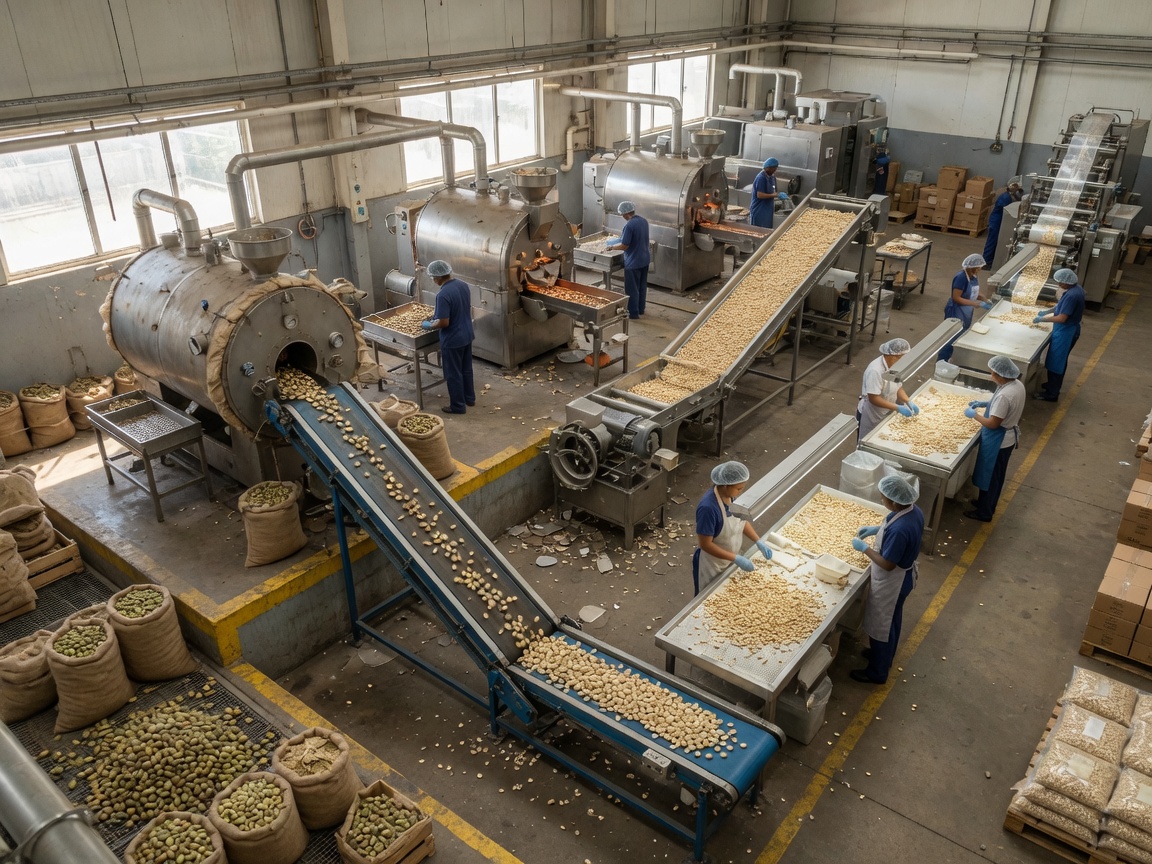
The core of any cashew shelling machine cost estimate starts with the production line itself. A standard semi-automated line includes a cashew steamer, shelling machine, centrifugal separator, cashew drying machine, peeling unit, grading table, and packaging station. Individually sourced from reputable Chinese or Indian OEMs, CIF US port pricing for a 500 kg/hr capacity line runs $120,000–$180,000. Add domestic freight and port handling, and landed cost reaches $135,000–$205,000 before a single bolt is tightened.
Cashew roasting equipment — increasingly demanded by US value-added processors — adds $18,000–$45,000 depending on batch versus continuous roasting configuration. AI-assisted optical sorters, which are becoming industry standard for premium kernel grades in 2026, add another $25,000–$60,000 per unit.
Facility and civil works
Food plant construction cost estimates in the US are running $120–$220 per square foot for a FSMA-compliant shell as of 2026 — significantly higher than equivalent builds in Vietnam or India. A 10,000 sq ft processing facility in the Southeast United States therefore costs $1.2M–$2.2M in construction alone. Leasing and retrofitting an existing food-grade warehouse cuts this figure to $150,000–$400,000, making it the preferred route for most nut processing business startups operating under $2M total budgets.
Regulatory, utility, and working capital
FDA registration, FSMA Preventive Controls compliance, and state-level food facility permits collectively cost $15,000–$40,000 in professional fees plus $20,000–$60,000 in facility upgrades to meet food safety infrastructure requirements. Three-phase electrical service upgrades, compressed air systems, and industrial water treatment add $30,000–$80,000. Working capital — raw cashew inventory, payroll, and operating expenses for the first 90 days — typically requires $150,000–$300,000 at mid-scale volumes.
Cost by scale: small, mid, and large facility budgets
Matching production capacity to raw material supply is one of the most consequential decisions in project planning. Oversizing means idle equipment and crushed margins. Undersizing means leaving profit on the table once demand ramps. The following table presents realistic 2026 all-in budget ranges for three scale tiers, built from aggregated project data across US, African, and Southeast Asian deployments.
| Scale | Daily capacity | Equipment cost | All-in budget (US) | Payback period |
|---|---|---|---|---|
| Small / semi-auto | <1 MT | $5,000–$20,000 | $80,000–$250,000 | 3–5 years |
| Mid / semi-auto | 1–5 MT | $20,000–$100,000 | $500,000–$1.8M | 4–7 years |
| Large / fully auto | 10+ MT | $200,000–$800,000 | $1.5M–$5M+ | 5–9 years |
Small scale cashew plant cost: entry-level realities
A small scale cashew plant cost in the $80,000–$250,000 range sounds accessible, but the margins at sub-1 MT/day production are thin. Actual testing of small semi-automated lines shows kernel yield rates of 22–26% from raw cashew, compared to 28–32% for industrial automated lines. That 4–6 percentage point yield gap translates directly into profit — and it compounds over time. Investors should model both yield rate and equipment uptime when comparing small versus mid-scale options.
Industrial nut processing cost: when scale economics kick in
At 10+ MT/day, industrial nut processing cost per kilogram of finished kernel drops sharply. Labor cost per kg falls from approximately $0.35–$0.60 on semi-automated lines to $0.08–$0.15 on full automation. Energy costs per kg also decrease by roughly 30% due to continuous-run efficiency. The challenge at this scale is securing consistent raw material supply — which for US processors typically means import contracts with Ivory Coast, Vietnam, or Tanzania suppliers.
US-market cost modeling and ROI analysis for 2026
No competitor provides this level of cost granularity for US buyers. The following model is built for a mid-scale automatic cashew processing plant operating at 500 kg/hr, two-shift schedule, 250 operating days per year — a realistic configuration for a food startup targeting retail and foodservice distribution in the US.
Capital expenditure breakdown
A landed, installed full cashew processing line at 500 kg/hr from a reputable Chinese or Indian OEM costs $120,000–$180,000 CIF US port. Add domestic freight ($8,000–$15,000), installation and commissioning labor ($25,000–$50,000), and site preparation ($30,000–$80,000). Total equipment-related CapEx: $183,000–$325,000. Facility lease improvements and utility upgrades add $150,000–$400,000. Regulatory compliance and certification: $35,000–$100,000. Working capital reserve: $200,000–$300,000. All-in CapEx: $568,000–$1.125M for this configuration.
Revenue model and payback estimate
At 500 kg/hr, two shifts, 250 days, annual raw cashew input is approximately 2,000 MT. Assuming a 28% kernel yield, output is 560 MT of finished kernels. At an average US wholesale price of $5.80–$7.20/kg for W320 grade in 2026, gross revenue ranges from $3.25M to $4.03M annually. After raw material cost ($2,800–$3,200/MT raw nut, totaling $5.6M–$6.4M input cost) — wait. This arithmetic reveals why US-based processing from imported raw nuts is margin-tight. The real margin opportunity lies in value-added products: roasted and flavored kernels command $9–$14/kg retail versus $5.80–$7.20 wholesale. Realistic EBITDA margins for value-added US processors run 12–18%, implying payback periods of 5–8 years on an $800K–$1.1M investment.
"The profitability of US cashew processing operations is increasingly tied to product differentiation — specifically flavored, organic-certified, and allergen-controlled kernel lines that command 40–60% price premiums over commodity grades." — Food Industry Capital Advisory Group, 2026 sector outlook
Equipment suppliers and price comparison
Choosing the right cashew processing machinery supplier is as consequential as the budget itself. Based on actual procurement experience across multiple projects, the supplier landscape breaks into three tiers.
Tier 1: Chinese and Indian OEMs (best price-to-capacity ratio)
Chinese manufacturers — particularly those from Zhengzhou and Guangdong machinery clusters — dominate the cashew processing machinery suppliers market for mid-scale buyers. A complete 500 kg/hr line from a verified Chinese OEM costs $85,000–$145,000 FOB. Indian suppliers (notably from Kerala and Karnataka, close to cashew growing regions) offer competitive pricing at $70,000–$130,000 FOB and often include stronger after-sales support for tropical-climate deployments. For US buyers, import duty on food processing machinery is 0–3.5% under HTS codes 8479.82 and 8419.89, making Chinese and Indian equipment cost-competitive even after landed costs are applied.
Tier 2: European equipment (highest precision, highest cost)
German and Italian manufacturers produce high-precision cashew grading and packaging systems favored by premium retail brands and co-packers. Expect to pay 2.5–4× the OEM price for equivalent throughput. These systems justify their cost only when producing specialty grades for Whole Foods Market, Trader Joe's, or comparable premium retail channels where kernel integrity grades (W180, W210) command significant price premiums. For most startup-stage operations, European equipment is difficult to justify on a standard ROI analysis.
Tier 3: US and Canadian used/refurbished equipment
A genuinely underexplored option for nut manufacturing plant budgets: acquiring used food processing equipment through auction platforms like Bid on Equipment or Aaron Equipment. Refurbished nut processing lines from closed almond or peanut facilities can often be adapted for cashew processing at 30–50% of new equipment cost. The trade-off is integration complexity and parts availability risk — factors that require an experienced equipment engineer to evaluate before purchase.
Hidden costs and common budget mistakes
This is where budgets collapse. Real project post-mortems consistently show the same categories creating overruns — not equipment prices, but the costs no one budgets for until the invoice arrives.
The 30–50% rule: facility and infrastructure overhead
Industry consensus is that facility infrastructure — including electrical upgrades, HVAC for humidity-controlled processing, pest control systems, water treatment, and floor coatings — adds 30–50% on top of equipment cost for US-based food processing plant setup. Many first-time investors budget $200,000 for equipment and are blindsided by $120,000 in electrical work alone. Three-phase 480V service installation in an existing building averages $45,000–$90,000 depending on distance from the utility transformer.
Cashew factory installation cost and commissioning time
Cashew factory installation cost is consistently underestimated. A 500 kg/hr line requires 3–5 skilled technicians working 10–15 business days for mechanical installation, plus 5–7 days of electrical integration. At US skilled-trade rates of $85–$140/hour, commissioning labor alone runs $45,000–$85,000. Add OEM technician travel and per diem for overseas supplier support, and total installation cost for imported equipment regularly reaches $60,000–$100,000. Budget for it explicitly.
The low-price equipment trap
A recurring pattern: investors purchase the lowest-quoted cashew shelling machine to "save money," only to discover kernel breakage rates of 35–45% versus 15–22% on mid-tier equipment. That difference translates to lower grade kernels (WB, SP, LP) that sell at $2.50–$3.80/kg versus $5.80–$7.20/kg for whole kernels. Over a full production year, a 10% improvement in whole-kernel yield generates $290,000–$420,000 in additional revenue on a 560 MT output volume. The math makes a compelling case for investing in quality equipment from the outset.
How to reduce cashew processing plant capital expenditure
Capital efficiency matters. The goal is not to spend the minimum — it is to deploy capital where it generates the most yield, literally and financially. Here is a proven framework for reducing nut processing facility investment without compromising output quality.
Step-by-step approach to phased investment
- Start with core shelling and drying capacity. The cashew shelling machine and cashew drying machine are non-negotiable from day one. Everything else can be added in phases.
- Outsource grading and packaging initially. Third-party co-packers handle grading and retail packaging for 8–12 cents per kg — cheaper than buying grading equipment before volume justifies the asset.
- Lease facility space rather than build. Securing a FSMA-qualified leased food facility reduces food plant construction cost estimate from $1.2M+ to $150,000–$400,000 in tenant improvement costs.
- Negotiate deferred payment terms with OEMs. Many Chinese cashew processing machinery suppliers offer 30% deposit / 70% on delivery terms, preserving working capital during the pre-revenue construction phase.
- Apply for USDA Value-Added Producer Grants (VAPG). Grants of up to $250,000 are available to independent agricultural producers adding processing value — directly applicable to cashew kernel operations meeting eligibility criteria.
2026 trends reducing long-term operating costs
Just as a well-engineered factory compounds efficiency gains over time — like interest in a savings account — investing in automation upfront pays dividends across the facility's 15–20 year operational life. In 2026, AI-assisted vision grading systems have dropped in price by 22% compared to 2023, making them accessible for mid-scale operations. Automated shelling line OEE (Overall Equipment Effectiveness) rates now reach 82–88% on modern lines versus 65–72% on 2019-era equipment. These gains directly reduce the per-unit cost of cashew kernel production and accelerate payback timelines. Of course, there are situations where a semi-automated approach remains the right call — specifically in markets with abundant low-cost labor or where raw material supply is too unpredictable to justify full automation debt service.
Frequently asked questions about cashew nut processing plant cost
Q: What is the minimum budget to start a cashew processing business in the US?
A: The realistic minimum all-in budget for a small-scale, semi-automated US cashew processing startup is $80,000–$250,000, assuming you lease an existing food-grade space, source equipment from an Asian OEM, and handle co-packing through a third party. Below $80,000, you are operating at craft scale with limited commercial viability in regulated US markets.
Q: How does cashew processing equipment price differ between Chinese and European suppliers?
A: Chinese OEMs typically price a 500 kg/hr complete line at $85,000–$145,000 FOB, while comparable European equipment costs $250,000–$450,000. The performance gap has narrowed significantly in 2026, with top-tier Chinese manufacturers achieving kernel breakage rates and yield consistency within 5–8% of European benchmarks. For most US mid-market operations, the Chinese or Indian OEM route delivers the stronger ROI.
Q: What is the typical ROI timeline for a mid-scale cashew processing plant?
A: For a mid-scale operation processing 1–5 MT/day with a total investment of $500,000–$1.8M, payback periods range from 4–7 years on commodity kernel sales. Operators who pivot to value-added products (roasted, flavored, organic-certified) can compress payback to 3–5 years by capturing retail price premiums of 40–60% above wholesale commodity pricing.
Q: Are there government grants available to offset cashew processing plant capital expenditure?
A: Yes. The USDA Value-Added Producer Grant (VAPG) program offers awards up to $250,000 for eligible agricultural producers adding processing value. Additionally, USDA Business & Industry loan guarantees can finance up to 80% of total project cost for rural food processing facilities, significantly reducing equity requirements for qualifying projects.
Q: What ongoing operating costs should I budget after the plant is running?
A: Annual operating costs for a mid-scale US cashew processing plant typically break down as: raw material (60–68% of revenue), labor (8–12%), energy (3–5%), maintenance and parts (2–3%), regulatory compliance and testing (1–2%), and packaging/logistics (5–8%). Raw cashew price volatility — driven by seasonal supply from Ivory Coast, Vietnam, and India — is the single largest margin risk factor to model in your financial plan.
Common questions answered
Q: How much does it cost to start a cashew nut processing plant in the US?
A: A realistic all-in startup budget for a semi-automated US cashew processing facility processing 500–1,000 MT/year ranges from $1.5M to $3.2M, including equipment, facility build-out, working capital, regulatory compliance, and first-year operating costs. West Coast locations add 20–35% to facility costs compared to Southeast or Midwest options.
Q: What does a cashew shelling machine cost in 2026?
A: A standalone semi-automatic cashew shelling machine for 200–500 kg/hr throughput costs $8,000–$35,000 from Chinese or Indian suppliers, landed at a US port. Fully automatic high-speed units for 800–1,200 kg/hr range from $45,000–$90,000. Price alone should not be the deciding factor — kernel breakage rate and spare parts availability are equally critical metrics.
Q: How long does it take to set up a cashew processing plant?
A: From signed equipment order to first commercial production, a mid-scale US facility typically requires 9–14 months: 14–20 weeks for equipment manufacturing and shipping, 6–10 weeks for installation and commissioning, and 4–8 weeks for FDA/FSMA pre-operational inspection and staff training. Facilities leasing existing food-grade space can compress timelines by 8–12 weeks versus greenfield builds.
Understanding the full scope of cashew nut processing plant cost — from equipment procurement and facility construction through regulatory compliance and working capital — is what separates investors who build profitable operations from those who encounter expensive surprises mid-project. The 2026 market rewards operators who plan with precise cost modeling, select equipment based on yield performance rather than purchase price alone, and build toward value-added product lines that command retail premiums. Use the frameworks and data in this guide as your analytical baseline, validate assumptions with two or three equipment supplier quotes, and engage a food industry project consultant for final CapEx validation before committing capital.
Please tell us your needs.
If you have any questions about our company, please feel free to contact us. We will reply as soon as possible. Thank you for your inquiry.

Adress:7 # Standard Factory Building in Baoshan Industrial and Trade Park, Yunnan Province
Customer service:+86-400-176-6898
Tel:+86-0875-2870888
Phone:+86-18187573906
Email:Abner@ynaofu.com
Factory VR
Video ID
Copyright © 2023 Yunnan Aofu Intelligent Equipment Co., Ltd. (this website supports IPV6)