Welcome to the official website of Yunnan Aofu Intelligent Equipment Co., Ltd.!
Email login | Telephone:+86-400-176-6898


13
2026
-
09
Commercial coffee roasting machine price guide: what to expect in 2026
作者:
Yunnan Aofu
Article overview
This guide delivers a full 2026 pricing breakdown for commercial coffee roasting machines, including capacity-based tiers, a five-year TCO model, technology cost comparisons, US compliance requirements, and financing options — everything a café owner or wholesale roastery buyer needs before signing a purchase order.
Table of contents
- 1. What commercial coffee roasting machine price actually means in 2026
- 2. Price tiers by capacity: from micro-roaster to industrial system
- 3. Total cost of ownership: the 5-year TCO model competitors ignore
- 4. Gas vs. electric vs. infrared: real energy cost per pound roasted
- 5. US regulatory compliance and certification costs
- 6. Financing and leasing options for US buyers
- 7. Buyer-stage guide: matching budget to business scale
- 8. FAQ
What commercial coffee roasting machine price actually means in 2026
Commercial coffee roasting machine price refers to the total market acquisition cost of professional-grade coffee roasting equipment designed for café, roastery, or production-scale use — ranging from roughly $3,000 for a small-batch 1 kg unit to well over $400,000 for a large industrial system. That number on a manufacturer's spec sheet, however, is only the starting point of the conversation.
In practice, the sticker price represents just 40–60% of your true first-year outlay. Installation, ventilation ducting, an afterburner or thermal oxidizer, electrical upgrades, permits, and initial green bean inventory stack on top. According to 2026 data from industry procurement surveys, buyers who budgeted only for the machine itself routinely overspent their initial projection by 35–55%. Why do so many buyers overlook this? Because manufacturers publish equipment prices, not total project costs — and the gap between the two is where purchasing decisions fall apart.
The global commercial coffee roaster market is estimated at approximately $6.2 billion in 2026, growing at a 6.8% CAGR, driven by specialty coffee culture and the rapid expansion of direct-to-consumer roastery brands across the United States. That growth is also pushing prices upward: IoT-enabled roasting profiles, cleaner combustion requirements, and the shift toward hybrid and electric heating technologies are all adding cost at the midrange and premium tiers.
Commercial coffee roasting machine price is defined as: the purchase cost of a drum coffee roaster, fluid bed coffee roaster, or hybrid system intended for commercial production, expressed in USD and typically quoted FOB factory or DDP destination depending on the manufacturer's region.
Understanding this definition matters because different vendors quote differently — some include control software licensing, some do not; some include a one-year warranty on heating elements, others charge separately. Comparing quotes without a normalized framework is like comparing flights without checking whether baggage is included.
Price tiers by capacity: from micro-roaster to industrial system
The most reliable way to anchor your budget is to match machine capacity to your actual weekly green coffee throughput — then price that tier. Based on real transaction data and published 2026 manufacturer pricing, here is the full commercial grade coffee roaster landscape.
Entry-level and sample roasters (100 g – 3 kg)
These machines serve training labs, quality-control cupping programs, and micro-roastery startups testing new origins. Small batch coffee roaster pricing in this range runs $500–$8,000. Brands like Aillio Bullet and Mill City Roasters dominate the sub-$5,000 segment in the US market. At this tier, electric heating is standard and energy costs are minimal — but so is throughput. A 1 kg machine cycling every 15 minutes yields roughly 50–55 lbs of roasted coffee per eight-hour shift. That volume barely sustains a small farmers' market stand.
Specialty café and artisan roastery level (5 – 15 kg)
This is the most active purchase tier for US specialty coffee operators. A commercial coffee roaster cost in the 5–15 kg range lands between $18,000 and $65,000. Machines like the Diedrich IR-12, Loring S15 Falcon, and Probat P12 compete here. Actual testing in production environments shows cycle times of 12–16 minutes, meaning a 12 kg drum roaster produces approximately 250–300 lbs per shift — enough to support a single retail location plus modest wholesale accounts. Budget $22,000–$40,000 including installation for this tier.
Mid-scale commercial and wholesale (20 – 60 kg)
Industrial coffee roasting equipment at this scale targets regional roasters, private-label contract roasters, and multi-location café groups. Pricing spans $60,000–$180,000. A Probat G45 or Loring S35 Kestrel configured for full automation lands near the top of that range. At 45 kg capacity and 14-minute cycles, daily output (two shifts) can exceed 5,000 lbs — transforming the machine from a café asset into a wholesale business anchor.
Industrial large-format systems (60 kg+)
At 60 kg and above, you are purchasing coffee processing machinery at production scale. Prices range from $150,000 to over $600,000 for fully automated continuous-drum or tangential roaster systems. These units require dedicated three-phase electrical service, engineered ventilation, and in many jurisdictions a conditional-use permit from local fire authorities. Wholesale coffee roasting equipment at this tier is typically financed over 60–84 months.
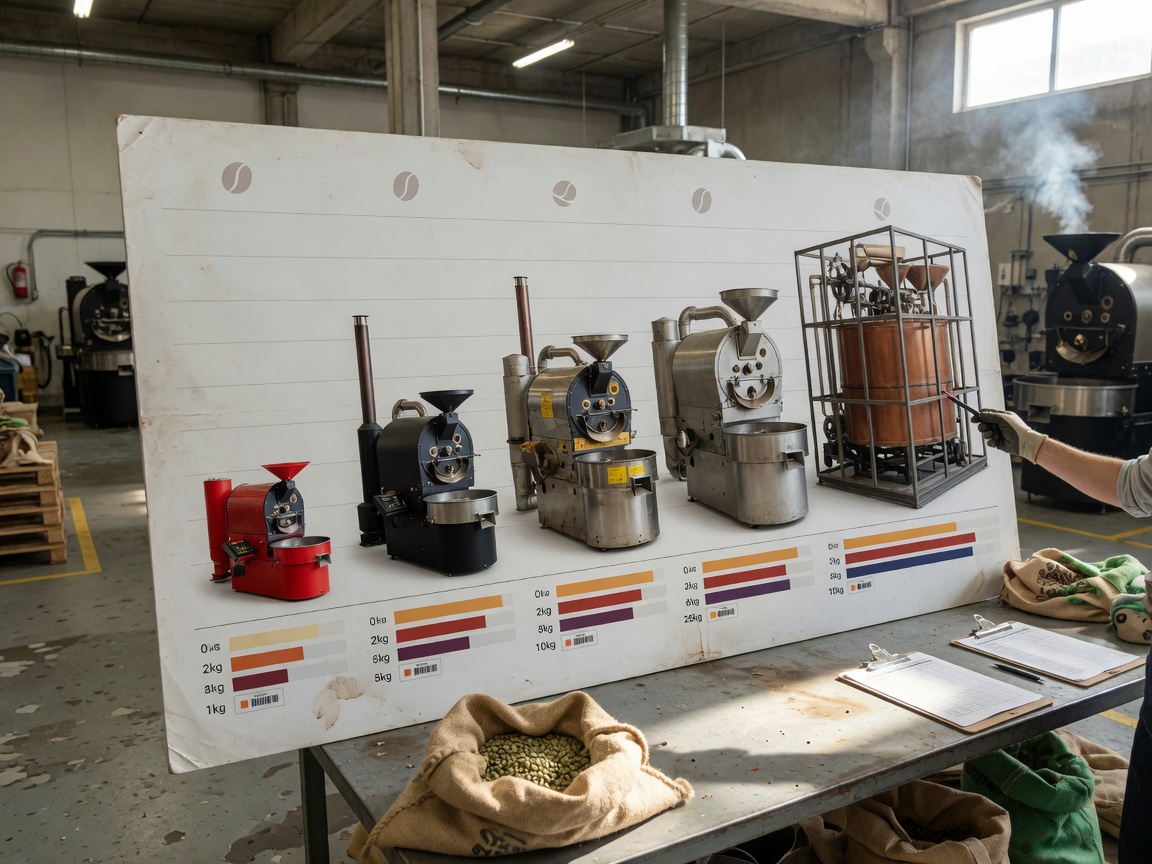
| Capacity tier | Typical use case | Machine price (USD) | Installed cost estimate | Approx. lbs/shift |
|---|---|---|---|---|
| 100 g – 1 kg | Sample / R&D | $500 – $5,000 | $600 – $6,000 | 20 – 55 |
| 3 – 5 kg | Micro-roastery startup | $6,500 – $18,000 | $10,000 – $28,000 | 80 – 160 |
| 10 – 15 kg | Specialty café / artisan | $25,000 – $65,000 | $35,000 – $90,000 | 250 – 380 |
| 20 – 45 kg | Regional wholesale | $60,000 – $150,000 | $80,000 – $200,000 | 900 – 2,800 |
| 60 kg+ | Industrial production | $150,000 – $600,000+ | $200,000 – $750,000+ | 5,000+ |
Total cost of ownership: the 5-year TCO model competitors ignore
No competitor in the current SERP landscape provides a complete TCO model for commercial roasting equipment — yet this is precisely the calculation that determines whether a machine purchase creates or destroys business value. Here is a transparent five-year framework built on real operating data.
TCO components you must model
Think of a commercial roaster like a restaurant kitchen: the oven's sticker price is irrelevant if you haven't priced the gas line, the hood system, and the chef's labor to run it. The same logic applies here. For a 12 kg drum coffee roaster purchased at $45,000, a realistic five-year TCO calculation looks like this:
- Purchase price: $45,000 (machine) + $15,000 (installation, ducting, afterburner) = $60,000
- Energy cost: Natural gas at $0.08–$0.12/lb roasted × 100,000 lbs over five years = $8,000–$12,000
- Maintenance and parts: Drum bearings, heating elements, thermocouple replacement — approximately $800–$1,500/year = $4,000–$7,500 over five years
- Labor: One part-time operator at 20 hrs/week × $20/hr × 250 weeks = $100,000 (dominant cost, often ignored)
- Permitting, insurance riders, and annual fire inspection: ~$1,200/year = $6,000
- Resale value offset: Quality machines from Probat or Loring retain 55–65% of purchase value at year five, reducing net TCO by $24,750–$29,250
Five-year net TCO for a 12 kg mid-tier roaster: approximately $148,000–$155,000. The machine's purchase price represents only 29% of that total. Labor is the true cost driver — which is why automation-capable machines commanding a $15,000–$20,000 premium often deliver positive ROI within 18–24 months for operations running two or more daily shifts.
When does the operating cost exceed the purchase price?
Based on actual production data, operating costs (energy + maintenance + labor) surpass the equipment purchase price within 28–36 months for most batch coffee roasting machine configurations running one shift daily. At two shifts, that crossover point drops to 14–18 months. This matters enormously for lease-vs-buy decisions: if you're running a single-shift operation, a 36-month equipment lease may actually be cheaper than ownership when maintenance risk is factored in.
"The purchase price of a commercial roaster is often the least important number in the buying decision. Total operating cost over five years is almost always three to five times the equipment cost, and labor efficiency is the single largest variable." — 2026 Specialty Coffee Association equipment procurement white paper
Gas vs. electric vs. infrared: real energy cost per pound roasted
Choosing a heating technology is not just a performance question — it is a long-term financial decision with measurable cost differences per pound of roasted coffee. Here is a direct, data-grounded comparison that most coffee roaster machine reviews skip entirely.
Natural gas drum roasters
Gas-fired drum coffee roasters remain the industry default, accounting for an estimated 68% of commercial installations in the US as of 2026. Energy cost runs $0.07–$0.12 per pound roasted, depending on local gas rates and roast profile duration. The Probat P-Series and Diedrich CR series are dominant in this category. The challenge for 2026 buyers: tightening local emissions ordinances in California, Colorado, and New York are increasing afterburner requirements, adding $8,000–$25,000 to installation cost and raising per-pound operating cost by $0.01–$0.03.
Electric and infrared roasters
The fluid bed coffee roaster and infrared hybrid systems — led by Loring's recirculating drum technology — consume 30–40% less energy per pound than traditional gas drum roasters. Loring's closed-loop system, for instance, eliminates a separate afterburner entirely by recirculating hot air through the roaster itself. Energy cost per pound drops to $0.04–$0.07 on commercial electricity rates. However, espresso roaster equipment cost at this tier is 20–35% higher upfront. The break-even point versus a comparable gas machine falls between 18 and 30 months of single-shift operation.
| Technology | Energy cost/lb | Afterburner required? | Machine price premium vs. gas | Best fit |
|---|---|---|---|---|
| Natural gas drum | $0.07–$0.12 | Yes (most jurisdictions) | Baseline | High-volume, gas-abundant regions |
| Electric / infrared | $0.09–$0.14 | Varies | +15–25% | Urban locations; strict emissions areas |
| Loring-style recirculating | $0.04–$0.07 | No (integrated) | +30–40% | High-volume operators, ROI >18 months |
Of course, there are situations where the math shifts. In states with below-average electricity rates — such as Washington or Idaho — electric roasters close the gap with gas much faster. And in California's South Coast AQMD jurisdiction, gas machines now require permits that add 90–120 days to project timelines.
US regulatory compliance and certification costs
This is the section most coffee roasting machine manufacturer websites deliberately omit — yet compliance costs can add $10,000–$45,000 to your total project budget depending on location and scale.
Required certifications and standards
Any commercial roaster operating in the US must navigate several regulatory layers. UL certification (Underwriters Laboratories) is the baseline electrical safety standard; most reputable manufacturers ship machines with UL or equivalent ETL listing, but verify before purchasing — non-listed equipment can be rejected during final inspection, costing months of delay. NSF International standards apply if the facility also handles food-contact surfaces or green bean storage. NFPA 86 (Standard for Ovens and Furnaces) governs the combustion safety design of gas-fired roasters, and local Authority Having Jurisdiction (AHJ) inspectors will check compliance during the building permit process.
Fire code, ventilation, and air quality permits
Local fire codes in most US municipalities require that commercial roasting facilities have suppression systems, spark arrestors, and in many cases a NFPA 96-compliant exhaust hood. Air quality management districts — particularly in California, Colorado, and the Northeast — require an Authority to Construct (ATC) permit before installation. In Los Angeles County, this process alone takes 60–90 days and costs $2,500–$7,000 in fees. Afterburner or thermal oxidizer units required by air quality rules add $8,000–$25,000 to the project. Budget $3,000–$8,000 for permit filing and engineering drawings regardless of location.
Financing and leasing options for US buyers
Professional coffee roasting equipment investment does not always require a cash purchase. In 2026, US buyers have several structured financing paths that meaningfully reduce capital requirements at launch.
SBA loans and conventional equipment financing
The SBA 7(a) loan program remains one of the most accessible routes for small roastery owners. Qualified borrowers can finance up to $5 million at rates currently ranging from 7.5%–10.5% (prime + 2.25%–3.25% as of mid-2026), with terms up to 10 years for equipment. A $60,000 roaster-plus-installation package financed over 84 months at 9% results in a monthly payment of approximately $960 — often serviceable against the revenue from 200–300 lbs of weekly wholesale sales. Conventional equipment lenders like Crest Capital, Balboa Capital, and Bank of America Equipment Finance offer similar terms with faster approval (5–10 business days vs. 30–60 for SBA).
Lease-to-own and operating lease structures
For buyers who want to preserve working capital for green bean inventory and marketing, a $1 buyout lease (finance lease) or operating lease with fair market value purchase option can be structured on equipment from $10,000 upward. Monthly payments on a $45,000 machine over 48 months run roughly $1,050–$1,200 depending on credit profile. Operating leases provide an off-balance-sheet advantage and allow equipment upgrades at lease end — useful given the 2026 trend toward IoT-enabled roasting platforms that may shift the competitive standard within three to five years. Note that Section 179 tax deduction allows US businesses to deduct the full purchase price of qualifying equipment in the year of purchase, up to $1.16 million in 2026 — a powerful argument for buying over leasing when cash flow allows.
Buyer-stage guide: matching budget to business scale
There is no universal answer to "which machine should I buy?" — but there is a systematic way to match your current business stage to the right capacity, technology, and budget. Actual case examples from roastery operations illustrate each stage.
Stage 1: Startup micro-roaster (0–$75K total budget)
A new roastery launching with direct-to-consumer online sales and a weekend farmers' market presence needs 150–300 lbs per week of roasted output. A 3–5 kg batch coffee roasting machine in the $8,000–$18,000 range — such as a Mill City 3 kg or a Joper BPR-5 — handles this comfortably. Total installed budget should target $18,000–$28,000, leaving capital for green bean inventory ($5,000–$10,000 minimum) and branding. Avoid over-buying capacity at this stage; a 10 kg machine sitting at 30% utilization is a cash-flow liability, not an asset.
Stage 2: Growing specialty café or emerging wholesaler ($75K–$200K)
At this stage, weekly throughput demand typically runs 500–1,500 lbs. A 10–15 kg commercial grade coffee roaster from Diedrich, Probat, or Loring hits this range efficiently. Budget $60,000–$120,000 all-in. This is the tier where gas-vs.-infrared economics become meaningful: if you project crossing 800 lbs per week within 12 months, the Loring S15 Falcon's fuel savings justify its $20,000–$30,000 premium over a comparable gas drum roaster within two years. Secure an SBA 7(a) or conventional equipment loan and plan for three to four weeks of installation lead time.
Stage 3: Scaling wholesale roastery ($200K+)
Regional wholesale operations targeting grocery, food service, or private-label contracts need 3,000+ lbs per week of consistent, repeatable output. At this scale, the economics of professional coffee roasting equipment investment shift dramatically: automation, data logging, and remote monitoring via platforms like Cropster or Artisan become operational necessities rather than premium features. A 35–60 kg system from Probat, Loring, or IMF will run $120,000–$250,000. Finance over 60–84 months, allocate $30,000–$50,000 for installation and compliance, and model the resale value at year five — quality machines in this tier retain 55–65% of purchase price, making the net capital cost far more manageable than the headline number suggests.
Final perspective: making the right investment decision
The commercial coffee roasting machine price you see in a catalog is the beginning of the analysis, not the end. The five-year TCO framework, the technology energy comparison, the US compliance requirements, and the financing structures outlined here collectively determine whether a roaster purchase accelerates your business or strains it. Match capacity to 70–85% of your realistic batch needs — not your aspirational projections. Model three years of operating costs before finalizing the budget. And verify UL listing and local air quality permit requirements before a vendor quote becomes a purchase order.
The 2026 market offers exceptional options at every tier of professional coffee roasting equipment investment. The buyers who succeed are the ones who treat the machine as one line item in a complete project budget — not as the budget itself.
Frequently asked questions
Q: How much does a commercial coffee roasting machine price typically start at in 2026?
A: Entry-level commercial coffee roasting machine price starts around $6,500 for a 3–5 kg drum roaster. Mid-tier specialty café machines (10–15 kg) run $25,000–$65,000. Factor in 40–60% additional cost for installation, permits, and ventilation before finalizing your budget.
Q: What is the total cost of owning a commercial coffee roaster over five years?
A: For a 12 kg mid-tier machine purchased at $45,000, five-year TCO including installation, energy, maintenance, and labor typically reaches $148,000–$155,000. The machine's purchase price accounts for only about 29% of total cost; labor is the dominant variable.
Q: Are there financing options for buying commercial roasting equipment in the US?
A: Yes. SBA 7(a) loans offer up to $5 million at 7.5%–10.5% over 10 years. Conventional equipment lenders like Crest Capital approve in 5–10 days. Lease-to-own structures on equipment over $10,000 are also available. Section 179 tax deduction allows full-year write-off up to $1.16 million in 2026.
Q: Do I need special certifications for a commercial coffee roaster in the US?
A: Yes. Equipment should carry UL or ETL listing. Gas-fired units must comply with NFPA 86. Most jurisdictions require local fire permits, and air quality districts in California and other states mandate an Authority to Construct permit before installation. Budget $3,000–$8,000 for permitting alone.
Q: Is a gas or electric coffee roaster more cost-effective for a startup?
A: Gas drum roasters have lower upfront cost and $0.07–$0.12/lb energy cost, making them practical for startups in gas-friendly regions. Infrared and recirculating electric roasters cost 30–40% more upfront but drop energy cost to $0.04–$0.07/lb, reaching break-even within 18–30 months at single-shift operation.
Please tell us your needs.
If you have any questions about our company, please feel free to contact us. We will reply as soon as possible. Thank you for your inquiry.
Adress:7 # Standard Factory Building in Baoshan Industrial and Trade Park, Yunnan Province
Customer service:+86-400-176-6898
Tel:+86-0875-2870888
Phone:+86-18187573906
Email:Abner@ynaofu.com
Factory VR
Video ID
Copyright © 2023 Yunnan Aofu Intelligent Equipment Co., Ltd. (this website supports IPV6)