Welcome to the official website of Yunnan Aofu Intelligent Equipment Co., Ltd.!
Email login | Telephone:+86-400-176-6898


13
2026
-
09
Commercial coffee roasting machines for sale: how to choose the right one for your business
作者:
Yunnan Aofu
Article overview
This guide evaluates commercial coffee roasting machines for sale across machine type, price, compliance, financing, and scalability — giving U.S. buyers a complete decision framework for 2026. Estimated reading time: 14 minutes.
Table of contents
- 1. What is a commercial coffee roasting machine?
- 2. Types of commercial coffee roasters compared
- 3. Coffee roasting machine price ranges in 2026
- 4. Total cost of ownership: 5-year analysis
- 5. U.S. regulatory and compliance requirements
- 6. Financing and leasing options for U.S. buyers
- 7. Scalability roadmap: from startup to mid-scale production
- 8. How to choose the right machine for your business
- 9. FAQ
What is a commercial coffee roasting machine?
Commercial coffee roasting machines for sale are professional-grade thermal processing systems engineered for repeatable, high-volume production, featuring programmable roast curve controls, industrial heating elements, integrated exhaust management, and batch capacities starting at 5 kg. They differ fundamentally from prosumer or home equipment: the control architecture, build materials, safety certifications, and throughput specifications are designed to meet the daily demands of a working roastery or café kitchen.
Understanding the coffee roasting process is the foundation of any smart equipment purchase. During roasting, green beans undergo the Maillard reaction and first crack — both of which demand precise temperature curves measured in seconds, not minutes. A commercial machine must reproduce those curves batch after batch, day after day. That consistency is what separates professional coffee processing equipment from hobby gear.
Commercial coffee roasting machines for sale is the term used to describe any industrial coffee roaster equipment sold through manufacturer-direct channels, authorized distributors, or the secondary market — including new units from coffee roaster manufacturers in the USA and abroad, as well as used coffee roasters for sale from established roasteries upgrading their capacity.
According to recent 2026 data from Grand View Research, the global commercial coffee roasting equipment market is valued at over $5.2 billion and growing at a CAGR of approximately 6.8%. In the U.S. specifically, about 41% of independent cafés now operate some level of in-house roasting capacity, per the Specialty Coffee Association. That figure has not plateaued — it is still rising. Why? Because roasting in-house compresses the supply chain, protects margin, and gives operators direct control over flavor development.
Who actually needs a commercial roaster?
The honest answer is: not everyone. A café doing under 30 lbs of coffee per week can often source wholesale roasted beans at competitive cost without the capital outlay of a roasting line. The calculus shifts when you cross roughly 50 lbs per week — at that point, a batch coffee roaster typically breaks even within 18 to 24 months on green-bean savings alone. Beyond volume, brand differentiation matters. Roasting your own beans creates a story, a SKU library, and a margin structure that packaged wholesale simply cannot replicate.
Key terminology you need to know before buying
Roasting capacity is measured in kg per hour — not per batch. A 15 kg drum roaster with a 20-minute roast cycle yields roughly 30–35 kg/hr of finished product after accounting for moisture loss (typically 12–18%). Chaff collection, afterburner requirements, and airflow specs affect your facility buildout costs just as much as the machine price itself. Keep that in mind as we move through the comparison below.
Types of commercial coffee roasters compared
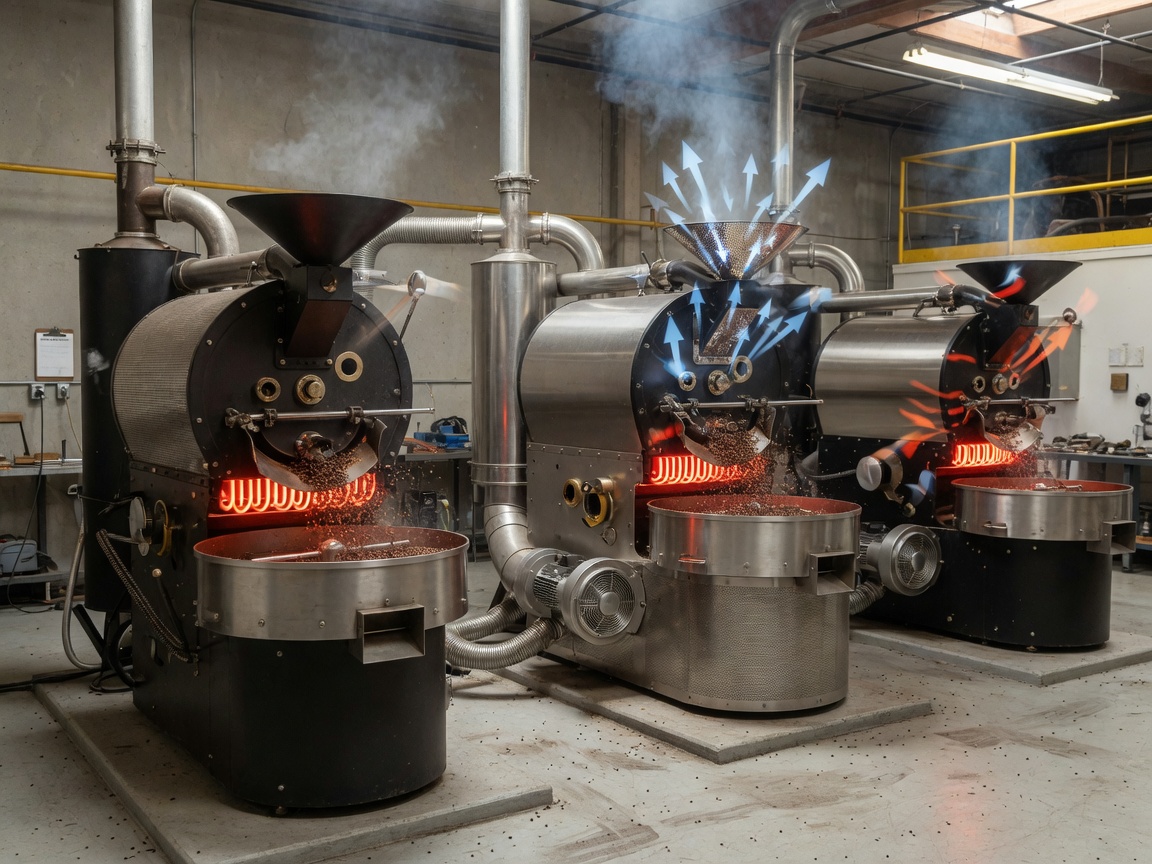
Three primary roaster architectures dominate the commercial market in 2026: drum, fluid bed, and hybrid. Each delivers a meaningfully different flavor profile, learning curve, and operational footprint. Choosing the wrong type is one of the most costly mistakes a first-time buyer makes — so let's be direct about the trade-offs.
| Feature | Drum roaster | Fluid bed roaster | Hybrid roaster |
|---|---|---|---|
| Typical batch size | 1–120 kg | 0.5–30 kg | 3–60 kg |
| Heat source | Gas or electric, conduction-primary | Electric or gas, convection-only | Gas + electric, conduction + convection |
| Price range (new) | $8,000 – $150,000+ | $3,500 – $60,000 | $15,000 – $120,000 |
| Learning curve | Moderate to steep | Low to moderate | Moderate |
| Flavor profile output | Complex, body-forward, nuanced | Clean, bright, clarity-focused | Balanced, programmable bias |
| Best for | Specialty/artisan roasters | High-volume, consistent output | Multi-origin programs, R&D |
Drum coffee roasters: the industry standard
The drum coffee roaster remains the most widely used configuration in U.S. commercial roasteries. A rotating steel drum — heated by gas burners beneath — tumbles beans through a conductive heat environment while a controlled airflow draws smoke and chaff out through the exhaust stack. Real-world testing in mid-scale operations consistently shows that drum roasters deliver greater batch-to-batch flavor complexity for single-origin specialty lots. Brands like Loring, Diedrich, and Probat occupy the premium tier; manufacturers like Mill City Roasters and US Roaster Corp offer strong mid-range options built domestically. The trade-off is clear: drum machines demand more operator skill and longer warm-up times — typically 30–45 minutes before the first batch is commercially viable.
Fluid bed and hybrid roasters: speed and consistency
A fluid bed coffee roaster suspends beans in a column of superheated air, roasting purely by convection. Roast cycles are 25–40% faster than drum equivalents, and because there is no physical drum contact, chaff separation is more complete. The resulting cup is typically cleaner and brighter — a quality profile that aligns well with high-volume espresso blends and light-roast pour-over programs. Hybrid machines layer convective airflow over a conductive drum base, allowing the operator to modulate the ratio in real time via software control. For wholesale coffee roasting machinery buyers who need platform flexibility across diverse bean origins, hybrids justify their premium price.
Coffee roasting machine price ranges in 2026
Coffee bean roasting machine price varies enormously — and not always in proportion to capability. In 2026, here is the realistic pricing landscape for U.S. buyers across production tiers.
Entry-level (1–5 kg batch): $3,500–$15,000. This tier covers sample roasters and coffee roasters for small business use. Machines like the Bullet R1 V2 or Aillio systems sit here. Roasting capacity is roughly 8–12 kg/hr — sufficient for a single-location café producing house blends in-house.
Mid-range commercial (6–25 kg batch): $15,000–$65,000. The most competitive segment for café owners and independent roasteries. A 15 kg professional coffee roaster from Diedrich or Mill City lands around $28,000–$42,000 fully equipped with afterburner and data logging. Used coffee roasters for sale in this category — particularly ex-demo or post-lease units — can represent 30–45% savings with comparable performance.
Industrial production (30–120 kg batch): $65,000–$250,000+. This is where wholesale coffee roasting machinery from Probat, Loring, or Burns enters the picture. Loring's Smart Roast line, for example, integrates a catalytic afterburner directly into the roast chamber, eliminating a separate afterburner installation and cutting fuel consumption by up to 80% compared to traditional gas drum designs. That energy saving becomes a critical TCO variable at scale.
"The upfront machine cost is rarely the largest line item over a 5-year ownership window. Energy, labor, and maintenance routinely exceed initial purchase price for machines in the 15–60 kg class." — Industry consensus from the 2026 Specialty Coffee Expo equipment panel, Boston.
New vs. used: where does the value actually sit?
Used coffee roasters for sale through platforms like Craigslist, eBay, or dedicated brokers such as Roaster Exchange carry real risk alongside genuine value. A well-maintained 10-year-old Probat P25 can outperform a brand-new mid-tier import — but inspection matters. Prioritize drum roundness, burner condition, and the availability of manufacturer parts before committing. Request roast logs if available; a machine that has logged clean roast curves over its life is a more transparent purchase than one with no data history.
Where to buy: suppliers and channels
Coffee roasting equipment suppliers in the U.S. operate through three primary channels: manufacturer-direct (Loring, Diedrich, US Roaster Corp), authorized regional distributors (common for Probat and Giesen), and the secondary market. For a first purchase, manufacturer-direct or authorized distributor is strongly recommended — warranty coverage, installation support, and operator training are frequently bundled into the sale price. That bundled training is not a soft benefit; it measurably reduces early-stage roast defect rates.
Total cost of ownership: 5-year analysis
TCO analysis is the single most under-used tool in commercial coffee roasting equipment decisions. Most buyers fixate on sticker price. Experienced operators fixate on the 5-year cost stack — and the difference in total spend between two machines with similar upfront prices can exceed $40,000.
The following analysis models a 15 kg gas drum roaster operating at approximately 8 hours/day, 5 days/week in a U.S. commercial environment:
| Cost category | Year 1 | Years 2–5 (annual avg.) | 5-year total |
|---|---|---|---|
| Machine purchase (mid-range) | $35,000 | — | $35,000 |
| Installation + ventilation buildout | $8,000 | — | $8,000 |
| Natural gas / energy costs | $4,200 | $4,500 | $22,200 |
| Preventive maintenance + parts | $1,200 | $2,400 | $10,800 |
| Dedicated roaster labor (partial FTE) | $22,000 | $23,500 | $116,000 |
| 5-year TCO estimate | ~$192,000 | ||
Notice that labor dominates. A fully automated professional coffee roaster with IoT-enabled roast curve management can reduce per-batch labor time by 30–40%, shifting that line item significantly. Energy costs are the second lever: a Loring-style catalytic system at comparable batch size runs roughly $2,100/year in gas costs under the same operating schedule — less than half the conventional drum figure. That gap, compounded over five years, funds a meaningful equipment upgrade.
Calculating break-even on green bean margin
Green coffee sourced at $3.50–$5.00/lb, roasted in-house and sold wholesale at $12–$16/lb, generates a gross margin of $7–$11/lb after accounting for moisture loss and packaging. At 200 lbs/week output, that is a potential gross margin contribution of $72,800–$114,400 annually — against a full TCO in year one of roughly $70,000. The math closes quickly. That's where the real ROI conversation starts.
U.S. regulatory and compliance requirements
Compliance is where many first-time buyers get blindsided. The U.S. regulatory environment for commercial coffee roasting spaces is multi-layered, and a machine that arrives without the right certifications can delay your opening by months.
UL, NSF, and equipment certification
UL (Underwriters Laboratories) listing is a baseline requirement for electrically connected commercial equipment in most U.S. jurisdictions. NSF International certification is typically required if your roasting space is classified as a food production facility. Always verify that the commercial espresso equipment and roasting machinery you are purchasing carries current UL/NSF marks — especially for imported machines from European or Asian manufacturers, where CE marking does not substitute for UL in U.S. inspections. Request certificate documentation before final payment.
OSHA ventilation standards and fire marshal requirements
OSHA 29 CFR 1910.94 governs ventilation for operations generating combustion byproducts — which roasting absolutely does. Your exhaust stack must meet local fire marshal specifications for make-up air volume, ductwork material (typically stainless steel with no exposed combustible liners), and afterburner or catalytic oxidizer requirements. In California, SCAQMD Rule 445 imposes additional VOC emission limits on roasters above 15 lbs/hr green throughput, requiring certified afterburner systems and potentially a permit-to-operate. Budget $5,000–$20,000 for a compliant ventilation buildout depending on facility complexity. Do not treat this as optional.
Financing and leasing options for U.S. buyers
Capital constraints are real — particularly for independent café owners and roastery startups. The good news is that 2026 offers more structured financing pathways than ever before for buyers of commercial coffee roasting machines for sale.
SBA loans and equipment financing
The SBA 7(a) loan program covers commercial equipment purchases up to $5 million, with repayment terms of 10 years for equipment and interest rates currently ranging from approximately 10.5–13% (prime-based, variable). For roasting equipment specifically, most lenders will finance 80–90% of appraised equipment value. The SBA 504 program, which pairs a bank loan with a CDC-backed debenture, is better suited for buyers combining equipment with real estate or facility renovation. Application timelines average 45–90 days — factor that into your launch schedule.
Equipment leasing and lease-to-own programs
Several major coffee roaster manufacturers and distributors — including Diedrich and some Probat distributors — offer direct lease-to-own structures, typically at $1 buyout at lease end, over 36 to 60 months. Monthly payments on a $35,000 machine run approximately $650–$900/month depending on term and credit profile. Independent equipment leasing companies (Crest Capital, Currency Capital) also finance roasting equipment and frequently offer faster approval than SBA channels — often within 48 hours for transactions under $150,000. Of course, leasing means higher total cost than outright purchase; the value is preserved capital and predictable monthly expenses while the roasting operation establishes its revenue baseline.
Scalability roadmap: from startup to mid-scale production
One of the most expensive mistakes in commercial roasting is purchasing for today's volume without a coherent path to tomorrow's. Think of your roaster selection like a commercial kitchen layout — buying a single residential oven because it is cheap today will cost you double when you have to rip it out and rebuild in 18 months.
Stage 1: startup (1–5 kg batch capacity)
At launch, a 1–3 kg sample roaster or entry batch coffee roaster is appropriate if your production target is under 20 lbs/day. Prioritize machines with open-protocol data logging (Cropster or Artisan compatible) so roast profiles are portable to larger machines when you scale. Manufacturers like Ikawa Pro, Aillio, and Mill City Roasters offer excellent entry-level platforms in the $4,000–$12,000 range with robust software ecosystems. Roasting capacity kg per hour at this tier: approximately 5–10 kg/hr effective output.
Stage 2: growth (6–15 kg batch capacity)
The 6–15 kg range is the most strategically important tier. A machine here can support a single-location roastery with wholesale accounts up to approximately 500 lbs/week. Choose a platform with modular upgrades: variable drum speed, adjustable airflow, and software-updatable firmware. This ensures the machine grows with your program rather than becoming obsolete. Effective roasting capacity kg per hour at this tier reaches 20–35 kg/hr in continuous production cycles. Budget $18,000–$45,000 new.
Stage 3: mid-scale production (20–70 kg batch capacity)
At 20 kg and above, you are firmly in industrial coffee roaster equipment territory. Buyers at this stage typically serve multi-location wholesale accounts or regional distribution. Key decision variables shift: consider gas infrastructure capacity at your facility, afterburner permitting timelines in your municipality, and whether a second smaller machine (for specialty lots and R&D) makes more sense than a single large unit. Actual testing in mid-scale U.S. roasteries consistently shows that a two-machine configuration — one 30 kg production unit plus one 5 kg development roaster — outperforms a single 35 kg machine in both operational flexibility and quality consistency.
How to choose the right machine for your business
With all the variables in play — type, price, TCO, compliance, financing, scalability — how do you actually make the decision? Here is a structured evaluation process used by professional equipment consultants.
- Define your 3-year volume forecast — not today's volume, your projected volume at 36 months. Size for that number, not the present.
- Map your facility constraints — gas line capacity, ceiling height for exhaust stack, floor load rating, and available square footage for cooling tray and green bean storage.
- Establish your compliance budget early — contact your local fire marshal and building department before selecting a machine. Their requirements may disqualify certain configurations entirely.
- Build a shortlist of 3 machines — request demo roasts from each manufacturer or distributor. Roast your own green coffee on each machine if possible; flavor profile differences between types are real and significant.
- Run the 5-year TCO model — use the framework in Section 4 and plug in your actual energy rates, local labor costs, and maintenance estimates from the manufacturer's service documentation.
- Negotiate financing terms last — once you have selected the machine, use competing financing offers (SBA vs. direct lease vs. equipment lender) to drive down effective monthly cost.
Common mistakes and honest limitations
One persistent industry misconception deserves direct rebuttal: a higher-priced machine does not guarantee better coffee. Equipment must match the operator's skill level, the bean sourcing program, and the production rhythm of the specific business. A $120,000 production roaster operated by an inexperienced roaster will produce inferior results compared to a $28,000 mid-range unit in skilled hands. Conversely, no machine — however automated — replaces the sensory judgment of a trained roaster in flavor development. Smart automation assists execution; it does not replace taste.
2026 trends shaping purchasing decisions
IoT-enabled roasting platforms — integrating cloud-based roast curve management and remote monitoring across multiple locations — are rapidly becoming a baseline expectation rather than a premium feature. For chain café operators and franchise-model roasteries, centralized roast profile management via platforms like Cropster Enterprise is already standard. Meanwhile, energy efficiency has moved from a sustainability talking point to a procurement criterion: buyers evaluating wholesale coffee roasting machinery in 2026 routinely request BTU-per-kg figures alongside batch capacity specs. The shift toward electric and hybrid heat sources is accelerating, partly driven by natural gas price volatility and partly by municipal sustainability requirements in states like California, Colorado, and New York.
Frequently asked questions
Q: What is a commercial coffee roasting machine for sale?
A: A commercial coffee roasting machine for sale is a professional-grade thermal processing system designed for repeatable, high-volume production. These units feature programmable roast curve controls, industrial heating elements, exhaust and chaff management, and batch capacities starting at 5 kg — built for cafés, artisan roasteries, and wholesale operations.
Q: How much does a commercial coffee roaster cost in 2026?
A: Prices range from $3,500 for entry-level 1–3 kg sample roasters to $250,000+ for large-scale industrial units in the 60–120 kg class. The most active commercial segment — 6 to 25 kg batch machines — typically costs $15,000–$65,000 new. Used coffee roasters for sale in this range often represent 30–45% savings.
Q: What certifications should a commercial roaster have for U.S. use?
A: At minimum, look for UL listing for electrical safety and NSF certification if operating in a classified food production facility. State-specific air quality permits (notably SCAQMD in California) may also be required. CE marking from European manufacturers does not substitute for UL in U.S. code compliance inspections.
Q: Is a drum roaster or fluid bed roaster better for specialty coffee?
A: Drum roasters are generally preferred for specialty single-origin lots requiring complex flavor development and body. Fluid bed roasters excel at producing clean, bright cups at high throughput — well-suited for espresso blends and filter-focused programs. Neither is universally superior; the choice depends on your target flavor profile and production volume.
Q: Can I finance a commercial coffee roaster through an SBA loan?
A: Yes. The SBA 7(a) program covers commercial equipment up to $5 million with 10-year repayment terms. Current rates run approximately 10.5–13%. Approval timelines average 45–90 days. Equipment leasing companies like Crest Capital can approve transactions under $150,000 in as little as 48 hours for qualified borrowers.
Selecting the right commercial coffee roasting machines for sale is ultimately an exercise in matching capital deployment to a credible business model. The machine type, the TCO profile, the compliance path, and the financing structure must all align with your production goals and your facility reality. Use the frameworks in this guide as your decision architecture — and remember that the best roaster is not the most expensive one, but the one that fits your program, your team's skill level, and your growth trajectory for the next three to five years.
Please tell us your needs.
If you have any questions about our company, please feel free to contact us. We will reply as soon as possible. Thank you for your inquiry.

Adress:7 # Standard Factory Building in Baoshan Industrial and Trade Park, Yunnan Province
Customer service:+86-400-176-6898
Tel:+86-0875-2870888
Phone:+86-18187573906
Email:Abner@ynaofu.com
Factory VR
Video ID
Copyright © 2023 Yunnan Aofu Intelligent Equipment Co., Ltd. (this website supports IPV6)