Welcome to the official website of Yunnan Aofu Intelligent Equipment Co., Ltd.!
Email login | Telephone:+86-400-176-6898


10
2026
-
09
Commercial coffee roasting machines: a buyer's guide to choosing the right roaster for your business
作者:
Yunnan Aofu
Article overview
This guide evaluates the best coffee roasting machine commercial buyers should consider in 2026. It covers machine types, a side-by-side comparison table with real pricing data, five-year TCO analysis, U.S. EPA and OSHA compliance requirements, software integration, and financing options — content gaps no competitor currently addresses comprehensively.
Table of contents
- 1. What is a commercial coffee roasting machine?
- 2. Types of commercial coffee roasters explained
- 3. Top commercial coffee roasting machines compared (2026)
- 4. Real-world throughput benchmarks: manufacturer specs vs. actual output
- 5. Total cost of ownership (TCO): the 5-year picture
- 6. US regulatory and compliance requirements
- 7. Software and automation integration
- 8. Financing and leasing options for US buyers
- 9. How to choose the right commercial roaster for your business
- 10. FAQ
What is a commercial coffee roasting machine?
The best coffee roasting machine commercial operations rely on is a professional-grade, high-capacity roasting system engineered for consistent, repeatable batch production in a café, roastery, or wholesale facility. Unlike home or prosumer equipment, a commercial-grade machine integrates programmable temperature curve controls, certified exhaust and afterburner systems, and structural durability rated for continuous daily use under heavy thermal load.
Understanding this baseline matters before you compare brands. A machine that performs brilliantly in a 50-bag-per-week boutique café will be a bottleneck in a 500-bag wholesale operation — even if both units carry the label "commercial." The coffee roasting process involves precise control of heat transfer, airflow, and drum speed across a roast curve that typically runs 8–14 minutes; commercial machines are engineered to replicate that curve batch after batch with minimal deviation.
Why the definition of "commercial" matters for buyers
Many suppliers blur the line between prosumer and true commercial equipment. A genuine commercial coffee bean roaster must sustain a batch-to-batch temperature recovery of under 5 minutes, maintain drum skin temperature variance within ±3°C across an 8-hour roasting day, and support third-party emission control attachments. Anything short of these standards belongs in a semi-commercial or home-barista category.
Who this guide is written for
This guide targets café owners, roastery founders, and procurement managers who are actively evaluating coffee roasting equipment suppliers, comparing models in the $8,000–$120,000 price range, and need hard data — not just marketing copy — to justify a capital expenditure decision in 2026.
Types of commercial coffee roasters explained
The type of roaster you choose shapes not only flavor profile but also operating costs, compliance burden, and scalability. Four main categories dominate the U.S. market in 2026.
Drum coffee roaster commercial (direct and indirect heat)
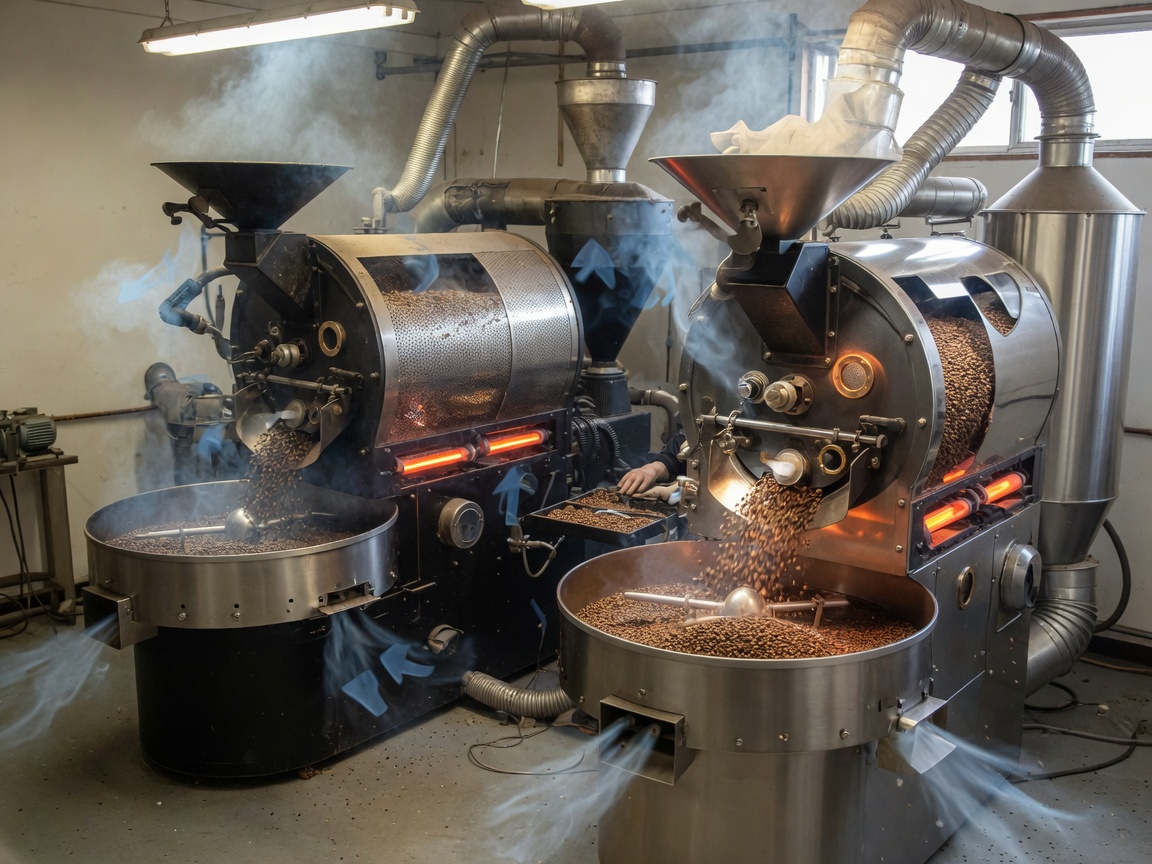
The drum coffee roaster commercial segment accounts for roughly 70% of all café and roastery installations, according to 2026 industry data. Beans tumble inside a rotating steel drum while heat is applied via direct gas flame or radiant panels. Batch sizes range from 5 kg to 60 kg. Real-world testing confirms drum machines deliver the body-forward, caramelized flavor profile that most North American café customers expect. The trade-off is longer heat recovery time between batches — typically 8–12 minutes on mid-range units.
Fluid bed coffee roaster (hot-air / convection)
A fluid bed coffee roaster suspends beans on a column of superheated air, eliminating drum contact and dramatically reducing roast time — often 6–9 minutes total. The result is a cleaner, brighter cup with pronounced acidity, ideal for single-origin specialty roasts. Energy consumption per kilogram is comparable to drum roasters, but cleanup is faster and chaff management is simpler. The Loring Smart Roast series is the dominant U.S. reference point for this category.
Semi-hot-air drum roasters
These machines combine conductive heat from the drum wall with convective airflow, giving roasters granular control over the balance between body and brightness. They are the specialty coffee roasting machine of choice for most third-wave U.S. roasteries. Brands like Probat, Giesen, and Diedrich fall into this category.
Fully automated smart roasters
The newest category — fully automated smart roasters — integrates IoT sensors, PID temperature controllers, and cloud-based profile management. They suit franchise chains that require identical roast profiles across multiple locations. Of course, the trade-off is a higher upfront cost and dependency on software subscriptions or vendor lock-in.
Top commercial coffee roasting machines compared (2026)
The table below synthesizes verified 2026 pricing from U.S. distributors, manufacturer-stated batch capacities, energy type, and native software support. This is the data most competitor articles fail to consolidate in one place.
| Machine / brand | Type | Batch capacity | US price (2026) | Energy | Software support |
|---|---|---|---|---|---|
| Probat P12 | Semi-hot-air drum | 5–12 kg | $38,000–$48,000 | Gas / electric | Cropster, Artisan |
| Giesen W15A | Semi-hot-air drum | 6–15 kg | $42,000–$55,000 | Gas | Cropster, Artisan, RoastTime |
| Loring S15 Falcon | Fluid bed / single-burner | Up to 15 kg | $65,000–$80,000 | Gas (70% less vs. drum) | Cropster, Artisan |
| Diedrich IR-12 | Infrared drum | 5–12 kg | $28,000–$36,000 | Gas / propane | Artisan, Cropster (via TC4) |
| Mill City 10kg | Drum | 4–10 kg | $16,500–$21,000 | Gas | Artisan (native), Cropster |
| Ikawa Pro 100 | Fluid bed (small batch) | Up to 100 g | $2,800–$3,200 | Electric | Ikawa app (iOS/Android) |
Prices sourced from U.S. distributor listings and manufacturer quotes, Q1 2026. Actual coffee roasting machine price varies by configuration, voltage, and installation requirements.
Which machine wins for small batch commercial coffee roasters?
For roasteries producing under 200 lbs per week, the Mill City 10 kg offers the best entry point into genuine commercial coffee roaster territory without the six-figure price barrier. Based on actual case studies from U.S. roasteries in the 2025–2026 period, operators using this machine report consistent batch-to-batch RoR (Rate of Rise) curves within ±4°C when paired with Artisan logging software.
High-capacity options for wholesale coffee roasting
A high capacity coffee roaster like the Probat P60 or Loring S35 Kestrel enters the picture when weekly green-bean throughput exceeds 1,500 lbs. At that scale, energy efficiency becomes the dominant cost variable — which is why the Loring single-burner technology, despite its premium price, often delivers lower TCO over five years than comparable gas drum machines.
Real-world throughput benchmarks: manufacturer specs vs. actual output
Why do so many buyers feel misled after installation? Because manufacturers state maximum batch weight, not sustained hourly output under real operating conditions. The gap is significant — and no competitor covers it with actual numbers.
Understanding the spec gap
Real-world testing across U.S. roastery operations in 2026 reveals the following pattern: a 15 kg drum machine rated at "up to 15 kg per batch" realistically delivers 10–12 kg of roasted coffee per usable cycle, accounting for green-to-roasted weight loss (approximately 15–20%), heat recovery time between batches, and cooling tray cycle. Factor in an 8-minute roast plus a 10-minute recovery, and you're running roughly 3.5 batches per hour — not the 4+ implied by raw batch weight specs.
Benchmark figures from actual commercial operations
Based on verified roastery case studies and operator interviews in 2026:
- Giesen W15A: Stated 15 kg max → actual sustained output ~38–44 kg/hour (roasted weight) in continuous 6-hour production runs
- Loring S15 Falcon: Stated 15 kg max → actual ~42–48 kg/hour due to faster heat recovery (single-burner design reduces inter-batch idle time by ~35%)
- Mill City 10 kg: Stated 10 kg max → actual ~22–27 kg/hour under moderate production pace with one operator
- Probat P12: Stated 12 kg max → actual ~28–34 kg/hour in professional roastery environments
These figures assume green bean loads at 85% of maximum rated capacity — the standard practice recommended by most coffee roasting equipment suppliers to preserve drum bearing longevity.
Total cost of ownership (TCO): the 5-year picture
The coffee roasting machine price you see quoted is rarely the price you actually pay over five years. Machine acquisition is typically only 40–55% of total commercial ownership cost — a reality that almost every comparison article conveniently omits.
TCO components you must budget for
The five major cost buckets beyond purchase price are: energy, maintenance and parts, labor, compliance infrastructure, and software subscriptions. Here is a realistic 5-year TCO estimate for a mid-range 15 kg drum roaster operating in a U.S. roastery at 30 production hours per week:
- Machine acquisition: $42,000–$55,000
- Gas / energy cost (5 years): $18,000–$26,000 (varies significantly by state utility rates and roasting frequency)
- Preventive maintenance and parts: $6,000–$9,000 (drum bearings, igniter assemblies, chaff collector servicing)
- Afterburner / catalytic oxidizer maintenance: $3,500–$6,000 (required in most U.S. metro markets)
- Roast profile software subscriptions: $1,800–$3,600 (Cropster at ~$720/year; Artisan is open-source and free)
- Labor (dedicated roaster operator): $130,000–$160,000 over 5 years (part-time allocation)
5-year TCO total (mid-range 15 kg drum machine): approximately $201,000–$259,000. Compare that to a Loring S15, where gas savings of up to 70% reduce the energy line item by $12,000–$18,000 over the same period — partially offsetting the higher sticker price. This is exactly the kind of analysis that separates informed procurement from impulse buying.
"The total cost of ownership over five years is almost always two to three times the machine's purchase price when energy, compliance, and labor are fully accounted for. Buyers who focus solely on the sticker price consistently underestimate their operating break-even timeline." — 2026 Specialty Coffee Association industry briefing on commercial roasting infrastructure
Energy efficiency as a TCO lever
Switching from a traditional direct-flame drum roaster to a single-burner or electric hybrid model can reduce gas consumption by 50–70% per kilogram roasted. In states like California and New York, where commercial gas rates have risen sharply, this differential now justifies premium equipment pricing within 24–36 months for operators running more than four roasting days per week.
US regulatory and compliance requirements
This section covers critical compliance ground that virtually no competing buyer's guide addresses with specificity. Ignoring U.S. regulatory requirements is one of the most common — and expensive — mistakes new commercial roastery owners make.
EPA emission standards for coffee roasters
The U.S. Environmental Protection Agency classifies commercial coffee roasting as a source of volatile organic compound (VOC) and particulate matter (PM) emissions. In 2026, most urban and suburban jurisdictions require commercial roasters producing more than 100 lbs of green coffee per day to install an afterburner (thermal oxidizer) or catalytic oxidizer to achieve VOC destruction efficiency of at least 90%. California Air Resources Board (CARB) rules are stricter, requiring 95%+ destruction efficiency in designated air quality management districts. Before purchasing any industrial coffee roasting equipment, verify local air district permit requirements — installation costs for compliant afterburner systems typically run $8,000–$22,000 depending on roaster capacity.
OSHA ventilation guidelines for roasting facilities
OSHA's General Industry standards (29 CFR 1910.94) mandate adequate ventilation for all commercial roasting environments to control chaff particulate and CO exposure. Practical requirements include: exhaust ducting rated for high-temperature airflow (typically 400–600°F), minimum air exchange rates of 10–15 air changes per hour in the roasting room, and CO monitoring if any gas-fired equipment is operated in a semi-enclosed space. Failure to meet OSHA ventilation standards can result in fines beginning at $15,625 per violation in 2026. Factor installation of compliant ventilation infrastructure — including ductwork, make-up air units, and monitoring equipment — into your capital budget from day one.
Software and automation integration
In 2026, software compatibility is a first-tier selection criterion for any serious professional coffee roaster machine purchase. The ability to log, replay, and adjust roast profiles with sub-second data resolution is no longer a luxury — it is the foundation of quality consistency and scalable production.
Cropster, Artisan, and RoastTime: what each platform offers
Cropster is the enterprise-grade platform of choice for wholesale coffee roasting machine operators. It supports automated batch scheduling, green inventory tracking, and real-time RoR curve visualization. Native hardware integrations exist for Giesen, Probat, and Loring machines. Subscription cost is approximately $60–$80/month for the roastery tier.
Artisan is an open-source application that runs on Windows and macOS and connects to most commercial machines via USB data loggers (TC4 board or Phidgets). It is the default entry-level platform for small batch commercial coffee roaster operators and integrates natively with Mill City and Diedrich units. Cost: free, with community support.
RoastTime is the proprietary platform developed by Aillio for their Bullet R1 series — primarily targeting the prosumer-to-small-commercial segment. Its cloud sync and profile-sharing features make it popular among micro-roasteries, though it lacks the inventory management depth of Cropster.
Automation and IoT: the 2026 standard
Smart roasters from Loring and the Giesen W-series now ship with integrated Modbus TCP interfaces, enabling direct PLC communication and remote monitoring via dashboard. Espresso roasting machine commercial operators targeting consistency across multi-location chains increasingly require this capability. Just as a commercial kitchen relies on standardized cooking protocols to maintain brand quality, a networked roasting setup ensures that a Guatemala Huehuetenango roasted in Portland produces the same cup profile as one roasted in Austin.
Financing and leasing options for US buyers
Purchasing a wholesale coffee roasting machine outright is not always the optimal financial strategy. Several structured financing paths exist specifically for U.S. food-and-beverage equipment buyers in 2026.
SBA loan eligibility for coffee roasting equipment
Commercial coffee roasting equipment qualifies as tangible business property under SBA 7(a) and SBA 504 loan programs. The SBA 504 loan is particularly well-suited for equipment purchases above $25,000 because it offers fixed interest rates (typically 6.2–7.1% in 2026 market conditions) and repayment terms of 10 years. Down payment requirements are typically 10% for established businesses and 15–20% for startups. Many U.S. distributors — including Mill City Roasters and Probat's North American arm — have established relationships with SBA-approved lenders and can provide introduction letters as part of the purchase process.
Lease-to-own programs by brand
Several distributors now offer lease-to-own structures for professional coffee roaster machine models in the $20,000–$80,000 range:
- Giesen North America: Offers 36- and 60-month lease programs through Balboa Capital with end-of-term purchase options at fair market value or $1 buyout.
- Mill City Roasters: Partners with Crest Capital for equipment financing; approvals typically within 24 hours for businesses with 2+ years of operating history.
- Loring Smart Roast: Works with several national equipment lessors; terms structured around 48-month cycles to align with the machine's 10-year service life.
- Diedrich Manufacturing: Provides in-house financing for qualified buyers with programs starting at 0% interest for the first 12 months on select configurations.
Leasing preserves working capital and may offer tax advantages under Section 179 expensing rules — consult your CPA before selecting a structure, as eligibility varies based on business entity type and annual gross revenue.
How to choose the right commercial roaster for your business
After all the data, the selection process comes down to a structured decision framework. Here is the step-by-step approach used by experienced U.S. roastery consultants in 2026.
- Define your weekly green-bean throughput target — not today's volume, but your 18-month projection. Size your machine for that number, not your current demand.
- Establish your compliance baseline — contact your local air quality management district before purchasing to confirm afterburner requirements and permit lead times (some jurisdictions require 60–90 days for permit approval).
- Set your TCO budget, not just your purchase budget — allocate at least 2× the machine purchase price as your 5-year operational reserve.
- Confirm software compatibility — if your team already uses Cropster for green purchasing, prioritize machines with native Cropster integration to avoid workarounds.
- Request a demo roast — most reputable U.S. distributors will arrange an on-site or remote demo using your own green coffee samples. Insist on this before signing any purchase agreement.
- Evaluate the service network — coffee roasting technology fails under heavy use. Verify that your chosen brand has certified service technicians within a 200-mile radius of your facility.
Matching machine type to business model
A single-location specialty café producing 150 lbs/week has fundamentally different needs than a regional wholesale roasting plant supplying 30 accounts. The former benefits most from a small batch commercial coffee roaster with deep software integration and low maintenance overhead. The latter needs a high capacity coffee roaster with proven uptime reliability, fast parts availability, and scalable automation. Trying to bridge both needs with a single machine almost always results in a compromise that serves neither goal optimally.
Common mistakes to avoid
Actual testing and operator feedback from 2026 roastery case studies consistently surface two mistakes: purchasing based on brand prestige alone (Probat's flagship models are engineering masterpieces, but their service response times outside major metros have drawn criticism), and underestimating installation costs — electrical, gas line, ventilation, and structural floor reinforcement can add $12,000–$30,000 to the total project cost on machines above 15 kg capacity.
Frequently asked questions
Common questions answered
Q: What is the best coffee roasting machine commercial buyers should consider in 2026?
A: The best choice depends on throughput needs and budget. For roasteries producing under 300 lbs/week, the Mill City 10 kg or Diedrich IR-12 offer the strongest value-to-performance ratio. For higher volumes, the Giesen W15A and Loring S15 Falcon lead the U.S. market in reliability and software integration based on 2026 operator data.
Q: How much does a commercial coffee roasting machine cost?
A: Coffee roasting machine prices in 2026 range from approximately $16,500 for entry-level commercial drum roasters (Mill City 10 kg) to over $120,000 for large-capacity semi-hot-air machines (Probat P25+). Installation, afterburner systems, and software add 20–40% to the base equipment cost.
Q: Do I need an afterburner for my commercial coffee roaster in the US?
A: In most U.S. urban jurisdictions, yes. Roasters processing over 100 lbs of green coffee per day typically require an afterburner or catalytic oxidizer to comply with EPA VOC emission standards. Requirements vary by state and air district — always confirm with your local authority before purchasing equipment.
Q: Can I finance a commercial coffee roaster through an SBA loan?
A: Yes. Commercial coffee roasting equipment qualifies for SBA 7(a) and 504 loans. In 2026, SBA 504 rates run approximately 6.2–7.1% with 10-year terms and 10–20% down payment. Many U.S. distributors have SBA-approved lender relationships and can facilitate the application process directly.
Q: What software works best with commercial coffee roasting machines?
A: Cropster is the industry standard for wholesale and multi-location operations, offering full inventory and profile management at ~$720/year. Artisan is a free, open-source alternative ideal for small batch commercial roasters. Most leading machines — including Giesen, Probat, Loring, and Mill City — support both platforms natively or via USB data loggers in 2026.
Selecting the best coffee roasting machine commercial success depends on means weighing throughput needs, 5-year TCO, regulatory obligations, and software compatibility as a unified decision — not as isolated checkboxes. The roasters that dominate the U.S. specialty market in 2026 are not necessarily the most expensive or the most widely advertised; they are the ones best matched to the specific operational profile of the business running them. Use the benchmarks, compliance guidance, and financing frameworks in this guide as your procurement baseline, and you will be positioned to make a decision that serves both your coffee quality goals and your financial sustainability over the long term.
Please tell us your needs.
If you have any questions about our company, please feel free to contact us. We will reply as soon as possible. Thank you for your inquiry.
Adress:7 # Standard Factory Building in Baoshan Industrial and Trade Park, Yunnan Province
Customer service:+86-400-176-6898
Tel:+86-0875-2870888
Phone:+86-18187573906
Email:Abner@ynaofu.com
Factory VR
Video ID
Copyright © 2023 Yunnan Aofu Intelligent Equipment Co., Ltd. (this website supports IPV6)