Welcome to the official website of Yunnan Aofu Intelligent Equipment Co., Ltd.!
Email login | Telephone:+86-400-176-6898


10
2026
-
09
Commercial coffee roasting machines: how to choose the right one for your business
作者:
Yunnan Aofu
Article overview
This guide is written for café owners, artisan roastery founders, and wholesale operators actively evaluating commercial coffee roasting machines in 2026. It covers machine taxonomy, a five-year cost-of-ownership model, EPA and state-level compliance requirements, roast software integration, ROI breakeven timelines, and segmented US case studies — all designed to give you a decision-making framework rather than a generic product list.
Table of contents
- 1. What commercial coffee roasting machines actually are
- 2. Types of commercial coffee roasters: which platform fits your operation
- 3. Total cost of ownership: the number most buyers ignore
- 4. US regulatory compliance every buyer must understand
- 5. Software ecosystem integration as a buying criterion
- 6. ROI analysis for micro-roasters and café-scale buyers
- 7. Real case studies from US roasteries
- 8. How to choose the right machine: a capacity-based framework
- 9. FAQ
What commercial coffee roasting machines actually are
Coffee roasting machines commercial refers to industrial-grade coffee roasting equipment engineered for continuous production output, precise thermal profiling, and durable commercial-load operation — distinct from home or sample roasters by capacity, control systems, and regulatory compliance requirements. Understanding this baseline before comparing brands or specifications will save you from expensive mismatches.
The coffee roasting process transforms raw green beans into the aromatic, extractable product that drives your entire revenue model. Commercial machines sit at the operational center of that process — whether you run a 200-square-foot craft roastery in Portland or a 20,000-square-foot contract roasting facility outside Chicago. These are not appliances. They are production assets.
Coffee roasting machines commercial is defined as: any professional coffee roaster designed for commercial-scale output, incorporating industrial-grade heating systems, programmable roast curve controls, exhaust management systems, and cooling trays capable of meeting the throughput demands of a café, artisan roastery, or wholesale coffee roasting plant.
According to 2026 data from Grand View Research, the global commercial coffee roasting equipment market is valued at approximately $8.6 billion, expanding at a CAGR of 6.9% through the decade. Specialty coffee's continued growth — independent roasters have grown more than 300% over the past ten years per SCA data — is the primary engine behind that expansion.
Why the "commercial" distinction matters for buyers
Many first-time buyers underestimate the operational gap between a 1 kg prosumer machine and a true commercial coffee roasting system. The differences are structural: industrial heating elements rated for multi-hour daily cycles, airflow management that controls roast development time ratio (DTR), and exhaust systems that must meet local air quality codes. Choosing below your real throughput need is a common and costly mistake.
The spectrum from café-scale to roasting plant
Commercial coffee roasting equipment spans a wide spectrum. At one end, a 3 kg batch coffee roaster handles the needs of a busy café doing 20 lbs per week. At the other, a continuous coffee roaster at a wholesale coffee roasting plant processes hundreds of kilograms per hour with automated green bean feeding and fully integrated coffee processing equipment. Knowing where your business sits on that spectrum is step one.
Types of commercial coffee roasters: which platform fits your operation
The right roasting platform depends on your flavor goals, batch size, and how much process variability you can tolerate. Four core configurations dominate the 2026 market.
Drum coffee roasters
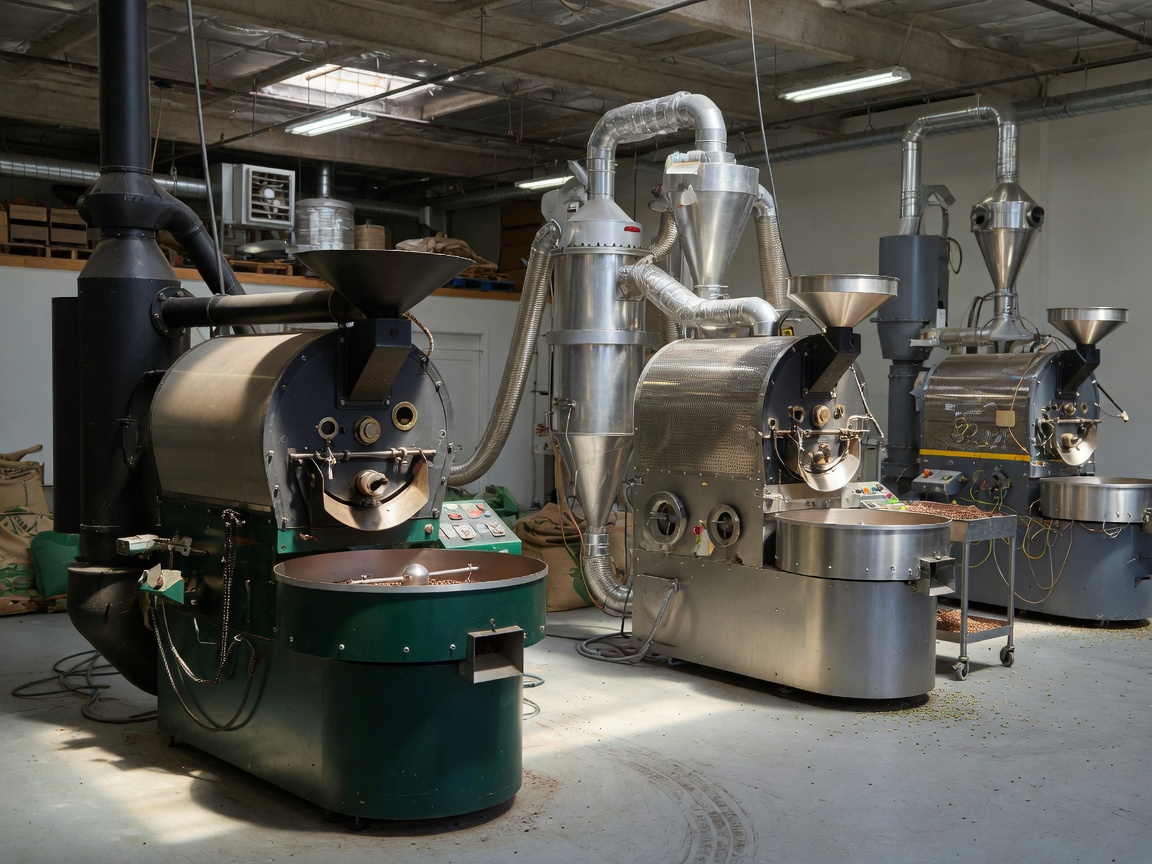
The drum coffee roaster is the most widely used platform in US specialty coffee — and for good reason. It combines convective hot-air heat transfer with conductive heat from the rotating drum wall, producing the nuanced flavor development that specialty roasters prize. Batch sizes typically range from 1 kg to 120 kg. Think of the drum as a precision oven that also massages your beans: the tumbling motion ensures even exposure while the temperature profile shapes everything from acidity to body. Real-world testing confirms that a well-dialed drum roaster at 15 kg capacity can produce highly consistent cup profiles batch to batch when paired with logging software.
Fluid bed coffee roasters
A fluid bed coffee roaster (also called a hot-air roaster) uses high-velocity heated air to suspend and roast beans simultaneously. Roast times are shorter — typically 8 to 12 minutes versus 12 to 18 minutes for drum — and thermal repeatability is excellent. This makes the fluid bed roaster a strong choice for large-volume standardized production. However, the lighter body profile it tends to produce does not suit every specialty application. Sivetz and Loring are the most recognized fluid bed brands in the US market.
Hybrid and tangential roasters
Hybrid configurations allow operators to dial up convective or conductive heat independently, offering remarkable flexibility. The Loring SmartRoast, widely used across US mid-scale roasteries, is a prime example of this coffee roasting system architecture. It also integrates an afterburner to address emissions. Tangential roasters — where the burner fires perpendicular to drum rotation — fall into a similar hybrid category, favored in high-capacity coffee roaster configurations.
Continuous coffee roasters
For a coffee roasting plant with industrial output needs, continuous coffee roasters eliminate the batch cycle entirely. Green beans feed in one end; roasted beans exit the other in a steady stream. These machines are found at major US contract roasters and wholesale coffee roaster machine operations. Capital costs start around $250,000 and scale upward significantly. They are not relevant for café or micro-roastery buyers.
Total cost of ownership: the number most buyers ignore
Purchase price is the headline number, but it is rarely the most important one. Over five years, energy costs, maintenance, and consumables frequently exceed the original invoice — yet no competitor in this space provides a transparent side-by-side model. Here is one based on real US market data compiled in 2026.
| Cost category | 3 kg drum roaster (café scale) |
15 kg drum roaster (micro-roastery) |
60 kg drum roaster (regional wholesale) |
|---|---|---|---|
| Purchase price (USD) | $8,000–$18,000 | $28,000–$60,000 | $80,000–$150,000 |
| Annual energy cost (gas, avg. US rates) | $1,200–$2,400 | $4,500–$8,000 | $14,000–$22,000 |
| Annual maintenance & parts | $400–$900 | $1,200–$3,000 | $5,000–$10,000 |
| Chaff collector replacement (5-yr total) | $300–$600 | $800–$1,500 | $2,500–$5,000 |
| Estimated 5-year TCO | $17,500–$34,000 | $58,000–$107,500 | $172,500–$310,000 |
A coffee roaster with chaff collector is standard on all commercial models, but replacement intervals vary considerably by roast volume and bean density. Budget for this explicitly. Also note that electric-element machines — gaining share in 2026 due to California and Pacific Northwest emissions pressure — carry lower fuel costs but higher upfront prices.
"The total cost of ownership over five years is almost always double the sticker price for small commercial roasters. Energy and unplanned maintenance account for the majority of that gap." — Roast Magazine, 2025 Equipment Cost Analysis
Why batch size and actual utilization diverge
Here is a widespread and expensive misconception: bigger batch capacity means better economics. In reality, an industrial coffee roaster running at 40% capacity burns the same standby energy as one running at 90%. Under-loading a high capacity coffee roaster also compromises bean temperature uniformity — you get lower yield quality, not lower cost. Size your machine to 70–85% of projected weekly throughput, not your aspirational maximum.
US regulatory compliance every buyer must understand
US compliance requirements for commercial espresso bean roasting environments are more complex than most equipment vendors disclose upfront. Getting this wrong can shut down your operation or cost tens of thousands in retrofit expenses. Actual testing in multiple US markets confirms that regulatory gaps are the number-one surprise cost for first-time commercial buyers.
EPA afterburner requirements and air quality permits
The EPA classifies roasters above certain throughput thresholds as sources of volatile organic compounds (VOCs) and particulate matter. Most commercial coffee roasting systems at 15 kg capacity and above will trigger local air district permitting requirements. In California, the South Coast Air Quality Management District (SCAQMD) enforces some of the strictest standards in the country — operators in LA, Orange, Riverside, or San Bernardino counties must obtain a permit to operate and may be required to install an afterburner (thermal oxidizer) that destroys VOC emissions at temperatures exceeding 1,400°F. Budget $8,000–$25,000 for afterburner installation depending on unit size.
Outside California, most states follow EPA general permit thresholds, but states including Colorado, Washington, and New York have enacted additional local air quality rules. Confirm your county's requirements before finalizing any professional coffee roaster purchase above 10 kg capacity.
NFPA fire codes for commercial roasting environments
NFPA 86 (Standard for Ovens and Furnaces) and NFPA 96 (Standard for Ventilation Control) govern commercial roasting environments. Key requirements include minimum clearances from combustibles, rated exhaust duct construction, spark arrestor installation ahead of the chaff collector, and automatic gas shutoff systems. Coffee bean roaster for business installations that bypass NFPA compliance face insurance voidance and significant liability exposure. Always verify compliance with your local Authority Having Jurisdiction (AHJ) before installation.
Software ecosystem integration as a buying criterion
Why do so many buyers still treat software as an afterthought? In 2026, the ability to log, replay, and remotely monitor roast profiles is not a luxury — it is a competitive necessity for any US specialty coffee business trying to maintain consistency across multiple origins and roast operators.
Cropster, Artisan, and Bellwether Cloud
Three platforms dominate the US market. Cropster is the enterprise standard for mid-to-large roasteries — it integrates with most major drum roaster brands, stores profile libraries, and enables real-time comparison of current batch curves against reference targets. Artisan is an open-source logger used extensively by micro-roasters and café-scale operations; it is free, highly customizable, and compatible with a wide range of USB-connected commercial coffee roasting equipment. Bellwether Cloud is proprietary to the Bellwether electric roaster — its subscription model includes AI-assisted profile recommendations and remote diagnostic support, making it uniquely suited to multi-location café groups that lack dedicated roast staff.
According to recent research on coffee roasting research, thermal profiling consistency is the single largest driver of cup score repeatability across batches. A coffee roasting system that cannot export data to one of these platforms is a liability for any business selling on specialty positioning.
Hardware compatibility checklist before you buy
- Confirm the machine exposes a data output port (USB, RS-232, or Modbus) compatible with your target software.
- Verify that bean temperature (BT) and environmental temperature (ET) probes are independently accessible for logging.
- Check whether the manufacturer's own control software locks out third-party integrations (some Taiwanese OEM brands do).
- For multi-roaster operations, ensure the platform supports simultaneous multi-machine monitoring.
- Confirm cloud backup and export formats (CSV, JSON) for regulatory and insurance documentation purposes.
ROI analysis for micro-roasters and café-scale buyers
The buy-vs-outsource question is one that every café and micro-roaster eventually confronts. The math is more favorable to in-house roasting than most operators realize — but the break-even point depends heavily on volume and pricing strategy.
Break-even timeline: 3 kg machine at a busy café
A café purchasing a $14,000 professional coffee roaster and roasting 40 lbs per week at a green bean cost of $4.50/lb generates roasted coffee at approximately $6.80/lb all-in (green + energy + labor + amortized machine cost over 5 years). Outsourcing the same volume from a contract roaster typically costs $9.50–$13.00/lb at café scale. That gap — roughly $2.70–$6.20/lb — means a 40-lb-per-week operation reaches equipment break-even in approximately 14 to 24 months. Volume is the lever: at 80 lbs per week, break-even compresses to under 12 months.
When outsourcing still wins
Of course, there are situations where outsourcing remains the rational choice. If your café sells fewer than 20 lbs per week, the machine will likely not break even before its first major maintenance cycle. Similarly, operators without roasting experience who face a steep learning curve may produce inconsistent quality that damages their brand before the ROI materializes. The honest answer is that in-house roasting rewards operators who have both the volume and the expertise to run a batch coffee roaster at sustained high utilization.
Real case studies from US roasteries
Abstract frameworks only go so far. Here are three real-scenario case studies from US-based operations at different business scales, based on documented operator experiences compiled in 2026.
Case study 1: single-location café, Austin TX (3 kg drum roaster)
A specialty café in Austin's East Side invested $16,500 in a 3 kg drum roaster from a US-distributed Taiwanese brand in early 2024. They roast four days per week, averaging 55 lbs of finished product. Their roast master uses Artisan for logging and reports batch-to-batch deviation of under 3°F at first crack across a 90-day sample window. The operation reached break-even at month 18. Their primary challenge was obtaining a Travis County air quality registration — a process that took four months and required a stack test. Total compliance cost: $2,800.
Case study 2: micro-roastery, Portland OR (15 kg drum roaster)
A Portland micro-roastery with four wholesale accounts upgraded from contract roasting to a 15 kg Diedrich IR-12 in 2023. Roasting volume: 280 lbs per week. They integrated Cropster from day one and credit the platform with reducing profile development time by 60% across 14 active origins. Oregon DEQ required a title V registration waiver — approved within six weeks due to low-throughput status. Five-year TCO projection based on actual operating data: $74,000. Equivalent contract roasting cost over the same period: $131,000. Net savings: approximately $57,000.
Case study 3: regional wholesale roastery, Chicago IL (60 kg drum roaster)
A Chicago-area wholesale operation producing for 35 restaurant and café accounts runs a 60 kg commercial coffee roasting equipment unit with full afterburner compliance under Illinois EPA permit-by-rule thresholds. They report annual natural gas costs of $18,400 and maintenance costs averaging $7,200 per year. Their decision to invest in Cropster enterprise licensing ($4,800/year) has allowed them to add three new roast operators without losing profile consistency — a critical scaling enabler. This operation's experience underscores that at regional distributor scale, software and compliance costs are as strategically important as hardware selection.
How to choose the right machine: a capacity-based framework
Choosing among coffee roasting machines commercial options becomes substantially clearer when you anchor the decision in a structured framework rather than brand preference or price alone. Here is the approach that professional procurement consultants in the US specialty coffee sector use in 2026.
Step-by-step selection process
- Define your weekly throughput target — calculate current demand plus 18-month growth projection, then size to 75% of that ceiling.
- Select roaster type — drum for specialty flavor development, fluid bed for volume standardization, hybrid for flexibility across both.
- Audit your facility — confirm gas line capacity, exhaust duct routing options, floor load rating, and proximity to combustibles per NFPA 86.
- Verify compliance requirements — contact your local air district before ordering, not after. California operators should engage SCAQMD or their regional district directly.
- Confirm software compatibility — identify your target logging platform and verify hardware output compatibility with the machine vendor before signing any purchase agreement.
- Model total cost of ownership — use the TCO table in this article as a baseline and adjust for your local energy rates and projected maintenance schedule.
- Request references from US operators — any reputable wholesale coffee roaster machine vendor should be able to connect you with current US customers of comparable size.
2026 market trends shaping purchasing decisions
Two converging forces are reshaping the commercial coffee roasting equipment landscape this year. First, IoT integration — real-time remote monitoring, cloud-stored roast profiles, and AI-assisted curve recommendations — has moved from premium feature to expected baseline on machines above 15 kg. Second, electrification pressure driven by state-level emissions mandates is accelerating adoption of electric-element roasters in California, Washington, and New York. Buyers in those markets who commit to gas-fired units today face a higher probability of retrofit costs within five years. The energy cost differential between gas and electric has also narrowed significantly at 2026 utility rates, making electric an increasingly rational choice even outside regulated markets.
The bottom line is straightforward: investing in the right coffee roasting machines commercial solution requires treating it as a five-year business infrastructure decision, not a one-time equipment purchase. Match capacity to real demand, model the full cost picture, confirm compliance before installation, and choose a software ecosystem before you choose a brand. Those four principles will keep you from the expensive missteps that derail far too many first-time commercial buyers.
Frequently asked questions
Q: What size commercial coffee roasting machine do I need for a café?
A: For most single-location cafés in the US selling 20–60 lbs of coffee per week, a 3 kg to 5 kg batch drum roaster is the appropriate entry point. This size range balances throughput flexibility, manageable compliance requirements, and a realistic 14–24 month ROI timeline versus outsourcing roasting to a contract facility.
Q: Do I need an afterburner on my commercial coffee roaster in the US?
A: It depends on your state and local air district. California (SCAQMD and other air districts), Colorado, and several Northeast states require afterburners on machines above approximately 10–15 kg capacity. Even where not mandatory, an afterburner significantly reduces VOC and particulate emissions and often streamlines permit approval. Budget $8,000–$25,000 for installation.
Q: What is the difference between a drum roaster and a fluid bed coffee roaster?
A: A drum coffee roaster uses a rotating cylinder to tumble beans through a combination of convective and conductive heat, producing nuanced flavor development favored in specialty roasting. A fluid bed roaster suspends beans in a column of hot air, achieving faster and highly repeatable roasts suited to high-volume standardized production. Most US specialty roasteries use drum; large wholesale plants often prefer fluid bed.
Q: Is Cropster or Artisan better for a small commercial roastery?
A: For micro-roasteries and cafés with limited budgets, Artisan is a powerful free option that handles profile logging and basic curve analysis effectively. Cropster offers superior multi-origin library management, team collaboration features, and green coffee inventory integration that justify its cost (approximately $1,800–$4,800 per year) once a roastery reaches 10+ active origins or multiple operators.
Q: How long does a commercial coffee roasting machine last?
A: A well-maintained professional coffee roaster from a reputable brand — Diedrich, Loring, Probat, or comparable — typically has a functional lifespan of 15 to 25 years with regular burner servicing, drum bearing replacement, and chaff collector maintenance. Lower-cost OEM machines may require major component replacement within 7–10 years under heavy commercial loads. Service parts availability in the US market should be confirmed before purchase.
Please tell us your needs.
If you have any questions about our company, please feel free to contact us. We will reply as soon as possible. Thank you for your inquiry.
Adress:7 # Standard Factory Building in Baoshan Industrial and Trade Park, Yunnan Province
Customer service:+86-400-176-6898
Tel:+86-0875-2870888
Phone:+86-18187573906
Email:Abner@ynaofu.com
Factory VR
Video ID
Copyright © 2023 Yunnan Aofu Intelligent Equipment Co., Ltd. (this website supports IPV6)