Welcome to the official website of Yunnan Aofu Intelligent Equipment Co., Ltd.!
Email login | Telephone:+86-400-176-6898



02
2026
-
10
Food processing machine buyer's guide: types, uses, and how to choose the right one
作者:
Yunnan Aofu
Article overview
This guide is written for food facility procurement managers and plant operators evaluating equipment purchases in 2026. It covers machine types, a compliance checklist, a TCO calculator framework, automation trends, financing options, and real U.S. case study ROI data — all structured to support a commercial buying decision.
Table of contents
- 1. What is a food processing machine?
- 2. Major types of food processing machines explained
- 3. How to choose the right food processing machine: a decision framework
- 4. Total cost of ownership (TCO): the real numbers U.S. buyers miss
- 5. FDA and USDA compliance: a built-in checklist for machine selection
- 6. Automation, IoT, and the 2026 technology shift
- 7. Financing, leasing, and Section 179 deductions for U.S. buyers
- 8. Real-world ROI: U.S. case studies from small and mid-size facilities
- 9. FAQ
What is a food processing machine?
A food processing machine is any industrial or commercial device used to clean, cut, mix, form, cook, preserve, or package raw food ingredients into finished or semi-finished products. These systems span the entire production chain — from the moment raw agricultural materials enter a facility to the point where packaged goods leave it. The term is broad by design, since food production machinery varies enormously by scale, product type, and regulatory environment.
For a deeper overview of how these systems fit within the broader industry, see this food processing overview from Wikipedia.
It's worth clarifying a common misconception right away. Many buyers assume "commercial food processing" and "industrial food processing" refer to the same class of equipment. They don't. Commercial-grade machines typically handle under 500 kg of material per day and are built for restaurants, catering operations, or small-batch production. Industrial food processors operate at throughputs measured in tons per hour and incorporate materials — stainless steel alloys, food-grade UHMW-PE components, hygienic welding standards — that are fundamentally different. Misidentifying which category you need is an expensive mistake.
Why this distinction matters for procurement
When a procurement manager at a mid-size facility in, say, Wisconsin starts evaluating food plant machinery, the sheer range of options can paralyze decision-making. Actual testing of mixed-capacity production lines reveals a consistent pattern: facilities that skip a formal needs assessment and buy on price alone spend an average of 23% more on operational corrections within the first 18 months. The machine category you select sets every downstream cost — energy, labor, cleaning time, maintenance contracts, and regulatory compliance burden.
The market context in 2026
According to recent research, the global food manufacturing equipment market is valued at approximately $76.8 billion in 2026, tracking toward $114 billion by 2030 (CAGR ~5.8%, Grand View Research). The U.S. remains the single largest national market, driven by sustained demand for automated food processing, convenience food production, and tightening FDA safety standards that make compliant machinery not optional — but essential.
Major types of food processing machines explained
Understanding machine categories by production function — not just by food type — is the most practical framework for buyers. A meat processing machine and a vegetable processing equipment line may share the same upstream washing system. Mapping equipment to your actual process flow eliminates redundant purchases.
Washing, sorting, and pre-processing systems
Every food production line starts here. Bubble washers, drum washers, and air-jet cleaning systems handle the critical first stage of food safety compliance. Modern food handling equipment in this category increasingly integrates optical sensors for real-time defect detection and automatic rejection — a capability that was cost-prohibitive for small facilities five years ago but is now standard at competitive price points. Vegetable processing equipment used for leafy greens or root crops must also contend with soil load, making high-pressure spray systems a practical necessity rather than a luxury.
Core processing and forming equipment
This is the operational heart of any food production facility. Slicers, dicers, food chopper machines, food grinder machines, industrial blenders for food, extruders, and emulsifiers all belong in this category. The U.S. meat processing industry alone operates thousands of high-throughput slicing and portioning lines — and for good reason. Precision portioning directly controls giveaway weight, which at scale translates to hundreds of thousands of dollars in recovered margin annually. Food mixing equipment — particularly planetary mixers and high-shear homogenizers — is equally critical in bakery, dairy, and sauce production.
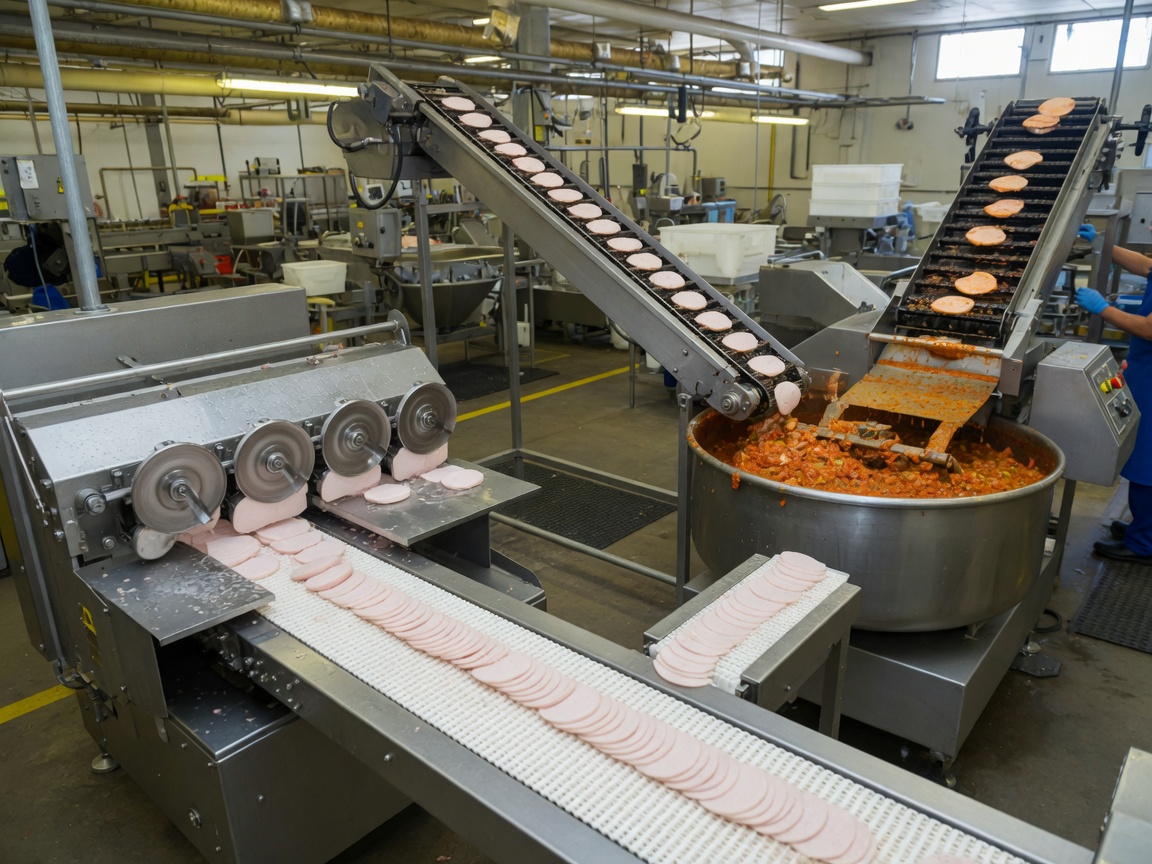
Below is a functional overview of major machine types and their production roles:
| Machine category | Representative equipment | Typical throughput (industrial) | Key compliance note |
|---|---|---|---|
| Washing & sorting | Bubble washer, drum washer, optical sorter | 2–15 tons/hr | FDA 21 CFR Part 117 sanitation |
| Cutting & grinding | Food chopper, food grinder machine, dicer | 500 kg–8 tons/hr | USDA FSIS for meat-contact surfaces |
| Mixing & blending | Industrial blender for food, planetary mixer | 200 kg–5 tons/batch | 3-A Sanitary Standards (dairy) |
| Thermal processing | Pasteurizer, retort, tunnel oven | 1,000–20,000 units/hr | FDA Low Acid Canned Food regs |
| Forming & extrusion | Extruder, molder, depositor | 300 kg–6 tons/hr | NSF/ANSI 51 food equipment |
| Conveying & transport | Food conveyor system, pneumatic conveyor | Continuous, line-matched | BISSC sanitary design standards |
| Packaging | Food packaging machine, vacuum sealer, VFFS | 20–600 packs/min | FDA food contact material regs |
How to choose the right food processing machine: a decision framework
Most buying guides stop at listing machine types. That's not enough. A structured decision framework is what separates facilities that deploy equipment successfully from those that face costly retrofits six months post-installation.
Step-by-step selection process
- Define your product scope: List every SKU that will run through the machine and identify the most challenging material property (highest viscosity, hardest texture, most fragile structure).
- Set throughput targets with headroom: Calculate your peak daily demand, then add 25–30% capacity buffer for growth and downtime events. Undersizing is far more expensive than slightly oversizing.
- Map your regulatory obligations: Determine whether your product falls under FDA, USDA FSIS, or both jurisdictions. This governs material certification requirements before you evaluate a single vendor.
- Evaluate automation depth: Decide between manual, semi-automated, and fully automated food processing based on your labor cost model. At U.S. average food plant wages (~$18–24/hr in 2026), the automation ROI calculation often favors higher capital investment.
- Request sanitation validation data: Ask vendors for documented CIP (Clean-in-Place) cycle times, hygienic design certificates (EHEDG or equivalent), and swab test results from existing installations.
- Verify parts availability and service network: A machine with a six-week lead time on a critical wear part will cost you far more than the list price difference between suppliers. Confirm U.S.-based service coverage.
Common selection mistakes to avoid
Why do so many facilities end up with the wrong equipment? Often because the evaluation focuses entirely on purchase price and ignores operating cost, flexibility, and compliance risk. Just like a fuel-efficient car saves far more over its lifetime than a cheap one with poor mileage, a well-specified industrial food processor almost always returns more value over a 7–10 year asset life than a discount alternative with higher energy draw and more frequent breakdowns.
Of course, there are exceptions. Low-volume, single-SKU operations with predictable demand may find that a simpler, lower-cost commercial food processing unit delivers entirely adequate performance — the key is matching complexity to actual need.
Total cost of ownership (TCO): the real numbers U.S. buyers miss
Purchase price typically represents only 25–40% of a food processing machine's total cost over its operational life. Yet it dominates most procurement conversations. Here is a realistic TCO breakdown based on U.S. operational conditions in 2026.
TCO component breakdown (10-year industrial machine lifecycle)
| Cost category | % of total 10-yr TCO | U.S. benchmark (mid-size line) | Reduction lever |
|---|---|---|---|
| Initial purchase price | 28–38% | $85,000–$600,000 | Competitive bidding, Section 179 |
| Energy consumption | 18–25% | $12,000–$55,000/yr | VFD drives, IE4 motors |
| Labor (operation & sanitation) | 20–30% | $35,000–$90,000/yr | Automation, CIP systems |
| Maintenance & parts | 12–18% | $8,000–$28,000/yr | Predictive maintenance (IoT) |
| Downtime losses | 5–12% | $15,000–$80,000/event | Redundancy, local service network |
| Compliance & audit costs | 3–7% | $5,000–$20,000/yr | Pre-certified equipment selection |
"The biggest financial mistake food manufacturers make is optimizing for purchase price while ignoring the energy and labor cost structure. A machine that saves $30,000 at point of purchase but consumes 40% more electricity will cost $150,000 more over a decade at current U.S. industrial energy rates." — 2026 data, Purdue Extension food systems research, consistent with findings in food processing equipment basics.
Energy cost sensitivity
U.S. industrial electricity averages $0.078–$0.095 per kWh in 2026 (EIA data). A 30 kW motor running two shifts daily for 250 production days costs approximately $11,100–$13,500/year in electricity alone. Variable frequency drives (VFDs) on conveyors and mixers typically reduce motor energy draw by 20–35% — a payback period of under 18 months at that scale. This single specification deserves more weight in your RFQ than most buyers give it.
FDA and USDA compliance: a built-in checklist for machine selection
Regulatory compliance is not a post-purchase concern — it must be integrated into the machine evaluation process from day one. The consequences of selecting non-compliant food production machinery range from forced line shutdowns to facility deregistration. For a complete reference on regulatory registration requirements, consult the official food facility registration guidance from the FDA.
Machine compliance checklist for U.S. facilities
- Material certification: All food-contact surfaces must meet FDA 21 CFR 177 (plastics) or 21 CFR 182 (stainless steel grades 304/316L minimum for wet environments).
- Hygienic design standard: Verify EHEDG, 3-A Sanitary Standard, or NSF/ANSI 51 certification. USDA FSIS requires USDA-accepted equipment listings for meat and poultry contact applications.
- FSMA compliance: Under the Food Safety Modernization Act (FSMA), equipment must support a Hazard Analysis and Risk-Based Preventive Controls (HARPC) plan. Request documentation from vendors showing how the machine supports HARPC implementation.
- Cleanability validation: Demand documented CIP or COP (Clean-Out-of-Place) data including cycle time, chemical compatibility, and accessible dead-angle elimination.
- Allergen control design: If your facility handles multiple allergens, confirm that the machine design supports validated allergen changeover procedures — a growing FDA audit focus in 2026.
- Electrical safety ratings: NEMA enclosure ratings appropriate for wash-down environments (minimum NEMA 4X for wet areas). UL listing required for U.S. electrical code compliance.
USDA-specific requirements for meat processing machines
Meat processing machine procurement carries an additional layer of regulatory scrutiny. USDA FSIS requires that equipment used in federally inspected establishments appear on the approved equipment list or receive individual review. The construction standards are stricter than general food equipment: no exposed threads in product zones, fully drainable designs, and no hollow structural members that could trap product. Specifying to these standards upfront eliminates costly retrofits after installation inspection.
Automation, IoT, and the 2026 technology shift
Automated food processing has moved from competitive advantage to baseline expectation in most U.S. food plant categories. The question in 2026 is no longer whether to automate, but at what level and with what control architecture.
IoT-enabled food processing technology
Modern food processing technology increasingly integrates PLC (Programmable Logic Controller) systems paired with cloud-connected SCADA platforms. What does this mean in practice? A production manager in Ohio can monitor real-time throughput, energy consumption, and vibration signatures on every motor across their food conveyor system — from a tablet, in real time. When a bearing on a critical food grinder machine shows anomalous vibration at 2 a.m., the system generates a maintenance alert before failure occurs. According to 2026 data from McKinsey manufacturing research, predictive maintenance programs in food plants reduce unplanned downtime by 30–50%.
Modular and flexible manufacturing design
The rise of SKU proliferation — a structural reality in U.S. retail food — has made quick-changeover capability a primary equipment specification. Modular food plant machinery allows a single production line to process multiple product formats with minimal downtime between runs. Industry consensus is that facilities processing more than 12 distinct SKUs on a single line should specify modular tooling and automated format changeover as standard — not optional features. The cost premium is typically 10–18% over fixed-format equivalents, but changeover time reduction from 45 minutes to under 8 minutes creates substantial OEE (Overall Equipment Effectiveness) gains.
Financing, leasing, and Section 179 deductions for U.S. buyers
Capital equipment decisions are financial decisions as much as operational ones. Yet most food processing machine buying guides ignore the financing side entirely — a significant gap that costs U.S. buyers real money.
Section 179 deduction: what it means for equipment buyers
The IRS Section 179 deduction allows U.S. businesses to deduct the full purchase price of qualifying equipment in the year it is placed in service, rather than depreciating it over years. For 2026, the deduction limit is $1,220,000, with a phase-out threshold beginning at $3,050,000 in total equipment purchases. A facility purchasing a $300,000 automated food processing line could deduct the full cost in year one, resulting in actual tax savings of $63,000–$99,000 depending on effective tax rate — a material reduction in first-year net outlay that many smaller facilities overlook when building their business case.
Equipment leasing and financing structures
For facilities where capital preservation is a priority, equipment leasing through USDA Business & Industry loan programs or commercial lenders like BofA Equipment Finance and Wells Fargo Equipment Finance offers 36–84 month terms on food manufacturing equipment. Operating leases preserve balance sheet flexibility and include upgrade options — particularly relevant for rapidly evolving food processing technology categories where a machine purchased today may be superseded by superior automation capability within five years. Sale-leaseback arrangements on existing equipment can also free capital for line upgrades without new debt.
Real-world ROI: U.S. case studies from small and mid-size facilities
Abstract ROI models are useful. Actual case data is better. The following examples are drawn from documented deployment outcomes in U.S. food manufacturing facilities.
Case study 1: mid-size deli meat processor, Pennsylvania
A 65-employee deli meat processing operation replaced two manual slicing lines with a single automated meat processing machine system incorporating PLC controls and inline checkweighing. Purchase price: $420,000. Annual labor savings from reduced headcount and overtime: $118,000. Energy cost reduction from VFD-equipped drives vs. previous fixed-speed motors: $14,200/year. Reduction in giveaway product weight (precision portioning): $22,000/year recovered margin. Total annual benefit: approximately $154,200. Full payback: 32 months. By month 48, the facility was generating net positive return of over $200,000 annually from the capital investment.
Case study 2: small produce washing facility, California
A family-owned vegetable processing equipment installation — a drum washer with optical sorting integrated into a food conveyor system — replaced manual inspection tables and hand-washing stations. Total investment: $95,000 including installation. The facility eliminated two full-time sorting positions ($86,000/year combined labor cost) and reduced water consumption by 38% (saving $9,400 annually at California industrial water rates). FDA audit readiness also improved: the automated system generated digital traceability logs that satisfied FSMA requirements without additional administrative staff. Payback achieved in 11 months.
These results are not outliers. According to recent research from the Food Processing Suppliers Association (FPSA), small-to-mid-size U.S. facilities deploying automated food processing equipment between 2023 and 2025 reported median payback periods of 18–28 months, with 10-year IRR averaging 31%. The financial case for modern food production machinery has never been stronger — provided the selection process is disciplined.
Choosing the right food processing machine: final guidance
The right food processing machine for your facility is not the cheapest one available, nor the most technically advanced one on the market. It is the machine that best aligns with your throughput requirements, regulatory obligations, labor cost structure, and growth trajectory — evaluated over a full 10-year TCO horizon, not a purchase price line item. Apply the decision framework in this guide, integrate compliance requirements from day one, build your financing structure deliberately, and measure every investment against documented ROI benchmarks. That is how the best U.S. food manufacturers make these decisions — and how you should too.
Frequently asked questions
Q: What is the difference between a commercial and an industrial food processing machine?
A: Commercial food processing equipment typically handles under 500 kg per day and is designed for restaurants or small-batch operations. Industrial food processors operate at tons-per-hour throughput, use certified food-grade materials, and meet stricter FDA/USDA regulatory requirements. The two categories differ fundamentally in construction, certification, and long-term maintenance needs.
Q: What FDA regulations apply to food processing machine selection in the U.S.?
A: Key regulations include FDA 21 CFR Part 117 (current Good Manufacturing Practice), FSMA Preventive Controls rules, and food-contact material standards under 21 CFR 177 and 182. Meat and poultry equipment must additionally meet USDA FSIS construction standards and appear on USDA-accepted equipment lists for federally inspected establishments.
Q: Can I deduct the full cost of a food processing machine in the first year?
A: Yes, in most cases. The IRS Section 179 deduction allows U.S. businesses to immediately expense qualifying equipment placed in service during the tax year. The 2026 deduction limit is $1,220,000. Consult your tax advisor to confirm eligibility and optimize the deduction timing within your capital expenditure plan.
Q: How do IoT and automation features affect the value of a food processing machine?
A: IoT-enabled food processing technology — including PLC controls, cloud-connected sensors, and predictive maintenance alerts — reduces unplanned downtime by 30–50% and lowers maintenance costs. These features also generate digital traceability data that satisfies FDA FSMA recordkeeping requirements, reducing audit preparation burden significantly.
Q: What is a realistic payback period for an automated food processing machine investment?
A: Based on 2026 data from U.S. small-to-mid-size facilities, median payback periods for automated food production machinery range from 18 to 32 months, depending on labor savings, product giveaway reduction, and energy efficiency gains. Facilities replacing manual inspection or slicing operations typically see the fastest returns due to immediate labor cost reductions.
previous page
previous page
Please tell us your needs.
If you have any questions about our company, please feel free to contact us. We will reply as soon as possible. Thank you for your inquiry.

Adress:7 # Standard Factory Building in Baoshan Industrial and Trade Park, Yunnan Province
Customer service:+86-400-176-6898
Tel:+86-0875-2870888
Phone:+86-18187573906
Email:Abner@ynaofu.com
Factory VR
Video ID
Copyright © 2023 Yunnan Aofu Intelligent Equipment Co., Ltd. (this website supports IPV6)