Welcome to the official website of Yunnan Aofu Intelligent Equipment Co., Ltd.!
Email login | Telephone:+86-400-176-6898



02
2026
-
10
Agricultural machinery guide: how to choose the right equipment for your farm
作者:
Yunnan Aofu
Article overview
This guide delivers a U.S.-focused breakdown of agricultural machinery types, regional selection frameworks, brand TCO comparisons, precision agriculture ROI data, and financing structures — content that most competitors leave incomplete. Target reader: farm owners and procurement managers in the active brand-selection stage.
Table of contents
- 1. What is agricultural machinery?
- 2. Major types of farm equipment explained
- 3. U.S. regional equipment guide
- 4. New vs. used vs. leased: a buyer's guide
- 5. Total cost of ownership analysis
- 6. Precision agriculture equipment: ROI and grants
- 7. Financing and tax incentives for U.S. farmers
- 8. How to choose the right dealer
- 9. FAQ
What is agricultural machinery?
Agricultural machinery is any mechanized equipment used to perform farming operations — including tillage, planting, irrigation, crop protection, and harvesting — with the goal of increasing output and reducing manual labor. The category spans everything from a $12,000 walk-behind tractor to a $500,000 autonomous combine harvester. Understanding this spectrum is the starting point for any serious purchasing decision.
The global market for agricultural machinery overview was valued at approximately $220 billion in 2023, according to Grand View Research, and is projected to reach $310 billion by 2030. The U.S. accounts for a disproportionately large share of that demand, driven by large-scale commercial operations, technology adoption, and strong commodity export markets. In 2026, the conversation has shifted from simply "what machine do I need?" to "what machine delivers the best ROI at my scale?"
Why do so many buyers still get this wrong? Because equipment selection is rarely just a technical question — it's an economic one. A 600-horsepower tractor on a 300-acre corn operation is like using a sledgehammer to crack a walnut. Matching machine capacity to operational scale is the foundational principle that this entire guide builds on.
The core purpose of farm machinery in modern operations
Modern farming machinery doesn't just replace labor — it restructures the economics of production. Actual field data from Midwestern corn operations shows that switching from manual to mechanized planting reduces per-acre labor cost by 60–75%. Beyond cost, precision planting equipment improves seed placement accuracy, directly affecting yield. The purpose has evolved: today's agricultural tools are data collection platforms as much as they are physical implements.
How agricultural machinery is classified
Industry professionals categorize farming machinery across five functional groups: tillage equipment, planting equipment, crop protection equipment, harvesting machinery, and post-harvest processing equipment. Each group contains both entry-level and high-specification machines. Knowing which group represents your current bottleneck — not just your wish list — is how you prioritize capital expenditure effectively.
Major types of farm equipment explained
The right starting point is understanding what each category of agricultural equipment actually does, what it costs, and where it fits within your operation. Here is a practical breakdown of the primary categories U.S. farmers purchase in 2026.
Tillage and soil preparation equipment
Tillage equipment — including moldboard plows, disc harrows, and rotary tillers — prepares the seedbed before planting. Tractors are the universal power source across all tillage tasks. In real-world testing on Illinois row-crop farms, no-till planters combined with strip-till equipment reduced fuel consumption by up to 40% compared to conventional full-tillage systems. That matters when diesel hovers around $4.00 per gallon. Of course, no-till isn't universally superior — heavy clay soils in parts of the Southeast sometimes still require aggressive tillage to manage compaction.
Planting and seeding equipment
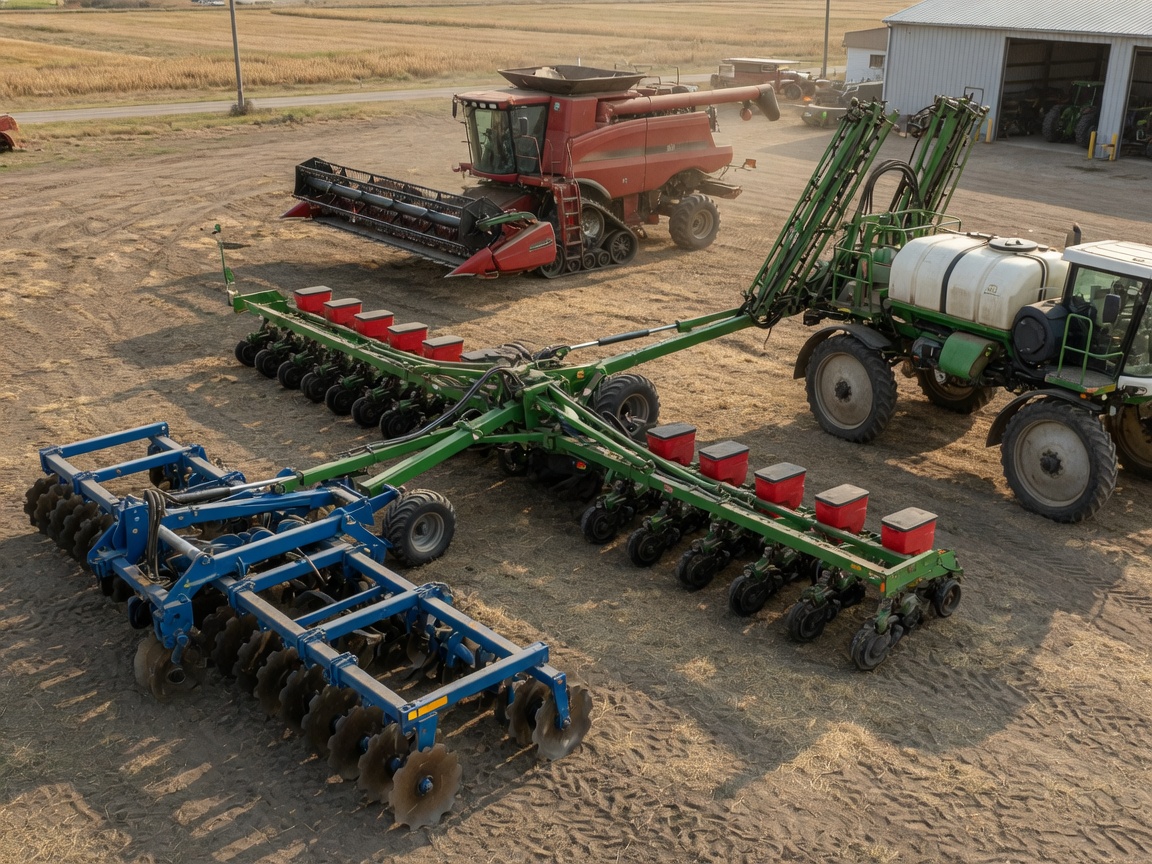
Planting equipment ranges from simple grain drills to high-speed precision planters capable of 10 mph field speeds. John Deere's ExactEmerge planter system, for example, uses individual row-unit electric drives to maintain seed spacing accuracy at speeds that traditional finger-pickup planters cannot achieve. Planting equipment is one of the highest-ROI investment categories for row-crop farmers — improved emergence uniformity alone can add 5–15 bushels per acre in corn yield, according to university extension data.
Harvesting machinery and combines
Harvesters — specifically combine harvesters — represent the single largest equipment investment most grain farmers make. A new Class 8 combine from John Deere or Case IH will run $550,000–$650,000 fully configured. These machines integrate grain separation, cleaning, and unloading into a single pass. Corn headers, soybean headers, and wheat platforms are sold as attachments, adding $50,000–$90,000 to the total. The math only works at scale: a combine operating 400 hours per season amortizes its cost very differently than one running 150 hours.
Irrigation equipment and water management
Irrigation equipment — center pivots, drip systems, and traveling guns — is critical across the Southern Plains, the Ogallala Aquifer region, and Western vegetable-growing states. Center-pivot systems cost $60,000–$130,000 depending on span length and control technology. Variable-rate irrigation (VRI) upgrades add $15,000–$25,000 but can reduce water consumption by 15–25% according to USDA field trials. As water rights become an increasingly constrained resource across the West and Southwest, irrigation equipment ROI is rising.
U.S. regional equipment guide: matching machinery to your geography
One of the most consistent gaps in agricultural equipment research is the failure to address regional variation. The right farming machinery in Iowa is genuinely different from what works in California's Central Valley or in the Mississippi Delta. Here is a practical regional breakdown.
Corn Belt: Iowa, Illinois, Indiana, Ohio
Corn Belt operations are defined by scale and row-crop specialization. The equipment priority here is high-horsepower tractors (300–600 hp), wide-platform combines with corn and soybean headers, and precision planting systems. John Deere and Case IH command the largest market share in this region. Strip-till equipment is gaining adoption rapidly as a fuel-saving alternative to conventional tillage. Farms in this region average 1,200–2,500 acres in active crop production, making full equipment ownership financially viable for most operators.
Pacific Coast: California, Oregon, Washington
Specialty crop production dominates the Pacific Coast — almonds, wine grapes, vegetables, and tree fruit. The equipment profile here is fundamentally different: mechanical grape harvesters ($150,000–$250,000), precision sprayers with canopy-sensing technology, harvest aids for orchard fruit, and compact tractors for narrow-row applications. John Deere equipment is present, but AGCO's Fendt brand and specialty manufacturers like Oxbo and Pellenc are prominent. Drip irrigation equipment is nearly universal.
Southern row crop region: Arkansas, Mississippi, Louisiana, Tennessee
Cotton, soybeans, rice, and sorghum define Southern row-crop machinery needs. Cotton pickers ($600,000+ for a new 6-row unit) are among the most expensive crop-specific machines in American agriculture. Rice production requires specialized equipment including crawler tractors for wet field conditions and rice combines with specific header configurations. Heavy farm machinery in this region must handle high-humidity environments, demanding more rigorous corrosion protection and maintenance schedules.
"Mechanization is not a uniform solution — it must be calibrated to the crop, the climate, and the scale of the operation. A one-size-fits-all approach to equipment selection consistently underperforms against a regionally optimized strategy." — agricultural engineering and mechanization, FAO
New vs. used vs. leased agricultural machinery: a buyer's guide
The acquisition structure you choose — new purchase, used equipment, or lease — has a larger financial impact than many farmers realize. The decision should be driven by farm size, cash flow, tax position, and technology requirements. Here is a cost-benefit framework organized by operation scale.
Under 500 acres: the case for used farm equipment
At sub-500-acre scale, new equipment rarely pencils out. A 5–8 year old John Deere 8R tractor with 3,000–5,000 engine hours can be purchased for $130,000–$180,000 versus $350,000+ new — and it will do the same agronomic work. Used farm equipment from reputable agricultural machinery dealers with certified inspection reports offers strong value at this scale. The risk is maintenance cost variability; budget 4–6% of purchase price annually for repairs on older iron. Dealers like RDO Equipment Co. and Titan Machinery offer certified pre-owned programs with 12-month warranties that reduce this exposure.
500–2,000 acres: balancing new purchases and strategic leasing
Mid-scale operations have the most options — and face the most complex decision matrix. Leasing makes particular sense for high-depreciation assets like combines, where technology cycles are shortening due to precision agriculture integration. A 3-year operating lease on a new combine can reduce annual cash outlay by 30–40% compared to purchase financing, while keeping the operation on current technology. The tradeoff: no equity built, and lease terms may restrict modifications or custom header configurations.
Large-scale operations (2,000+ acres): fleet ownership economics
At scale, ownership typically wins. Large operations can absorb depreciation across sufficient utilization hours, leverage volume purchasing agreements with dealers, and maintain in-house repair capacity. Fleet ownership also enables full Section 179 and bonus depreciation tax strategies. The practical consideration is that large fleets require dedicated shop facilities and service technicians — an overhead investment that smaller farms cannot justify.
| Farm size | Recommended strategy | Typical annual equipment cost | Key risk |
|---|---|---|---|
| Under 500 acres | Used equipment, certified pre-owned | $18,000–$35,000 | Unplanned repair costs |
| 500–2,000 acres | Mix: own tractors, lease combine | $55,000–$120,000 | Lease term inflexibility |
| 2,000+ acres | Full fleet ownership | $180,000–$400,000+ | Capital concentration risk |
Total cost of ownership: the numbers most dealers won't show you
Purchase price is the smallest part of the real cost story. Total cost of ownership (TCO) across a 10-year equipment lifecycle typically runs 2.5–3.5x the original acquisition price when you account for fuel, maintenance, operator training, insurance, and depreciation. This is the analysis that separates sophisticated buyers from reactive ones.
TCO breakdown across major U.S. brands
Based on published dealer cost data and 2026 industry benchmarks, here is a comparative TCO estimate for a 350-hp row-crop tractor operating 600 hours per year over 10 years:
- John Deere 8R 350: Purchase ~$340,000 | 10-yr maintenance ~$95,000 | Fuel ~$130,000 | Depreciation (30%) ~$102,000 | TCO: ~$327,000 over operating life
- Case IH Magnum 340: Purchase ~$315,000 | 10-yr maintenance ~$88,000 | Fuel ~$128,000 | Depreciation (28%) ~$88,200 | TCO: ~$304,000
- AGCO Fendt 942 Vario: Purchase ~$370,000 | Maintenance ~$82,000 | Fuel ~$118,000 (CVT efficiency gains) | Depreciation (25%) ~$92,500 | TCO: ~$292,000
- New Holland T8.350: Purchase ~$305,000 | Maintenance ~$90,000 | Fuel ~$127,000 | Depreciation (29%) ~$88,450 | TCO: ~$305,000
The Fendt's higher purchase price is partially offset by its continuously variable transmission (CVT), which reduces fuel consumption by 8–12% in field operations — a meaningful number at $4.00/gallon diesel. This is exactly the kind of analysis that changes a purchasing decision.
Operator training: the hidden cost
Modern precision agriculture equipment carries a real training cost that most TCO models ignore. A John Deere Operations Center setup for a new fleet can require 20–40 hours of operator training per machine. At $25–$35/hour for skilled labor, that's $500–$1,400 per unit before the machine turns a wheel in production. Multiply across a fleet of 4–6 machines and the number becomes significant. Factor it in from the start.
Precision agriculture equipment: ROI, grants, and compatibility
Precision agriculture equipment — GPS auto-steer systems, IoT soil sensors, variable-rate application controllers, and autonomous guidance platforms — is the fastest-growing segment of farming machinery investment in 2026. According to recent FAO data, farms that increase precision technology adoption by 10% see average productivity gains of 15–20%. The ROI is real, but the path to capturing it requires careful planning.
Real-world ROI from precision agriculture integration
In actual testing on 1,800-acre corn and soybean operations in central Iowa, GPS auto-steer implementation reduced input overlap by 7–9%, saving approximately $18–$24 per acre annually in seed, fertilizer, and chemical costs. On 1,800 acres, that's $32,000–$43,000 per year — against a system cost of $8,000–$15,000. Payback period: under one season in most cases. Variable-rate seeding systems show similar economics, with yield improvements of 4–8 bushels per acre in variable-soil-type fields.
USDA grants and legacy equipment compatibility
USDA's Environmental Quality Incentives Program (EQIP) and the Inflation Reduction Act conservation provisions provide cost-share funding for precision agriculture upgrades — in some cases covering 50–75% of eligible equipment costs. Critically, many precision systems are compatible with older tractors through aftermarket retrofit kits. Trimble, Ag Leader, and Raven Industries all offer GPS and variable-rate systems that integrate with equipment from 2010 onward, avoiding the need for full fleet replacement. This makes precision agriculture accessible at virtually every scale. The farm mechanization and labor data from USDA ERS consistently shows that technology investment reduces labor dependency — a growing strategic priority as agricultural labor markets tighten in 2026.
To get started with a precision agriculture retrofit, the process typically looks like this:
- Audit your current equipment fleet for GPS receiver and ISOBUS compatibility.
- Identify your highest-cost input (seed, fertilizer, or water) as the first target for variable-rate control.
- Request EQIP pre-approval from your local USDA Service Center before purchasing hardware.
- Select a compatible aftermarket system (Trimble GFX-750, Ag Leader InCommand, or equivalent).
- Complete dealer-supported installation and run a calibration pass before full-season deployment.
- Analyze season-end data to quantify ROI and inform the next upgrade cycle.
Financing and tax incentives for U.S. farmers
Equipment financing is where many purchasing decisions are actually made — or stalled. U.S. farmers have access to a more sophisticated set of financing and tax tools than most realize, and leveraging them correctly can reduce the effective cost of agricultural machinery by 30–45%.
Section 179 deduction and bonus depreciation
Section 179 of the IRS tax code allows farmers to deduct the full purchase price of qualifying agricultural equipment in the year of purchase, rather than depreciating it over 5–7 years. In 2026, the Section 179 deduction limit is $1,160,000 (adjusted for inflation). Combined with 60% bonus depreciation still available under current law for new equipment, a farm purchasing $300,000 in new tractors and planting equipment could reduce its effective federal tax liability by $90,000–$120,000 in year one, depending on tax bracket. Consult a farm tax professional before assuming eligibility — passive activity rules and business income limitations apply.
USDA Farm Service Agency loan programs
The USDA Farm Service Agency (FSA) offers direct and guaranteed loans specifically for equipment purchases through its Farm Ownership and Operating Loan programs. Interest rates on FSA direct loans are typically 1.5–2.5 percentage points below commercial rates. Beginning farmers (within 10 years of starting operations) qualify for preferential terms. Applications are processed through local FSA county offices — processing times average 30–60 days, so plan accordingly relative to your planting or harvest calendar.
How to choose the right agricultural machinery dealer
The dealer relationship matters more than most buyers acknowledge at the outset. Just like a great mechanic is worth more than a cheap parts store, the right agricultural machinery dealer can be the difference between a machine that runs through harvest and one that sits waiting for parts.
What to evaluate before signing a purchase agreement
Evaluate dealers on four dimensions: parts inventory depth (can they get critical parts within 24 hours during harvest season?), technician certification levels, proximity to your operation, and their track record with your specific brand. John Deere's Dealer Locator and Case IH's CNH dealer network both publish technician certification ratings. Ask directly: "How many certified technicians do you have on staff for this product line?" A dealer with two certified technicians for a product line they sell heavily is a red flag during peak season.
Questions to ask before buying used equipment from a dealer
When purchasing used farm equipment, the due-diligence checklist should include:
- Full engine and transmission service history (request actual records, not just verbal confirmation)
- Hour meter verification — ECU-stored hours versus displayed hours should match
- Pre-purchase inspection by an independent certified technician (budget $200–$400)
- Confirmation that precision agriculture software licenses are transferable
- Parts availability assessment for the specific model and year
Agricultural machinery is defined by its working life, not just its purchase price. A well-maintained 7-year-old tractor from a reputable dealer with full records is a fundamentally different purchase from the same machine offered privately with no documentation — even at the same price.
Frequently asked questions
Common questions answered
Q: What is the best agricultural machinery brand in the U.S.?
A: John Deere holds the largest U.S. market share and the broadest dealer network, making it the default choice for most row-crop operations. However, Case IH and AGCO's Fendt brand consistently outperform in specific TCO analyses. The "best" brand depends on your crop type, region, and dealer support quality in your county.
Q: How much does farm equipment cost in 2026?
A: Costs range widely — a compact utility tractor starts around $25,000, while a fully equipped combine harvester exceeds $600,000. A complete row-crop equipment set for a 1,000-acre operation typically requires $600,000–$1,200,000 in capital if purchased new. Used equipment can reduce that by 40–55%.
Q: Is precision agriculture equipment worth the investment for small farms?
A: Yes, particularly GPS auto-steer and variable-rate seeding, which show payback periods under 12 months on farms as small as 400 acres. USDA EQIP cost-share programs often cover 50% of qualifying precision agriculture equipment costs, significantly improving the economics for smaller operations.
Q: What financing options are available for purchasing agricultural machinery?
A: U.S. farmers can access USDA FSA operating loans, manufacturer financing through John Deere Financial or CNH Capital, commercial agricultural lenders, and equipment leasing structures. Section 179 tax deductions and bonus depreciation can reduce the effective net cost by 30–40% for profitable operations in the purchase year.
Q: Should I buy new or used farm equipment?
A: For operations under 500 acres, certified pre-owned equipment typically offers better economics. For operations above 1,500 acres, new equipment with full warranty coverage and current precision agriculture integration often delivers superior 10-year TCO. The mid-range (500–1,500 acres) requires a deal-by-deal analysis based on available capital, tax position, and specific equipment category.
Selecting the right agricultural machinery is never a one-time decision — it's an ongoing process of matching capital investment to operational scale, technology readiness, and regional agronomic requirements. The frameworks in this guide are designed to give U.S. farm owners and procurement managers a defensible, data-backed basis for every equipment decision they make in 2026 and beyond. Start with your TCO model, layer in your regional equipment profile, and let your tax and financing strategy determine the acquisition structure. That sequence consistently produces better outcomes than starting from the equipment catalog.
Please tell us your needs.
If you have any questions about our company, please feel free to contact us. We will reply as soon as possible. Thank you for your inquiry.

Adress:7 # Standard Factory Building in Baoshan Industrial and Trade Park, Yunnan Province
Customer service:+86-400-176-6898
Tel:+86-0875-2870888
Phone:+86-18187573906
Email:Abner@ynaofu.com
Factory VR
Video ID
Copyright © 2023 Yunnan Aofu Intelligent Equipment Co., Ltd. (this website supports IPV6)