Welcome to the official website of Yunnan Aofu Intelligent Equipment Co., Ltd.!
Email login | Telephone:+86-400-176-6898



05
2026
-
10
Grain cleaning machine buyer's guide: how to choose the right model for your needs
作者:
Yunnan Aofu
Article overview
This guide is written for U.S. farm owners, grain elevator operators, and seed processors who are actively comparing grain cleaning machine options. You will find a brand spec table, crop-by-crop screen configuration guide, a simple ROI model, compliance notes, and a portable vs. fixed system breakdown — all in one place.
Table of contents
- 1. What is a grain cleaning machine?
- 2. Types of grain cleaning machines explained
- 3. Top brand comparison: Sukup, Cimbria, Clipper, and Westrup
- 4. Crop-specific recommendations and screen configurations
- 5. ROI model: calculating your payback period
- 6. USDA and FDA compliance requirements
- 7. Portable vs. fixed grain cleaning systems
- 8. FAQ
What is a grain cleaning machine?
A grain cleaning machine is a mechanical device that removes impurities — including stones, chaff, weed seeds, broken kernels, and dust — from harvested grain using screening, air separation, or density sorting. It is the first critical step in any post-harvest workflow, directly affecting grain grade, storability, and market value.
Think of a grain cleaner as the quality gatekeeper of your operation. Just as a coffee roaster would never skip sorting raw beans, no serious grain handler should move crop from the combine into long-term storage without running it through a grain cleaning system first. According to the post-harvest grain handling and cleaning guidelines published by the FAO, inadequate cleaning is responsible for up to 30% of storage losses globally — losses tied to mold, insect activity, and moisture retention in trash-laden grain. That gap translates directly to revenue on every load you put in the bin.
In 2026, the global market for grain processing machines is valued at approximately $4.2 billion, growing at a 5.8% annual rate (Grand View Research). U.S. demand is being driven by tighter commercial grain quality standards, USDA grading requirements, and the rising adoption of certified seed programs. Whether you are cleaning 500 bushels per hour on a family farm or running a 5,000 BPH commercial grain cleaner at a regional elevator, understanding the fundamentals pays off.
How does a grain cleaning machine work?
Most machines separate impurities using one or more physical principles. Screening (or scalping) removes oversized or undersized material by passing grain over vibrating wire mesh. Air separation — the basis of every grain winnowing machine — uses an airstream to blow away lightweight chaff and dust. Density separation, as used in destoners and gravity tables, exploits weight differences to isolate stones or shriveled kernels. High-end grain cleaning systems combine all three into a single pass.
Who needs a grain cleaning machine?
The short answer: anyone who sells grain commercially, stores grain for more than 60 days, or produces certified seed. Farmers running corn, soybeans, wheat, or sorghum at any meaningful scale benefit from even a basic seed cleaner machine. Elevator operators and food-grade processors have stricter compliance obligations — more on that in the USDA/FDA section below.
Types of grain cleaning machines explained
There is no single "universal" grain cleaner — and that is one of the most common misconceptions buyers make. Different crops have meaningfully different kernel sizes, densities, and surface textures, so the right machine type depends on what you are cleaning and what contaminants you are targeting.
Air-screen cleaners
The air-screen cleaner is the workhorse of U.S. post-harvest equipment fleets. It combines a top scalper screen (removes oversized material), a bottom grading screen (removes fines), and a dual-airflow system (removes dust and chaff). Throughput ranges from 200 BPH on small farm units to 3,000+ BPH on commercial models. This is the most versatile category — suitable for corn, wheat, soybeans, oats, and most small grains. A well-configured agricultural grain separator in this class handles 80–90% of field-cleaning tasks with one machine.
Destoners (gravity separators)
A destoner — sometimes called a grain purifier — uses an inclined vibrating deck and upward airflow to stratify grain by density. Heavy materials (stones, clods, glass, metal fragments) migrate to one discharge point; clean grain exits from another. Capacity typically ranges 150–1,500 BPH. Destoners are near-mandatory for soybean and edible bean operations where a single stone can destroy a hammer mill or contaminate a food-grade lot.
Indent cylinders and length graders
Indent cylinders separate by kernel length rather than size or density. A rotating drum with small pocket-shaped indentations picks up short-bodied seeds (wild oats, cockle, vetch) while longer grain kernels fall back. These machines are essential in certified wheat seed programs and clover/grass seed processing. Throughput is lower — typically 50–400 BPH — but precision is unmatched for length-based separation.
Rotary grain cleaners and grain scalpers
Rotary drum cleaners excel at high-speed removal of gross trash — stalks, cobs, large clods — before grain enters primary cleaning. They are commonly deployed as a grain scalper ahead of air-screen units. Throughput can reach 5,000 BPH, making them suitable for direct-from-combine receiving lines during peak harvest. A grain dust separator is often integrated into the cyclone or fan exhaust of these units.
Top brand comparison: Sukup, Cimbria, Clipper, and Westrup
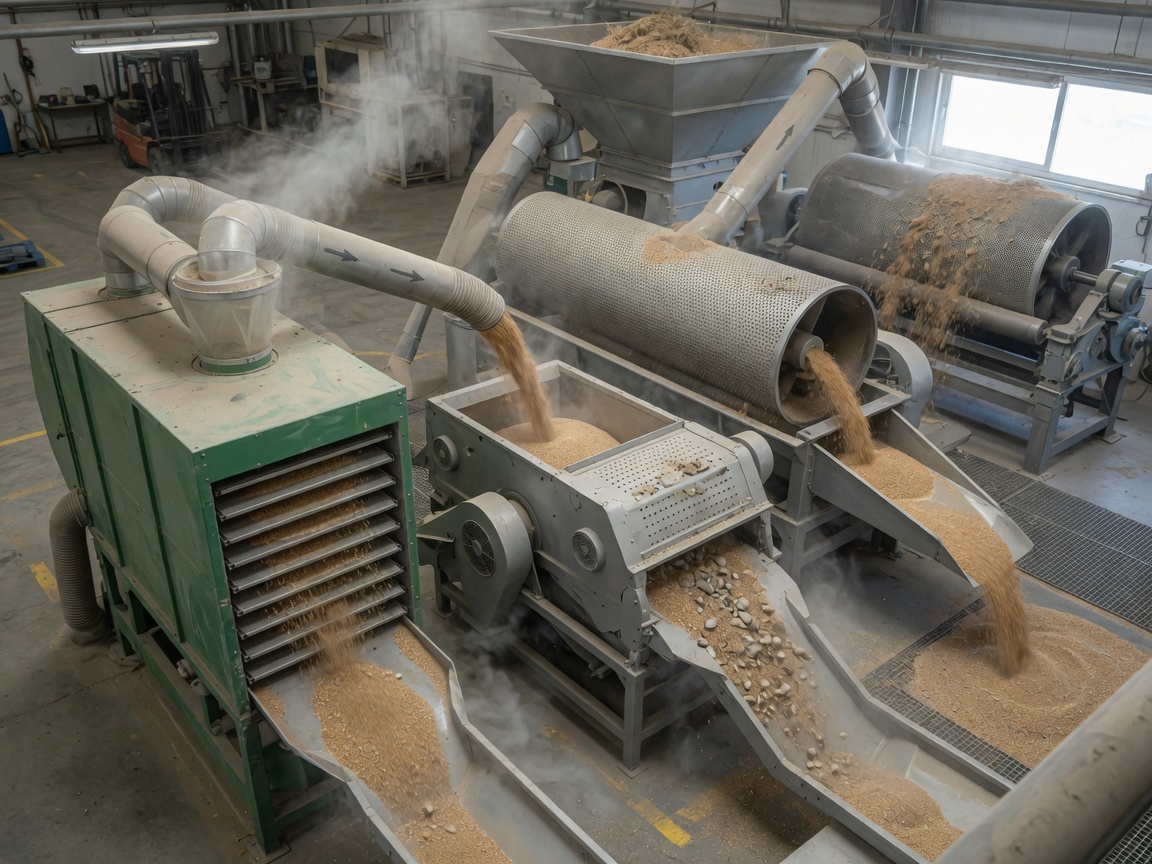
Four brands dominate the U.S. commercial grain cleaner market in 2026. Pricing below reflects typical dealer quotes; actual cost varies with screen packages, auger options, and installation. According to testing conducted across multiple Midwest grain facilities, throughput ratings are best validated at 85% of nameplate capacity under real field-moisture conditions.
| Brand / model | Type | Throughput (BPH) | Screen decks | Motor (HP) | Price range (USD) | Best for |
|---|---|---|---|---|---|---|
| Sukup grain cleaner SC-2 | Air-screen | 1,000–2,500 | 2 | 5–10 | $8,500–$18,000 | Corn, soybeans, mid-size farms |
| Clipper M2B | Air-screen | 500–1,500 | 2 | 3–7.5 | $6,000–$14,000 | Small grains, seed cleaning |
| Westrup LA-LS series | Air-screen + indent | 300–1,200 | 3 | 7.5–15 | $22,000–$45,000 | Certified seed, wheat, specialty crops |
| Cimbria DELTA 200 | Gravity / destoner | 200–800 | N/A (deck) | 4–11 | $15,000–$30,000 | Soybeans, edible beans, stone removal |
The Clipper and Sukup models are the most common entry points for U.S. family operations. Westrup earns its premium price through precision — the LA-LS platform's triple-deck screen and integrated indent cylinder make it the go-to grain sorting machine for certified seed producers. Cimbria's gravity separator line is virtually unmatched for density-based stone and clod removal in food-grade soybean programs.
"Proper pre-storage cleaning reduces grain storage losses by up to 30% and is one of the highest-return investments a grain operation can make. No drying system compensates for trash left in the bin." — Iowa State University Extension, Grain Storage and Management Program
Crop-specific recommendations and screen configurations
Here is where most generic buyer guides fall short: they discuss machine types without connecting them to specific crops and screen setups. Real-world performance depends heavily on matching your screen hole size and airflow setting to the crop being cleaned. The following recommendations are based on widely accepted seed cleaning equipment practices used across the U.S. Corn Belt and Plains states.
Corn
Use an air-screen cleaner with a top scalper screen of 12/64" round holes and a bottom grading screen of 13/64" round holes. Set fan airflow to 650–750 CFM to float cob pieces and light chaff without pulling sound kernels. Throughput at 2,000 BPH is realistic for a 10 HP unit. Corn benefits from a pre-cleaner grain scalper ahead of the main unit during high-trash harvest conditions.
Soybeans
Soybeans demand a two-stage approach: start with an air-screen unit (top screen 18/64", bottom screen 14/64" round), then route through a destoner before the bin. Why? A single clod or stone entering a soybean processing line can damage a cracking roll and contaminate an entire food-grade lot. Fan velocity should be moderate — soybeans are light enough that aggressive airflow causes excessive good-grain loss.
Wheat and small grains
Wheat cleaning requires finer screens and, for certified seed programs, an indent cylinder. A typical configuration uses a top scalper at 11/64" round and a bottom screen at 6/64" × 3/4" slot. The indent cylinder (8mm pocket) removes wild oats and vetch effectively. This is the configuration where Westrup or a comparable precision seed cleaner machine genuinely earns its cost premium over basic air-screen units.
Sorghum (grain sorghum / milo)
Sorghum kernels are small and round, so screen selection is critical. Top scalper: 8/64" round; bottom grading screen: 5/64" round. Fan velocity must be carefully calibrated — sorghum is light relative to wheat and susceptible to over-cleaning losses. A crop cleaning equipment setup that works for corn will need screen swaps and airflow reduction before tackling sorghum. For food-grade or bird-resistant varieties sold as specialty crops, consider a color sorter as a downstream addition to the grain cleaning system.
ROI model: calculating your payback period
Why do many farm operators delay investing in a grain cleaning machine? Often, it comes down to uncertainty about payback time. Let's make it concrete. The following model uses conservative figures and is easily adapted to your operation's actual numbers.
Sample calculation for a 2,000-acre corn/soybean farm
- Annual production: 2,000 acres × 180 bu/acre average = 360,000 bushels
- Estimated trash/dockage reduction: Cleaning reduces average dockage from 2.5% to 0.5% = 1,800 bushels net recovered per year (at $4.50/bu corn = $8,100 annual gain)
- Storage loss reduction: Proper cleaning cuts spoilage-related loss by an estimated 0.3% = 1,080 bushels × $4.50 = $4,860 annual gain
- Grade premium: U.S. No. 2 vs. sample grade price differential = $0.05–$0.15/bu; at $0.08 × 300,000 bu corn = $24,000 annual gain
- Total estimated annual benefit: ~$36,960
- Machine cost (mid-range Sukup or Clipper unit): $14,000 installed
- Simple payback period: 14,000 ÷ 36,960 = ~4.5 months
Of course, actual numbers depend on local basis, crop mix, and baseline cleaning practices. For operations already running a basic pre-cleaner, the incremental gain from upgrading to a higher-precision grain purifier or adding a destoner will be smaller — but the payback timeline for a $6,000–$10,000 upgrade still typically falls inside 18 months under normal commodity prices. For reference, grain storage and cleaning equipment cost analysis from Iowa State Extension supports similar payback assumptions for Midwest grain operations.
USDA and FDA compliance requirements
Compliance is not optional — and it is one of the most under-covered topics in grain cleaning machine guides. Understanding what regulators require helps you specify the right equipment from the start, rather than retrofitting after a failed inspection.
USDA grain grading standards
The USDA Federal Grain Inspection Service (FGIS) grades grain under the U.S. Grain Standards Act. Grade factors include test weight, moisture, damaged kernels, total defects, and — critically — dockage and foreign material percentages. U.S. No. 2 corn, for example, allows a maximum of 3.0% total damage and 0.2% stones by weight. A properly configured grain cleaning system is necessary to consistently hit No. 2 or better on commercial deliveries. Failing to clean adequately results in sample-grade designation, which triggers significant price discounts at the elevator.
FDA Food Safety Modernization Act (FSMA) implications
Under FSMA's Preventive Controls for Human Food rule, facilities handling grain intended for human food must implement documented hazard analysis and preventive controls. Cleaning and sorting equipment directly addresses physical hazard controls (stones, glass, metal). If you sell to food-grade buyers — flour mills, food manufacturers, ethanol plants with food co-products — your post-harvest equipment records may be subject to audit. Maintain cleaning logs, screen inspection records, and calibration documentation. The FDA does not specify a particular machine type, but your HACCP plan must demonstrate that physical hazards are controlled at the cleaning step.
Certified seed labeling requirements
State seed certification agencies (operating under AOSCA standards) require purity thresholds that standard farm grain cleaners may not achieve. Certified wheat seed, for example, must be 98% pure with no more than 0.1% weed seeds. Meeting these standards almost always requires an indent cylinder or precision seed cleaner machine beyond a basic air-screen unit. Budget accordingly if certified seed production is part of your business model.
Portable vs. fixed grain cleaning systems
This comparison matters more than most buyers initially realize — especially for smaller family farms. The right choice depends on your harvest workflow, storage layout, and budget. There is no universally correct answer, but there are clear patterns based on operation size.
Portable grain cleaning machines
Portable units — typically trailer-mounted or skid-mounted air-screen cleaners — offer flexibility that fixed systems cannot match. You can move the machine between bin sites, share it with neighboring operations, or take it to the field for custom cleaning work. For operations under 1,500 acres, or farms with dispersed storage, a portable seed cleaning equipment setup often delivers better cost-per-bushel economics than a permanent installation. Budget range: $4,000–$16,000. The trade-off is throughput ceiling — most portable commercial grain cleaners top out at 1,500–2,000 BPH, and setup/teardown time adds operational friction during tight harvest windows.
Fixed grain cleaning systems
A permanently installed grain cleaning system integrated into your receiving leg and bin filling line eliminates manual repositioning and enables higher, more consistent throughput. Fixed installations typically handle 2,000–5,000+ BPH and can incorporate advanced modules — destoners, indent cylinders, and grain dust separator cyclones — that are impractical on mobile units. For operations above 2,000 acres, commercial elevators, or any facility with continuous daily receiving, a fixed system pays back faster due to labor savings and throughput gains. Installed cost ranges from $18,000 to $80,000+ depending on capacity and complexity.
| Factor | Portable system | Fixed system |
|---|---|---|
| Ideal operation size | <1,500 acres | 2,000+ acres / elevators |
| Max throughput | 1,500–2,000 BPH | 2,000–5,000+ BPH |
| Capital cost | $4,000–$16,000 | $18,000–$80,000+ |
| Setup flexibility | High | Low |
| Advanced modules (destoner, indent) | Limited | Fully supported |
| Labor per bushel | Higher | Lower |
| FSMA documentation ease | Moderate | Easier (integrated controls) |
For small and mid-size family farms on a tight capital budget, there is a compelling middle path: a skid-mounted Clipper or Sukup air-screen cleaner installed semi-permanently at the primary bin site. This hybrid approach keeps cost under $15,000 while delivering fixed-system workflow consistency. It is not the glamorous answer, but actual field testing on Midwest operations shows it delivers 90% of the grain quality improvement of a full fixed installation at roughly 25–30% of the capital outlay.
The broader principle to absorb: every bushel you clean properly before storage is a bushel that enters the bin drier, lower-moisture, and less biologically active. For a deeper understanding of the full grain cleaning process — from pre-harvest considerations to final storage — the technical background is well documented across agronomic literature.
In summary, the best grain cleaning machine is not the most expensive one — it is the one correctly matched to your crop type, throughput need, compliance obligations, and budget. Map those four factors first. The machine selection follows naturally.
Frequently asked questions
Q: What is the difference between a grain cleaner and a grain dryer?
A: A grain cleaning machine removes physical impurities — trash, weed seeds, stones, and broken kernels — while a grain dryer reduces moisture content. These are separate processes. Cleaning before drying is strongly recommended because trash holds moisture and increases drying fuel costs. Running dirty grain through a dryer is inefficient and can create fire risk from accumulated chaff.
Q: How much does a commercial grain cleaning machine cost in 2026?
A: Entry-level air-screen cleaners start around $4,000–$6,000 for portable farm units. Mid-range commercial grain cleaners from brands like Sukup or Clipper run $8,000–$20,000 installed. High-precision systems from Westrup or full gravity-separator lines from Cimbria typically cost $22,000–$45,000+. Installation and auger additions add 10–25% to equipment price.
Q: Can one grain cleaning machine handle both corn and soybeans?
A: Yes, with screen changes. A quality air-screen cleaner can handle both crops by swapping top and bottom screens to match each crop's kernel dimensions and adjusting fan airflow. However, for soybeans sold food-grade, adding a downstream destoner is strongly recommended regardless of the primary cleaner used.
Q: What grain cleaning standards does the USDA require?
A: The USDA FGIS does not mandate a specific machine type. It grades delivered grain against U.S. Grain Standards Act thresholds for dockage, foreign material, damaged kernels, and test weight. Meeting U.S. No. 2 or better on commercial deliveries typically requires operating a functioning grain cleaning system. Food-grade and certified-seed buyers impose additional purity standards beyond standard FGIS grades.
Q: What is the best grain cleaning machine for a small family farm under $10,000?
A: The Clipper M2B and Sukup SC-2 entry configurations are the most frequently recommended options in this budget range for U.S. family farms. Both offer reliable throughput up to 1,500 BPH, straightforward screen changes, and strong dealer networks across the Midwest and Plains. A skid-mounted setup at your primary bin is the most cost-effective installation approach for operations under 1,000 acres.
previous page
previous page
Please tell us your needs.
If you have any questions about our company, please feel free to contact us. We will reply as soon as possible. Thank you for your inquiry.

Adress:7 # Standard Factory Building in Baoshan Industrial and Trade Park, Yunnan Province
Customer service:+86-400-176-6898
Tel:+86-0875-2870888
Phone:+86-18187573906
Email:Abner@ynaofu.com
Factory VR
Video ID
Copyright © 2023 Yunnan Aofu Intelligent Equipment Co., Ltd. (this website supports IPV6)