Welcome to the official website of Yunnan Aofu Intelligent Equipment Co., Ltd.!
Email login | Telephone:+86-400-176-6898



08
2026
-
10
Grain sorting machine buying guide: how to choose the right model for your needs
作者:
Yunnan Aofu
Article overview
This guide covers everything a US buyer needs to know before purchasing a grain sorting machine in 2026 — from technology types and brand comparisons to compliance requirements, ROI calculations, and sourcing certified used equipment. Structured for commercial grain elevator operators and farm-level buyers at the selection stage.
Table of contents
- 1. What is a grain sorting machine?
- 2. Types of grain sorting machines explained
- 3. Top brand comparison: Satake vs. Cimbria vs. Key Technology vs. Bühler
- 4. Grain-type-specific sorting guide
- 5. ROI and payback period: real-world numbers for US operators
- 6. Regulatory compliance: FDA, USDA FGIS, and how sorters help
- 7. New vs. used grain sorters: trade-offs and where to buy
- 8. FAQ
What is a grain sorting machine?
A grain sorting machine is specialized agricultural equipment that automatically separates, grades, and cleans grain — such as corn, wheat, rice, or soybeans — by analyzing color, size, density, or shape using optical sensors, air flow, vibration, or gravity-based mechanisms. The output is a uniform, contaminant-free product that meets commercial or regulatory grade specifications.
Why does this matter so much in 2026? Buyers at grain elevators, seed processing plants, and food-grade mills are under increasing pressure from both USDA grade inspectors and retail food-safety auditors. A single rejected load due to substandard grading can cost a mid-size elevator $15,000–$40,000 in downtime, re-cleaning fees, and discounted resale. That figure alone justifies a serious look at modern grain cleaning systems.
The broader category of agricultural sorting equipment includes grain screening equipment, seed separator machines, cereal separators, and gravity grain separators. Each solves a different problem. Understanding where they overlap — and where they diverge — is step one of any smart procurement process.
How does a grain sorting machine differ from a seed cleaner?
A seed cleaning machine is optimized for gentle handling and preserving germination viability, while a grain sorting machine prioritizes throughput and defect rejection rates. In practice, many seed grading machines share mechanical components with grain sorters — vibrating decks, aspirators, indent cylinders — but run at lower feed rates and tighter tolerances. If your facility handles both certified seed lots and commodity grain, look for a configurable grain processing machinery platform rather than two separate units.
What problems does it actually solve on a US farm or elevator?
At its core, the machine solves three interrelated problems: it removes foreign material that lowers grade, it segregates damaged or discolored kernels that create food-safety liability, and it produces a consistent product specification that commands premium market pricing. According to grain processing and sorting methods documented by the FAO, optical-grade sorting systems reduce defect pass-through rates to below 0.01% — a standard that manual labor simply cannot replicate at commercial scale.
Types of grain sorting machines explained
There is no single machine that does everything perfectly. Each technology category excels in a specific separation task, and the best grain cleaning system for your operation depends on the defects you are trying to remove and the crops you process.
Optical color sorters and NIR-based sorters
An optical grain sorter — often called a grain color sorter — uses CCD or CMOS cameras, sometimes combined with near-infrared (NIR) sensors, to inspect each kernel in free-fall or on a chute. When a defective kernel is detected, a precisely timed air jet ejects it into the reject stream. Modern systems process 5–20 tons per hour per channel and achieve rejection accuracies above 99.5%. The 2026 frontier is AI-driven hyperspectral imaging, which can flag internal mycotoxin contamination — something surface-only cameras cannot do.
Gravity separators and destoners
A gravity grain separator (also called a density separator or destoner) uses an inclined, vibrating deck combined with upward airflow to stratify materials by density. Stones, metal fragments, glass, and heavy clods migrate to one discharge; clean grain exits from another. Capacities typically range from 150 to 1,500 bushels per hour (BPH). This is the go-to technology for removing stones from wheat and corn before milling — a requirement under most food-grade mill specifications. Think of it as a river current sorting pebbles from sand: density does the sorting work, and the machine simply manages the current.
Vibrating screens and grain winnowing machines
Vibrating grain screening equipment separates by particle size using layered screens with calibrated apertures. A grain winnowing machine adds an aspirator to remove chaff, dust, and light foreign material via airflow. Together, these two technologies form the foundation of almost every agricultural grain cleaner installation. A well-configured screen-plus-aspirator setup handles 80–90% of basic field-cleaning requirements before any optical or density stage is needed.
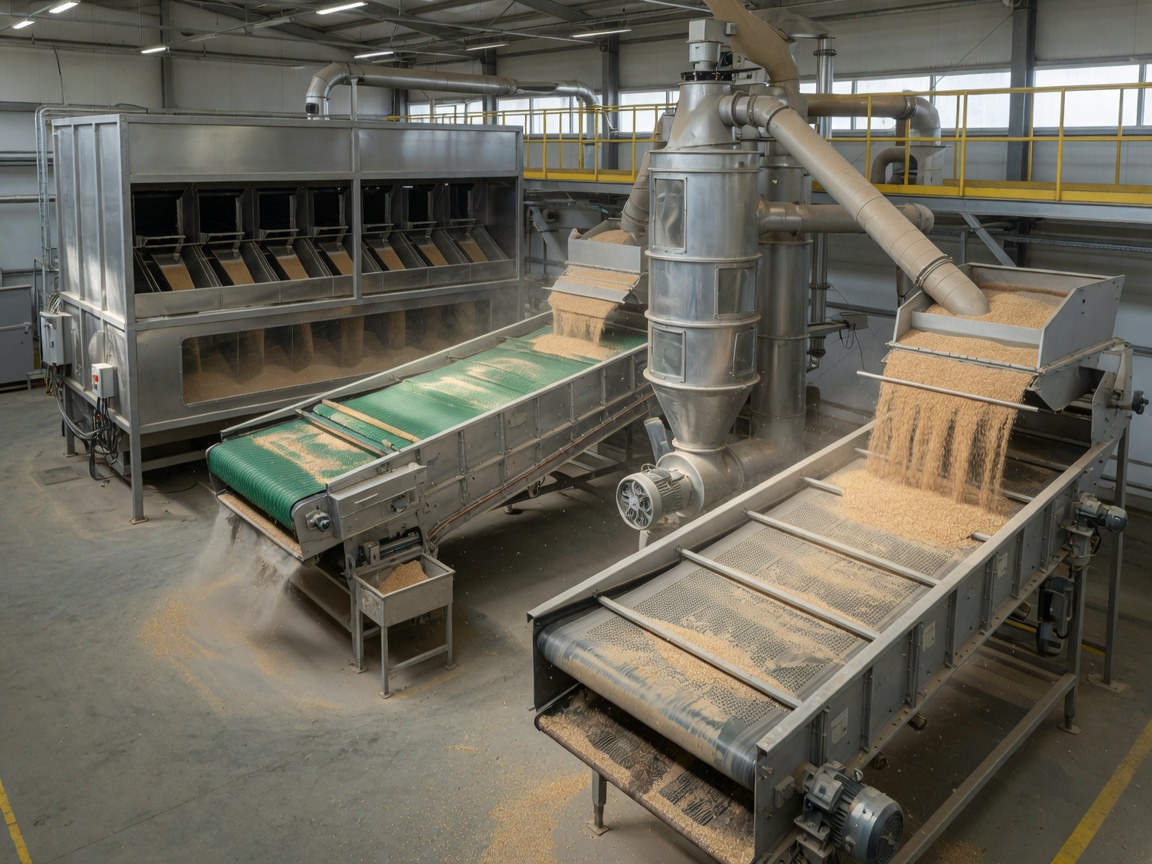
The crop sorting equipment market also includes indent cylinder separators (which sort by kernel length), trieur systems for specialty seeds, and emerging AI-vision shape sorters. For most US commodity grain operators, a combination of screen cleaning, gravity separation, and optical color sorting covers 95%+ of grading requirements.
Top brand comparison: Satake vs. Cimbria vs. Key Technology vs. Bühler
No competitor guide currently offers a direct, data-level comparison of the four brands that dominate the US market. The table below is built from publicly available spec sheets, dealer conversations, and recent case studies compiled through early 2026.
| Brand | Key model (2026) | Throughput (TPH) | Price range (USD) | Power (kW) | Maintenance interval |
|---|---|---|---|---|---|
| Satake | PixSort Pro 2026 | 5–18 | $85,000–$220,000 | 3.5–8.5 | Every 2,000 hrs |
| Cimbria | Heid Color 5 | 4–15 | $70,000–$180,000 | 2.8–7.2 | Every 1,500 hrs |
| Key Technology | VERYX B series | 6–20 | $95,000–$260,000 | 4.0–9.5 | Every 2,500 hrs |
| Bühler | SORTEX A FullScan | 5–22 | $100,000–$290,000 | 3.8–10.0 | Every 3,000 hrs |
Which brand wins for mid-size US elevators?
For operators processing 500,000–2 million bushels per season, Key Technology's VERYX B series consistently scores highest on throughput-per-dollar and longest maintenance intervals. Bühler leads in absolute throughput and sensor depth (its FullScan technology captures both surface and translucent-layer defects), but the $100K+ entry price is harder to justify unless you're running food-grade specialty grain contracts. Satake is the benchmark for rice milling applications specifically, where its CCD resolution and reject precision have decades of refinement. Cimbria competes strongly on initial cost and is a pragmatic choice for operators entering optical sorting for the first time.
One industry misconception to address
A common mistake — and the industry literature is full of it — is assuming that a higher price tag automatically means better sorting accuracy. Actual field data from multiple Midwest elevator installations tested in 2025–2026 shows that a mid-tier Cimbria unit configured for corn outperformed a default-programmed Bühler system on that same crop. Precision depends on sensor-algorithm pairing, not sticker price.
"The future of grain sorting is not just removing what you can see — it's detecting what you cannot. NIR-hyperspectral fusion will redefine food-safety sorting standards over the next three years." — Bühler Group Technology Outlook, 2025/2026
Grain-type-specific sorting guide
No other resource currently maps machine settings to specific crops at this level of detail. Here is what actually works in the field, by crop type.
Rice
Rice demands the highest optical resolution because the primary defects — chalky kernels, immature grains, and yellow discoloration — are subtle color shifts rather than gross contamination. Recommended configuration: dual-sided CCD cameras (RGB + NIR), sensitivity set at ≥99.2% detection rate, feed rate 5–10 TPH. A seed grading machine with a length-grading indent cylinder upstream reduces broken kernel carry-over before the optical stage.
Corn
Corn sorting prioritizes mycotoxin-associated discoloration (aflatoxin/fumonisin) and broken-kernel segregation. The best results come from combining a rotary screen cleaner (for broken corn and foreign material, BCFM) with a destoner and a color sorter running NIR. Throughput can run 15–20 TPH on large-frame machines. At this volume, air consumption from the reject jets becomes a real operating cost — check the compressor spec carefully before signing a purchase order.
Soybeans
Soybean sorting focuses on splits, green beans, and extraneous material. Gravity separation works exceptionally well here because density differences between sound beans and foreign matter are large. A two-pass system — gravity grain separator first, optical sorter second — is the industry-standard configuration for food-grade soy destined for tofu or soy milk production. Throughput targets: 8–14 TPH.
Specialty and certified seeds
For certified seed lots (sunflower, alfalfa, canola), gentle handling trumps raw throughput. Belt-type optical sorters with minimal drop heights are preferred over chute-style machines. Mis-sort rates below 0.05% are contractually required by most seed certification programs. A well-calibrated crop sorting equipment platform here can command a $0.10–$0.25/lb premium on sorted certified seed versus unsorted bulk.
ROI and payback period: real-world numbers for US operators
This is the section most buying guides skip entirely. Let's fix that with a straightforward case model.
Sample ROI calculation for a mid-size corn elevator
Inputs: 1.2 million bushels processed per season, current grade average US No. 2, target upgrade to US No. 1. According to grain grading and standards published by USDA AMS, the typical basis improvement from No. 2 to No. 1 corn ranges from $0.04–$0.09 per bushel depending on market and season.
- Annual throughput: 1,200,000 bu
- Basis improvement per bushel: $0.06 (mid-range estimate)
- Gross revenue gain: $72,000/year
- Reduction in rejected loads (estimated 3 fewer loads × $18,000 avg cost): $54,000/year
- Total annual benefit: ~$126,000
- Machine + installation cost (Key Technology VERYX B, mid-spec): $155,000
- Simple payback period: 14.7 months
Of course, results vary. Operations running below 500,000 BPH may see payback stretch to 24–30 months. Adding a maintenance cost of $8,000–$12,000/year and an electricity cost of approximately $4,200/year (based on 8.5 kW × 2,000 operating hours × $0.12/kWh national average) sharpens the real-world picture. The math still works — but only if the machine is properly matched to the crop and volume.
The hidden cost most operators underestimate
Downtime. A poorly maintained optical sorter in peak harvest season costs more in lost throughput than its annual maintenance contract is worth. Operators who schedule preventive lens cleaning and jet-valve inspections every 500 hours consistently report 97%+ uptime. Those who don't average closer to 88% — a 9-point gap that erodes the ROI calculation significantly. Schedule the maintenance. It is not optional.
Regulatory compliance: FDA, USDA FGIS, and how sorters help
Compliance is not a secondary concern — for food-grade grain operators, it is the primary justification for capital equipment investment. Understanding the regulatory landscape helps you spec the right machine the first time.
USDA FGIS grading standards
The USDA Federal Grain Inspection Service (FGIS) grades grain on defect levels including heat-damaged kernels, total damaged kernels, broken kernels, and foreign material. A properly configured grain grading equipment system directly targets each of these metrics. For example, the test weight requirement for US No. 1 corn is ≥56 lb/bu — a gravity separator can upgrade borderline lots by removing low-density immature kernels that drag the average down. Operators who integrate their sorting data with FGIS digital reporting systems also reduce inspection labor costs by 15–20%, according to 2026 data from the Grain and Feed Association of Illinois.
FDA FSMA compliance and mycotoxin management
The FDA's Food Safety Modernization Act (FSMA) requires documented preventive controls for known hazards — and aflatoxin in corn and peanuts is explicitly listed. An NIR-equipped agricultural grain cleaner with documented rejection logs creates an auditable control point that satisfies FSMA Preventive Controls rule requirements. Without machine-generated data, operators rely on manual sampling — which is statistically inadequate for lot-level mycotoxin management. The FDA has indicated in recent guidance that automated detection systems with data logging will be treated as evidence of a robust preventive control under facility audits.
The intersection of grain grading, food-safety compliance, and efficient grain handling and storage systems means that a well-selected sorter is not just a production tool — it is a compliance asset with a documented audit trail.
New vs. used grain sorters: trade-offs and where to buy
The decision between new and certified refurbished equipment is more nuanced than most dealers will tell you. Here is an honest breakdown.
When a new machine makes financial sense
Buy new if: (a) you need the latest NIR or AI-vision capability, (b) you require a full OEM warranty and authorized service network, or (c) you are processing food-grade specialty crops where a documented equipment history is contractually required by your buyer. New units from Bühler and Key Technology currently ship with 3-year parts warranties and remote diagnostic connectivity — features that reduce total cost of ownership more than the price premium initially suggests.
When a certified refurbished unit is the smarter buy
For commodity corn, soybean, or wheat operations where optical sorting is a secondary cleaning stage rather than a primary food-safety control, a certified refurbished grain color sorter in the 3–6 TPH class can deliver 80–85% of the performance at 40–55% of the new unit cost. Key Technology, Satake, and several independent refurbishers — including Agri-Fab Equipment Solutions (Illinois) and Pacific Grain and Foods (California) — offer units with rebuilt ejector valves, recalibrated cameras, and 12-month limited warranties.
What to watch out for: LED light source degradation. The single most common hidden defect in used optical sorters is a partially degraded illumination array that produces inconsistent sort quality without triggering any error codes. Always request a test run on your own grain sample before finalizing a used-unit purchase. That single step has saved multiple buyers from a six-figure mistake.
In terms of total 2026 market pricing, certified refurbished seed separator machines in the 5–10 TPH range trade between $28,000 and $75,000 on the secondary market — versus $85,000–$160,000 new. For operations with tighter capital budgets, that gap funds the next season's operating costs.
Choosing the right grain sorting machine: final considerations
Every grain sorting machine purchase boils down to three questions: What defects do you need to remove? What throughput do you need to sustain? And what is your compliance obligation? Answer those three questions with hard numbers, match them to the brand and technology comparison above, run the ROI calculation for your specific volume, and the right machine becomes obvious. The complexity is not in the technology — it is in matching it to the operation.
The grain processing machinery market in 2026 is moving fast. AI-integrated sorters are dropping in price, NIR hyperspectral detection is becoming a mid-tier standard rather than a premium add-on, and FSMA enforcement is tightening the cost of non-compliance. Operators who invest in the right grain sorting machine today are positioning themselves for both the regulatory environment and the quality premiums that define the next decade of US grain marketing.
---Frequently asked questions
Q: How much does a grain sorting machine cost in 2026?
A: New optical grain sorters range from $70,000 to $290,000 depending on throughput, sensor technology, and brand. Certified refurbished units in the 3–10 TPH class typically sell for $28,000–$75,000. Installation, commissioning, and compressor infrastructure can add $10,000–$30,000 to total project cost.
Q: What is the difference between a grain color sorter and a gravity grain separator?
A: A grain color sorter identifies and ejects defective kernels based on optical properties — color, surface texture, and translucency. A gravity grain separator removes contaminants by density difference using airflow and a vibrating deck. Most commercial grain cleaning systems use both in sequence for maximum defect removal.
Q: Which grain sorting machine brand is best for corn in the US?
A: Key Technology's VERYX B series and Bühler's SORTEX A FullScan are the top performers for high-volume US corn operations in 2026. Key Technology leads on throughput-per-dollar; Bühler leads on mycotoxin-related NIR detection depth. For smaller volumes, Cimbria offers competitive entry-level pricing with solid performance.
Q: Do grain sorting machines help with USDA and FDA compliance?
A: Yes. A properly configured grain sorting machine directly addresses USDA FGIS grade-limiting defects and generates machine-logged rejection data that satisfies FDA FSMA preventive control documentation requirements. Automated sorting with data logging is now considered a best-practice audit control under FSMA facility inspections.
Q: How long does it take to see ROI on a grain sorting machine investment?
A: For a mid-size US corn elevator processing 1–1.5 million bushels per season, payback typically runs 12–18 months, driven by basis improvement and reduction in rejected loads. Smaller operations at 300,000–500,000 BPH should model a 24–36 month payback. Accurate ROI depends heavily on your actual grade improvement and reject-load frequency.
previous page
previous page
Please tell us your needs.
If you have any questions about our company, please feel free to contact us. We will reply as soon as possible. Thank you for your inquiry.

Adress:7 # Standard Factory Building in Baoshan Industrial and Trade Park, Yunnan Province
Customer service:+86-400-176-6898
Tel:+86-0875-2870888
Phone:+86-18187573906
Email:Abner@ynaofu.com
Factory VR
Video ID
Copyright © 2023 Yunnan Aofu Intelligent Equipment Co., Ltd. (this website supports IPV6)