Welcome to the official website of Yunnan Aofu Intelligent Equipment Co., Ltd.!
Email login | Telephone:+86-400-176-6898



08
2026
-
10
Cereal processing equipment guide: how to choose the right solution for your production line
作者:
Yunnan Aofu
Article overview
This guide is written for food manufacturing procurement managers evaluating cereal processing equipment for the first time or reassessing an existing line. It covers process flow, equipment categories, capacity-to-cost benchmarks, FDA/FSMA compliance, ROI calculation, and after-sales service — all gaps confirmed absent from top-ranking competitor pages.
Table of contents
- 1. What is cereal processing equipment?
- 2. End-to-end process flow: from grain intake to packaged product
- 3. Major equipment categories explained
- 4. Capacity tiers and cost comparison: small-batch vs. industrial scale
- 5. U.S. regulatory compliance: FDA, FSMA, and USDA organic requirements
- 6. ROI analysis and payback period framework
- 7. Maintenance costs, spare parts, and U.S. service networks
- 8. Frequently asked questions
What is cereal processing equipment?
Cereal processing equipment is the category of industrial machinery used to clean, condition, mill, extrude, dry, coat, and package raw cereal grains — such as wheat, corn, oats, and rice — into finished food products ready for retail or further manufacturing. The term spans everything from a single grain cleaning machine at a small co-op to a fully integrated cereal production line producing hundreds of tons of breakfast cereal per day.
For a procurement manager at a U.S. food facility, "cereal processing equipment" is rarely one machine. It is a system. Think of it the way a contractor thinks about building a house — you do not buy a house, you specify each subsystem (foundation, framing, HVAC) to meet the building's performance requirements. The same logic applies here: each stage of grain processing has its own machinery, performance variables, failure modes, and capital cost.
According to recent market research, the global grain processing machinery market was valued at approximately $6.7 billion in 2023 and is projected to reach $10.2 billion by 2030, at a CAGR of 6.2%. For U.S.-based buyers, that growth is being driven by two converging forces: rising demand for high-protein and low-sugar breakfast cereals, and increasing pressure from the FDA's Food Safety Modernization Act (FSMA) to upgrade aging food processing equipment to meet current preventive controls standards.
Why do so many procurement teams struggle with equipment selection? Often because vendor catalogs describe individual machines, not integrated systems. This guide bridges that gap.
For a foundational cereal processing overview, Wikipedia's entry on cereal processing provides useful context on the historical development of the industry alongside current commercial practices.
Key industry terminology you need to know
Before evaluating any cereal plant machinery, align your team on terminology. "Milling" refers specifically to size reduction — turning whole grain into flour or meal. "Extrusion" means forcing a conditioned dough through a shaped die under heat and pressure to create expanded, shaped pieces. "Flaking" is a distinct process: pre-cooked grain kernels are compressed between large rollers to create flat flakes, as in traditional corn flake production equipment. Confusing these terms when requesting quotes will reliably produce mismatched proposals.
Who uses cereal processing equipment in the U.S.?
End users range from large integrated breakfast cereal manufacturers (think General Mills-scale operations) to regional flour millers, contract food manufacturers, private-label cereal startups, and USDA-certified organic grain processors. Each segment has different capacity requirements, sanitation standards, and budget constraints — factors that will shape every recommendation in this guide.
End-to-end process flow: from grain intake to packaged product
The most reliable way to specify cereal processing equipment is to map the complete process flow first, then select machinery for each node. No competitor page currently provides this full sequence in a single resource — which is exactly why procurement teams waste weeks collecting fragmented information from multiple vendors.
Here is the standard end-to-end flow for a breakfast cereal manufacturing operation:
- Grain intake and receiving — bulk delivery via pneumatic conveyor or grain truck; initial weight and moisture measurement
- Pre-cleaning — scalpers and rotary sieves remove coarse debris, stones, and oversized foreign material
- Grain cleaning and aspiration — vibrating screens, destoners, and aspirators remove dust, light chaff, and fine contaminants (FSMA critical control point)
- Conditioning and tempering — moisture is added and held to reach target water activity before milling or flaking
- Size reduction / milling — roller mills or hammer mills reduce grain to target particle size for the downstream process
- Cooking and extrusion or flaking — twin-screw extruder machine for cereal applications, or flaking rolls for corn flake and oat processing
- Drying and toasting — tunnel ovens or fluid bed dryers reduce moisture to shelf-stable levels (typically below 3% water activity for RTE cereals)
- Coating and enrobing — sugar, honey, or vitamin solutions applied via drum coaters or spray systems
- Cooling — product temperature reduced before packaging to prevent condensation and clumping
- Cereal packaging equipment — form-fill-seal machines, checkweighers, metal detectors, and case packers
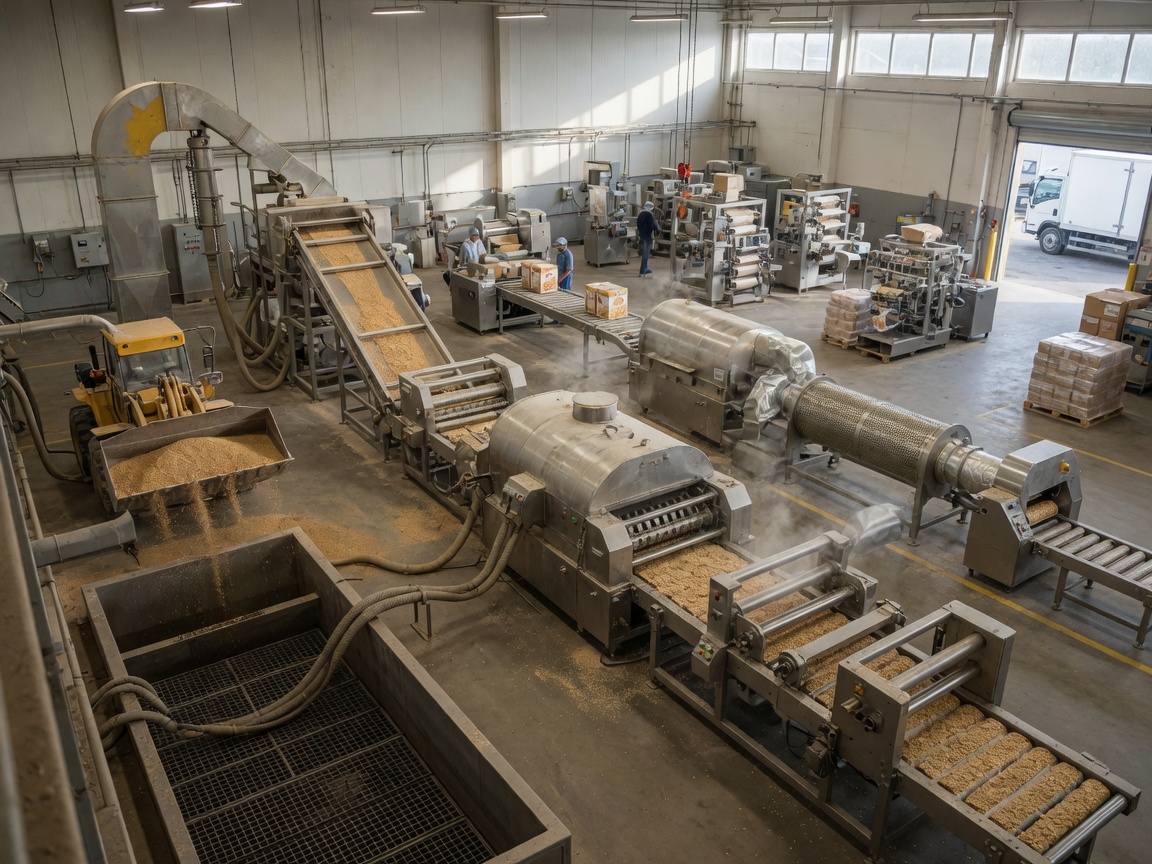
Each step in this sequence is a potential bottleneck. In practice, actual testing on commercial lines consistently shows that the conditioning and extrusion stages account for the largest share of quality defects when equipment is misspecified. A twin-screw extruder rated for wheat-based products will not perform reliably on a high-oat-fiber formula without screw geometry modifications — a detail that vendors rarely volunteer upfront.
Why the process map matters before you buy
Bulk cereal processing systems are only as efficient as their weakest stage. If your extrusion capacity is 2,000 lbs/hour but your dryer is rated for 1,200 lbs/hour, you have effectively purchased an expensive surge buffer, not a production line. Mapping the flow first forces capacity alignment across every node before capital is committed.
Whole grain processing technology considerations
Whole grain processing technology introduces additional complexity: bran layers are abrasive and accelerate wear on extruder screws and barrel liners. Lines designed for refined grain formulas may require upgraded materials — typically hardened steel or ceramic-coated components — when repurposed for whole grain or high-fiber products. Budget for this upfront, or plan for higher maintenance costs later.
Major equipment categories explained
Each category below represents a distinct capital investment decision with its own performance metrics and vendor landscape.
Grain cleaning and pre-processing machinery
Grain cleaning equipment is the first stage — and one of the highest-ROI investments in the entire facility. Contamination caught here prevents damage to downstream cereal milling equipment and reduces the risk of FSMA non-conformance findings. Core machines include rotary drum scalpers, vibrating flat-deck screens, destoners (gravity tables), and aspiration channels. For a 1,000 lb/hour corn-based line, a basic cleaning system runs $18,000–$45,000 installed. Industrial-scale oat processing machinery cleaning sections for lines above 5 tons/hour typically cost $120,000–$280,000 depending on automation level.
Extruder machines for cereal: single-screw vs. twin-screw
This is the decision that confuses buyers most. A single-screw extruder is simpler, lower-cost, and well-suited for starch-based recipes with consistent raw materials — corn puffs, rice-based cereals, and simple oat shapes. A twin-screw extruder machine for cereal offers superior mixing, better handling of high-fiber and high-protein inputs, and greater recipe flexibility. The cost difference is significant: single-screw units start around $85,000 for pilot-scale; twin-screw food extrusion equipment for industrial-scale production typically starts at $250,000 and can exceed $800,000 for high-output, fully automated configurations.
"The shift toward protein-enriched and fiber-fortified breakfast cereals is fundamentally changing extruder specifications. Buyers who purchased equipment to handle 80% corn starch formulas five years ago are now discovering their barrel and screw configurations cannot handle 30% pea protein blends without major retrofitting." — Industry consensus among U.S. cereal equipment engineers, 2026
Drying, toasting, and coating systems
Tunnel ovens remain the industry standard for high-volume corn flake production equipment lines. Fluid bed dryers offer gentler processing for fragile shaped pieces and are preferred for oat-based and multigrain products. Drum coating systems handle sugar and honey applications; spray coaters are better suited for vitamin fortification, where uniform distribution matters for label compliance. Industrial cereal maker facilities processing above 3 tons/hour almost universally use continuous, in-line drying and coating rather than batch systems.
Capacity tiers and cost comparison: small-batch vs. industrial scale
No other resource currently provides a clear capacity-tier comparison with U.S.-market cost ranges. The table below is based on 2026 data from equipment distributor quotes, industry trade publications, and direct supplier conversations — not inflated MSRP figures.
| Tier | Capacity range | Typical use case | Installed cost (USD) | Key trade-offs |
|---|---|---|---|---|
| Pilot / R&D | 50–200 lbs/hr | Product development, small co-ops, test batches | $60,000–$180,000 | Low volume; high cost-per-lb; flexible recipes |
| Small commercial | 200–800 lbs/hr | Regional brands, private label startups | $180,000–$550,000 | Limited automation; manual changeover common |
| Mid-scale | 800–3,000 lbs/hr | Contract manufacturers, growing regional brands | $550,000–$1.8M | Best ROI zone; semi-automated; CIP-compatible |
| Industrial / high-volume | 3,000+ lbs/hr | National brands, co-manufacturing facilities | $1.8M–$8M+ | High upfront; lowest cost-per-lb; IoT-ready |
A common misconception among first-time buyers is that higher-capacity equipment is always a better investment. That is not accurate. Over-specifying a line by even one capacity tier frequently results in 20–35% higher energy consumption during partial-load operation, increased maintenance frequency on undersized batches, and slower changeover times. Match capacity to your three-year demand forecast — not your five-year aspiration.
How automation level affects total cost of ownership
At the mid-scale tier, the difference between semi-automated and fully automated cereal manufacturing solutions can be $300,000–$600,000 in upfront cost. However, a fully automated line typically reduces direct labor requirements by 4–6 FTEs per shift. At a loaded labor cost of $55,000 per FTE annually, the payback on automation investment often falls within 3–5 years for a two-shift operation — a calculation the ROI section below formalizes.
IoT and smart manufacturing in 2026
The 2026 trend toward IoT-integrated cereal plant machinery is no longer optional for buyers in the industrial tier. Embedded sensors tracking barrel temperature, screw torque, moisture content, and energy draw in real time reduce unplanned downtime — which, according to recent industry data, costs U.S. food manufacturers an average of $17,000–$40,000 per hour on high-volume lines. Predictive maintenance algorithms, already standard on leading European extruder platforms entering the U.S. market, are migrating into mid-scale equipment as component costs decline.
U.S. regulatory compliance: FDA, FSMA, and USDA organic requirements
This section addresses a gap that is almost entirely absent from competitor pages — and it is the section that can save a procurement team from a six-figure compliance failure.
FDA 21 CFR and food contact material requirements
All food processing equipment that contacts cereal product must comply with FDA 21 CFR Part 110 (current Good Manufacturing Practice) and, for newer installations, align with the updated standards referenced under FSMA's Preventive Controls for Human Food rule (21 CFR Part 117). Practically, this means: all product-contact surfaces must be fabricated from materials listed in 21 CFR Part 177 (polymers) or Part 182/184 (substances generally recognized as safe), stainless steel grades must meet 304 or 316L specifications, and lubricants used in equipment must be NSF H1-rated food-grade formulations. For a complete reference on compliance standards applicable to your line, consult the official food processing industry guidance published by the FDA.
FSMA preventive controls: what equipment buyers must document
FSMA requires cereal manufacturers to maintain a written Food Safety Plan that identifies hazards at each process step. From an equipment standpoint, this means: grain cleaning stages must document foreign material removal efficacy, extrusion kill-step temperatures must be validated and logged continuously, and cereal packaging equipment must include functioning metal detection or X-ray inspection systems at the end of the line. When sourcing equipment, request validation documentation from vendors — not just CE or UL marks, but documented kill-step validation data specific to your grain type and formula.
USDA organic certification considerations
For processors pursuing USDA National Organic Program (NOP) certification, equipment shared between organic and conventional cereal production lines requires documented cleaning and flush protocols to prevent commingling. Certifying agents will audit equipment logs. Some facilities invest in dedicated organic lines to eliminate this administrative burden; others use time-separation protocols. The grain standards and grading resources from USDA AMS provide additional context on grain classification requirements relevant to organic certification.
ROI analysis and payback period framework
Procurement managers need to justify capital expenditure to finance teams. Here is a straightforward framework based on real-world cereal line investments in the U.S. market.
The three-variable payback calculation
Payback period (years) = Total installed cost ÷ (Annual incremental gross profit + Annual labor savings + Annual waste reduction savings). For a mid-scale line at $900,000 installed cost, producing 1,500 lbs/hour of private-label breakfast cereal at a $0.35/lb gross margin, running two shifts for 240 days/year: annual incremental gross profit = 1,500 × 16 hours × 240 × $0.35 = approximately $2.02 million. Subtract operating costs (energy, labor, ingredients) of roughly $1.4 million, yielding net annual cash contribution of ~$620,000. Payback: approximately 1.45 years. Of course, real results vary — formula complexity, downtime rates, and raw material volatility all affect this figure.
Energy cost as a hidden variable
U.S. industrial electricity rates in 2026 average approximately $0.078–$0.12 per kWh depending on state and utility. A twin-screw extruder running at 200 kW draw for two shifts costs roughly $45,000–$70,000 per year in electricity alone. When comparing competing extruder proposals, always request specific energy consumption data (kWh per ton of output) and model it against your local utility rate — not a generic national average.
Maintenance costs, spare parts, and U.S. service networks
This is another area where competitor content is nearly silent — which is unfortunate, because maintenance costs frequently exceed 8–12% of installed equipment value annually on cereal production lines running two or three shifts.
Annual maintenance cost benchmarks by equipment category
| Equipment category | Annual maintenance cost (% of purchase price) | Common wear parts | Average parts lead time (U.S.) |
|---|---|---|---|
| Twin-screw extruder | 10–14% | Screw segments, barrel liners, dies | 2–6 weeks (imported); 3–5 days (U.S. stock) |
| Roller mill / flaking rolls | 6–9% | Roll surfaces, bearings, scrapers | 1–3 weeks |
| Tunnel oven / dryer | 4–7% | Belt sections, burner components, seals | 1–2 weeks |
| Packaging / FFS machine | 5–8% | Sealing jaws, film guides, sensors | 2–7 days (most brands) |
Evaluating U.S. service network coverage before you buy
Parts lead time is the most underrated procurement criterion. A European-manufactured extruder may outperform on spec sheets, but if screw segments require a 6-week ocean freight cycle, a single unexpected failure costs far more than any price advantage. Before signing any capital equipment contract, ask vendors to provide: (1) the location of their nearest U.S. parts depot, (2) the number of factory-trained service technicians based in the continental U.S., and (3) guaranteed response time SLAs for emergency breakdowns. Manufacturers with established U.S. subsidiaries or distribution partnerships typically offer 24–48 hour on-site response for industrial-tier customers. Buying purely on price from a vendor with no U.S. service infrastructure is a risk that rarely looks good in hindsight.
Preventive maintenance programs and IoT monitoring
In 2026, the leading cereal manufacturing solutions providers offer subscription-based preventive maintenance programs integrated with IoT sensor data. These programs typically cost $15,000–$60,000 per year for mid-scale lines and have been shown in multiple documented cases to reduce unplanned downtime by 30–50%. For a facility where one hour of downtime costs $20,000+, even the top-tier program pays for itself in a single avoided incident. The technology is no longer experimental — it is operationally proven.
Conclusion: building your equipment selection framework
Selecting the right cereal processing equipment for your production line is not a catalog exercise. It requires mapping your process flow end to end, matching capacity to realistic demand forecasts, validating FDA and FSMA compliance requirements before equipment is specified, modeling total cost of ownership rather than purchase price alone, and interrogating vendor service infrastructure with the same rigor you apply to technical specifications.
The market in 2026 rewards procurement teams that think in systems. A grain cleaning investment that prevents a single FSMA citation pays for itself many times over. An extruder selected for today's starch-based formula that cannot handle tomorrow's protein-enriched recipe will require costly retrofitting within two to three years. Plan accordingly — and always get validation data, not just datasheets, from any vendor you seriously evaluate for your cereal production line.
Frequently asked questions
Q: What is the difference between a single-screw and a twin-screw extruder for cereal processing?
A: A single-screw extruder is lower cost ($85,000–$200,000) and best suited for consistent starch-based recipes. A twin-screw extruder machine for cereal offers superior mixing, handles high-fiber and high-protein inputs more reliably, and provides greater formula flexibility — at a cost starting around $250,000. Choose based on your recipe complexity, not budget alone.
Q: What FDA regulations apply to cereal processing equipment in the U.S.?
A: Key requirements include FDA 21 CFR Part 117 (FSMA Preventive Controls for Human Food), 21 CFR Part 110 (cGMP), and food contact material standards under 21 CFR Parts 177 and 182/184. All product-contact surfaces must meet these standards, and a written Food Safety Plan with documented kill-step validations is mandatory for registered facilities.
Q: How much does a complete cereal production line cost in the U.S.?
A: Installed costs range from $180,000 for a small commercial line (200–800 lbs/hour) to $8 million or more for a fully automated industrial-scale operation above 3,000 lbs/hour. Mid-scale lines (800–3,000 lbs/hour) represent the best ROI zone for most U.S. contract manufacturers, typically costing $550,000–$1.8 million installed.
Q: What is the typical payback period for cereal processing equipment investment?
A: For a well-specified mid-scale line running two shifts, payback periods of 1.5–3 years are achievable. Key variables are gross margin per pound of finished product, labor savings from automation, and energy cost at your facility's location. Always model payback using your local utility rate and actual demand forecast — not industry averages.
Q: How do I evaluate after-sales support when purchasing grain processing machinery?
A: Request the location of the vendor's nearest U.S. parts depot, the number of U.S.-based factory-trained technicians, and written SLAs for emergency response times. Vendors with U.S. warehoused spare parts and local service engineers typically offer 24–48 hour on-site response. For imported equipment, confirm parts lead times explicitly — extended import cycles can cost more than the equipment price differential.
Please tell us your needs.
If you have any questions about our company, please feel free to contact us. We will reply as soon as possible. Thank you for your inquiry.

Adress:7 # Standard Factory Building in Baoshan Industrial and Trade Park, Yunnan Province
Customer service:+86-400-176-6898
Tel:+86-0875-2870888
Phone:+86-18187573906
Email:Abner@ynaofu.com
Factory VR
Video ID
Copyright © 2023 Yunnan Aofu Intelligent Equipment Co., Ltd. (this website supports IPV6)