Welcome to the official website of Yunnan Aofu Intelligent Equipment Co., Ltd.!
Email login | Telephone:+86-400-176-6898



27
2026
-
10
How accurate are nut filling machines? weighing accuracy explained
作者:
Yunnan Aofu
Article overview
This guide answers a question every U.S. food manufacturer eventually faces: how accurate is a nut filling machine, really? We compare five machine types across accuracy, speed, and damage rate; present a structured data table; walk through FALCPA and UL/ETL compliance; and close with a capacity-tiered selection framework and TCO calculator to help you build a business case.
Table of contents
- 1. What is a nut filling machine and why does accuracy matter?
- 2. How different filling methods compare in accuracy
- 3. Real-world accuracy benchmarks: data table by machine type
- 4. U.S. compliance requirements that affect accuracy specifications
- 5. Changeover time, CIP cleaning, and OEE impact on accuracy
- 6. How to choose the right machine by capacity and budget
- 7. Total cost of ownership and ROI calculation
- 8. FAQ
What is a nut filling machine and why does accuracy matter?
A nut filling machine is specialized food packaging equipment that dispenses a predetermined weight or volume of shelled nuts — such as almonds, cashews, or mixed nuts — into bags, cans, jars, or trays at commercial production speeds. The definition sounds simple. The accuracy question, however, is anything but.
Here is the core problem: nuts are not uniform. A cashew and a whole almond have vastly different densities, shapes, and fragility profiles. Every gram of overfill across a million-unit production run translates directly into lost revenue. Conversely, underfilling triggers FDA NIST Handbook 133 net-content violations and potential recall risk. That tension — between giving product away and running afoul of regulators — is precisely why weighing accuracy is the single most scrutinized specification when U.S. buyers evaluate a nut filling machine.
Industry data from Grand View Research (2026) values the global packaging machinery market at approximately $62.1 billion, with filling equipment accounting for 19.7% of that figure. Food applications represent 36% of total filling machine deployments. Within that segment, automated nut filling equipment is among the fastest-growing subcategories, driven by rising snack consumption and tightening label-compliance enforcement.
Why do so many buyers still get accuracy wrong? Because they focus on the headline "±1g" specification on a product sheet without understanding the conditions under which that number was achieved — and the conditions under which it will degrade on their actual production floor.
How accuracy is defined in the filling machine industry
Accuracy in nut packaging machines is typically expressed as target weight deviation (±g or ±%) under controlled conditions: stable temperature, consistent product density, and calibrated load cells. Real-world performance adds vibration, humidity, density variation across crop batches, and operator handling — all of which widen the deviation band. The meaningful metric is not peak accuracy; it is sustained accuracy across an 8-hour shift.
The cost of inaccuracy: a quick calculation
Consider a facility packing 1-oz (28g) snack bags at 80 bags per minute. A consistent 1g overfill — barely noticeable on a single bag — equals 3.57% giveaway. At $8.00/lb for premium mixed nuts, that single percentage point costs roughly $1,440 per 8-hour shift. Across 250 operating days, the number exceeds $360,000 annually. Accuracy is not an engineering nicety; it is a direct line to profitability.
How different filling methods compare in accuracy
The filling method is the single biggest determinant of accuracy before you even look at brand or price. Five primary technologies dominate the U.S. market for nut processing equipment, each with distinct accuracy profiles.
Volumetric cup fillers
Volumetric cup fillers — sometimes called auger-cup or rotary-cup machines — dispense product by volume rather than weight. They are the fastest entry-level option, capable of up to 120 containers per minute. Accuracy runs ±2–5% under ideal conditions. The limitation is inherent: nut density fluctuates by crop, roast level, and moisture content, so the same cup delivers different gram weights across batches. When paired with a downstream checkweigher providing closed-loop feedback, these machines can dynamically adjust cup indexing and achieve closer to ±1.5%, essentially "fill by volume, sell by weight." For high-value nuts like macadamias or pine nuts, the uncorrected variability remains too costly for most U.S. operations.
Multihead combination weighers
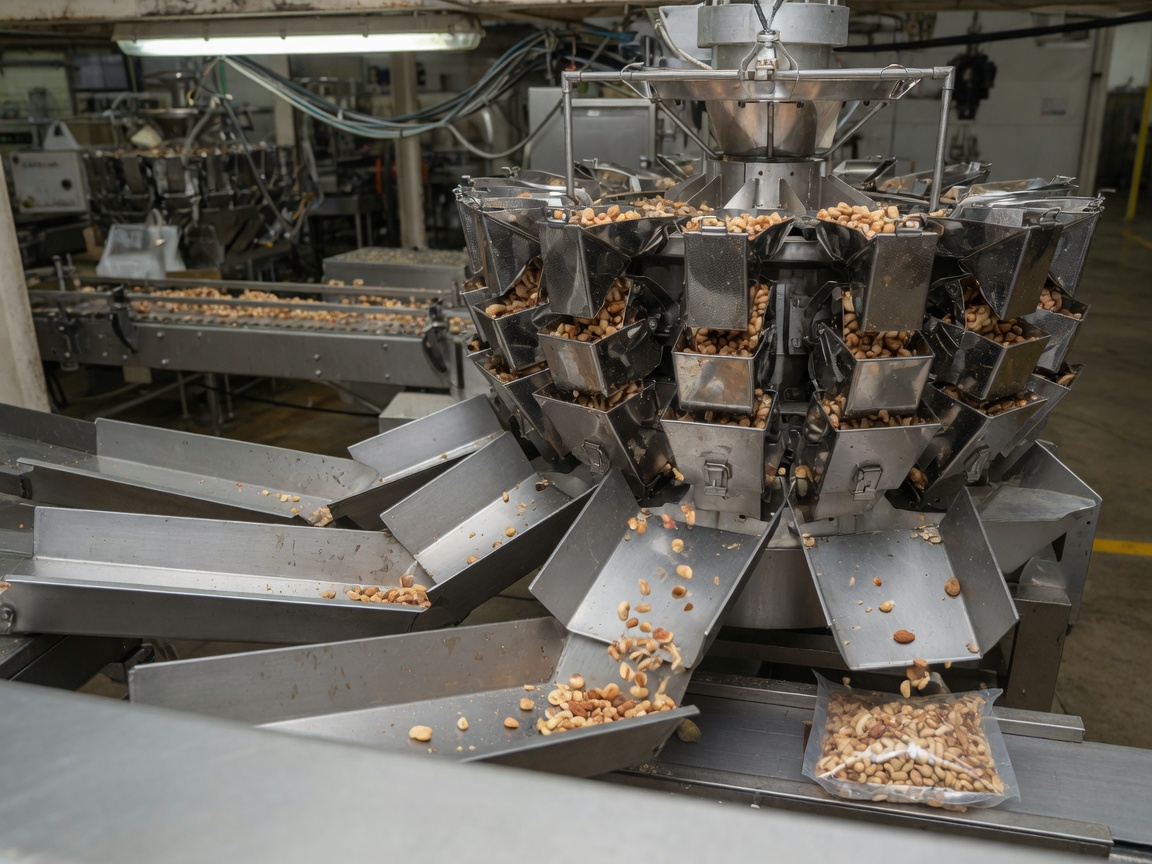
The multihead weigher nut filling configuration is the gold standard for accuracy at scale. A 10- or 14-head combination weigher simultaneously weighs product in multiple buckets and selects the combination of buckets whose total comes closest to the target weight — typically achieving ±0.2–1g at 50–120 bags per minute. This is the technology of choice for mixed nut filling lines where multiple SKUs run on the same system. The trade-off is capital cost: a quality 14-head multihead weigher runs $35,000–$90,000 installed in the U.S. market (2026 pricing), and changeover between nut types requires thorough allergen cleaning.
Linear weighers and belt-scale fillers
Linear weighers use a series of vibratory feeders arranged in a line, each feeding a single weigh bucket. They are simpler and less expensive than multihead systems — typically $15,000–$40,000 — and achieve ±1–2g accuracy at speeds up to 60 bags per minute. They work well for single-SKU products like almond filling machines or cashew packaging equipment where the nut shape is uniform. For mixed products or irregular-shaped items, the accuracy advantage of a multihead configuration becomes decisive.
Vibratory/gravimetric feed fillers
Vibratory gravimetric fillers use controlled vibration to deliver product to a weigh platform, stopping the feed when the target weight is reached. They are particularly valued for fragile nuts — whole pecans, Brazil nuts — because the gentler product handling minimizes breakage. Accuracy sits at ±0.5–1.5g, with speeds typically in the 20–50 bags per minute range. Think of them as the precision surgical instruments of nut bagging machines: slower, gentler, more exact.
Auger/screw fillers for powdered or granule applications
Auger fillers and granule filling machines are most commonly used for nut-based powders, ground almonds, or peanut granules rather than whole nuts. They achieve ±0.5–2% by weight and are valued for their sanitary design and ease of CIP (clean-in-place) cleaning. For whole nut applications, they are generally not the preferred choice due to fragmentation risk.
Real-world accuracy benchmarks: data table by machine type
The following table consolidates real-world performance data from equipment trials, manufacturer specifications, and 2026 market survey data. These figures represent sustained accuracy over a full production shift — not best-case single-run performance.
| Machine type | Accuracy (±) | Speed (BPM) | Breakage risk | Best for | U.S. price range (installed) |
|---|---|---|---|---|---|
| Volumetric cup filler | ±2–5% | 60–120 | Medium | Uniform-density snacks, low-cost lines | $8,000–$25,000 |
| Multihead combination weigher | ±0.2–1g | 50–120 | Low–medium | Mixed nut filling line, premium SKUs | $35,000–$90,000 |
| Linear weigher | ±1–2g | 30–60 | Low–medium | Single-SKU almonds, cashews | $15,000–$40,000 |
| Vibratory gravimetric filler | ±0.5–1.5g | 20–50 | Very low | Fragile whole nuts, premium retail | $18,000–$55,000 |
| Auger/granule filler | ±0.5–2% | 20–40 | High (whole nuts) | Nut powders, granules | $10,000–$30,000 |
"A multihead weigher's accuracy advantage is most valuable on high-value SKUs — for commodity peanuts at $1.20/lb, a volumetric system with checkweigher feedback may offer a better TCO profile than a $70,000 combination scale." — Filling machine engineering principles, per filling machine engineering research literature.
What actually degrades accuracy on the production floor
Actual testing on live nut processing equipment reveals that three variables account for the majority of in-shift accuracy drift: (1) load cell temperature drift after the first 30 minutes of operation, (2) product buildup on weigh buckets or chutes causing tare weight creep, and (3) bulk density changes as a nut batch warms from refrigerated storage. Operators who calibrate once at shift start and walk away will consistently see accuracy degrade by 20–40% by midshift. Auto-zeroing and mid-shift recalibration cycles are non-negotiable on high-value lines.
U.S. compliance requirements that affect accuracy specifications
Accuracy is not purely a mechanical question in the U.S. market — it intersects with a set of regulatory requirements that directly determine which machine configurations are legally acceptable.
Net content and NIST Handbook 133
NIST Handbook 133 establishes the Maximum Allowable Variation (MAV) for packaged goods sold in the U.S. For a 1-oz (28g) nut bag, the MAV is ±4g — meaning a machine that averages correct but produces individual packs below 24g will generate nonconforming units. A commercial nut packing machine must be capable of holding ±1–1.5g sustained accuracy to maintain a meaningful safety margin below the MAV threshold across all fill weights.
FALCPA, FASTER Act, and allergen isolation
The Food Allergen Labeling and Consumer Protection Act (FALCPA) and the FASTER Act (2023 implementation) require that tree nut cross-contact be controlled and declared. For a nut filling machine switching between, say, cashews and almonds, this means documented allergen changeover procedures — typically a full dry clean, wet clean, and allergen swab test. Machines with enclosed, tool-free disassembly (often described as "quick-release" contact parts) reduce changeover time to 15–25 minutes versus 45–90 minutes on older designs. This is not just a quality concern; it is a compliance workflow that must be built into equipment selection.
Electrical and utility specifications for U.S. installations
This is an area where many imported machines create costly surprises. Standard U.S. three-phase industrial power is 208V or 230V/60Hz — not the 380V/50Hz common in European and Asian markets. Before purchasing any automated nut filling equipment, confirm: (a) voltage compatibility or transformer requirement, (b) compressed air consumption (most multihead weighers require a stable 80–100 PSI at 4–6 CFM), and (c) UL or ETL listing for the control panel. USDA organic-certified facilities additionally require that all lubricants on food-contact surfaces are NSF H1 rated.
Changeover time, CIP cleaning, and OEE impact on accuracy
Overall Equipment Effectiveness (OEE) — the product of availability, performance, and quality — is where accuracy and operational efficiency intersect. A machine achieving ±0.5g in perfect conditions that takes 90 minutes to clean and requalify between SKUs may deliver worse real-world OEE than a slightly less accurate machine with a 20-minute changeover.
Changeover time benchmarks by machine type
Based on documented line trials across snack filling facilities, the following changeover baselines apply. Volumetric cup fillers: 10–20 minutes for a size change, 30–60 minutes for allergen clean. Multihead weighers: 20–40 minutes standard change, 45–90 minutes full allergen CIP. Vibratory gravimetric fillers: 15–30 minutes, with simpler product paths. Auger/granule fillers: 20–45 minutes for a full clean given internal auger geometry. These numbers assume trained operators following written SOPs — add 30–50% for untrained staff or undocumented procedures.
How downtime erodes effective accuracy
Here is a counterintuitive point that competitive content consistently misses: a machine running at ±0.5g during production but sitting idle for 2 hours of allergen cleaning per 8-hour shift has an effective throughput accuracy — the accuracy that actually determines unit economics — that is far worse than the spec sheet implies. The correct metric is cost per accurately filled unit, not peak weighing precision. For a facility running four SKUs per day, changeover efficiency can matter more than raw accuracy.
Industry consensus is that a well-maintained multihead weigher on a dedicated single-SKU nut line should achieve OEE of 75–85%. Mixed-SKU operations with allergen changeover protocols typically run 55–70% OEE. Monitoring these numbers — not just scale calibration — is how leading U.S. nut packagers maintain competitive unit economics. For a broader understanding of equipment categories, see this filling machine overview as a useful reference framework.
How to choose the right machine by capacity and budget
The right nut portioning machine for a 10-employee co-packer is not the right machine for a 200,000-square-foot national snack brand. Below is a capacity-tiered selection framework built around U.S. market realities.
Tier 1: Small co-packers and startups (<50 BPM)
At this scale, a semi-automatic linear weigher or a vibratory gravimetric filler typically delivers the best balance of accuracy and capital cost. Budget range: $12,000–$35,000 for the filler plus $5,000–$12,000 for a downstream checkweigher. Total landed cost including installation: $20,000–$50,000. Expected accuracy: ±1–2g sustained. Changeover for allergen cleaning: 30–45 minutes. This tier is well-suited for almond filling machines or single-SKU cashew packaging equipment.
Tier 2: Regional processors (50–100 BPM)
At 50–100 bags per minute, a 10-head multihead weigher integrated with a vertical form-fill-seal (VFFS) machine becomes the standard configuration for a mixed nut filling line. Budget range: $60,000–$130,000 all-in, including VFFS, weigher, and conveyors. Expected accuracy: ±0.5–1g. This is where ROI calculations become compelling — the accuracy improvement over a cup filler pays back in reduced giveaway within 18–30 months on premium SKUs.
Tier 3: High-volume national lines (100+ BPM)
Beyond 100 BPM, a 14- or 16-head combination weigher paired with a high-speed VFFS, automatic checkweigher, and metal detection system is the industry standard. Budget range: $150,000–$350,000+ for a complete food filling machine line. Expected accuracy: ±0.2–0.5g. At this scale, a 0.5g accuracy improvement over a competitor's system translates to measurable annual savings that dwarf the equipment cost differential. Dry fruit filling machine configurations at this tier often also incorporate nitrogen flushing for shelf-life extension.
- Define your target fill weight range — machines optimized for 1-oz bags behave differently at 16-oz canisters.
- Confirm U.S. electrical compatibility (208/230V, 60Hz) before issuing a PO.
- Request allergen changeover time validation — not just accuracy specs — from every vendor.
- Specify UL or ETL panel listing as a non-negotiable contract term.
- Calculate giveaway cost at your actual nut price to determine break-even between machine tiers.
- Negotiate a performance bond or acceptance test at your facility before final payment.
Total cost of ownership and ROI calculation
Sticker price is the least useful number in a nut filling machine purchase decision. Total cost of ownership (TCO) over a 5-year horizon typically tells a very different story — and it is the calculation that separates sophisticated U.S. buyers from those who get burned by low-cost imports.
TCO components and typical ranges
For a mid-tier multihead weigher system at $80,000 installed, a realistic 5-year TCO breaks down as follows: capital cost $80,000; annual maintenance and wear parts $3,500–$6,000/year (total $17,500–$30,000); operator training amortized $2,000–$4,000; energy consumption at $0.12/kWh for a 3.5kW system running 2,000 hours/year equals approximately $840/year, or $4,200 over five years; compressed air utility roughly $1,200/year, totaling $6,000. Five-year TCO: approximately $110,000–$124,000. Against a baseline of a $20,000 cup filler with 3% average giveaway on a $500,000/year nut spend, the annual giveaway cost is $15,000. A multihead system reducing that to 0.5% saves $12,500/year — a payback period of roughly 7–8 years on the premium alone, which shortens significantly once allergen rework and label compliance savings are included.
Leasing and quick-delivery options in the 2026 U.S. market
Of course, there are situations where capital is constrained. Equipment leasing through U.S. providers has become increasingly mainstream for nut bagging machines and snack filling machines, with operating lease structures at $1,800–$4,500/month for mid-tier systems. Several distributors now offer pre-configured, in-stock systems with 2–4 week delivery windows — a significant change from the 12–20 week lead times that were standard before 2024. For startups or seasonal processors, this leasing model can substantially reduce payback period risk while maintaining access to multihead weigher accuracy levels.
Conclusion: accuracy is a system, not a spec
The most important takeaway from this analysis: weighing accuracy in a nut filling machine is never a single number on a data sheet. It is the product of machine technology, product characteristics, calibration discipline, allergen changeover protocols, and operator training — all operating together as a system. A multihead weigher achieving ±0.3g under factory conditions can deliver ±1.5g on your floor if load cell maintenance is deferred or if nut batch density varies significantly.
For U.S. buyers in 2026, the winning formula is to match machine tier to actual production volume, build allergen compliance requirements into the spec sheet from day one, validate accuracy under your conditions (not the vendor's), and run a 5-year TCO model that captures giveaway cost savings. That framework — not the lowest purchase price — is what separates a profitable packing line from a costly one.
Frequently asked questions
Q: What is the most accurate type of nut filling machine available?
A: Multihead combination weighers deliver the highest sustained accuracy — typically ±0.2–1g — by selecting optimal weight combinations from multiple buckets simultaneously. For premium mixed nut filling lines running at 50+ BPM, this technology is the current industry benchmark in the U.S. market as of 2026.
Q: How much does a commercial nut filling machine cost in the U.S.?
A: Entry-level volumetric cup fillers start at $8,000–$25,000 installed. Mid-tier linear weighers run $15,000–$40,000. A full multihead weigher + VFFS system for a mixed nut line typically costs $60,000–$130,000 all-in. High-volume national lines with checkweighers and metal detection can reach $150,000–$350,000+.
Q: Do nut filling machines meet FALCPA allergen requirements?
A: Machine compliance with FALCPA depends on changeover and CIP procedures, not machine design alone. Buyers should require documented allergen changeover protocols, quick-release contact parts for cleaning, and validate cleaning effectiveness with allergen swab tests. UL/ETL panel listing and NSF H1 lubricants are also required for USDA organic or regulated facilities.
Q: What causes a nut filling machine to lose accuracy over time?
A: The three main causes of in-shift accuracy drift are load cell temperature drift, product buildup on weigh buckets causing tare creep, and bulk density changes as refrigerated nuts warm to room temperature. Regular auto-zeroing, mid-shift calibration checks, and scheduled load cell maintenance are the standard countermeasures.
Q: Is a volumetric cup filler accurate enough for U.S. retail nut packaging?
A: It depends on nut value and pack size. For commodity peanuts in large-format bags, cup fillers with checkweigher feedback can meet NIST Handbook 133 MAV requirements. For premium nuts like macadamias or pine nuts in 1-oz snack bags, the ±2–5% native accuracy of a cup filler creates unacceptable giveaway costs and compliance risk — a gravimetric or multihead system is strongly recommended.
Please tell us your needs.
If you have any questions about our company, please feel free to contact us. We will reply as soon as possible. Thank you for your inquiry.

Adress:7 # Standard Factory Building in Baoshan Industrial and Trade Park, Yunnan Province
Customer service:+86-400-176-6898
Tel:+86-0875-2870888
Phone:+86-18187573906
Email:Abner@ynaofu.com
Factory VR
Video ID
Copyright © 2023 Yunnan Aofu Intelligent Equipment Co., Ltd. (this website supports IPV6)