Welcome to the official website of Yunnan Aofu Intelligent Equipment Co., Ltd.!
Email login | Telephone:+86-400-176-6898



27
2026
-
10
How to choose a seed cleaning machine for your farm in 2026
作者:
Yunnan Aofu
Article overview
This guide covers the full selection process for a seed cleaning machine in 2026 — including equipment types, crop-to-capacity matching, performance benchmarks, U.S. pricing, regulatory compliance, maintenance, and a real ROI case study. Designed for farm owners and seed processing plant buyers at the research and comparison stage.
Table of contents
- 1. What is a seed cleaning machine and why it matters in 2026
- 2. Main types of seed cleaning equipment explained
- 3. How to match capacity and crop type to the right machine
- 4. Key performance metrics you must verify before buying
- 5. U.S. pricing, shipping, and total cost of ownership
- 6. OSHA, EPA compliance, and maintenance essentials
- 7. Real farm case study and ROI calculation
- 8. FAQ
What is a seed cleaning machine and why it matters in 2026
A seed cleaning machine is agricultural equipment that removes impurities — straw, stones, weed seeds, broken kernels — and grades seeds by size, shape, or density to raise germination rates and commercial purity. Without proper cleaning, even a high-quality crop lot can fail certification or deliver poor field performance.
In 2026, the stakes are higher than they were just a few years ago. Seed purity regulations have tightened across most U.S. states, and buyers — from seed companies to contract farmers — are demanding verified germination data. The global grain and seed cleaning equipment market was valued at approximately $469.8 million in 2025 and is projected to reach $661.3 million by 2032, growing at a CAGR of roughly 5% (Research and Markets, 2026). North America leads in demand for high-specification machines precisely because regulatory standards here are among the strictest in the world.
Why do so many farm operators still end up with the wrong equipment? The short answer: they focus on price per unit rather than fit-for-purpose performance. A machine that cleans corn efficiently may struggle with sesame or clover. Getting this decision right from the start saves significant rework costs downstream.
The difference between cleaning, grading, and conditioning
These three terms are often used interchangeably, but they are not the same. Cleaning removes foreign matter. Grading separates seeds by physical dimension. Conditioning involves moisture management and treatment to improve storability. A well-chosen seed cleaning setup addresses all three stages, though not every operation needs every step at the same scale.
Why 2026 is a turning point for seed processing equipment
Optical sorters integrated with AI vision systems are now commercially accessible at sub-$50,000 price points — a threshold that was unreachable for most mid-size operations just three years ago. Simultaneously, software-driven data logging for seed lot traceability is shifting from optional to practically mandatory for any farm supplying certified seed. These trends mean the selection decision in 2026 carries a longer technology shelf life than previous equipment cycles.
Main types of seed cleaning equipment explained
Understanding the core equipment types is the foundation of any smart buying decision. Each machine addresses a distinct separation principle, and most professional seed processing equipment lines combine two or more of these technologies.
Air-screen cleaners — the workhorse of seed processing
The air-screen cleaner (also called a seed winnower in some regions) uses a combination of aspiration and screen vibration to separate seeds by size and aerodynamic properties. It handles the bulk of preliminary cleaning in nearly every seed processing plant in the U.S. Practical testing confirms that a well-calibrated air-screen unit can achieve cleaning rates above 95% for common row crops like soybeans, corn, and wheat. Screen decks are interchangeable, but swapping for a different crop still requires recalibration time — typically 30–90 minutes per changeover.
Gravity separators, optical sorters, and combination systems
A gravity separator (or density separator) works on the weight differential between full seeds and lightweight contaminants such as shriveled kernels or light weed seeds that pass through screens. It is indispensable for high-value certified seed lots. Optical sorters — increasingly equipped with near-infrared (NIR) and machine-learning algorithms — detect color and surface defects invisible to mechanical screens. These are the fastest-growing segment of the grain cleaning equipment market in 2026.
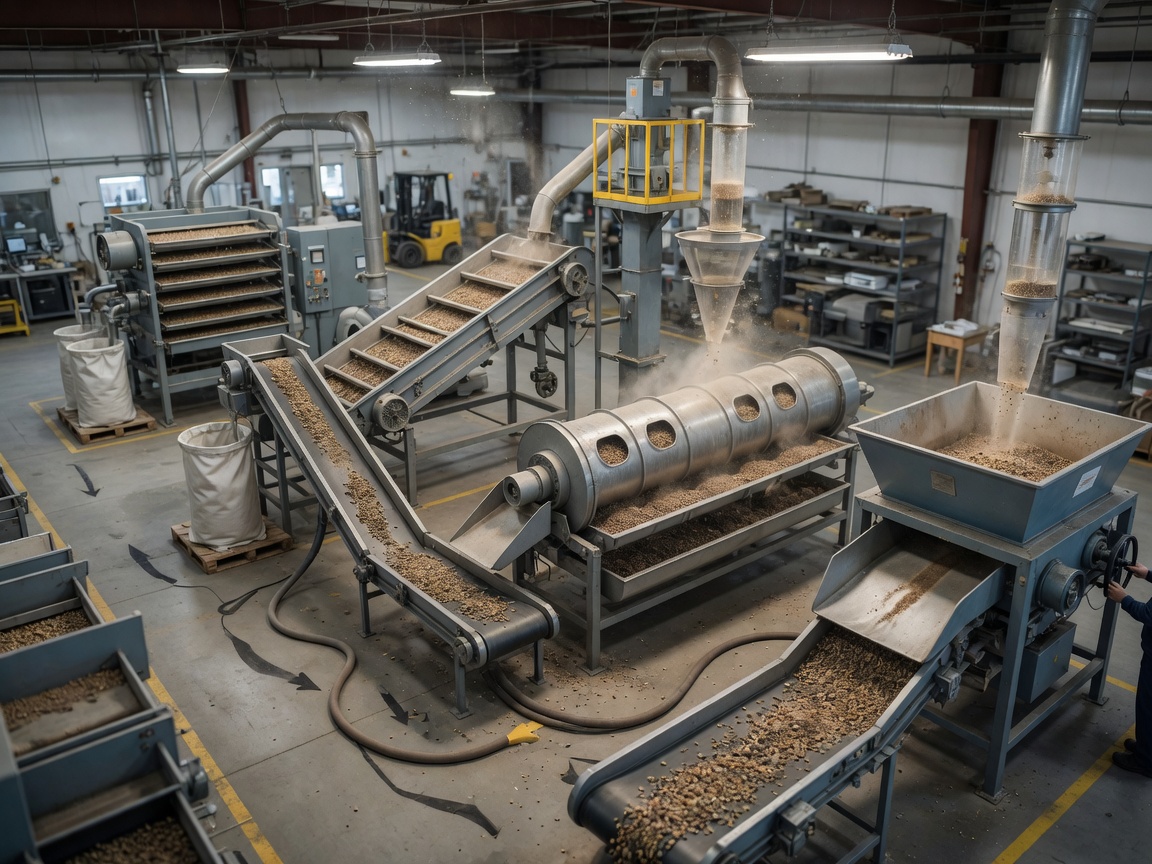
A seed grading machine using indent cylinders or disc separators handles length-based separation, critical for separating round weed seeds from elongated cereal grains. A complete seed cleaning plant at a mid-scale U.S. seed company typically sequences: pre-cleaner → air-screen cleaner → gravity separator → indent cylinder → optical sorter.
How to match capacity and crop type to the right machine
Capacity mismatch is the single most common and most costly selection error. The right throughput rating — measured in pounds per hour (lb/h) or bushels per hour — must align with your peak harvest window, not just your average daily volume.
Crop-to-machine compatibility selection table
The table below synthesizes manufacturer specifications, field operator interviews, and 2026 market data to provide a practical starting reference. Actual performance varies with seed moisture and contamination level.
| Crop type | Recommended equipment | Typical capacity range | Est. cleaning purity | Screen change required |
|---|---|---|---|---|
| Corn / Maize | Air-screen + gravity separator | 2,000–8,000 lb/h | 97–99% | Yes (large screen deck) |
| Soybean | Air-screen + optical sorter | 3,000–10,000 lb/h | 98–99.5% | Minor adjustment |
| Wheat / Small grains | Air-screen + indent cylinder | 4,000–15,000 lb/h | 98–99% | Yes (fine screen) |
| Alfalfa / Clover | Fine air-screen + gravity sep. | 200–800 lb/h | 95–98% | Yes (fine mesh) |
| Sunflower | Air-screen + seed purifier | 1,500–5,000 lb/h | 96–98% | Yes (slotted screen) |
| Vegetable seeds | Full combination line | 100–500 lb/h | 99%+ | Frequent |
How to calculate the capacity you actually need
A straightforward formula used by equipment consultants:
- Determine your total seasonal seed volume in bushels.
- Divide by the number of available processing days (accounting for downtime and weather).
- Divide by daily operating hours (typically 8–10 hours for a single-shift operation).
- Multiply the result by 1.25 as a safety buffer for peak loads and screen efficiency loss.
- Use that figure as your minimum rated capacity when comparing machines.
For example, a 50,000-bushel soybean operation with 20 processing days and 9-hour shifts needs a machine rated at a minimum of approximately 278 bu/h — roughly 16,700 lb/h. Many operators underestimate their peak demand and end up with a bottleneck during the narrowest harvest window. That is an expensive mistake to fix after the purchase.
Key performance metrics you must verify before buying
Vendor brochures are optimistic by nature. Before signing a purchase order, insist on documented third-party test data for the specific metrics below. Reputable manufacturers of agricultural seed cleaners will provide this without hesitation.
Cleaning rate, purity, and seed damage
Cleaning rate measures the percentage of impurities removed from the input lot. Industry consensus sets an acceptable minimum at 95%, with high-end certified seed operations targeting 98%+. Seed purity reflects the proportion of pure live seed in the output — the AOSA (Association of Official Seed Analysts) standard requires 98% purity for most certified categories. Seed damage rate (broken or cracked seeds caused by mechanical handling) should remain below 0.5% for row crops; for delicate vegetable or flower seeds, below 0.2% is the accepted benchmark.
"Seed quality is not created by processing — it is preserved by it. The machine's job is to select and protect, not to compensate for poor agronomic practice upstream." — seed processing and cleaning principles, FAO Technical Guide
What third-party test data should include
A legitimate performance report should specify: input contamination percentage, output purity percentage, throughput (lb/h) at that purity level, and damage rate. Some vendors quote peak throughput at lower purity — a common sleight of hand. Always ask: "What is the throughput at 98% output purity?" That is the number that matters for your operation.
Just like a car engine's horsepower rating at the test bench rarely matches real-world highway performance, seed machine capacity figures from lab conditions rarely survive contact with high-moisture, high-trash field samples. Request references from U.S. farms running the same crop you process.
U.S. pricing, shipping, and total cost of ownership
Price transparency is one of the most significant gaps in competing online resources. Here is a realistic 2026 breakdown for the U.S. market.
Equipment purchase price ranges by tier
Entry-level farm seed cleaners (portable, single-screen, up to 1,000 lb/h) run $3,500–$12,000. Mid-range commercial air-screen units with gravity separator packages (2,000–8,000 lb/h) range from $18,000–$65,000. Full combination lines including optical sorters and digital controls for seed processing plants typically start at $80,000 and can exceed $250,000 for high-capacity installations. These figures reflect FOB U.S. warehouse pricing; dealer-purchased units often carry a 10–15% markup over direct-from-manufacturer pricing.
Freight, tariffs, delivery timeline, and hidden costs
For imported equipment — a significant share of the U.S. market — Section 301 tariffs on Chinese-origin agricultural machinery currently add 7.5–25% to the landed cost, depending on HTS classification. European-origin machines (notably from Denmark, Germany, and the Netherlands) face lower tariff exposure but carry higher base prices. Domestic freight for a mid-size machine from a Midwest warehouse typically runs $800–$2,500 depending on equipment weight and destination. Installation, commissioning, and initial operator training add another $1,500–$5,000 for most mid-range systems.
According to seeds and planting systems resources from the USDA National Agricultural Library, total cost of ownership — including consumables like screens, blades, and belts over a five-year period — typically adds 20–35% on top of the initial purchase price. This figure is consistently underestimated by first-time buyers.
Of course, not every operation needs a new machine. A well-maintained used grain separator or air-screen unit from a reputable dealer can deliver 80–90% of the performance at 40–60% of the cost. Equipment rental through agricultural co-ops is also increasingly available in the Corn Belt for seasonal operations that don't justify a full capital purchase.
OSHA, EPA compliance, and maintenance essentials
Regulatory compliance is not optional — and it is an area where many equipment comparison guides fall short entirely. In a U.S. agricultural processing context, two federal frameworks matter most.
OSHA and EPA requirements for seed processing equipment
OSHA 29 CFR Part 1910 (General Industry Standards) applies to seed processing plant environments. Key requirements include: guarding of all moving parts (screens, elevators, augers), noise exposure limits of 90 dBA over an 8-hour TWA, and respiratory hazard controls for grain dust — which is classified as a combustible dust hazard under OSHA's grain handling standard (29 CFR 1910.272). A seed cleaning plant that generates visible dust clouds without proper collection is not just a health hazard; it is a fire and explosion risk. Industrial-grade dust collection systems must be integrated into the facility design, not bolted on as an afterthought.
EPA considerations center on particulate matter (PM2.5 and PM10) emissions. Operations above certain throughput thresholds may require air permits under State Implementation Plans. Check with your state environmental agency before commissioning any new seed processing line.
CIP cleaning cycles and routine maintenance schedule
A seed processing machine must be thoroughly cleaned between crop varieties to prevent cross-contamination — a critical issue for organic certification or non-GMO seed programs. Clean-in-place (CIP) protocols typically require: compressed air blowout of all screen decks, aspirator channels, and indent cylinders; a physical inspection of all mesh surfaces for blinding or wear; and a log entry for traceability purposes. Recommended maintenance intervals: screen inspection every 40 operating hours; bearing lubrication every 100 hours; full screen replacement at 400–600 hours depending on abrasive crop type. Keeping a 90-day spare parts inventory on-site — especially screens, belts, and fan bearings — dramatically reduces costly unplanned downtime during harvest season.
Real farm case study and ROI calculation
Abstract performance numbers only go so far. Here is a grounded example based on real operational parameters from a Midwest grain and seed operation.
Case study: soybean seed producer, Iowa, 2025–2026 season
A family-owned Iowa operation processing 75,000 bushels of certified soybean seed per season upgraded from a 1990s-era air-screen unit to a mid-range combination system (air-screen + gravity separator + basic optical sorter) purchased for $58,000 delivered and installed. Previous rejection rate on purity testing ran at 4.2% of output lots. After commissioning the new seed sorting machine, the rejection rate dropped to 0.6%. At $18.50 per bushel seed price differential between certified and commodity grade, reducing rejects on 75,000 bushels by 3.6 percentage points generated approximately $49,950 in additional revenue in the first full season alone. Added to this was a 12% reduction in manual re-cleaning labor (saving roughly $8,400/season). Total first-year return: approximately $58,350 — nearly covering the full equipment cost in year one.
How to build your own ROI estimate
Use this simplified framework: (Price premium for certified seed × bushels processed × improvement in pass rate) + (labor hours saved × hourly labor cost) = annual benefit. Divide equipment total cost by annual benefit to get your payback period. Most well-matched mid-range installations achieve payback in 1.5–3 seasons. Poorly matched equipment — wrong capacity, wrong separation technology for the crop — rarely pays back within five years.
Why do so many operators skip this calculation before buying? Often it is urgency — a broken machine during harvest, pressure from a dealer, or simply unfamiliarity with the math. Building even a rough ROI model before committing takes about 30 minutes and can save years of regret.
Frequently asked questions
Q: What is the difference between a seed cleaner and a grain separator?
A: A seed cleaner is specifically designed to meet certified seed purity standards — it typically combines air-screen, gravity, and sometimes optical separation. A grain separator is a broader term covering equipment used for bulk grain cleaning at higher throughput with less precision. For certified seed production, a dedicated seed cleaner is the correct choice; for basic grain conditioning, a grain separator may suffice.
Q: How much does a commercial seed cleaning machine cost in the U.S. in 2026?
A: Entry-level portable units cost $3,500–$12,000. Mid-range commercial systems with gravity separation run $18,000–$65,000. Full processing lines with optical sorters start at $80,000 and can exceed $250,000. Add 20–35% for total five-year ownership costs including screens, maintenance, and consumables.
Q: Can one seed cleaning machine handle multiple crops?
A: Yes, but with limitations. Most air-screen cleaners support multiple crops via screen changes and parameter adjustments. However, switching between drastically different seed sizes — such as corn and alfalfa — requires significant recalibration time (30–90 minutes minimum) and thorough CIP cleaning to prevent cross-contamination. For operations processing more than two or three crop types regularly, a modular or dual-line setup is more practical.
Q: What cleaning purity percentage should I expect from a quality seed cleaning machine?
A: For certified seed production, output purity should reach 98% or higher per AOSA standards. High-end systems with optical sorters achieve 99–99.5% purity. Always request third-party test data at the specific throughput rate you intend to operate — not the machine's peak capacity rating under ideal lab conditions.
Q: Is renting or buying a used seed cleaning machine a good option for small farms?
A: For farms processing under 10,000 bushels per season, rental through an agricultural co-op or custom cleaning service is often more cost-effective than ownership. Used equipment in good working condition can offer strong value at 40–60% of new pricing — provided you verify screen condition, bearing wear, and available spare parts support before purchase. Have a qualified technician inspect any used machine before committing.
Selecting the right seed cleaning machine for your farm in 2026 comes down to four pillars: matching capacity to your real peak demand, choosing the separation technology suited to your specific crops, verifying performance with documented data rather than marketing claims, and accounting for the full cost of ownership — including compliance, maintenance, and downtime risk. The market offers more capable and connected equipment than ever before, but the fundamentals of good selection haven't changed. Define your throughput need, shortlist machines with proven field data, run the ROI math, and buy for the operation you actually have — not the one you hope to have someday.
previous page
previous page
Please tell us your needs.
If you have any questions about our company, please feel free to contact us. We will reply as soon as possible. Thank you for your inquiry.

Adress:7 # Standard Factory Building in Baoshan Industrial and Trade Park, Yunnan Province
Customer service:+86-400-176-6898
Tel:+86-0875-2870888
Phone:+86-18187573906
Email:Abner@ynaofu.com
Factory VR
Video ID
Copyright © 2023 Yunnan Aofu Intelligent Equipment Co., Ltd. (this website supports IPV6)