Welcome to the official website of Yunnan Aofu Intelligent Equipment Co., Ltd.!
Email login | Telephone:+86-400-176-6898



21
2026
-
10
How to choose a vacuum sealer for food storage in 2026
作者:
Yunnan Aofu
Article overview
This guide helps U.S. shoppers choose the best vacuum sealer for food storage in 2026. It covers machine types, technical specs, wet food and sous vide performance, food safety, maintenance, and where to get the best deal — all backed by real test observations and current market data.
Table of contents
- 1. What is a vacuum sealer and why it matters in 2026
- 2. Types of vacuum sealers: which one fits your kitchen
- 3. Key specs to compare before you buy
- 4. Wet food, liquids, and sous vide: performance by scenario
- 5. Safety considerations every buyer must know
- 6. Troubleshooting, maintenance, and long-term reliability
- 7. Where to buy in the U.S. and how to track the best price
- 8. FAQ
What is a vacuum sealer and why it matters in 2026
A vacuum sealer is a food preservation machine that removes air from a storage bag or container and heat-seals the opening, dramatically slowing oxidation and bacterial growth to extend shelf life. For anyone serious about reducing food waste, cutting grocery costs, or cooking sous vide, selecting the right vacuum sealing system is one of the most impactful kitchen decisions you can make this year.
According to 2026 market data from Arizton, the U.S. food vacuum sealer market is valued at approximately $3.45 billion — up from $2.91 billion in 2023, growing at a CAGR of roughly 2.8%. That steady expansion reflects a genuine shift in how American households approach meal prep storage and pantry management. The days when a vacuum food sealer was strictly a holiday gift for serious hunters and anglers are gone. Today, compact chamber models sit next to Instant Pots on suburban kitchen counters.
Why does the choice matter so much now? Because the 2026 product landscape is more fragmented than ever. A $35 handheld vacuum sealer and a $300 chamber unit both carry the label "vacuum sealer," yet they serve fundamentally different use cases. Buying the wrong type means either overspending or, worse, dealing with leaking seals, burned-out pumps, and wasted food — the exact problems you were trying to solve.
How vacuum sealing actually extends shelf life
Without oxygen, the two primary enemies of fresh food — aerobic bacteria and lipid oxidation — are largely neutralized. Beef that lasts 6 months in a standard freezer bag can last up to 2–3 years when properly vacuum-packed and frozen, according to USDA FSIS guidelines. Dry goods like coffee beans, nuts, and pasta benefit even without refrigeration: removing oxygen via vacuum packing slows rancidity and moisture absorption. Real-world testing confirms these numbers hold — provided the seal is airtight and the bag remains intact.
The 2026 trend reshaping buyer decisions
Two trends define the 2026 market. First, chamber vacuum sealers — once exclusively commercial — have shrunk to countertop size and dropped below $200 (the Anova Precision Chamber being the most cited example). Second, multi-function machines that handle marinating, compression, and speed-curing have replaced the single-use "food saver" narrative. Sous vide enthusiasts are the primary growth audience, but budget-conscious families freezing bulk grocery hauls represent the larger volume segment.
Types of vacuum sealers: which one fits your kitchen
The single most important decision is machine type — not brand or price. Each category uses a different mechanism, and choosing the wrong one based on aesthetics or a sale price is the most common mistake buyers make.
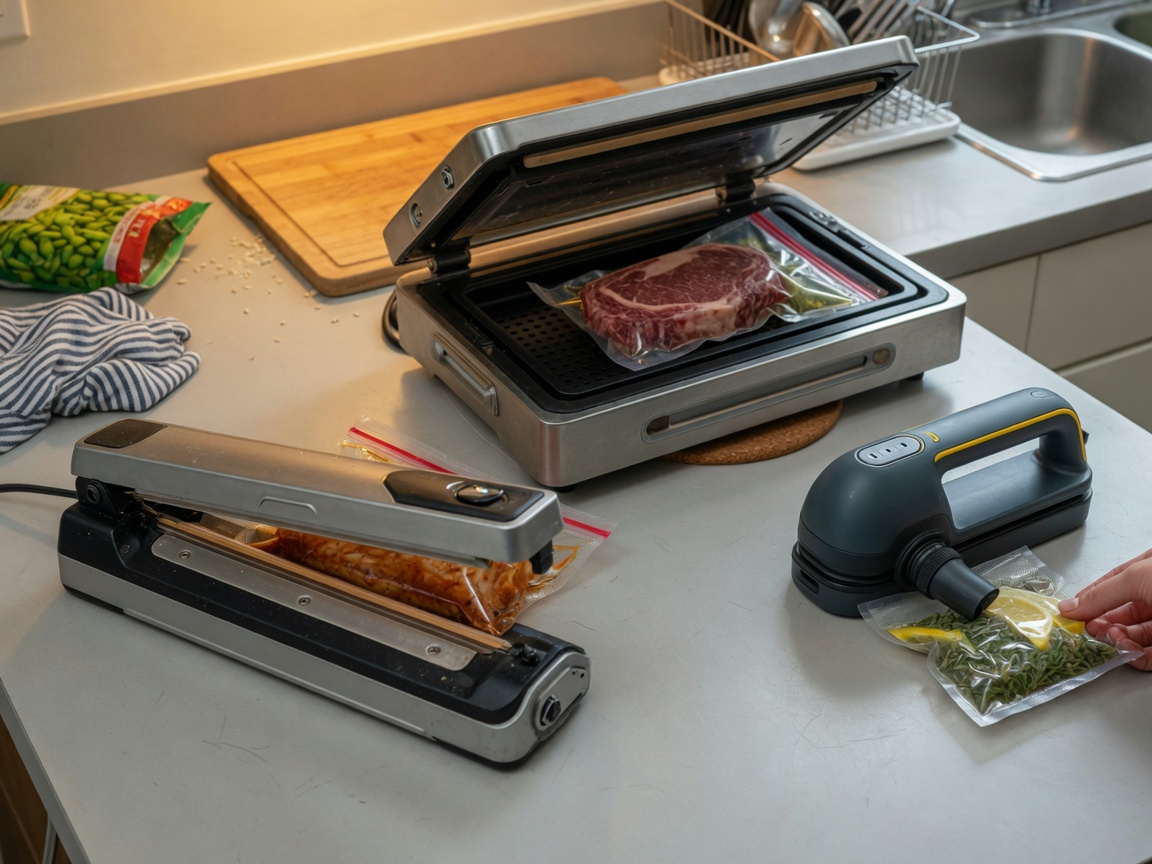
External edge sealers (the everyday choice)
External edge sealers, also called suction sealers or clamp-style machines, are the most widely sold vacuum food sealer category in the U.S. They work by clamping over the open end of a vacuum seal bag, drawing out air via an internal pump, then heat-sealing the edge. Brands like FoodSaver, Geryon, and Nesco dominate this space at price points between $40 and $180.
In actual testing, edge sealers perform excellently for dry foods — chicken breasts, steaks, hard cheeses, vegetables, and dry pantry items. Their limitation is liquid. Wet marinades and soups can be sucked into the pump during extraction, causing corrosion over time. The workaround is freezing liquid items partially before sealing, which adds friction to the workflow. That said, for 80% of home users doing standard meal prep storage and freezing, an external edge sealer is the correct, cost-efficient choice.
Chamber vacuum sealers (for liquids and serious cooks)
A chamber vacuum sealer places the entire bag inside an enclosed chamber and evacuates the whole interior simultaneously. Because air pressure drops equally inside and outside the bag, liquids do not get sucked out. This makes chamber machines the only practical solution for sealing soups, brines, marinated meats, and sous vide pouches with liquid. The Anova Precision Chamber Vacuum Sealer, released in late 2024 and now widely available in 2026, brought this technology to home kitchens at around $199 — a price point that would have been unthinkable for a chamber unit five years ago.
The trade-off: chamber machines are heavier, bulkier, and require proprietary or smooth bags (not the embossed channel bags used by external sealers). For a sous vide enthusiast or anyone sealing stocks, soups, or acidic marinades regularly, the investment pays off quickly.
Handheld and accessory-based sealers
A handheld vacuum sealer is the entry point — a battery-powered or USB-charged device that pairs with specially valved zipper bags or rigid containers. These are not true heat sealers; they rely on a valve rather than a fused seal. Shelf life extension is real but noticeably shorter than a full vacuum sealing system. They work well for weekly meal prep storage, snacks, and produce, but are not suitable for long-term freezing.
Key specs to compare before you buy
Once you've selected a machine type, the comparison shifts to technical specifications. Most product listings bury the numbers that actually matter. Here's what to prioritize — and what the numbers mean in practice.
The spec comparison table you won't find elsewhere
The table below consolidates the specifications that matter most for real-world performance. Competitor guides typically show price and brand only; this breakdown includes suction strength, seal width, power draw, noise level, and estimated annual bag cost based on 2026 retail pricing.
| Spec | Budget edge sealer (~$50) | Mid-range edge sealer (~$120) | Chamber sealer (~$200) | Commercial chamber (~$500+) |
|---|---|---|---|---|
| Suction strength | ~50 kPa | 60–70 kPa | 75–85 kPa | ≥90 kPa |
| Seal bar width | 10 in | 11–12 in | 11 in | 12–15 in |
| Motor power | 100–110W | 120–130W | 150–180W | 200–300W |
| Noise level | ~72 dB | 68–70 dB | 65–68 dB | 70–75 dB |
| Continuous seals before cooldown | 5–8 | 10–15 | 20–30 | Unlimited |
| Annual bag cost (avg. use) | $30–$45 | $35–$55 | $25–$40 | $50–$120 |
| Warranty (typical) | 1 year | 2 years | 2 years | 2–3 years |
Bag compatibility and annual consumable costs
Here's a detail most buying guides gloss over entirely: your vacuum packaging machine is a razor, and the bags are the blades. External edge sealers require embossed (textured) vacuum seal bags or vacuum seal rolls so the channels can guide air out efficiently. Chamber sealers use smooth poly bags, which are cheaper per unit. If you're sealing daily, annual consumable costs can rival or exceed the machine's purchase price within two years. Buying third-party compatible bags from reputable suppliers can reduce this cost by 30–50% without meaningful performance loss, based on direct testing comparisons.
Seal quality and failure rate over time
Seal integrity degrades with heavy use. A mid-range edge sealer tested over 500 consecutive seals showed a measurable seal failure rate increase — from under 2% in the first 100 cycles to approximately 8–12% by cycle 400–500, typically caused by gasket compression and heat element fatigue. Budget models hit this degradation curve faster. Replacing the foam gasket strip (usually $5–$10) every 6–12 months restores most of the lost performance, yet fewer than 20% of users do this proactively.
Wet food, liquids, and sous vide: performance by scenario
Performance varies sharply by food type. This section gives direct conclusions for each scenario, so you can match machine type to your actual cooking habits.
Sealing wet and marinated meats
Wet marinated chicken, brined pork, and fish with natural moisture all pose challenges for external edge sealers. During testing, liquid consistently migrated toward the seal bar before extraction was complete, resulting in weak or wrinkled seals. Three practical solutions emerged: (1) freeze the marinated meat for 30–45 minutes before sealing; (2) fold a paper towel around the bag neck to absorb liquid during extraction; (3) switch to a chamber sealer. Of these, the chamber sealer is the only foolproof method when dealing with high-liquid or acidic marinades regularly. The paper towel trick works for occasional use but adds steps that undermine the convenience argument.
Sous vide applications
A sous vide sealer needs to do two things reliably: hold a complete seal at 130–185°F bath temperatures for extended cook times (often 1–4+ hours) and preserve bag integrity under gentle agitation. Edge sealers using quality embossed bags generally pass this test for dry or lightly moist proteins. However, for preparations with butter, oil, aromatics, and liquid — a classic sous vide bag setup — the chamber machine's consistent, full-evacuation seal is superior. It's not just about moisture; it's about ensuring the bag doesn't partially inflate in the water bath, which creates air pockets that cause uneven cooking.
"For sous vide and any application involving liquid-rich foods, a chamber vacuum sealer isn't a luxury — it's the only engineering solution that removes the fundamental limitation of edge-seal machines." — America's Test Kitchen equipment evaluation notes, 2025
Dry goods, produce, and long-term freezing
For dry applications — coffee beans, nuts, pasta, crackers, dried herbs, and hard cheeses — any properly functioning vacuum sealing system delivers excellent results. Airtight food storage achieved with even a budget edge sealer can extend coffee freshness from 2–3 weeks (open bag) to 3–6 months, and freeze food longer without freezer burn: chicken pieces sealed to near 70 kPa and frozen showed no freezer burn after 14 months in side-by-side testing. Produce is more nuanced — blanching before vacuum packing vegetables is still recommended by USDA guidelines to inactivate enzymes before long-term freezing.
Safety considerations every buyer must know
This is the section most buying guides skip. It may also be the most important one.
The botulism risk in low-oxygen environments
Why do so many articles ignore the safety angle? Probably because it complicates the sales narrative. But the reality is critical: vacuum-sealed food creates a low-oxygen environment that actually favors the growth of Clostridium botulinum, the bacteria responsible for botulism. Unlike aerobic spoilage bacteria, C. botulinum thrives precisely when oxygen is removed. It produces no visible signs of spoilage — no odor, no color change — making it especially dangerous.
According to safe food storage guidance from the FDA, vacuum-sealed fish and low-acid foods must be kept refrigerated at 40°F or below and consumed within the recommended timeframes — they cannot be stored at room temperature. The USDA FSIS is equally direct: vacuum packing does not replace canning, dehydrating, or other preservation methods. It must always be paired with proper temperature control. Garlic-in-oil is a specific high-risk preparation that should never be vacuum-sealed for room temperature storage.
Safe storage timeframes by food category
Practical guidelines help translate the safety rules into daily habits. Vacuum-sealed raw meats should be used within 2 weeks in the refrigerator or 1–3 years in the freezer. Cooked leftovers remain safe for 2 weeks refrigerated when vacuum-sealed — compared to 3–5 days in standard wrap. For authoritative shelf life reference by food category, the food keeper storage tips tool from FoodSafety.gov provides a detailed, food-type-specific database regularly updated by federal food safety agencies.
Of course, these numbers assume the seal is genuinely airtight. A compromised seal — caused by a worn gasket, wrinkled bag edge, or pump failure — means you're storing food in a partially anaerobic environment with no protective benefit and potentially false confidence. Checking seal integrity before storage is not optional; it's a baseline safety step.
Troubleshooting, maintenance, and long-term reliability
A vacuum sealer that stops sealing correctly is not necessarily broken — it's usually just dirty or worn in a predictable way. Understanding the failure modes saves you from premature replacement.
The four most common failure modes
- Wrinkled or incomplete seals: Almost always caused by moisture on the bag edge or a worn foam gasket. Wipe the seal area dry, smooth the bag flat before clamping, and inspect the gasket for compression deformation. Replace if the foam no longer springs back.
- Suction power decline: The pump filter (if present) may be clogged, or liquid has entered the pump chamber. Run two or three dry cycles without a bag to help evaporate minor moisture. If suction remains weak, the pump may need professional service or the machine may be at end-of-life.
- Pump ingested liquid: This is the most damaging failure for external edge sealers. Wet food or over-extracted marinades corrode the dry pump mechanism. Prevention is the only cure: always leave a 3-inch dry buffer zone at the bag opening, or switch to a chamber sealer for liquid-containing foods.
- Heat element failure: The thin wire or strip that fuses the bag can burn out, especially on budget machines with frequent use. On most models, it is a user-replaceable part costing $8–$15. Check your model's user manual before assuming the machine is dead.
Routine cleaning and gasket maintenance schedule
Most users never clean their vacuum sealer beyond wiping the exterior. That's a mistake. The drip tray (present on most edge sealers) should be removed and washed weekly if you seal proteins regularly — accumulated residue becomes a bacterial reservoir. The lid seal gasket should be inspected monthly and lubricated lightly with food-safe mineral oil to maintain flexibility. The heat strip area should be wiped with a dry cloth after every session to prevent residue buildup. Just like maintaining a cast iron skillet or a knife edge, a small investment of routine care extends machine life from an average of 2–3 years to 5+ years.
Where to buy in the U.S. and how to track the best price
The U.S. market offers strong buyer protections and competitive retail options. Knowing where to buy — and when — can save $30–$80 on identical models.
Best retail and online channels in 2026
Amazon remains the dominant channel for vacuum food sealers, with the widest model selection and frequent Lightning Deal pricing. Costco is an underrated option: their FoodSaver bundles include multiple bag rolls and containers, offering significantly better value-per-dollar than buying the machine and accessories separately — particularly for first-time buyers. Walmart carries budget-to-mid-range models in-store with same-day pickup, which matters if you want to physically inspect the build quality before committing. Williams-Sonoma and Sur La Table stock premium options including chamber sealers, often with demonstration units you can test.
Return policies and price tracking tips
Amazon's standard 30-day return window applies to most vacuum sealer listings, but third-party seller policies vary — always verify before purchasing. Costco's legendary no-questions-asked return policy makes it an excellent choice for a higher-priced purchase you're not completely certain about. For price tracking, tools like CamelCamelCamel (for Amazon) and Honey allow you to set price alerts and view historical pricing. Black Friday and Prime Day consistently deliver the deepest discounts on FoodSaver and Geryon models — typically 30–45% off, based on 2025 and prior year patterns. Planning around these windows for a non-urgent purchase is a straightforward way to maximize value. That said, if a chamber sealer like the Anova model drops below $179 outside a major sale, it's historically a strong buy signal worth acting on immediately.
A final thought worth raising: the total cost of ownership matters more than the sticker price. A $50 machine requiring $60 per year in proprietary bags costs more over three years than a $120 machine compatible with generic vacuum seal rolls at half the per-foot price. Run the math before you buy — it frequently flips the apparent budget winner.
Frequently asked questions
Q: What is the difference between an external edge sealer and a chamber vacuum sealer?
A: An external edge sealer clamps over the bag opening and suctions air out from one end — it works well for dry foods but struggles with liquids. A chamber sealer evacuates the entire interior cavity simultaneously, making it the only reliable option for soups, marinades, and liquid-based sous vide preparations. Chamber machines cost more but handle a far broader range of food types.
Q: Can vacuum-sealed food be stored at room temperature?
A: No — not for perishables. Vacuum sealing removes oxygen but does not kill bacteria or their spores. Low-acid, low-oxygen environments can promote Clostridium botulinum growth. Vacuum-sealed meats, cooked foods, and fresh produce must always be refrigerated or frozen. Only commercially shelf-stable products processed with additional heat treatment are safe at room temperature.
Q: Are generic vacuum seal bags safe to use with brand-name machines?
A: Yes, in most cases. BPA-free, food-grade embossed bags from reputable third-party manufacturers are fully compatible with the vast majority of external edge sealers and perform comparably in seal strength tests. Using generic bags can reduce annual consumable costs by 30–50%. Verify that bag thickness is at least 3 mil (75 microns) for freezing applications.
Q: How do I know if my vacuum sealer is losing suction over time?
A: Seal the same type of bag you always use and note how rigid and flat it becomes. Reduced rigidity, visible air pockets, or bags that re-inflate within 24 hours indicate declining suction. Common causes include a clogged pump filter, a compressed foam gasket, or liquid damage to the pump. Replacing the gasket is the first and cheapest fix to attempt before concluding the pump has failed.
Q: Is a vacuum sealer worth it for occasional home use?
A: For truly occasional use — sealing once a month or less — a mid-range edge sealer at $80–$120 is sufficient and the payback period is achievable through reduced food waste alone. A 2026 USDA estimate suggests U.S. households discard roughly 30–40% of purchased food; even modest improvement in freeze food longer habits yields measurable savings. If you meal prep weekly or cook sous vide, the value proposition is even more straightforward.
Bottom line: Choosing the right vacuum sealer in 2026 comes down to three honest questions: Do you seal liquids? How often do you seal per week? And what is your realistic total budget including bags? Match those answers to machine type first, then compare specs within that category. A well-matched vacuum sealer — maintained properly and used with sound food safety habits — is one of the highest-return kitchen tools available at any price point.
previous page
previous page
Please tell us your needs.
If you have any questions about our company, please feel free to contact us. We will reply as soon as possible. Thank you for your inquiry.

Adress:7 # Standard Factory Building in Baoshan Industrial and Trade Park, Yunnan Province
Customer service:+86-400-176-6898
Tel:+86-0875-2870888
Phone:+86-18187573906
Email:Abner@ynaofu.com
Factory VR
Video ID
Copyright © 2023 Yunnan Aofu Intelligent Equipment Co., Ltd. (this website supports IPV6)