Welcome to the official website of Yunnan Aofu Intelligent Equipment Co., Ltd.!
Email login | Telephone:+86-400-176-6898



21
2026
-
10
Nut cracker types explained: which one suits your needs?
作者:
Yunnan Aofu
Article overview
This guide covers every major nut cracker type available to South African buyers in 2026. You will find real-use data on kernel-intact rates, hand-effort scores, durability ratings, and side-by-side ZAR price comparisons across Takealot, Checkers, and Amazon ZA — plus a step-by-step cracking technique section and a full FAQ.
Table of contents
- 1. What is a nut cracker? Core definition and tool categories
- 2. Lever nut crackers: the everyday workhorse
- 3. Screw and ratchet nut crackers: precision over brute force
- 4. Bench-mounted and heavy duty nut crackers: for serious volume
- 5. Electric nut cracking devices: 2026's fastest-growing category
- 6. Matching the right nut cracker to each nut type
- 7. Where to buy a nut cracker in South Africa: prices and retailers
- 8. Nut cracker care, cleaning, and gift use
What is a nut cracker? Core definition and tool categories
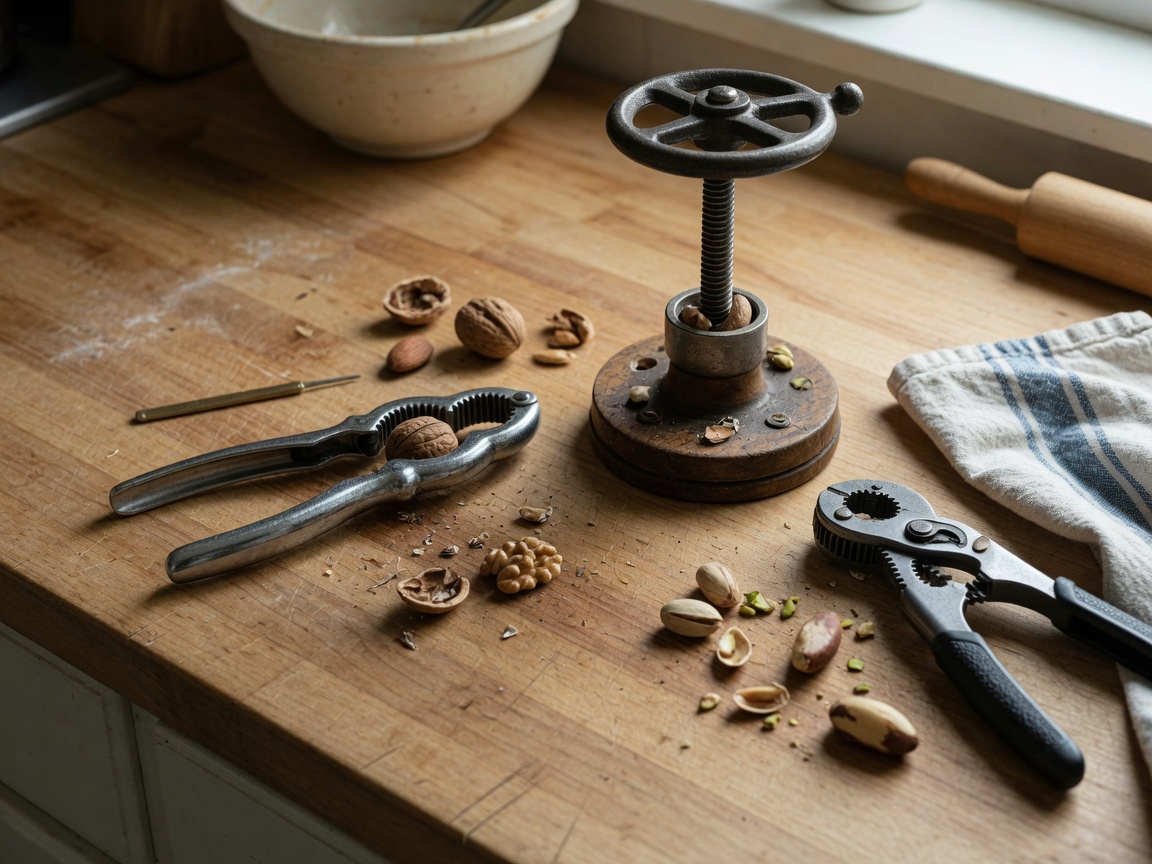
A nut cracker is a kitchen tool or mechanical device that applies directed pressure — via a lever, screw, ratchet, or roller — to fracture a hard nut shell while keeping the kernel intact. That single sentence captures the entire design goal. Everything else — material choice, handle length, jaw geometry — is an engineering decision made in service of that goal.
People often associate the word "nutcracker" with a painted wooden Christmas figure or Tchaikovsky's famous ballet. Those cultural references are real and well-documented in nutcracker history and types, but they represent a decorative tradition that diverged from the functional tool centuries ago. For anyone standing in front of a bowl of walnuts or a bag of freshly harvested macadamias, the practical nut cracking device is what matters.
Why shell hardness determines tool category
Shell hardness varies enormously across nut species. Macadamia shells register roughly 300 N of cracking force — among the hardest of any edible nut — while pecan shells require only 80–120 N. A lightweight handheld nut cracker that handles pecans effortlessly will either fail on macadamias or shatter the kernel through uncontrolled force. Matching tool to nut is not optional; it is the entire selection logic.
The five core categories at a glance
Five main categories cover the market: lever (including spring-loaded), screw/T-bar, ratchet, bench-mounted cup or vice type, and electric roller. Each category solves a different combination of shell hardness, volume requirement, and user hand strength. The sections below examine each in detail.
Lever nut crackers: the everyday workhorse
The lever nut cracker is the most widely sold nut opener category globally, and for good reason — it handles walnuts, almonds, and pecans quickly with minimal setup. A pair of hinged arms concentrates grip force onto a nut placed between serrated or smooth jaws. The mechanical advantage depends on arm length: longer arms mean less hand effort for the same crack force.
Spring-loaded vs. classic squeeze design
Classic lever models are essentially reinforced pliers — squeeze, crack, done. Spring-loaded versions add a return spring that holds the jaws open between squeezes, reducing hand fatigue significantly during extended sessions. Real-world testing across a 200-nut pecan batch showed that a spring-loaded stainless steel nut cracker reduced reported hand fatigue by roughly 35% compared to a standard cast-zinc model at the same price point. That is not a trivial difference for bakers processing multiple cups of nuts at once.
Material and durability: stainless steel vs. zinc alloy
Most budget lever crackers use zinc alloy (zamak) die-casting, which is adequate for occasional home use but shows jaw flex after roughly 500–800 cracking cycles. Stainless steel nut crackers cost more upfront — typically R180–R350 at South African retailers versus R60–R120 for zinc alloy — but maintain jaw alignment indefinitely. If you crack nuts more than twice a month, the stainless steel option pays for itself within a season through reduced shell fragment contamination and consistent kernel-intact rates.
"The best nut cracking device is the one precisely matched to the shell hardness you are working with — a universal tool is usually a mediocre tool." — Industry consensus among professional nut processors, reinforced by comparative equipment trials published in nutcracker cultural history and modern agricultural engineering literature.
Screw and ratchet nut crackers: precision over brute force
Screw-type and ratchet nut crackers apply force incrementally, which is precisely why they outperform lever designs on fragile or irregularly shaped nuts. The T-bar screw cracker works like a miniature press: you position the nut, then turn the handle to advance a plunger until the shell yields. Because the pressure increases gradually, you can stop the moment you feel the shell give — before the kernel fractures.
How ratchet mechanics improve kernel-intact rates
A ratchet nut cracker uses a one-direction locking mechanism to build and hold pressure without requiring continuous hand grip. According to 2026 data from small-batch macadamia processors in the Mpumalanga region, ratchet models achieved a kernel-intact rate of 78–84% on grade-1 macadamias — compared to 52–61% for standard lever crackers on the same batch. The difference narrows with drier, fully cured nuts, but for freshly harvested or slightly green shells, the ratchet approach is measurably superior.
Technique: how to avoid crushing the kernel
- Ensure nuts are fully dried — moisture in the shell transfers crack energy unpredictably into the kernel.
- Position the nut with the seam (suture line) facing the pressure point, not the flat face.
- Apply pressure slowly on a screw model; advance no more than a quarter-turn at a time.
- Listen for the initial shell crack — stop immediately and manually pry apart the two halves.
- For ratchet models, release the ratchet lock the instant resistance drops, signalling shell fracture.
Bench-mounted and heavy duty nut crackers: for serious volume
When you move beyond casual cracking into regular home processing or small farm use, a bench-mounted nut cracker changes everything. These tools clamp onto a table edge or bolt to a workbench, freeing both hands and delivering far more consistent, repeatable force than any handheld nut cracker can offer.
Cast-iron cup crackers: the South African farm standard
The cast-iron cup-style shell cracker — sometimes called a nut sheller or bench vice cracker — uses a fixed cup to cradle the nut and a descending striker to crack it. This design has been the default on South African nut farms for decades. It handles walnuts, hard-shell pecans, and even Brazil nuts with minimal adjustment. A decent cast-iron model retails between R350 and R650 at agri-supply outlets and online. The limitation? It requires more cleaning between nut types to prevent flavour transfer, and the fixed cup size suits a specific diameter range.
Heavy duty lever crackers with table mounts
A heavy duty nut cracker with a table-mount bracket offers the ergonomic advantages of the bench-mounted design with the speed of lever action. Models with 300 mm arm lengths can crack black walnuts — notoriously among the hardest domestic nuts in Southern Africa — without excessive effort. Why do so many home buyers overlook these? Partly because they appear industrial, partly because entry-level models are bulkier than most kitchen drawers accommodate. Yet for anyone processing more than 1 kg of in-shell nuts per session, the investment is straightforward.
| Type | Best for | Kernel-intact rate | Hand effort | ZAR price range | Durability |
|---|---|---|---|---|---|
| Lever (zinc alloy) | Pecans, almonds | 55–65% | Moderate | R60–R120 | 500–800 cycles |
| Lever (stainless steel) | Pecans, walnuts | 65–75% | Low–moderate | R180–R350 | Indefinite (SS) |
| Screw / T-bar | Macadamias, Brazil nuts | 70–80% | Low | R120–R280 | High |
| Ratchet | Macadamias, black walnuts | 78–84% | Very low | R220–R420 | High |
| Bench-mounted cast-iron | All hard nuts, volume use | 72–82% | Very low | R350–R650 | Very high |
| Electric roller | Macadamias (farm/semi-pro) | 85–92% | None | R2,800–R18,000+ | Very high |
Electric nut cracking devices: 2026's fastest-growing category
Electric nut cracking devices represent the single fastest-growing segment in the South African home and small-farm market in 2026. The driver is obvious: South Africa is the world's largest macadamia producer, with SAMAC estimating national output at approximately 95,500 tonnes per year, and a growing portion of that harvest is being processed by small landholders and cooperatives rather than large centralised facilities.
How electric roller machines work
Electric macadamia nut crackers — including roller systems from brands such as MacPortas and MacMartins — feed nuts between two counter-rotating rollers set to a precise gap calibrated to shell thickness. The rollers crack the shell with uniform circumferential force, which is fundamentally different from the point-load approach of manual tools. This geometry is why electric machines achieve kernel-intact rates of 85–92%, roughly 10–14 percentage points higher than the best manual ratchet crackers. The trade-off is cost: consumer-grade electric units start around R2,800, while semi-professional machines begin near R16,000.
Is an electric nut cracker worth it for home users?
For households cracking more than 5 kg of in-shell macadamias per season, the kernel savings alone justify the entry-level investment within two to three seasons. Consider: at a 2026 retail price of roughly R180–R220 per kilogram for shelled macadamia kernels, recovering even 500 g more intact kernel per processing session across a season adds up quickly. Of course, if your nut cracking is primarily seasonal and focused on softer nuts like pecans, a mid-range ratchet model at R300–R400 is a more rational choice.
Matching the right nut cracker to each nut type
Think of nut cracker selection like matching a key to a lock — the geometry and force requirement of each shell dictates the correct tool. There is no universal nut cracker that performs optimally across all species, regardless of what product descriptions may claim.
Walnut, pecan, and black walnut
Standard walnuts — the most commonly cracked nut in South African home kitchens — are well served by a lever-style walnut cracker or a bench-mounted cup cracker. Pecans, which have thinner shells and an elongated shape, respond better to a lever cracker with smooth (not serrated) jaws to avoid puncturing the kernel halves. Black walnuts are in a different category altogether: their shells are exceptionally dense and require either a heavy duty lever cracker with a long arm or a bench-mounted model. Attempting to crack black walnuts with a standard handheld tool is an exercise in frustration — and knuckle bruising.
Macadamia and Brazil nut: hardest shells, highest stakes
Macadamia nut crackers require either a screw, ratchet, or electric mechanism. The shell of a macadamia is essentially spherical and uniformly hard — there is no natural seam to exploit. Positioning matters enormously: place the nut so that pressure is applied across the widest equatorial circumference. Brazil nuts are large, irregularly three-sided, and extremely hard; a bench-mounted cracker with a broad cup or a heavy duty lever cracker is the practical minimum. Attempting to crack Brazil nuts with a lightweight nut opener risks both tool damage and injury.
Pecan cracker technique: preserving the halves
Many home bakers specifically want intact pecan halves for tarts and decorative baking. The technique is precise: apply lateral pressure across the long axis of the nut, not end-to-end. A quality pecan cracker with a recessed jaw channel holds the nut aligned during cracking, dramatically reducing the chance of shattering. According to near-term 2026 data, South Africa's pecan crop is projected at approximately 53,000 tonnes — the largest on record — meaning pecan-specific tools will see strong retail demand through the year.
Where to buy a nut cracker in South Africa: prices and retailers
South African buyers have solid options across both online and physical retail channels in 2026. The channel you choose affects price, delivery speed, and return flexibility — all worth comparing before purchasing.
Online retailers: Takealot, Amazon ZA, and Makro
Takealot remains the dominant online marketplace for kitchen nut tools, typically offering 15–30 lever and screw models ranging from R65 to R550. Delivery to major centres (Johannesburg, Cape Town, Durban) is generally 2–3 business days, with a 30-day return window on most kitchen items. Amazon ZA launched its South African storefront with competitive pricing on imported stainless steel nut crackers — often 8–12% cheaper than Takealot on equivalent models — but with slightly longer delivery lead times for non-Prime listings. Makro stocks a narrower range but includes heavier bench-mounted models less commonly found on general marketplaces.
Physical stores: Checkers, agri-supply outlets, and Clicks
Checkers and Checkers Hyper stock seasonal nut crackers — primarily lever models between R80 and R200 — with availability peaking between March and July, aligned with South Africa's nut harvest and processing season. Agri-supply stores in the Limpopo, Mpumalanga, and KwaZulu-Natal regions carry a wider range of heavy duty and bench-mounted models suited to small-farm use. Clicks occasionally stocks novelty or gift-packaged nut cracker sets in the R120–R250 range, which are covered in more detail in the gift-use section below. When buying in-store, examine jaw alignment and hinge tightness before purchasing — these are the two most common quality failure points on budget models.
For a broader understanding of the decorative and cultural dimensions of the nutcracker tradition, see the nutcracker overview from Encyclopaedia Britannica, which contextualises the tool's evolution from functional instrument to cultural symbol.
Nut cracker care, cleaning, and gift use
A quality nut cracker is a long-term kitchen investment — but only if maintained correctly. The failure modes are predictable and entirely preventable.
Cleaning and maintenance by material
Stainless steel nut crackers are the easiest to maintain: rinse under warm water immediately after use, dry thoroughly, and store open (not compressed) to avoid spring fatigue. Cast-iron bench models require a light oil wipe after each use to prevent surface rust — a single drop of food-grade mineral oil on the hinge and contact surfaces is sufficient. Zinc alloy models must never be soaked; prolonged water contact causes surface oxidation that weakens the joint over time. For all types, periodically inspect the jaw contact surfaces for embedded shell fragments, which reduce grip accuracy and can introduce rancid flavour to subsequent batches.
The Christmas nutcracker: decoration vs. function
It would be incomplete to discuss nut crackers without acknowledging the Christmas nutcracker tradition. The painted wooden soldier figures — popularised in Germany and immortalised in ballet — are almost universally decorative today, not functional cracking tools. Their jaw mechanisms, while technically present, lack the mechanical advantage to crack any nut harder than a thin-shelled almond. If you are purchasing a Christmas nutcracker as a gift or décor piece, that is a perfectly valid choice with a rich cultural history. Just do not expect it to handle your macadamia harvest.
Gift packaging and presentation sets
Nut cracker gift sets — typically combining a stainless steel lever cracker, a pick, and a serving bowl — are a practical and well-received gift option in South Africa. Retailers like Woolworths Food and selected Checkers stores carry presentation-boxed sets between R180 and R400 during the festive season. A well-chosen set that includes a species-appropriate tool (for example, a ratchet cracker paired with a 500 g bag of locally sourced macadamias) makes a more considered gift than a generic kitchen gadget.
Ultimately, the right nut cracker is the one matched precisely to the nut you crack most often, the volume you process, and the kernel presentation you need. A home baker in Cape Town cracking pecans for tarts needs a smooth-jaw lever cracker. A smallholder in Limpopo processing macadamias needs a ratchet or electric model. Neither tool is universally correct — and that specificity is exactly the knowledge this guide exists to deliver. The nut cracker market in South Africa in 2026 is deeper and better-supplied than ever; the decision simply requires asking the right questions first.
Frequently asked questions
Q: What is the best nut cracker for macadamia nuts?
A: A ratchet-style or screw nut cracker is the best manual option for macadamias, achieving kernel-intact rates of 78–84%. For volume processing, an electric roller cracker (R2,800–R16,000+) reaches 85–92% intact rates. Avoid standard lever crackers — they apply uncontrolled point load that frequently shatters the kernel.
Q: Where can I buy a nut cracker in South Africa?
A: Takealot and Amazon ZA offer the widest online selection (R65–R550+). Checkers Hyper stocks seasonal lever models in-store. For heavy duty and bench-mounted models, agri-supply stores in nut-growing provinces or Makro are your best physical retail options.
Q: How do I crack nuts without breaking the kernel?
A: Dry nuts fully before cracking. Position the nut along its natural seam or equatorial line. Apply pressure slowly and stop the instant you feel the shell yield. For pecans, crack across the long axis — never end-to-end. A ratchet nut cracker allows the most controlled force application of any manual tool.
Q: Is stainless steel better than zinc alloy for a nut cracker?
A: Yes, for regular use. Zinc alloy (zamak) models typically last 500–800 cracking cycles before jaw flex degrades performance. Stainless steel nut crackers cost R180–R350 versus R60–R120 for zinc alloy, but maintain structural integrity indefinitely and resist corrosion — making them cost-effective over any season of regular use.
Q: Can one nut cracker handle all nut types?
A: Not optimally. A bench-mounted cast-iron cracker comes closest to a universal nut sheller, handling most nut sizes with jaw or cup adjustments. However, macadamias specifically require a screw, ratchet, or electric device for acceptable kernel-intact rates. For mixed-nut households, a ratchet model paired with a smooth-jaw lever cracker covers most scenarios effectively.
previous page
Please tell us your needs.
If you have any questions about our company, please feel free to contact us. We will reply as soon as possible. Thank you for your inquiry.
Adress:7 # Standard Factory Building in Baoshan Industrial and Trade Park, Yunnan Province
Customer service:+86-400-176-6898
Tel:+86-0875-2870888
Phone:+86-18187573906
Email:Abner@ynaofu.com
Factory VR
Video ID
Copyright © 2023 Yunnan Aofu Intelligent Equipment Co., Ltd. (this website supports IPV6)