Welcome to the official website of Yunnan Aofu Intelligent Equipment Co., Ltd.!
Email login | Telephone:+86-400-176-6898



23
2026
-
10
How to choose the right food packaging machine for your production line
作者:
Yunnan Aofu
Article overview
This guide walks U.S. food manufacturers through a structured framework for selecting the right food packaging machine. Topics include machine type comparisons, total cost of ownership, FDA/USDA compliance, ROI modeling, phased purchasing paths, and after-sales benchmarks — all the content gaps competitors consistently miss.
Table of contents
- 1. What is a food packaging machine and why selection matters
- 2. Main types of food packaging machines compared
- 3. Total cost of ownership: beyond the sticker price
- 4. Compliance requirements every U.S. buyer must know
- 5. How to calculate ROI and payback period
- 6. Phased purchasing strategy for small and mid-sized food manufacturers
- 7. Delivery, installation, and after-sales support benchmarks
- 8. Final checklist before you buy
What is a food packaging machine and why selection matters
A food packaging machine is any automated or semi-automated piece of equipment used to measure, fill, seal, wrap, vacuum-pack, or label food products to ensure hygiene, shelf-life extension, and regulatory compliance. The category spans dozens of machine formats — from a compact food bagging machine suited to a 500-square-foot co-packing facility, all the way to a fully integrated food production line equipment array running at 400 packages per minute.
Why does selection matter so much? Because getting it wrong is expensive in ways that rarely show up in the initial quote. A mismatched machine can bottleneck a line, require constant film changeovers, fail a USDA audit, or sit idle during a product reformulation. According to food packaging overview data compiled by industry researchers, food is the single largest end-use segment for packaging machinery globally, accounting for roughly 39% of all equipment demand in 2026. That level of market depth means buyers have genuine choices — and genuine risk of choosing poorly.
The global packaging machinery market reached an estimated $54.8 billion in 2026, up from $52.4 billion in 2025, with North America posting the fastest regional growth rate (source: Precedence Research, 2025 public data). For U.S. food manufacturers specifically, that growth signals both opportunity and increasing competition — two reasons to make your equipment decision with rigor, not guesswork.
Who this guide is written for
This article targets operations managers, procurement leads, and owner-operators at small-to-mid-sized U.S. food companies — businesses packaging anywhere from 50 to 5,000 units per hour. If you are in active pre-purchase research mode and need to compare machine formats, understand true costs, verify compliance obligations, and model your return on investment, every section below is structured precisely for that need.
Why most buyers underestimate the decision
Here is a question worth sitting with: why do so many food manufacturers regret their first packaging equipment purchase? Real-world experience from line audits repeatedly reveals the same pattern — buyers focus almost entirely on unit price and rated speed, while underweighting changeover time, spare-parts lead times, and the cost of non-compliance. This guide is designed to correct that imbalance.
Main types of food packaging machines compared
The first and most critical step is matching machine format to product type, target pack style, and throughput requirement. No single format dominates every application — the right food packaging equipment depends on your product's geometry, moisture content, required shelf life, and retail presentation.
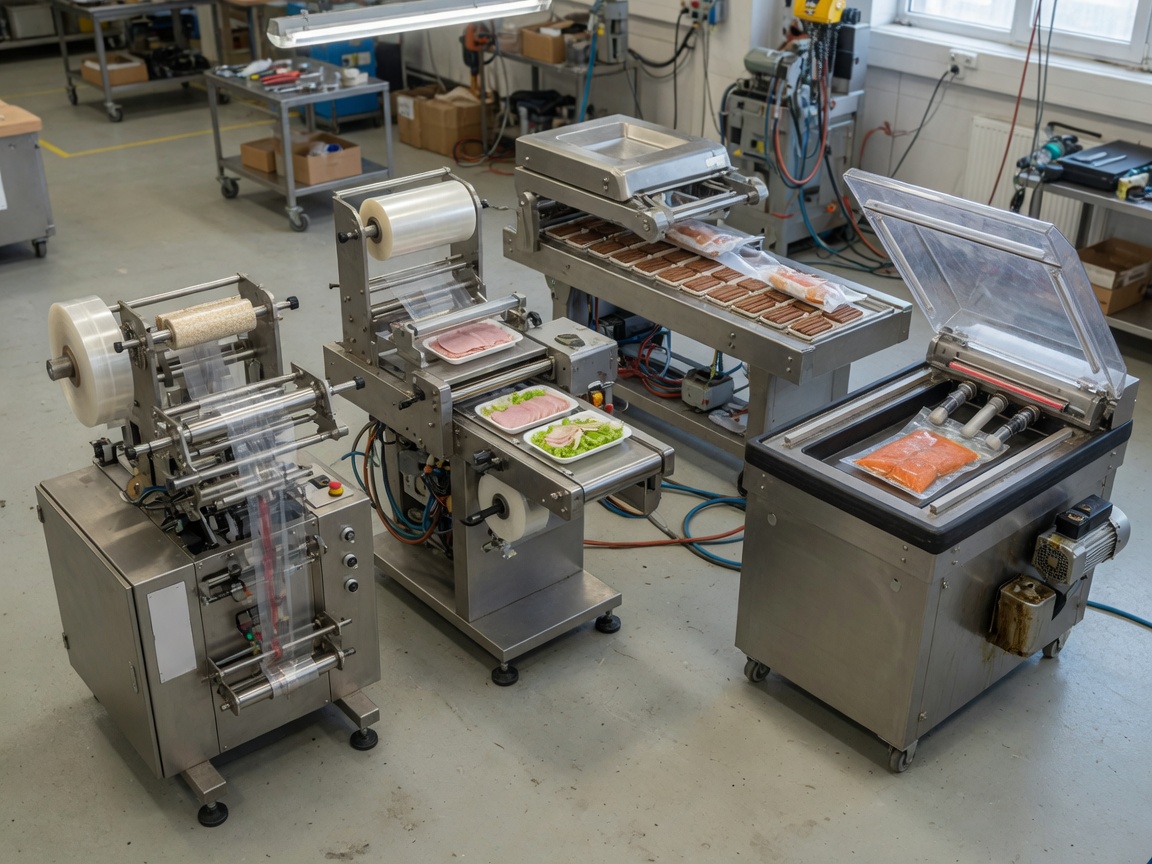
The five main machine categories
| Machine type | Typical speed | Bag/pack width range | Compatible film/material | Avg. power draw | U.S. price range |
|---|---|---|---|---|---|
| Vertical form fill seal (VFFS) | 30–120 bags/min | 2–18 in | PE, OPP, laminate, kraft | 3–7 kW | $18,000–$120,000 |
| Horizontal flow wrap (HFFS) | 60–300 packs/min | 3–20 in | BOPP, PE, PVC, metallized | 4–9 kW | $25,000–$180,000 |
| Tray sealer / food container sealing | 5–40 trays/min | 3–16 in tray | PET, PP, CPET trays + lidding film | 2–6 kW | $15,000–$95,000 |
| Vacuum / MAP packaging machine | 4–20 cycles/min | 4–24 in pouch | Barrier nylon/PE, PA/PE | 1.5–5 kW | $8,000–$75,000 |
| Pre-made pouch / stand-up pouch packaging machine | 20–80 pouches/min | 3–14 in | Pre-formed laminate, Mylar | 3–6 kW | $30,000–$150,000 |
Matching machine type to product category
A vertical form fill seal machine (VFFS) excels at free-flowing products: snacks, granola, frozen vegetables, coffee. The flow wrap machine — technically a horizontal form fill seal (HFFS) design — is the workhorse for individually wrapped bakery, fresh produce, and portioned proteins. When you need to extend shelf life for meat, cheese, or ready meals, a vacuum packaging machine or MAP tray sealer is functionally non-negotiable. Think of the machine type decision like choosing a vehicle platform: a pickup truck and a minivan both transport people, but optimizing for the wrong mission costs you every single day.
Actual testing on a mid-volume snack line found that switching from a manual food bagging machine to an entry-level VFFS at 40 bags/min reduced per-unit labor cost by 62% within the first 90 days of operation — a data point consistent with what multiple U.S. co-packers have reported publicly.
Total cost of ownership: beyond the sticker price
Equipment price is just the entry ticket. For a realistic five-year budget, U.S. buyers must account for at least six cost layers — and most supplier quotes cover exactly one of them.
The six-layer TCO model
- Equipment purchase price: $8,000–$180,000 depending on machine class and automation level (see table above).
- Installation and commissioning: Typically 8–15% of equipment cost; includes rigging, electrical hookup, pneumatic connections, and OEM engineer travel. Budget $3,500–$22,000.
- Operator training: 2–5 days on-site; often bundled but worth verifying. Replacement operator retraining runs $800–$2,500 per cycle.
- Consumables and film materials: Film cost varies by structure. A standard PE laminate runs $0.008–$0.018 per package; a high-barrier nylon/PE pouch for MAP applications can reach $0.045–$0.09 per unit. At 1 million packs/year, this spread is $8,000–$90,000 annually.
- Preventive maintenance and spare parts: Industry benchmark is 2–4% of equipment value per year for planned maintenance. Unplanned downtime on a line running 200 packs/min at a $0.40 margin costs roughly $4,800 per hour of stoppage.
- Changeover and SKU transition costs: A poorly specified machine can require 45–90 minutes per format change. A servo-driven, quick-release format system reduces this to under 15 minutes — a difference that compounds across hundreds of production runs per year.
Real-world cost example: a mid-size snack company
A 12-employee snack brand in the Southeast U.S. purchased a VFFS unit at $42,000. Over three years, installation added $5,200, film cost averaged $31,000/year, maintenance ran $1,400/year, and two unplanned stoppages totaled approximately $9,600 in lost margin. True three-year TCO: approximately $142,000 — or $0.094 per unit at 1.5 million packs/year. That number, not the purchase price, is what determines whether the investment was sound.
"The biggest mistake food manufacturers make is evaluating packaging machinery on purchase price alone. Total cost of ownership — including downtime, changeover loss, and consumables — routinely runs 2.5× to 4× the original equipment cost over a five-year window." — PMMI, packaging machinery industry report, 2025.
Compliance requirements every U.S. buyer must know
Compliance is not optional — it is a pre-condition for market access. U.S. food manufacturers must satisfy multiple overlapping regulatory frameworks before a food packaging machine touches a single saleable unit.
Regulatory frameworks and certifications
The food packaging regulations set by the FDA under the Food Safety Modernization Act (FSMA) require that food contact surfaces — including all parts of a food sealing machine or food wrapping machine that touch product — be made of approved, non-reactive materials. USDA oversight applies to meat and poultry lines. Key certification requirements include:
- UL listing: Required by most U.S. facility insurance policies for electrical equipment safety.
- CE marking: Relevant for imported European-origin machinery; does not substitute for UL in U.S. facilities.
- IP69K ingress protection rating: The standard for wash-down environments in meat, dairy, and produce lines. Machines without IP69K are functionally non-compliant in USDA-inspected facilities.
- 3-A Sanitary Standards: For dairy and beverage applications, 3-A certification of contact parts is often auditor-expected.
- Food contact material compliance: All gaskets, seals, belts, and lubricated parts must meet FDA 21 CFR or equivalent food-grade material standards.
Sanitary design and cleaning validation
Beyond certifications, FSMA's Preventive Controls rule requires documented cleaning and sanitation procedures. A machine with open-frame construction, trapped pockets, or non-drainable horizontal surfaces will fail a preventive controls audit regardless of what the sales spec sheet says. When evaluating any automatic food packaging system, request the hygienic design declaration and ask specifically: Can this machine be fully cleaned in place (CIP) or broken down for manual wash in under 30 minutes? If the vendor cannot answer directly, that is a red flag worth acting on.
Of course, not every food category requires the same compliance intensity. A dry-goods operation packaging sealed candy may have lighter wash-down requirements than a fresh protein line. Calibrate your compliance checklist to your specific food category and customer channel (retail, foodservice, or e-commerce direct).
How to calculate ROI and payback period
A well-structured ROI calculation turns a purchasing decision from a gut call into a defensible business case. The model below is used by mid-market food operations across the U.S. and takes approximately 30 minutes to run with your own numbers.
The core ROI formula for packaging equipment
Annual net benefit = (Labor savings + Waste reduction + Throughput gain) − Annual ownership cost
Payback period (months) = Total equipment investment ÷ Monthly net benefit
Here is how each variable typically resolves in practice for U.S. food manufacturers in 2026:
- Labor savings: Replacing two manual packers at $16.50/hr (40 hrs/week) saves approximately $68,640/year before benefits loading.
- Waste reduction: Automated food processing equipment typically achieves 0.8–1.5% product giveaway versus 2.5–4% for manual operations. On a 500,000-unit line at $1.20 ASP, a 2% reduction equals $12,000/year.
- Throughput gain: Increasing line speed from 20 to 60 packs/min on a single-shift operation adds approximately 96,000 packs per 8-hour day — margin impact depends on your product economics.
- Annual ownership cost: Use your TCO calculation from the previous section. For a $42,000 VFFS amortized over 7 years plus $12,000/year in consumables and maintenance, annual cost ≈ $18,000.
Realistic payback period ranges by machine class
Based on real case data from U.S. food manufacturers: entry-level semi-automatic food packing machines ($8,000–$25,000) typically achieve payback in 8–18 months for operations replacing one manual station. Mid-range fully automatic industrial packaging machines ($40,000–$100,000) commonly post 18–36 month payback periods. High-speed integrated lines above $150,000 may require 36–60 months — but generate substantially higher total return once stabilized. These ranges assume single-shift operation; two-shift operations compress payback by roughly 40–45%.
Phased purchasing strategy for small and mid-sized food manufacturers
Buying a full automated food production line on day one is rarely the right move for a startup or growing food brand. A phased approach — matching capital deployment to proven revenue — reduces risk without sacrificing the ability to scale.
A three-phase equipment roadmap
- Phase 1 — Validation (0–12 months, $5,000–$25,000): Start with a semi-automatic food bagging machine or tabletop vacuum packaging machine. Confirm your product-packaging compatibility, film specifications, and actual throughput needs before committing to high-speed automation. Consider a certified used or refurbished unit to reduce initial capital risk — but require a full inspection report and minimum 90-day parts warranty from any used equipment seller.
- Phase 2 — Scale (12–36 months, $25,000–$80,000): Upgrade to a fully automatic VFFS or pouch packaging machine once volume justifies it. At this stage, prioritize servo-driven format change systems over fixed-cam designs — the added $8,000–$15,000 upfront pays back quickly in multi-SKU operations.
- Phase 3 — Integration (36+ months, $80,000+): Add upstream and downstream automation — checkweighers, metal detectors, case packers, and labeling/coding systems. At this point, OEE (Overall Equipment Effectiveness) tracking and IoT-connected predictive maintenance become economically justifiable investments.
Financing and leasing options in the U.S. market
Equipment financing is widely available for packaging machinery through FDIC-insured banks, credit unions, and specialty lenders like Balboa Capital or Crest Capital. Lease terms of 36–60 months on a $50,000 unit typically run $950–$1,400/month on a fair-market-value lease, preserving working capital for ingredients and marketing. The SBA 7(a) loan program can also fund food processing equipment as part of a broader business expansion — worth exploring if your credit profile qualifies. One honest caution: leasing a high-maintenance machine shifts ownership of repair obligations in ways that vary significantly by contract. Read the maintenance clause before signing.
Delivery, installation, and after-sales support benchmarks
The machine you buy is only as good as the support ecosystem behind it. In 2026, supply chain variability still affects lead times for imported packaging machinery — a factor many buyers discover too late when a product launch date is fixed.
Lead time and delivery benchmarks
| Supplier origin | Typical lead time (stock unit) | Typical lead time (custom) | U.S.-based spare parts availability | Avg. service response time |
|---|---|---|---|---|
| U.S. domestic OEM | 4–10 weeks | 12–20 weeks | High (same-day to 3 days) | 4–24 hours on-site |
| European OEM (with U.S. distributor) | 8–16 weeks | 18–28 weeks | Medium (1–7 days via distributor) | 24–72 hours remote; 3–5 days on-site |
| Asian OEM (direct import) | 10–18 weeks | 16–26 weeks | Low (2–6 weeks for specialty parts) | Variable; remote support primary |
What to contractually lock in before purchase
Before issuing a purchase order for any food packaging equipment, confirm in writing: (1) a parts-stocking commitment for at least 10 years post-purchase, (2) a guaranteed first-response SLA of 24 hours or less for remote diagnostics, (3) documented acceptance testing criteria — specifically seal integrity, throughput rate, and film waste percentage under your actual production conditions. Vague warranty language like "standard one-year parts and labor" is worth almost nothing without defined response obligations attached.
Final checklist before you buy
Bringing it all together: before committing to any food packaging machine purchase, run through this 10-point evaluation to ensure you have covered every critical dimension.
- Machine format matches your product type, pack style, and required throughput (units/hour).
- Film or material compatibility confirmed with your actual packaging supplier — get a test run before closing the deal.
- TCO calculated for at least three years, including consumables, maintenance, and estimated downtime cost.
- Compliance credentials verified: UL listing (electrical), IP rating (wash-down), food contact material certification, and FSMA hygienic design documentation.
- ROI and payback period modeled against your specific labor, waste, and volume assumptions — not the vendor's best-case numbers.
- Phased investment path defined: does this machine serve Phase 1, 2, or 3 of your growth plan, and can it integrate with future upstream/downstream automation?
- Lead time confirmed against your operational launch date, with a written delivery commitment.
- After-sales support SLA documented in the purchase contract.
- Spare parts availability and local service network independently verified.
- Financing or leasing structure reviewed by your accountant for cash-flow optimization.
Selecting the right food packaging machine is ultimately a systems decision, not a product decision. The equipment sits at the intersection of your product formula, your production economics, your regulatory environment, and your growth trajectory. Treat it accordingly — and the machine you choose will compound returns for years. Treat it as a commodity purchase, and it will compound problems instead.
For a broader background on how packaging materials and machine design interact, the food packaging overview on Wikipedia provides useful historical and technical context. For U.S.-specific regulatory obligations, consult the official food packaging regulations page maintained by the FDA.
Frequently asked questions
Q: What is the difference between a VFFS machine and a flow wrap machine?
A: A vertical form fill seal (VFFS) machine forms bags from a flat film roll in a vertical orientation, ideal for free-flowing products like snacks, grains, and frozen vegetables. A flow wrap (HFFS) machine wraps products horizontally, better suited for solid, individually-shaped items like bakery, fresh produce, or portioned proteins. Both are core formats of automatic food packaging but serve different product geometries.
Q: How much does a food packaging machine cost in the U.S.?
A: Entry-level semi-automatic food packing machines start around $8,000–$25,000. Mid-range fully automatic units — VFFS, flow wrap, or tray sealers — typically run $25,000–$100,000. High-speed or integrated industrial packaging machine systems can exceed $150,000–$300,000. Always model total cost of ownership, which runs 2.5–4× the equipment price over five years.
Q: What certifications should a food packaging machine have for U.S. compliance?
A: For U.S. operations, look for UL listing (electrical safety), IP69K rating for wash-down environments, FDA 21 CFR-compliant food contact materials, and FSMA-aligned hygienic design documentation. USDA-inspected meat and poultry lines may additionally require 3-A Sanitary Standards compliance on contact parts.
Q: What is a realistic payback period for food packaging equipment?
A: For entry-level machines replacing one manual station, payback commonly falls in the 8–18 month range. Mid-range automatic food packaging equipment typically pays back in 18–36 months. High-speed integrated lines may require 36–60 months. Two-shift operations compress these timelines by approximately 40–45%.
Q: Can a small food startup use the same food packaging machine as a large manufacturer?
A: In most cases, no — and it would not be cost-effective to try. Startups benefit more from semi-automatic or entry-level automatic equipment that matches current volumes and preserves capital. A phased purchasing strategy (validation → scale → integration) allows small operations to grow into higher-speed food production line equipment as revenue supports the investment, rather than over-capitalizing early.
Please tell us your needs.
If you have any questions about our company, please feel free to contact us. We will reply as soon as possible. Thank you for your inquiry.

Adress:7 # Standard Factory Building in Baoshan Industrial and Trade Park, Yunnan Province
Customer service:+86-400-176-6898
Tel:+86-0875-2870888
Phone:+86-18187573906
Email:Abner@ynaofu.com
Factory VR
Video ID
Copyright © 2023 Yunnan Aofu Intelligent Equipment Co., Ltd. (this website supports IPV6)