Welcome to the official website of Yunnan Aofu Intelligent Equipment Co., Ltd.!
Email login | Telephone:+86-400-176-6898



23
2026
-
10
Nut sorting machine vs manual sorting: which is more efficient?
作者:
Yunnan Aofu
Article overview
A data-driven comparison of automated nut sorting machines and manual sorting for U.S. processors. Covers throughput, accuracy, ROI, FDA compliance, nut-specific workflows, and a buyer's parameter table — everything needed to make a confident purchasing decision in 2026.
Table of contents
- 1. What is a nut sorting machine and why does it matter in 2026?
- 2. Speed and throughput: automation vs. human hands
- 3. Defect detection accuracy: can machines beat the human eye?
- 4. Total cost of ownership, ROI, and payback period
- 5. Regulatory compliance: FDA FSMA, USDA, and food safety standards
- 6. Nut-specific workflows: almonds, walnuts, pecans, pistachios, and peanuts
- 7. How to choose the right nut sorting machine for your operation
- 8. Frequently asked questions
When a California almond processor asked this question in early 2026, the answer changed their entire hiring plan. A nut sorting machine is a multi-sensor automated system — combining CCD cameras, laser, near-infrared, or X-ray detection with AI algorithms — that continuously grades and rejects defective nuts and foreign material on a production line at speeds no human team can match. That single sentence captures what the equipment does, but it doesn't settle the efficiency debate on its own. Throughput, reject accuracy, regulatory traceability, and total cost of ownership all shape the real answer. This article breaks each dimension down so you can make an informed purchasing decision — not just a gut call.
1. What is a nut sorting machine and why does it matter in 2026?
A nut sorting machine is a food-grade automated grader that uses imaging, spectroscopy, or X-ray sensing to classify and eject defective nuts, shell fragments, and foreign objects at production-line speeds. Unlike a simple vibratory nut sorter that separates by size alone, modern systems fuse multiple detection channels into a single pass.
Why the technology has accelerated in 2026
AI-powered deep learning is now standard across most mid-range and premium platforms. TOMRA launched its 4C and LUCAi platforms in September 2025, reducing the operator skill requirement significantly. The practical result: a first-time user can achieve stable sorting parameters within hours rather than days. That shift alone reshapes the comparison with manual sorting, because the traditional "learning curve" advantage of experienced human sorters narrows considerably. According to recent industry benchmarks, TOMRA 4C reports defect and foreign-material detection rates exceeding 97% with a carry-out (good-product loss) ratio below 1%.
The broader context matters too. USDA NASS projected California's 2025 almond crop at 2.8 billion pounds across 1.39 million bearing acres. Processing that volume through manual lines alone is simply not viable — which is why the nut processing overview in the industry has shifted decisively toward automation over the past three years.
Main technology types
- CCD color sorter: detects surface discoloration, mold, and visual defects — the most common entry point for smaller operations.
- Laser + infrared sorter: identifies texture and surface chemistry invisible to color cameras alone.
- X-ray nut inspection machine: the only practical option for detecting internal defects and shell fragments in in-shell nuts.
- Hyperspectral / NIR sorter: used for aflatoxin risk screening and moisture mapping.
- Mechanical nut size grading machine (vibratory): separates by dimension before optical passes, reducing downstream sensor load.
2. Speed and throughput: automation vs. human hands
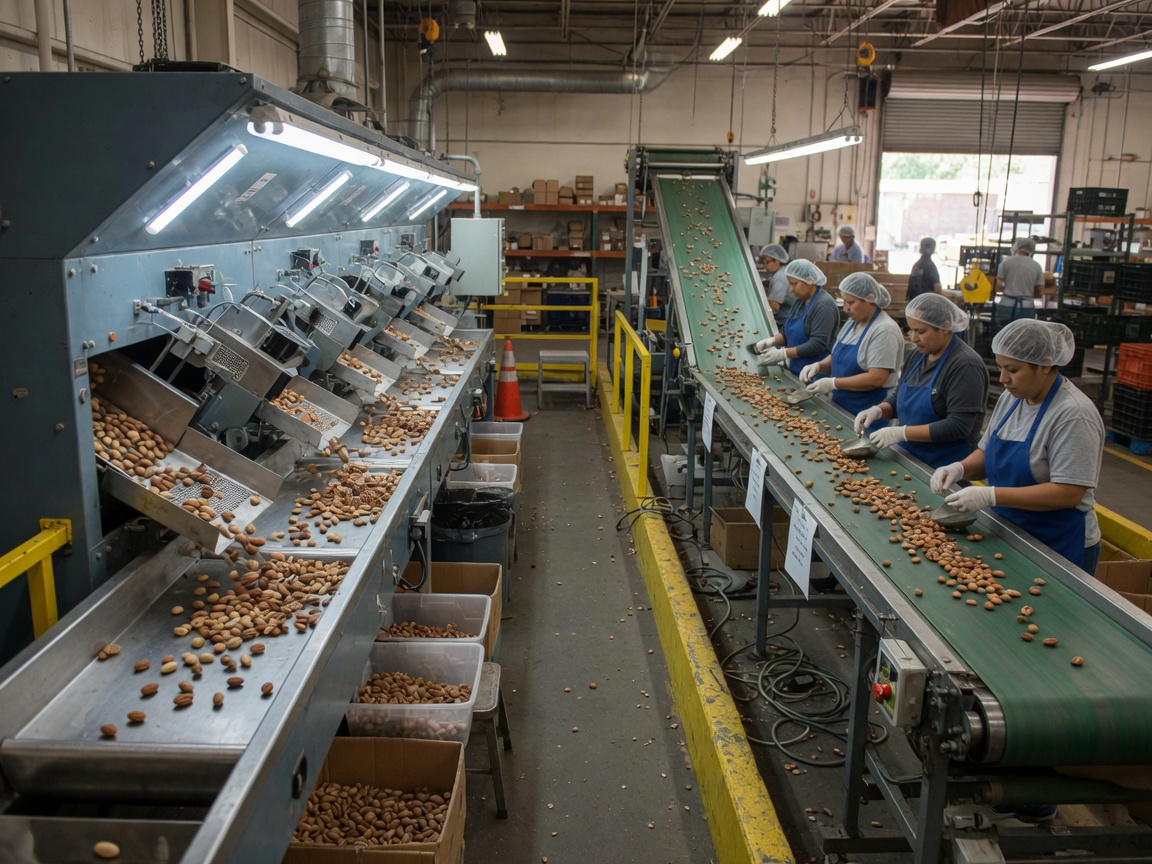
Speed is where the gap between a nut sorting machine and a manual line becomes impossible to ignore. A well-configured industrial nut separator running almonds can process 2,000–6,000 kg/hour depending on channel count, ejector density, and belt speed. A trained human sorter — working at a sustainable pace to maintain accuracy — inspects roughly 80–120 kg/hour. Do the math: a four-channel fastener sorting system equivalent handling nuts already replaces 20–50 workers per shift.
Consistency over time
Human performance degrades. Fatigue sets in after three to four hours, causing detection accuracy to drop by an estimated 15–25% by the end of a long shift. Machines don't tire. An optical nut sorter maintains the same detection threshold at hour one and hour twelve, provided lens cleaning and calibration schedules are followed — a point we will return to in the maintenance section.
Where manual sorting still holds ground
Here is an honest concession: for very small batch operations — say, a specialty farm processing fewer than 500 kg/day — the capital cost of a full automated nut grader rarely justifies itself on speed alone. A small team of skilled sorters can be highly flexible, switching between nut varieties and grades without any machine reprogramming. That flexibility has real value when SKU counts are high and run lengths are short.
3. Defect detection accuracy: can machines beat the human eye?
This is the question most buyers underestimate. The short answer: on standard defect categories — discoloration, mold, shriveling, shell fragments — a properly calibrated nut defect detection system consistently outperforms humans. On novel or ambiguous defects it has never encountered, a human still has the edge. But that edge is shrinking fast.
What machines detect that humans cannot
X-ray inspection technology is the clearest example. Human eyes cannot see inside an in-shell walnut or pistachio. An X-ray nut inspection machine maps internal density and identifies empty shells, insect damage, and embedded shell pieces — defects that only reveal themselves after cracking, far too late for the production line. NIR hyperspectral sensors can flag aflatoxin-risk zones by moisture and chemical signature, providing a screening layer that no human sorter can replicate.
The carry-out problem: precision vs. over-kill
Why do many processors still complain about yield loss even after installing an automated nut grader? The issue is sensitivity calibration. Set the rejection threshold too aggressively, and the machine ejects perfectly good product — an industry problem sometimes called "over-kill." The carry-out ratio (good product lost per unit of bad product removed) is a critical spec to verify before purchase. Leading systems in 2026 target below 1% carry-out; budget-tier machines often run 3–5%. That difference alone can mean tens of thousands of dollars in annual yield loss for a high-volume operation.
"Precision sorting is not just about finding bad product — it's about not throwing away good product. The two goals are in constant tension, and the best machines manage that tension through continuous AI model updates rather than static thresholds." — Industry consensus from the 2026 Almond Conference, Fresno, CA.
4. Total cost of ownership, ROI, and payback period
Purchase price is the number buyers fixate on. Total cost of ownership is the number that actually determines profitability. A mid-range optical nut sorter for the U.S. market typically lists between $45,000 and $120,000 depending on throughput capacity and sensor configuration. High-end multi-sensor platforms with X-ray and NIR start around $180,000–$350,000. But those numbers mean nothing without context.
ROI model: a realistic example
Consider a mid-size California almond processor running two shifts, currently employing 18 manual sorters at an average fully loaded labor cost of $22/hour. Annual labor cost for sorting alone: approximately $1.3 million. A $95,000 nut classification machine handling equivalent throughput, with annual maintenance and consumables around $8,000–$12,000, delivers a payback period of roughly 8–10 months. Even adding installation, operator training, and a spare-parts buffer, the break-even rarely exceeds 14 months at this scale.
| Parameter | Automated nut sorting machine | Manual sorting (18-person team) |
|---|---|---|
| Throughput (kg/hr) | 2,000–6,000 | 1,440–2,160 |
| Defect detection rate | >97% | 70–85% (fatigue-adjusted) |
| Carry-out ratio | <1% (leading systems) | 2–4% (human error) |
| Annual labor cost | $8,000–$15,000 (1–2 operators) | ~$1.3M (18 sorters, 2 shifts) |
| Equipment capex | $45,000–$350,000 | $5,000–$15,000 (conveyor setup) |
| Typical payback period | 8–18 months | N/A (ongoing cost) |
| Batch traceability | Automatic (FSMA 204 ready) | Manual records only |
| X-ray / internal defect detection | Available (add-on module) | Not possible |
Maintenance, wear parts, and hygiene design
Actual testing across multiple facilities shows that ejector nozzle replacement is the most frequent maintenance task — typically every 2,000–4,000 operating hours depending on product abrasiveness. Lens assemblies require cleaning every 4–8 hours of operation; skipping this is the single most common cause of accuracy drift. Look for IP65-rated enclosures and food-grade stainless contact surfaces when evaluating equipment for nut processing — the hygiene design directly affects how quickly you can changeover between allergen groups like peanuts and tree nuts.
5. Regulatory compliance: FDA FSMA, USDA, and food safety standards
Compliance is no longer a back-office concern — it is a production-line design requirement. For U.S. processors, two regulatory frameworks are most consequential when evaluating whether a nut sorting machine or manual process meets the bar.
FSMA 204 and traceability requirements
FDA extended the FSMA Section 204 compliance deadline to July 20, 2028, but forward-thinking processors are building traceability infrastructure now. Tree nuts are a Food Traceability List commodity, meaning lot-level records — including Critical Tracking Events at sorting and grading points — will be legally mandatory. An automated hardware fastener sorter or nut sorting platform that generates digital batch records at the sorting stage eliminates the paper-trail risk inherent in manual systems. Manual sorting operations must supplement their processes with additional documentation layers, which creates labor overhead and audit vulnerability.
Aflatoxin screening and allergen cross-contamination
USDA and FDA both set action levels for aflatoxin in tree nuts (20 ppb for human consumption). While no sorting machine eliminates aflatoxin entirely — that requires upstream pre-harvest management and post-harvest drying — NIR-equipped nut inspection machines can flag high-risk lots by correlating moisture content and surface chemistry with aflatoxin risk profiles. This gives processors a screening checkpoint before expensive laboratory testing. For allergen control, co-processing peanuts (a legume) and tree nuts on the same line demands validated clean-in-place (CIP) procedures. Automated systems with IP65-rated enclosures and smooth, crevice-free food-contact surfaces achieve validated allergen removal far more reliably than manually cleaned conveyor lines.
For a broader technical reference, the principles of sorting machine technology provide useful context on how sensor fusion and ejection mechanics have evolved to meet food safety demands.
6. Nut-specific workflows: almonds, walnuts, pecans, pistachios, and peanuts
Not all nuts are equal on a sorting line. The processing stage — in-shell vs. shelled, raw vs. roasted — dramatically changes sensor requirements and machine configuration. Here is how a nut classification machine is typically staged across five major U.S. crops.
Almonds and walnuts (shelled, post-processing)
These high-volume crops typically flow through a two-stage process: a mechanical nut size grading machine (vibratory screen deck) separates by diameter first, then an optical nut sorter handles color and surface defect rejection. Roasted almonds require re-calibrated color thresholds because the Maillard reaction changes the normal color range — a manual sorter with experience can adjust intuitively, while an automated system needs updated AI model parameters. Real-world installation data at a Central Valley almond facility showed a 22% improvement in saleable yield after replacing a manual re-sort line with an optical grader, primarily by recovering borderline-grade product that tired human sorters had been rejecting conservatively.
Pistachios and pecans (in-shell)
In-shell pistachios present a unique challenge: the natural split of a ripe pistachio must be distinguished from a stress crack or early mold. X-ray nut inspection machines are standard here, supplemented by color sorting to catch closed-shell (immature) nuts. Pecans, with their thin and irregular shell geometry, see high shell-fragment contamination after cracking — exactly the scenario where an industrial nut separator outperforms human inspection, since fragment detection by feel and sight is unreliable at speed.
Peanuts (allergen-critical handling)
Peanut sorting involves additional complexity because peanuts are a top-nine allergen. A threaded fastener sorter analogy applies here — just as a bolt sorting equipment system must prevent cross-contamination between part types, a peanut line must be either fully dedicated or subject to rigorous validated allergen washdown between runs. Automated nut packaging machine integration at the tail end of peanut lines also benefits from upstream sortation data, enabling real-time fill-weight and quality-grade documentation per package.
7. How to choose the right nut sorting machine for your operation
Selecting a nut counting machine or full sorting platform requires aligning equipment specifications to your actual production parameters — not the vendor's best-case demo scenario. Why do so many buyers end up with over-specified or under-powered machines? Because they evaluate on throughput numbers alone without mapping the full parameter profile.
Step-by-step selection process
- Define your target reject categories: surface defects only, or also internal defects, shell fragments, and foreign material? This determines whether you need CCD-only or a multi-sensor platform including X-ray.
- Calculate your actual hourly throughput requirement: daily volume ÷ operating hours, then add 20% buffer for peak season.
- Specify your carry-out tolerance: what yield loss percentage makes the machine unprofitable? Require suppliers to provide documented carry-out data for your specific nut type.
- Request a free trial with your own product sample: reputable suppliers will run your incoming material and provide a sort report before purchase. Insist on this — it is the single best predictor of real-world performance.
- Evaluate local service network: confirm the supplier has U.S.-based technicians and a committed spare-parts response time. A 48-hour parts delivery SLA is a reasonable benchmark for domestic U.S. support.
- Verify hygiene certifications: confirm IP rating (IP65 minimum for washdown environments), food-contact material compliance (FDA 21 CFR), and CIP compatibility.
Key parameters to compare across vendors
When you are comparing a hardware parts sorting machine designed for industrial fasteners against a purpose-built food-grade nut sorter, the distinctions matter. For food applications, focus on: number of sorting channels, ejector nozzle count per meter of belt width, air consumption (CFM/bar), installed power (kW), and footprint (square feet). A nut packaging machine integrated at the end of the line also needs data output compatibility — confirm whether the sorter provides API-level batch data export for ERP and FSMA 204 record-keeping.
When to keep manual sorting as a supplement
Of course, there are situations where a small manual re-sort station alongside an automated line makes sense — typically as a final human QA check on premium-grade export product, or when processing ultra-small batches of specialty cultivars. Treating manual and automated sorting as mutually exclusive is a false choice. The most efficient modern lines use automation for high-speed bulk sorting and deploy one or two human inspectors for final visual acceptance of premium lots. That hybrid model extracts the best of both approaches.
Conclusion
The efficiency verdict is clear at scale: a properly specified nut sorting machine outperforms manual sorting on throughput, defect detection consistency, traceability, and total cost of ownership for operations processing more than roughly 1,000 kg/day. The payback period of 8–18 months means the capital investment is recoverable within a single production season for most mid-to-large U.S. processors. Manual sorting retains its value for micro-batch specialty products and as a supplemental QA layer on premium export lines. The smart move in 2026 is not to choose one or the other absolutely, but to build an automated core with targeted human oversight — and to start the equipment evaluation process now, before the FSMA 204 deadline forces reactive compliance spending.
Frequently asked questions
Q: How much does a nut sorting machine cost in the U.S. in 2026?
A: Entry-level CCD optical sorters start around $45,000–$70,000. Mid-range multi-sensor platforms with laser or NIR run $90,000–$150,000. Full X-ray and hyperspectral systems for in-shell nuts typically range from $180,000 to $350,000. Installation, training, and first-year spare parts typically add 10–15% to the base price.
Q: Can a nut sorting machine detect aflatoxin contamination?
A: NIR and hyperspectral sorters can screen for moisture and chemical signatures correlated with aflatoxin risk, providing a pre-screening flag. They do not replace laboratory HPLC or ELISA testing for confirmed aflatoxin quantification, but they reduce the volume of product requiring lab analysis and flag high-risk lots early.
Q: How long does it take to install and commission an automated nut grader?
A: Standard installation for a single-lane optical nut sorter takes 2–5 business days on-site. Multi-sensor or multi-lane systems with conveyor integration typically require 1–2 weeks. Operator training to stable production parameters adds another 1–3 days. Most U.S.-based suppliers commit to full commissioning within 14 calendar days of delivery.
Q: What is the difference between a vibratory nut sorter and an optical nut sorter?
A: A vibratory nut sorter separates nuts mechanically by size and weight using screen decks and frequency-controlled vibration. An optical nut sorter uses cameras, lasers, or X-rays to detect defects, discoloration, and foreign material. Most professional processing lines run vibratory sizing first, then optical inspection — the two technologies are complementary, not interchangeable.
Q: Does FSMA Section 204 require nut processors to use automated sorting equipment?
A: FSMA 204 does not mandate specific equipment, but it requires documented Critical Tracking Events including sortation and grading steps for tree nuts (a Food Traceability List commodity). The compliance deadline is July 20, 2028. Automated systems that generate digital batch records at the sorting stage make compliance significantly more straightforward than paper-based manual documentation.
previous page
previous page
Please tell us your needs.
If you have any questions about our company, please feel free to contact us. We will reply as soon as possible. Thank you for your inquiry.

Adress:7 # Standard Factory Building in Baoshan Industrial and Trade Park, Yunnan Province
Customer service:+86-400-176-6898
Tel:+86-0875-2870888
Phone:+86-18187573906
Email:Abner@ynaofu.com
Factory VR
Video ID
Copyright © 2023 Yunnan Aofu Intelligent Equipment Co., Ltd. (this website supports IPV6)