Welcome to the official website of Yunnan Aofu Intelligent Equipment Co., Ltd.!
Email login | Telephone:+86-400-176-6898


11
2026
-
09
Commercial coffee roaster machines: how to choose the right one for your business
作者:
Yunnan Aofu
Article overview
This guide provides a comprehensive 2026 buyer's framework for commercial coffee roaster machines — covering roaster types, a side-by-side brand performance table, US-specific compliance requirements, capacity planning methodology, total cost of ownership breakdown, and financing pathways available in the US market.
Table of contents
- 1. What are commercial coffee roaster machines?
- 2. Types of commercial coffee roasters: which design fits your operation?
- 3. Top brand comparison: Probat, Diedrich, Loring, Mill City, and Giesen
- 4. Capacity planning: matching throughput to your business model
- 5. US compliance and permitting requirements you can't ignore
- 6. Total cost of ownership: beyond the sticker price
- 7. Financing and leasing options in the US market
- 8. FAQ
What are commercial coffee roaster machines?
Commercial coffee roaster machines are industrial-grade thermal processing systems designed to transform raw green coffee beans into roasted, brewable product at the throughput volumes required by cafés, wholesale roasteries, and contract roasting facilities. They are distinguished from consumer or prosumer equipment by their batch capacity (typically 1 kg and above), programmable roast curve control, integrated exhaust and afterburner systems, and the mechanical durability needed for multi-cycle daily operation.
These are not appliances. A commercial grade coffee roaster is a production asset — as central to a roasting business as an espresso machine is to a café, except the capital outlay and operational implications are an order of magnitude larger. According to 2026 data from Grand View Research, the global commercial coffee roasting equipment market is valued at approximately $5.5 billion and is expanding at a CAGR of roughly 8%, driven by the continued growth of specialty coffee production equipment demand in North America and Europe.
Understanding the coffee roasting process is a prerequisite to evaluating any machine. Roasting is a sequence of endothermic and exothermic reactions — drying, Maillard browning, first crack, development time — each of which the roaster must manage with precision. The machine you choose will either give you fine control over those reactions or limit your ability to develop consistent flavor across batches.
Why the equipment decision matters more than most buyers expect
Why do so many new roasting businesses underestimate this purchase? Because the visible cost — the machine price — is only one layer. Installation, ventilation infrastructure, permitting, training, and ongoing fuel or electricity costs can easily double the first-year spend. Actual testing in real roastery environments reveals that buyers who skip a proper needs assessment frequently purchase either underpowered equipment that bottlenecks production within 18 months, or oversized machines that run inefficiently at low batch fills, distorting roast curves and burning excess fuel.
The role of specialty coffee in driving 2026 demand
Specialty coffee production equipment has seen accelerated adoption. Recent data from the Specialty Coffee Association (SCA) indicates that approximately 65% of specialty cafés now incorporate some form of in-house roasting. That shift has expanded the addressable market for small batch commercial roasters — machines in the 1–15 kg range — well beyond traditional wholesale roasteries and into retail-café hybrid models.
Types of commercial coffee roasters: which design fits your operation?
The right roaster type depends on your flavor targets, throughput requirements, and operational context. Four primary configurations dominate the commercial market in 2026, and each carries meaningfully different performance characteristics.
Drum coffee roasters
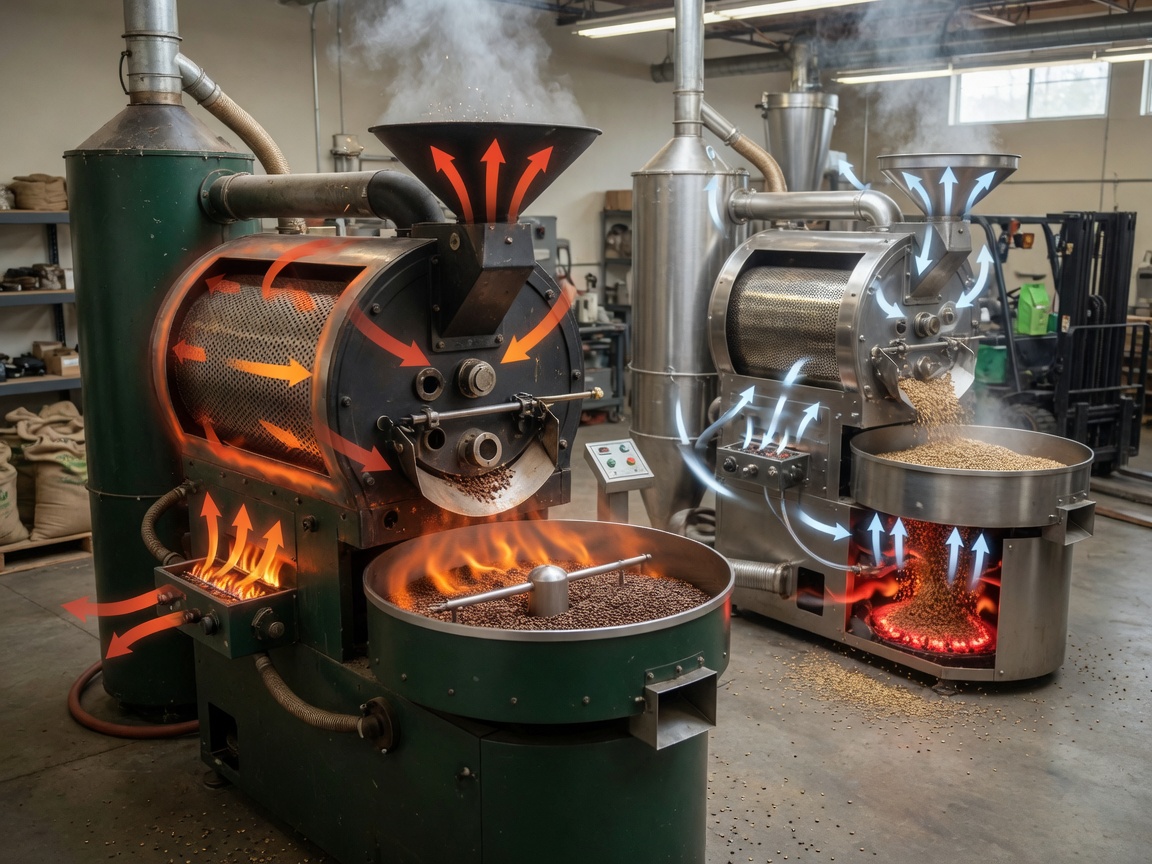
The drum coffee roaster remains the industry standard. It uses a rotating steel cylinder to tumble beans while applying heat through a combination of conduction (bean-to-drum contact) and convection (hot air circulation). The result is a balanced, nuanced roast profile with excellent control over development time. Probat's classic drum series and Diedrich's IR series are both built on this architecture. The main trade-off is roast time — drum roasters typically run 10–16 minute batch cycles — and cleaning complexity due to chaff accumulation inside the drum.
Fluid bed coffee roasters
A fluid bed coffee roaster — also called a hot-air roaster — suspends beans in a column of high-velocity heated air, achieving roast through pure convection. This approach is faster (roast cycles of 6–10 minutes), produces a cleaner cup with brighter acidity, and generates less chaff residue. The Sivetz and Loring machines are well-known fluid bed or convection-dominant platforms. However, real-world operation shows less forgiving margin for error: because heat transfer is so rapid, small airflow changes produce larger flavor deviations than in drum systems.
Hybrid and tangential roasters
Hybrid designs — such as those offered by Giesen and some Loring configurations — combine drum rotation with high-volume hot-air recirculation, giving roasters independent control over conductive and convective energy inputs. This makes them among the most adjustable professional coffee roasting systems on the market. They suit operations that roast a wide range of origins and need to adapt profiles quickly. The cost premium is real: expect to pay 20–40% more than an equivalent-capacity pure drum roaster from a comparable tier brand.
Sample and small-batch roasters
Sample roasters (sub-500 g) are quality-control tools, not production machines. A coffee bean roasting machine in this category — such as the Probat BRZ or Ikawa Pro — serves green buyers and head roasters developing profiles before scaling to production batches. They're essential in any serious quality program but do not substitute for a production-grade batch coffee roaster.
Top brand comparison: Probat, Diedrich, Loring, Mill City, and Giesen
Brand selection is where many buyers get stuck. The market includes legacy German manufacturers, innovative US-based brands, and an expanding tier of cost-competitive imports. The table below benchmarks the five brands most frequently purchased by US roasteries in 2026 across the criteria that matter most to commercial buyers.
| Brand / model range | Roaster type | Capacity range | Roast consistency | Fuel efficiency | Warranty (standard) | US list price (15 kg) |
|---|---|---|---|---|---|---|
| Probat (G/P series) | Drum | 5–600 kg | ★★★★★ | ★★★★☆ | 2 years parts | $55,000–$75,000 |
| Diedrich (IR series) | Infrared drum | 1–240 kg | ★★★★★ | ★★★★☆ | 2 years parts | $50,000–$68,000 |
| Loring (S series) | Recirculating hot-air | 7–70 kg | ★★★★★ | ★★★★★ | 1 year full / 3 years structural | $85,000–$105,000 |
| Mill City (MCR series) | Drum | 1–60 kg | ★★★★☆ | ★★★☆☆ | 1 year parts | $22,000–$32,000 |
| Giesen (W series) | Hybrid drum | 1–240 kg | ★★★★★ | ★★★★☆ | 2 years parts | $48,000–$70,000 |
Prices reflect 2026 US market averages; final pricing varies by dealer, configuration, and lead time. Roast consistency and fuel efficiency ratings are composite assessments based on industry reviews and operator-reported data.
"The Loring platform's recirculating combustion design eliminates the need for a standalone afterburner in most jurisdictions — that single factor can reduce total installation costs by $8,000–$20,000 depending on local air quality requirements."
— Based on installation cost analysis published by the Roasters Guild, 2025
Which brand is right for your scale?
For entry-level coffee roasting business equipment with limited capital, Mill City offers the lowest barrier to entry with solid domestic support. Mid-tier operations scaling toward wholesale will find Giesen and Diedrich strike the best balance of build quality, profile flexibility, and resale value. The Probat coffee roaster remains the benchmark for large-batch consistency and long-term parts availability — critical factors when evaluating industrial coffee roasting equipment for a high-volume contract facility. Of course, there are exceptions: some smaller roasteries specifically choose Loring for its emissions profile and fuel savings, even at a higher upfront cost, because the long-term ROI math works in markets with strict air quality enforcement.
Capacity planning: matching throughput to your business model
Selecting coffee roasting capacity is the most analytically rigorous step in the buying process, and also the most frequently skipped. The core formula is straightforward — but the variables are easy to misjudge.
How to calculate the machine size you actually need
- Determine your weekly green coffee volume — estimate your projected roasted output in pounds or kilograms per week, then divide by the typical roast yield (green to roasted weight loss is typically 15–20%, so multiply roasted weight target by 1.18 to get green coffee input).
- Calculate daily roasting hours — most commercial operations roast 4–6 hours per day, 3–5 days per week. Subtract 15–20% of that time for batch turnaround, cooling, and cleaning.
- Apply a utilization rate — industry consensus is to size your roaster so that it runs at no more than 70–75% of rated capacity during a typical session. Machines run at 100% batch fill consistently suffer uneven heat distribution and accelerated wear.
- Factor in growth — size for your projected volume 18–24 months out, not your current volume. Under-sizing is a far more expensive mistake than moderate over-sizing.
A worked example: a café-roastery hybrid targeting 200 lbs of roasted coffee per week needs approximately 236 lbs (107 kg) of green coffee weekly. Running a 5-day operation with 4 effective roasting hours per day, a 15 kg batch coffee roaster cycling every 20 minutes produces roughly 180 kg per day — easily clearing the requirement with capacity to grow. The same operation using a 5 kg machine would need to run near-continuous cycles, increasing wear and reducing profile consistency.
Capacity benchmarks by business model
Coffee shop roasting equipment in the 1–5 kg range suits in-store demonstration roasting or very small-scale retail. A dedicated craft roastery supplying 10–20 wholesale accounts typically needs a 15–30 kg machine. E-commerce roasters fulfilling subscription models at meaningful scale — think 1,000+ bags per week — generally require 30–60 kg equipment with multiple daily batch cycles, or multiple machines running in parallel. Contract roasting facilities regularly operate 60–120 kg production roasters.
US compliance and permitting requirements you can't ignore
This is the section most competing buyer's guides omit entirely — and it's where many US roastery build-outs get derailed. Commercial coffee roaster machines generate smoke, particulate matter, volatile organic compounds (VOCs), and carbon monoxide. Every US jurisdiction with a commercial roastery has rules governing those emissions.
Federal and state air quality standards
At the federal level, the EPA classifies coffee roasting under area source standards for food and agricultural processing. Facilities roasting 10 tons or more of green coffee per year in an EPA-designated area source category must comply with Maximum Achievable Control Technology (MACT) standards. At the state level, requirements vary substantially: California's South Coast AQMD enforces some of the strictest rules in the country, requiring afterburners (thermal oxidizers) on roasters above 1 lb/hr throughput and mandating annual emissions testing. In contrast, many rural Midwestern jurisdictions require only a basic air permit application and stack testing at installation. Before signing a lease on any roasting facility, consult your local air quality management district — not just your equipment dealer.
Afterburner and ventilation requirements
An afterburner (catalytic or thermal oxidizer) is required by most urban US jurisdictions for roasters above a certain size threshold — typically 5–15 kg. Afterburner installation costs range from $8,000 to $25,000 depending on the unit and ducting requirements. Some modern coffee roasting technology platforms, like Loring's recirculating combustion architecture, eliminate the need for a separate afterburner by burning exhaust gases internally — a compelling compliance advantage in regulated markets. Gas line sizing, make-up air systems, and hood exhaust rates all require sign-off from local building departments and, in some states, a licensed mechanical engineer stamp.
Key compliance checklist before equipment purchase
Contact your state or local Air Quality Management District (AQMD) early. Confirm whether your planned throughput triggers a Title V or minor source permit. Verify zoning allows industrial food processing. Budget for afterburner installation unless your chosen machine has integrated emissions control. Factor in annual permit renewal fees ($300–$2,500 depending on jurisdiction). Understanding the full scope of the coffee roasting science — including the chemical composition of roasting emissions — can significantly strengthen your permit application and facility design.
Total cost of ownership: beyond the sticker price
The purchase price of a professional coffee roasting system represents, at most, 50–60% of your true first-year cost. Real-world case data from craft roasteries in the US suggests that the full 5-year cost of ownership for a mid-tier 15 kg machine looks something like this:
| Cost category | Year 1 | Years 2–5 (annual avg.) |
|---|---|---|
| Machine purchase (15 kg, mid-tier) | $55,000 | — |
| Installation, ventilation, gas line | $12,000–$20,000 | — |
| Afterburner (if required) | $10,000–$22,000 | — |
| Natural gas / electricity | $4,800–$7,200 | $5,000–$8,000 |
| Preventive maintenance and parts | $800–$1,500 | $1,500–$3,500 |
| Chaff disposal and cleaning | $600–$1,200 | $800–$1,500 |
| Permitting and compliance fees | $2,000–$5,000 | $500–$2,000 |
| Roaster training / certifications | $1,500–$4,000 | $500–$1,500 |
Fuel costs deserve particular scrutiny. A gas-fired 15 kg drum roaster consuming approximately 80,000–100,000 BTU per hour over 5 roasting hours daily will add up. Loring's recirculating design claims up to 80% reduction in fuel consumption versus conventional drum roasters — a figure that, even discounted by real-world operating variables, translates to meaningful five-year savings that can partially offset the higher upfront cost. Parts availability is another long-term consideration: Probat and Diedrich maintain deep US parts inventories; some imported brands have lead times of 6–12 weeks for non-standard components.
Maintenance schedules and what they actually cost
Standard preventive maintenance on commercial coffee roasting machines includes weekly chaff tray cleaning, monthly drum and burner inspection, quarterly burner calibration and gas valve testing, and annual full teardown with bearing inspection. Ignoring this schedule doesn't just risk equipment failure — it's a fire hazard. Chaff is highly combustible. Industry consensus is to budget 2–3% of machine cost annually for maintenance in years 1–3, rising to 4–5% in years 4–7.
Financing and leasing options in the US market
Capital access is often the deciding factor in which commercial coffee roaster machine a business ultimately acquires. The good news: multiple financing pathways exist specifically for food production equipment in the US.
SBA loans and equipment financing
The SBA 7(a) loan program covers commercial roasting equipment as an eligible tangible business asset. A typical 7(a) equipment loan offers terms up to 10 years, with rates currently in the 7–10% range (2026 prime-rate environment). The SBA 504 program is relevant for larger acquisitions — particularly when the roaster is purchased alongside real estate or in the context of a manufacturing facility build-out. Eligibility requires the business to be US-based, for-profit, and within SBA size standards (generally under $15 million in average annual receipts for food manufacturing). Applications are submitted through SBA-approved Certified Development Companies (CDCs) or participating lenders.
Equipment leasing and rent-to-own structures
Several specialty equipment finance companies — including Crest Capital, Balboa Capital, and Direct Capital — offer lease structures specifically for food processing equipment. A $60,000 roaster package financed over 60 months at 8% interest generates a monthly payment of approximately $1,215. Some dealers, including Mill City Roasters, offer in-house financing or connect buyers with preferred lenders. Fair market value (FMV) leases offer the lowest monthly payments but no ownership at lease end; $1 buyout leases function more like loans and are preferable when long-term asset ownership matters for balance sheet purposes. Just like choosing between renting and owning a building, the right structure depends on your cash flow, tax strategy, and growth trajectory.
Grants and incentive programs
USDA Rural Development's Business and Industry (B&I) loan guarantee program covers roasting equipment for businesses in eligible rural areas. Some states — including Oregon, Vermont, and Colorado — maintain small business equipment grants for food manufacturers that may apply to coffee roasting business equipment. These programs are competitive and application-heavy, but can meaningfully reduce capital requirements for early-stage roasteries in qualifying locations.
Frequently asked questions
Q: How much does a commercial coffee roaster machine cost in the US?
A: Entry-level commercial grade coffee roasters (1–5 kg) start around $8,000–$22,000. Mid-range 15 kg machines from established brands like Diedrich or Giesen typically run $48,000–$70,000. High-capacity industrial coffee roasting equipment from Probat or Loring at 30 kg and above can reach $100,000–$250,000 or more. Total first-year cost, including installation and compliance, is generally 1.4–1.8× the machine price.
Q: Do I need a permit to operate a commercial coffee roaster in the US?
A: Yes, in virtually every US jurisdiction. Requirements range from a simple air permit application in rural areas to AQMD authority-to-construct permits and afterburner mandates in urban markets like California and New York. Always contact your local air quality management district before purchasing equipment or signing a facility lease.
Q: What size commercial roaster do I need for a café that roasts in-house?
A: Most café-roastery hybrid models operate comfortably on a 3–10 kg small batch commercial roaster. Size for your projected 18-month volume at 70% batch utilization, not your current demand. A 5 kg machine roasting 4-hour sessions five days per week can produce roughly 600–700 lbs of roasted coffee weekly — sufficient for most single-location retail operations.
Q: Is a drum roaster or fluid bed roaster better for specialty coffee?
A: Both are used extensively in specialty coffee production. Drum coffee roasters offer more forgiving control and are preferred for complex, layered flavor development. Fluid bed coffee roasters deliver cleaner, brighter profiles and faster cycles. Most specialty roasteries default to drum architecture; fluid bed suits operations prioritizing clean acidity or very fast throughput.
Q: Can I finance a commercial coffee roaster through an SBA loan?
A: Yes. Commercial coffee roasting machines qualify as eligible tangible assets under SBA 7(a) and 504 programs. Terms extend to 10 years for equipment loans; 2026 rates are approximately 7–10%. You'll need a business plan, 2 years of financials or projections, and a minimum credit profile acceptable to an SBA-participating lender.
Selecting the right commercial coffee roaster machines is ultimately a systems-level decision, not a product search. The machine type, brand, capacity, compliance infrastructure, and financing structure must all align with your production model, local regulatory environment, and five-year financial plan. Buyers who treat it as a simple equipment purchase routinely overspend, under-spec, or encounter compliance delays that push launch timelines back by months. Approach it with the same rigor you would any major capital investment — because in 2026, with the specialty coffee market more competitive than ever, that discipline is a genuine operational advantage.
Please tell us your needs.
If you have any questions about our company, please feel free to contact us. We will reply as soon as possible. Thank you for your inquiry.
Adress:7 # Standard Factory Building in Baoshan Industrial and Trade Park, Yunnan Province
Customer service:+86-400-176-6898
Tel:+86-0875-2870888
Phone:+86-18187573906
Email:Abner@ynaofu.com
Factory VR
Video ID
Copyright © 2023 Yunnan Aofu Intelligent Equipment Co., Ltd. (this website supports IPV6)