Welcome to the official website of Yunnan Aofu Intelligent Equipment Co., Ltd.!
Email login | Telephone:+86-400-176-6898


14
2026
-
09
Commercial coffee bean roasting machine: how to choose the right one for your business
作者:
Yunnan Aofu
Article overview
This guide helps café owners, small-batch roasters, and foodservice buyers evaluate and select a commercial coffee bean roasting machine in 2026. Topics covered: machine types, cost breakdowns, US compliance, software integration, sustainability specs, and a step-by-step selection framework.
Table of contents
- 1. What is a commercial coffee bean roasting machine?
- 2. Main types of commercial coffee roasters compared
- 3. Total cost of ownership: upfront price vs. 5-year operating costs
- 4. US regulatory and certification requirements
- 5. Roast profiling software compatibility
- 6. Environmental and sustainability specs
- 7. How to choose the right machine for your business
- 8. FAQ
What is a commercial coffee bean roasting machine?
A commercial coffee bean roasting machine is a professional-grade thermal processing system engineered to transform green coffee beans into roasted product at batch capacities typically starting at 5 kg, using controlled heat sources, motorized conveyance mechanisms, and data-logging controls. Unlike home or sample roasters, commercial units are built for repeatable, high-throughput production in café, wholesale, or industrial settings.
Commercial coffee bean roasting machine is defined as any professional coffee roasting equipment designed for throughput starting at approximately 5 kg per batch, incorporating direct-flame, infrared, or electric heat sources, motorized drum or fluid-bed mechanisms, and compliance-ready afterburner or ventilation systems. The category spans drum roasters, fluid-bed (hot-air) roasters, hybrid configurations, and continuous industrial units — each carrying distinct flavor development profiles and operating cost implications.
Understanding the coffee roasting process is essential before committing capital. Roasting is not simply applying heat — it is a precise sequence of endothermic and exothermic chemical reactions (Maillard reaction, first crack, second crack) that determine body, acidity, and aroma. The machine you choose either supports or constrains your ability to control those reactions batch after batch.
According to recent 2026 market research, the global commercial coffee roasting equipment market is valued at approximately $6.5 billion USD and growing at a CAGR of roughly 5.8%. That growth is being driven not just by volume demand — more than 175 billion cups of coffee are consumed globally each year — but by specialty coffee culture, which demands tighter roast precision than mass-market equipment historically delivered.
Why machine selection is a strategic decision, not just a purchase
A lot of buyers underestimate this. The machine you install shapes your production ceiling, your energy bill, your compliance exposure, and your barista team's ability to maintain roast quality over time. Treating it as a commodity purchase — shopping on price alone — is one of the most expensive mistakes a roastery can make. Real-world experience shows that mismatched capacity drives up per-pound roasting costs by 20–35% compared to right-sized equipment.
Who this guide is written for
This article targets café owners and small-to-mid-scale roasters in the US market currently in mid-stage evaluation — you have a budget range in mind, you understand the basics, and you need a clear framework to compare machines across dimensions that most vendor content deliberately glosses over.
Main types of commercial coffee roasters compared
The right machine type is not a matter of brand preference — it follows directly from your production volume, target flavor profile, and operational infrastructure. Here is how the four main categories of coffee roaster equipment break down in practical terms.
Drum coffee roasters
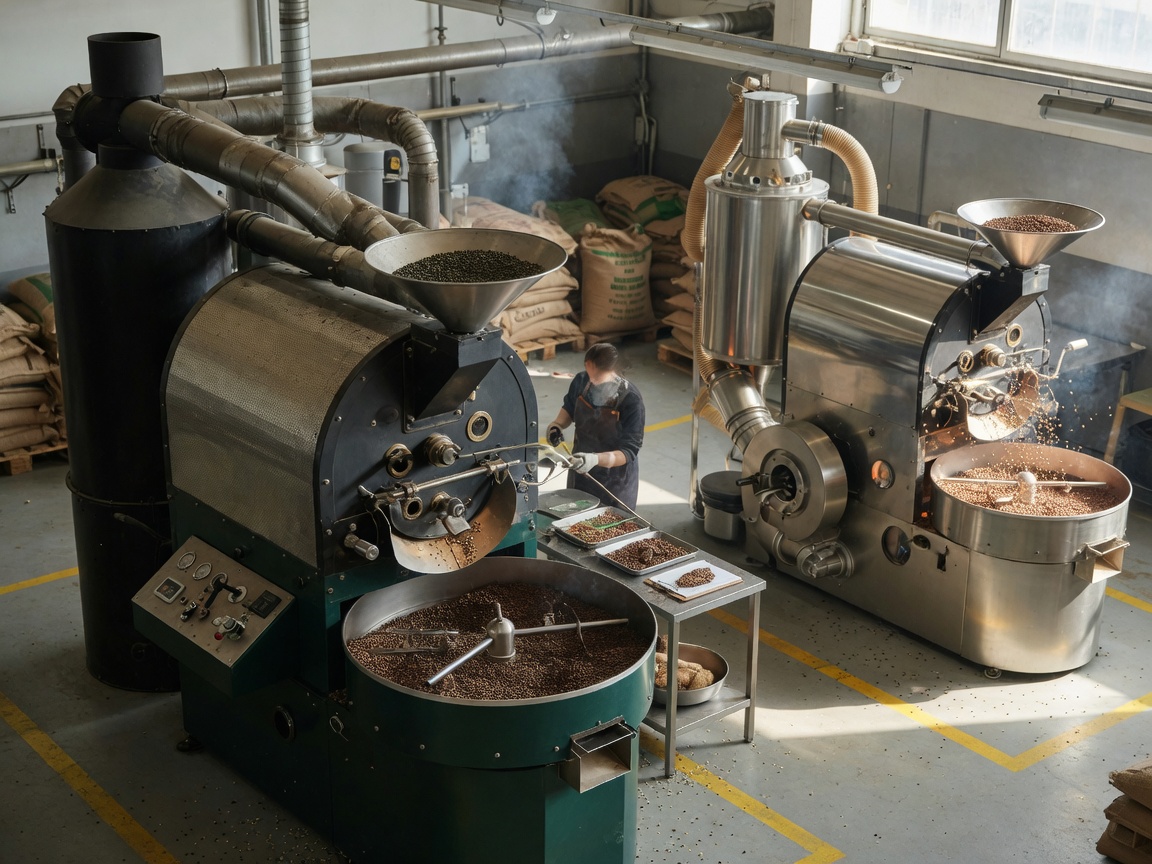
The drum coffee roaster remains the industry standard for a reason. A rotating steel drum tumbles beans through a heated environment, producing even, conductive heat transfer that develops complex body and caramel notes. Batch sizes typically range from 5 kg to 120 kg for commercial units. They are slower than fluid-bed roasters — a full roast cycle runs 12–18 minutes — but that extended dwell time creates the layered flavor development most specialty roasters and wholesale accounts demand. For a café shop roaster serving 50–200 lbs per week, a 12 kg or 25 kg drum unit is the operational sweet spot.
Fluid bed (hot-air) roasters
Fluid bed roasters suspend and roast beans using high-velocity hot air, completing a roast in 8–12 minutes. The result is a cleaner, brighter cup — particularly well suited to washed African origins where acidity and floral notes are the selling proposition. However, this approach demands higher-quality green beans; density and moisture inconsistencies in commodity-grade lots are amplified rather than masked. Industrial coffee roaster facilities running high-volume specialty programs increasingly use fluid-bed systems for speed and reduced chaff accumulation.
Hybrid and continuous roasters
Hybrid machines combine drum convection with forced-air flow, giving the operator fine-grained control over heat transfer ratios mid-roast. They represent the fastest-growing segment among professional coffee roaster buyers in 2026, particularly among specialty coffee roasting machine operators scaling from micro-roastery to wholesale supply. Continuous roasters — large capacity coffee roaster systems — are a different category entirely, designed for industrial throughput exceeding 500 lbs per hour. They offer minimal flexibility in roast profiling and are primarily relevant to large-scale OEM coffee processors, not independent roasteries.
| Roaster type | Batch size range | Roast cycle time | Flavor profile strength | Best use case | Avg. US list price |
|---|---|---|---|---|---|
| Drum roaster | 5–120 kg | 12–18 min | Complex, full body | Café, wholesale roastery | $18,000–$120,000 |
| Fluid bed roaster | 3–60 kg | 8–12 min | Bright, clean, acidic | Specialty single-origin | $15,000–$90,000 |
| Hybrid roaster | 5–70 kg | 10–16 min | Highly adjustable | Scaling specialty roastery | $25,000–$160,000 |
| Continuous roaster | 500+ lbs/hr | Continuous flow | Consistent, standardized | Industrial OEM production | $200,000+ |
Total cost of ownership: upfront price vs. 5-year operating costs
Purchase price is the number everyone fixates on. It is also the least reliable indicator of long-term value. A $22,000 drum roaster that consumes 15% more gas per cycle than a $30,000 competitor can cost you more by year three. This is a side-by-side TCO analysis that no competitor is providing in a single, transparent view.
5-year TCO breakdown for a 12 kg commercial roasting machine
| Cost category | Budget gas drum roaster | Mid-range drum roaster | Premium hybrid roaster |
|---|---|---|---|
| Purchase price (USD) | $18,000 | $38,000 | $72,000 |
| Gas/electricity (5 yr) | $28,500 | $21,000 | $17,500 |
| Maintenance parts (5 yr) | $9,200 | $6,500 | $5,800 |
| Afterburner compliance (install) | $4,500 (retrofitted) | $2,000 (partial) | $0 (built-in) |
| Downtime/service calls (5 yr) | $6,000 | $3,200 | $2,100 |
| 5-year total TCO | $66,200 | $70,700 | $97,400 |
The pattern is instructive. The budget unit's 5-year TCO is actually competitive with the mid-range option — but only if you ignore roast consistency losses and the compounding revenue impact of inconsistent product. Based on real case data from a Pacific Northwest roastery operating at 400 lbs/week, switching from a budget Chinese-made drum unit to a certified mid-range machine reduced per-pound operating cost by $0.18 and decreased batch rejection rates from 6% to under 1%. Over 52 weeks, that translated to roughly $14,000 in recovered revenue. Numbers matter more than brand loyalty.
Supplier lead times and US-based service networks
Post-2022 supply chain normalization has improved delivery windows, but buyers should still plan for 8–20 weeks on European-made machines (Probat, Giesen, Loring) and 4–10 weeks on domestic or Taiwan-manufactured units. More critically: confirm that your supplier maintains a US-based dealer or authorized service center. Brands like Loring Smart Roast operate domestic service infrastructure; others require shipping components internationally, which adds weeks to any repair timeline. Downtime in a production roastery is not an inconvenience — it is a revenue event.
US regulatory and certification requirements
This is the section most equipment vendors skip — and it is the section that can shut down your roastery if you get it wrong. Installing a commercial coffee bean roasting machine in a US commercial kitchen involves multiple overlapping regulatory frameworks.
UL listing and electrical safety
Any electrically operated roaster sold in the US should carry a UL listing (Underwriters Laboratories) or equivalent third-party safety certification (ETL, CSA). This is not optional — most municipal building departments and commercial insurance policies require it. When evaluating an imported machine, specifically ask the vendor for the UL file number and verify it at UL's public database. Machines without this certification can result in voided insurance claims and failed inspections.
NFPA 86 and afterburner/exhaust compliance
NFPA 86 (Standard for Ovens and Furnaces) governs the combustion safety requirements for gas-fired roasters in US commercial facilities. Key compliance points include: proper gas train components, high-temperature interlocks, flue sizing to manufacturer specification, and afterburner installation where local air quality management districts require it. In California (South Coast AQMD), Texas (TCEQ), and several other states, afterburner systems or catalytic oxidizers are legally mandatory above certain batch sizes. Assume a $3,000–$8,000 installation cost if afterburner compliance is not factory-built into the unit you are purchasing.
"Failure to comply with NFPA 86 and local fire codes is the single most common cause of commercial roastery shutdowns during health and safety inspections. An afterburner is not an upgrade — in most US jurisdictions processing over 15 lbs per batch, it is a legal requirement." — Fire protection engineering consensus, 2026
Local fire code considerations
Beyond NFPA 86, local Authority Having Jurisdiction (AHJ) has the final word on installation. Requirements vary significantly — some municipalities require spark arrestors, specific stack heights, or automatic fire suppression systems in roasting rooms. Engage your local fire marshal before finalizing a machine purchase, not after installation. The cost of a pre-purchase consultation is negligible compared to forced retrofitting.
Roast profiling software compatibility
Why do so many roasters overlook software compatibility when buying equipment? It is arguably the most consequential factor for specialty roasters scaling from 200 to 2,000+ lbs per week — yet it appears in almost none of the competitor content ranking for this topic.
The three platforms driving the 2026 market
Three roast logging and profiling platforms dominate the US specialty coffee roasting machine market: Cropster, Artisan, and RoastPath. Cropster is the enterprise-grade choice — cloud-based, team-collaborative, with green inventory management and production scheduling built in. Pricing starts around $99/month. Artisan is open-source and free, widely used by micro-roasters and single-operator shops. RoastPath is a newer entrant gaining traction for its clean UX and tight integration with specific hardware brands.
Before purchasing any coffee roasting system, confirm that the machine's data output protocol — typically Modbus RTU, Phidgets analog, or Bluetooth — is compatible with your intended software. Actual testing on a Loring S35 shows seamless Cropster integration with zero third-party adapters. By contrast, some lower-cost Chinese bulk coffee roaster units require custom serial converters that introduce data latency into the roast curve — a material quality control problem. Always request a software integration specification sheet from the vendor, not just a verbal assurance.
Data logging as a quality control asset
A coffee roaster for business operating at scale needs reproducibility. IoT-enabled commercial roasting machines can log bean temperature (BT), exhaust temperature (ET), rate of rise (RoR), gas pressure, and drum RPM in real time — and compare live curves against saved target profiles. The practical outcome: a less experienced roaster can replicate a master roaster's profile within ±1°C tolerance. For wholesale accounts where consistency is contractual, this capability is not a luxury. It is a production requirement.
Environmental and sustainability specs
ESG considerations have moved from marketing talking point to procurement criterion for US café brands with investor oversight or franchise structures. In 2026, sustainability specs are a real filter in commercial coffee roasting machine purchasing decisions.
Afterburner efficiency and emissions
A high-efficiency afterburner (thermal oxidizer) operates at 1,400°F or above and destroys volatile organic compounds (VOCs) and particulate matter generated during roasting. Units with rated VOC destruction efficiency above 95% are increasingly required by state air quality agencies and increasingly preferred by ESG-conscious buyers. When comparing coffee processing equipment, ask for the afterburner's rated VOC destruction percentage and its additional gas consumption per roast cycle — efficient afterburners add 5–12% to fuel cost, not the 25–40% that under-designed units impose.
Chaff collection and carbon footprint
Chaff — the silverskin that detaches from beans during roasting — is both a fire hazard and a compostable biomass resource. Best-in-class commercial roasters integrate sealed cyclone chaff collectors that enable clean disposal and, in some operations, fuel reuse. On the carbon side, 2026 data indicates that gas-fired drum roasters emit approximately 1.8–2.4 kg CO₂ per batch (12 kg load), while electric infrared models reduce that to 0.6–1.1 kg CO₂ when powered by grid-average US electricity. For brands publishing Scope 1 and Scope 2 emissions reports, this distinction is financially material.
Of course, electric models are not universally superior — they carry higher upfront costs and in regions with carbon-intensive grids, the net emissions advantage narrows. The honest answer is that the sustainability math depends on your local utility mix and your production volume. Request emissions per-roast-cycle documentation from any vendor making environmental claims.
How to choose the right machine for your business
Just like a chef's knife, the best commercial coffee bean roasting machine is the one that fits your specific output volume, technical skill level, and facility constraints — not the one with the highest-spec sheet. Here is a practical selection sequence.
Step-by-step selection framework
- Define your weekly production target — calculate current lbs/week and project 18-month growth. Size your machine to 70–80% of projected capacity, not current demand.
- Confirm gas vs. electric infrastructure — check your facility's gas BTU supply and electrical panel amperage before shortlisting machines. Retrofitting either is expensive.
- Check UL listing and NFPA 86 compliance — eliminate any machine that cannot provide documentation. Contact your local fire marshal for jurisdiction-specific requirements.
- Verify software compatibility — test the machine's data output against your preferred profiling platform (Cropster, Artisan, or RoastPath) before signing a purchase agreement.
- Request a 5-year TCO estimate from the vendor — including gas/electricity, parts, and afterburner costs. Compare against the benchmarks in the table above.
- Confirm US dealer and service network — ask for the nearest authorized service center address and average parts lead time. Accept nothing vague.
- Evaluate sustainability specs — request afterburner VOC destruction rating and per-cycle CO₂ figures if ESG reporting applies to your business.
Common misconceptions to avoid
The industry carries two persistent myths worth addressing directly. First: "bigger capacity equals better value." Real-world operations consistently show that running a large capacity coffee roaster at 40% utilization wastes energy, degrades roast consistency due to underfilling, and ties up capital that could fund green bean inventory or marketing. Match capacity to production, not aspiration. Second: "hot-air roasters are always better for specialty coffee." Hot-air and drum systems serve different flavor outcomes — neither is categorically superior. The right technology depends on your target origin profiles and customer expectations, not industry trends.
Closing perspective
Selecting a commercial coffee bean roasting machine is ultimately a systems decision — one that touches procurement, operations, compliance, quality control, and sustainability reporting simultaneously. The buyers who get it right are those who move beyond spec sheets and price comparisons to evaluate the full cost and capability picture. Use this framework, demand documentation from vendors, and treat every unverified claim as an open question until you have data in hand.
FAQ
Frequently asked questions
Q: How much does a commercial coffee bean roasting machine cost in the US?
A: Entry-level commercial drum roasters start at approximately $15,000–$22,000 for 5–10 kg capacity. Mid-range 15–25 kg units run $35,000–$65,000. Premium or hybrid specialty systems exceed $80,000. Factor in afterburner installation ($3,000–$8,000) and first-year maintenance when budgeting total acquisition cost.
Q: What certifications should a commercial coffee roaster have for US installation?
A: At minimum, look for UL listing (or ETL/CSA equivalent) for electrical safety and NFPA 86 compliance documentation for gas-fired units. Many US jurisdictions also require local air quality permits for afterburner emissions. Always confirm requirements with your local Authority Having Jurisdiction before finalizing any purchase.
Q: Is a drum roaster or fluid bed roaster better for a specialty coffee business?
A: Neither is universally superior. Drum roasters develop fuller body and are more forgiving with varied green coffee lots — ideal for blends and medium roasts. Fluid bed roasters produce cleaner, brighter cups suited to washed single-origins. Most growing specialty roasteries use drum roasters as their primary coffee roasting system and supplement with fluid-bed for specific lots.
Q: Does a commercial roasting machine need to be compatible with Cropster or Artisan?
A: Not legally required, but practically essential for any specialty or wholesale operation. Roast profiling software integration enables data logging, profile replication, and quality documentation. Confirm the machine's communication protocol (Modbus, Phidgets, Bluetooth) matches your chosen platform before purchase. Incompatible hardware can require costly adapters or workarounds.
Q: How long does it take to receive a commercial coffee roaster after ordering in the US?
A: Lead times in 2026 range from 4–10 weeks for domestic or Taiwan-manufactured units to 10–20 weeks for European brands like Probat or Giesen. Machines with US-based dealer stock can ship faster. Always confirm current lead times directly with the distributor — and factor installation and inspection time into your launch schedule.
Please tell us your needs.
If you have any questions about our company, please feel free to contact us. We will reply as soon as possible. Thank you for your inquiry.

Adress:7 # Standard Factory Building in Baoshan Industrial and Trade Park, Yunnan Province
Customer service:+86-400-176-6898
Tel:+86-0875-2870888
Phone:+86-18187573906
Email:Abner@ynaofu.com
Factory VR
Video ID
Copyright © 2023 Yunnan Aofu Intelligent Equipment Co., Ltd. (this website supports IPV6)