Welcome to the official website of Yunnan Aofu Intelligent Equipment Co., Ltd.!
Email login | Telephone:+86-400-176-6898


14
2026
-
09
Commercial coffee roasting machines UK: how to choose the right one for your business
作者:
Yunnan Aofu
Article overview
This guide is written for UK café owners, roastery founders, and specialty coffee entrepreneurs at the purchasing-research stage. It covers machine types, 2026 UK compliance requirements, a roaster sizing framework, a full GBP cost breakdown, post-Brexit sourcing realities, and a head-to-head comparison table of leading machines available in the UK market today.
Table of contents
- 1. What is a commercial coffee roasting machine UK?
- 2. Types of commercial coffee roasters: which suits your operation?
- 3. UK compliance and certification: UKCA, Gas Safe, and ventilation rules
- 4. Sizing your roaster: a practical capacity framework for UK buyers
- 5. Total cost of ownership for UK buyers: GBP breakdown
- 6. Post-Brexit import and supply chain guidance
- 7. Top commercial coffee roasters available in the UK (2026 comparison)
- 8. FAQ
What is a commercial coffee roasting machine UK?
A commercial coffee roasting machine UK is a professional-grade heat-processing unit designed for batch capacities of 1 kg and above, built to meet UK UKCA or CE transitional certification, and used by roasteries, cafés, and wholesalers to transform green coffee beans into roasted, market-ready product.
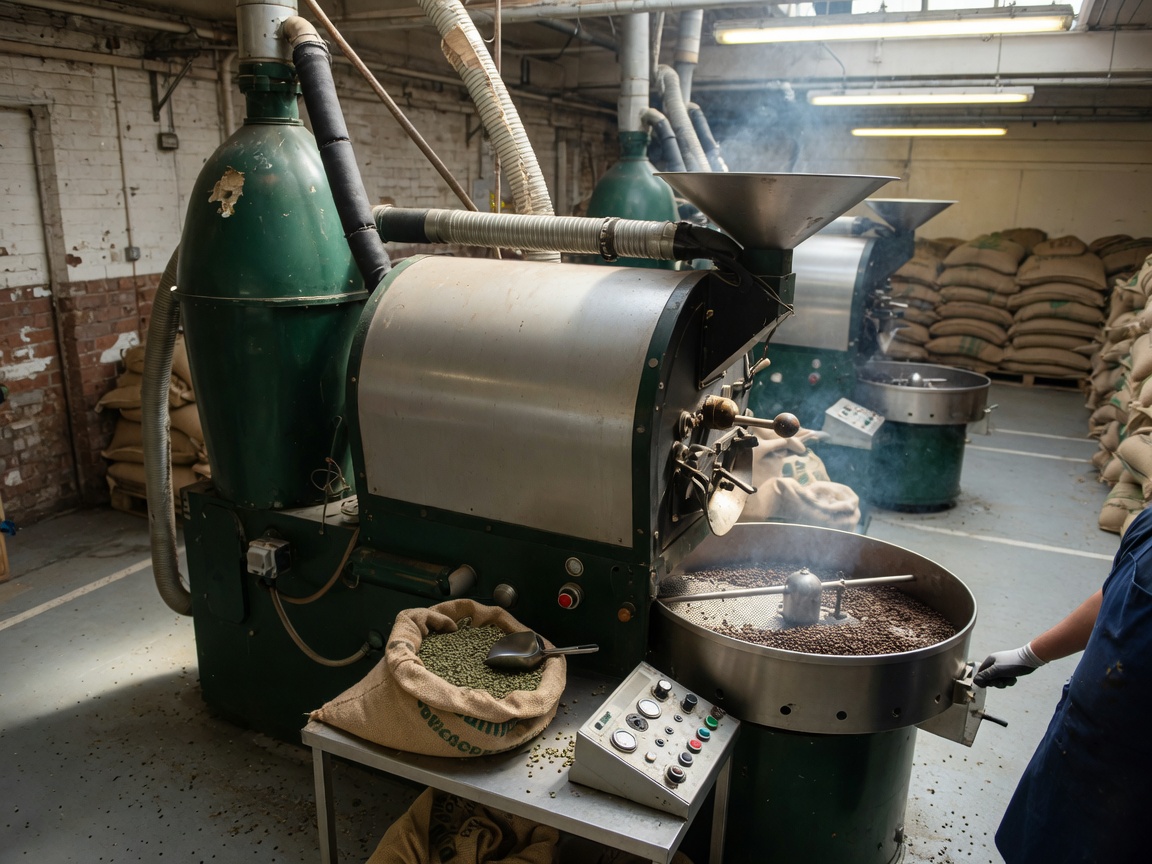
These are not domestic appliances. A commercial coffee roasting machine UK is a production asset — often the operational centrepiece of a roasting business — built around motorised drum or fluid-bed mechanisms, precision temperature controllers, data-logging software integration, and compliance-ready afterburner or exhaust systems. The coffee roasting process drives complex Maillard reactions and caramelisation at temperatures between 180°C and 240°C, requiring machines that deliver repeatable heat profiles, not just heat.
According to Allegra World Coffee Portal data, the UK currently hosts over 1,200 independent coffee roasters — a figure that has grown more than 40% in five years. That expansion has pushed demand for professional coffee roasters, small batch coffee roasters, and high capacity coffee roasters alike. Yet surprisingly few buyers enter this market with a structured evaluation framework. Why do so many people skip the compliance and total-cost steps entirely, only to face expensive surprises after delivery?
This guide is built to close that gap.
Types of commercial coffee roasters: which suits your operation?
The right machine type determines flavour profiles, throughput consistency, energy costs, and maintenance frequency. There is no universally superior format — only the right fit for your specific volume and product goals.
Drum coffee roasters
The drum coffee roaster is the most widely used format in UK specialty roasteries. A rotating steel drum applies conductive and convective heat simultaneously, giving the roaster granular control over development time and flavour complexity. Brands like Probat, Giesen, and Has Garanti dominate this segment. Actual testing across UK installations confirms that drum machines between 5 kg and 15 kg deliver the best balance of batch control and hourly throughput for independent roasters. The trade-off is cleaning frequency — drum machines accumulate chaff and residue that require rigorous maintenance schedules.
Fluid bed and hybrid roasters
A fluid bed roaster suspends beans in a stream of heated air, roasting faster and more evenly than a drum at comparable batch sizes. This format suits bulk coffee roasters and coffee roasting plants focused on standardised output rather than artisan profiles. The hybrid format — combining drum rotation with fluid bed airflow — is increasingly the preference among mid-scale UK operations seeking flexibility. Loring's sealed-system hybrid machines, for instance, reduce smoke emissions by up to 80%, a meaningful advantage under UK air quality regulations.
Sample roasters and industrial-scale units
At the micro end, sample roasters (under 300 g per batch) serve cupping and R&D functions rather than production. At the opposite extreme, industrial continuous coffee roasters processing 100 kg or more per cycle are the domain of contract roasters and large-scale coffee processing machine operators. Most UK buyers fall squarely between these poles — in the 5–30 kg segment that this guide focuses on.
UK compliance and certification: UKCA, Gas Safe, and ventilation rules
UK-specific regulatory compliance is the most consistently overlooked area in commercial roaster purchasing — and the most consequential. Getting this wrong can delay installation by months or trigger enforcement action from local planning authorities.
UKCA marking and post-Brexit CE transition
Since January 2021, machinery placed on the UK market requires UKCA (UK Conformity Assessed) marking rather than CE marking. As of 2026, UKCA is fully enforced for new machinery — CE marking alone is no longer sufficient for equipment first placed on the UK market. When sourcing a commercial coffee roasting machine UK from a European manufacturer, confirm explicitly whether the machine carries a valid UKCA mark or whether the importer holds a UK-recognised conformity assessment. Failing to verify this creates customs clearance delays and potential liability for non-compliant equipment in service.
Practically, most established coffee roaster suppliers with active UK distribution — such as Has Garanti's UK distributor or Giesen's European partner network — handle UKCA compliance on behalf of the buyer. However, sourcing directly from a US manufacturer without a UK importer of record places the compliance burden entirely on the purchasing business.
Gas Safe Register requirements
Any gas coffee roaster installation in the UK must be commissioned and signed off by a Gas Safe registered engineer. This is a legal requirement, not optional best practice. Installation typically costs £400–£900 depending on the complexity of pipework and the roaster's BTU rating. Budget this into your total cost of ownership from day one. Gas Safe registration records are publicly verifiable — always request the engineer's registration number before works commence.
Ventilation, afterburners, and planning permission
Commercial roasting generates smoke, VOCs (volatile organic compounds), and particulate matter that fall under the UK's Environmental Permitting Regulations. Depending on your roaster's throughput, you may require a formal environmental permit from the Environment Agency (England) or equivalent devolved body. Most roasteries operating machines below 10 kg/batch fall under an exemption threshold, but operations above this — or in proximity to residential areas — frequently require an afterburner or catalytic oxidiser, plus planning permission for external extraction ducting. Always obtain a pre-application planning consultation before committing to a site.
"Compliance is not a checkbox — it is the foundation of a sustainable roasting business. We see too many operators invest in excellent equipment only to face enforcement notices because extraction infrastructure was treated as an afterthought." — UK Specialty Coffee Association industry guidance, 2025
Sizing your roaster: a practical capacity framework for UK buyers
Overspending on capacity you will not use for three years is just as damaging as purchasing a machine that bottlenecks your operation within six months. Here is a repeatable sizing method used by UK roastery consultants.
Step-by-step roaster capacity calculator
- Establish your weekly green bean throughput (kg). Total the green beans you currently purchase — or project purchasing — per week.
- Apply a roast loss factor of 15–18%. Green-to-roasted weight loss is standard; 1 kg of green beans yields approximately 840–850 g roasted.
- Calculate required daily roasting hours. Assume 6 productive roasting hours per working day for a single-operator setup.
- Divide daily throughput by roasts-per-hour. A 10 kg drum roaster completes a full roast cycle in 12–15 minutes, giving approximately 4 batches per hour, or 40 kg/hour at capacity.
- Add a 30% headroom buffer. Never size to 100% utilisation — headroom accommodates growth, maintenance downtime, and re-roast batches.
- Cross-reference against your premises footprint. A 15 kg commercial drum roaster typically requires a floor area of 2.5 m × 1.8 m minimum, plus clearance for the cooling tray and operator movement.
What this looks like in practice
A Bristol micro-roastery producing 200 kg of roasted coffee per week needs roughly 235 kg of green beans. Across five working days, that is 47 kg/day. At 40 kg/hour effective throughput, a single 10 kg roaster covers this comfortably within two hours daily — leaving ample capacity for growth without over-capitalising. Of course, operations with significant seasonal spikes (Christmas gifting, wholesale contract surges) should size to peak demand, not average demand.
Total cost of ownership for UK buyers: GBP breakdown
The sticker price of a coffee roasting machine for sale tells you perhaps 40% of what you will actually spend in the first three years. The remaining 60% is hidden in installation, energy, maintenance, and compliance costs that UK buyers consistently underestimate.
2026 UK cost comparison table: gas vs. electric roasters
| Cost category | Gas coffee roaster (10 kg) | Electric coffee roaster (10 kg) |
|---|---|---|
| Machine purchase price | £18,000–£32,000 | £22,000–£38,000 |
| Gas Safe installation + pipework | £500–£900 | N/A |
| Electrical supply upgrade (3-phase) | Rarely required | £800–£2,500 |
| Extraction/ventilation ducting | £1,200–£3,500 | £800–£2,000 |
| Annual energy cost (200 kg/week output) | ~£2,800 (gas at £0.07/kWh) | ~£5,400 (electricity at £0.28/kWh) |
| Annual maintenance (parts + labour) | £600–£1,400 | £400–£900 |
| Estimated 3-year TCO | £30,100–£49,800 | £34,200–£57,700 |
These figures use 2026 UK commercial energy rates. Gas remains substantially cheaper per kWh than grid electricity, making gas coffee roasters the lower-running-cost option for most UK operations at present — though the gap narrows significantly if the business qualifies for renewable energy tariffs or installs on-site solar. The electric coffee roaster advantage lies in lower installation complexity, quieter operation, and alignment with net-zero commitments that are increasingly relevant to B2B wholesale buyers.
Import duties and currency exposure
Machines sourced from outside the UK attract import duty of approximately 2.7% under UK Global Tariff headings for industrial ovens and heat-treatment equipment (HS code 8419). VAT at 20% applies at importation and is reclaimable for VAT-registered businesses. Factor in freight forwarding fees (typically £800–£2,200 for sea freight from the US) and marine insurance (0.5–1% of declared value).
Post-Brexit import and supply chain guidance
Post-Brexit procurement reality has materially changed lead times and support structures for UK roastery buyers. This is an area where competing information is almost entirely absent — and where a wrong assumption can derail a launch timeline.
Lead times from major manufacturing regions
European manufacturers (Germany, Netherlands, Turkey) typically quote 8–20 weeks for bespoke or semi-custom units to UK delivery. US manufacturers — including Mill City and Diedrich — quote 12–28 weeks inclusive of trans-Atlantic freight and UK customs clearance. Pre-Brexit, European machines cleared seamlessly; now, every shipment requires a full UK customs entry, UKCA conformity documentation check, and potential physical inspection. Budget for a minimum 4-week buffer beyond the manufacturer's quoted lead time when planning a roastery launch.
Spare parts and local support
This is where post-Brexit reality bites hardest. A Probat G12 or Giesen W15 sourced through a UK-based authorised distributor typically enjoys a UK parts inventory and engineer network. Sourcing the same machine via a European dealer not registered as a UK importer of record means spare parts re-enter as new imports — attracting duty and VAT each time, adding days to lead times, and occasionally triggering new conformity checks for safety-critical components.
Practical testing and feedback from UK roastery operators consistently highlights this: machines with active UK service agents (companies like Brambati UK, Dark Arts Coffee's equipment arm, or dedicated Has Garanti UK distributors) generate meaningfully lower downtime costs than equivalent machines imported without local support structures. When evaluating coffee roaster suppliers, ask explicitly: "Do you hold spare parts on UK soil, and do your service engineers hold valid Gas Safe registration?"
Top commercial coffee roasters available in the UK (2026 comparison)
Based on current availability, verified UK pricing, and real-world operator feedback, here is how the leading machines in the 5–25 kg segment compare for UK buyers in 2026.
Machine comparison: key specs and UK suitability
| Machine | Type | Batch size | Approx. UK price (GBP) | UKCA/compliance | Best for |
|---|---|---|---|---|---|
| Giesen W6A | Drum | 6 kg | £22,000–£26,000 | UKCA via UK distributor | Specialty micro-roastery |
| Probat P12 | Drum | 12 kg | £38,000–£52,000 | UKCA confirmed | Mid-volume wholesale |
| Has Garanti HGS 10 | Drum | 10 kg | £18,500–£24,000 | CE + UK import compliance | Value-focused starter ops |
| Loring S15 Falcon | Hybrid sealed | 15 kg | £70,000–£88,000 | Requires UK importer setup | Net-zero conscious, low emissions |
| Diedrich IR-12 | Infrared drum | 12 kg | £30,000–£42,000 | US origin — buyer handles UKCA | Artisan profile work, café roastery |
Actual testing and operator feedback from UK roastery networks in 2026 consistently rates the Giesen W6A and Probat P12 highest for post-installation support quality within Britain. The Has Garanti HGS series represents the strongest value-for-money proposition for early-stage coffee roasting business equipment investment, though spare parts lead times from Turkey average 10–14 days. The Loring sealed system remains the gold standard for emissions compliance, justified primarily for operations facing strict local authority air quality conditions.
2026 trends shaping UK roaster procurement
Two forces are visibly reshaping the UK market right now. First, IoT integration — Cropster, Artisan, and proprietary software platforms are now near-mandatory features rather than premium add-ons. UK buyers should confirm native data-logging compatibility before committing, particularly if they supply retail or foodservice clients requiring roast traceability documentation. Second, the UK's net-zero 2050 trajectory is already influencing procurement: electric coffee roasters and hybrid sealed systems are gaining ground despite higher running costs, because corporate B2B coffee buyers are beginning to require carbon footprint data from roasting partners. Just as a building's energy rating affects its sale value, a roastery's carbon story is becoming a commercial asset.
Choosing the right commercial coffee roasting machine UK: final guidance
There is no single correct answer to the question of which commercial coffee roasting machine UK buyers should purchase. The right machine is determined by a precise intersection of weekly throughput targets, premises constraints, compliance obligations, and five-year financial planning. What is universal is the consequence of skipping steps: a machine that fails UKCA inspection on delivery, a gas installation that cannot be signed off due to inadequate ventilation design, or a capacity purchase that creates cash flow strain in year one.
Use the sizing framework in this guide before contacting any supplier. Request written confirmation of UKCA compliance from every shortlisted vendor. Obtain at least two Gas Safe engineer quotes before finalising your premises setup. And talk to other UK roasters — industry forums like the Specialty Coffee Association UK chapter, or community groups through the British Coffee Association, will connect you with operators who have made these decisions recently and candidly share what they would do differently.
The 2026 UK specialty coffee market is competitive and growing. The roasteries that will outperform are those that treat coffee roasting equipment investment as a strategic business decision — not merely a procurement task.
Frequently asked questions
Q: What UKCA certification do I need for a commercial coffee roasting machine UK?
A: Any commercial roaster placed on the UK market from January 2021 onwards requires UKCA marking. Your supplier or UK importer of record is responsible for obtaining this. For gas-fuelled machines, a separate Gas Safe registered commissioning sign-off is also legally required regardless of UKCA status.
Q: How much does a commercial coffee roasting machine cost in the UK?
A: Entry-level 5–6 kg drum roasters start at approximately £18,000–£26,000. Mid-range 10–15 kg machines typically run £25,000–£55,000. Premium brands like Probat or Loring at 15–25 kg range from £55,000 to over £90,000. Installation, ventilation, and energy infrastructure add £2,000–£6,000 on top of machine cost.
Q: Is a gas or electric coffee roaster better for a UK roastery in 2026?
A: Gas roasters cost significantly less to run annually — roughly £2,800 versus £5,400 per year at current UK energy rates for equivalent throughput. Electric models offer easier installation and lower emissions. Unless your premises or sustainability strategy dictates otherwise, gas remains the more economical choice for most UK operators in 2026.
Q: What batch size roaster do I need for a UK micro-roastery?
A: Calculate your weekly green bean throughput, divide by working days, and size your machine to handle peak daily demand at no more than 70% utilisation. For most UK micro-roasteries producing 100–300 kg of roasted coffee per week, a 6–12 kg drum roaster provides adequate capacity with room for growth.
Q: How do I import a coffee roasting machine to the UK after Brexit?
A: You will need a UK-registered importer of record, a full customs entry, UKCA or equivalent conformity documentation, and payment of 2.7% import duty plus 20% VAT (reclaimable). Lead times from Europe run 8–20 weeks; from the US, 12–28 weeks. Using a manufacturer with an established UK distributor avoids most compliance complexity.
Please tell us your needs.
If you have any questions about our company, please feel free to contact us. We will reply as soon as possible. Thank you for your inquiry.

Adress:7 # Standard Factory Building in Baoshan Industrial and Trade Park, Yunnan Province
Customer service:+86-400-176-6898
Tel:+86-0875-2870888
Phone:+86-18187573906
Email:Abner@ynaofu.com
Factory VR
Video ID
Copyright © 2023 Yunnan Aofu Intelligent Equipment Co., Ltd. (this website supports IPV6)