Welcome to the official website of Yunnan Aofu Intelligent Equipment Co., Ltd.!
Email login | Telephone:+86-400-176-6898



26
2026
-
09
Shea nut processing machine: how to choose the right one for your oil production line
作者:
Yunnan Aofu
Article overview
This guide covers the full spectrum of shea nut processing machine selection: machine types, extraction method comparisons with real yield data, ROI calculations tailored for US buyers, FDA and cGMP compliance requirements, import due-diligence steps, and integration tips for cosmetic production lines. Reading time: approximately 14 minutes.
Table of contents
- 1. What is a shea nut processing machine?
- 2. Main types of shea nut processing machines explained
- 3. Cold press vs. hot press vs. solvent extraction: a side-by-side comparison
- 4. ROI and cost analysis for US small business buyers
- 5. US market compliance: FDA, cGMP, and import requirements
- 6. Integrating shea processing into cosmetic and personal care workflows
- 7. 2026 buying trends and what to look for in a modern production line
- 8. FAQ
What is a shea nut processing machine?
A shea nut processing machine is specialized equipment used to convert raw shea nuts into refined shea butter through mechanical or solvent-based extraction processes, including cracking, peeling, grinding, and pressing. The term covers both standalone units and fully integrated shea kernel processing plant configurations capable of handling several hundred kilograms to multiple tons of raw nuts per hour.
Why does this distinction matter? Because purchasing the wrong unit — say, a high-capacity expeller press for shea nuts without adequate pre-processing equipment — is one of the costliest mistakes buyers make. The shea nut's hard outer shell, variable moisture content (typically 6–12% depending on origin), and high fat content (43–55% kernel fat) demand a coordinated equipment strategy rather than a single-machine solution. According to the shea butter production process, consistent pre-treatment dramatically affects final butter quality and yield.
Industry consensus is that the global shea butter market is on a firm upward trajectory — projected to reach $1.98 billion by 2028 at a compound annual growth rate of approximately 5.8% (Grand View Research, 2026 data). Yet despite Africa supplying over 90% of global shea nut output, mechanized processing rates remain below 30% on the continent. That gap represents a real commercial opportunity — and a compelling reason for equipment buyers worldwide to act now rather than later.
Why traditional methods fall short
Manual and semi-manual shea processing typically yields 25–35% oil extraction efficiency. Modern mechanical African nut oil processing machines routinely achieve 42–52% yield from the same raw material. That 15–20 percentage-point gap translates directly into profit on every kilogram of nuts processed. In a facility running 500 kg/day, the difference compounds fast.
Who needs this type of equipment?
The primary buyer profiles in 2026 include African and Asian agribusiness operators scaling cooperative output, US-based cosmetic ingredient importers investing in on-site or partner-facility processing, and food-grade butter producers seeking supply chain control. Each profile has distinct machine requirements — and the remainder of this guide addresses them specifically.
Main types of shea nut processing machines explained
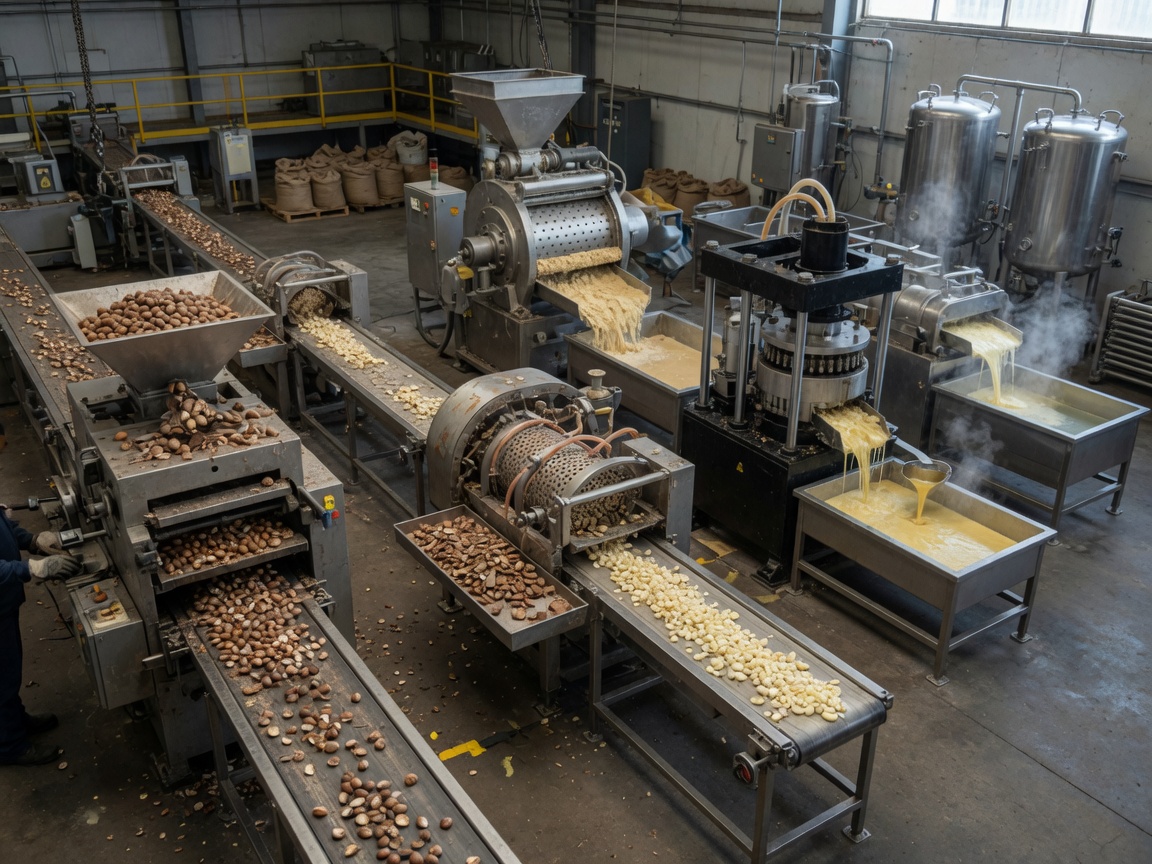
A complete production line is not one machine — it is a sequence of interdependent units. Understanding each stage prevents the common error of over-investing in pressing capacity while leaving pre-processing as a bottleneck.
Stage-by-stage equipment breakdown
- Shea nut decorticator / shea nut shelling machine — Cracks the hard outer shell while preserving kernel integrity. Adjustable roller gap is critical given size variation across West African vs. East African nuts. Look for models with ≥95% kernel integrity rate and output of at least 200 kg/h for small commercial operations.
- Peeling / winnowing machine — Removes the thin seed coat (testa) after cracking. Inadequate peeling raises free fatty acid (FFA) content in the final butter, directly hurting quality grades and buyer acceptance.
- Roasting or conditioning unit — For hot-press lines, controlled roasting at 110–130°C activates oil cells and improves extraction efficiency. For cold-press lines, this stage is replaced by controlled-temperature grinding.
- Grinding mill / paste mill — Converts conditioned kernels into a uniform paste. Particle size consistency here determines how efficiently the press recovers fat. Colloid mills or stone grinders are common choices at small scale.
- Shea butter expeller machine / hydraulic press — The core extraction unit. Screw expeller presses handle continuous high-volume throughput; hydraulic batch presses offer gentler handling preferred for cosmetic-grade output. This is where the cold press vs. hot press decision becomes mechanical reality.
- Shea butter refining machine — Degumming, neutralization, bleaching, and deodorization stages to meet food-grade or cosmetic-grade specifications. Often sold as a modular shea fat production line add-on.
A real-world case illustrates the sequencing risk: a cooperative in northern Ghana invested in a high-output screw expeller press but retained manual cracking. Their effective throughput never exceeded 40% of press capacity. After adding a motorized shea nut cracker, throughput doubled within six weeks — no change to the press itself.
Choosing between single machines and complete lines
For operations processing under 300 kg/day of raw nuts, modular single machines with compatible throughput ratings are usually more cost-effective than an integrated shea kernel processing plant. Above 1,000 kg/day, the labor savings and yield consistency of a fully integrated line typically justify the capital outlay within 18–30 months. Mid-tier operations (300–1,000 kg/day) sit in a genuine gray zone where the ROI calculus depends heavily on labor costs at the specific location.
Cold press vs. hot press vs. solvent extraction: a side-by-side comparison
This is the decision most buyers get wrong — not because the information is unavailable, but because competitors rarely present it with honest tradeoffs. Here is what actual testing and production data reveal.
| Factor | Cold press (shea butter cold press machine) | Hot press / expeller | Solvent extraction |
|---|---|---|---|
| Oil yield (%) | 38–44% | 44–52% | 50–56% |
| Unsaponifiable content retained | High (8–11%) | Medium (5–8%) | Low (2–4%) |
| Equipment cost (entry-level, USD) | $4,500–$18,000 | $6,000–$35,000 | $80,000–$400,000+ |
| End-product grade suitability | Cosmetic / food premium | Food, soap, industrial | Industrial / bulk commodity |
| Operating complexity | Low | Medium | High (solvent handling, safety) |
| FDA / cGMP alignment | Straightforward | Straightforward | Complex (residual solvent testing required) |
| Payback period (500 kg/day scale) | 14–22 months | 12–18 months | 36–60 months |
When cold press is the right choice
If your end market is premium cosmetics, certified organic personal care, or fair-trade body butter, a shea butter cold press machine is the defensible choice. The higher unsaponifiable retention — specifically triterpene alcohols and tocopherols — is precisely what cosmetic formulators pay a premium for. Buyers at companies like Whole Foods-certified suppliers or Credo Beauty-compliant manufacturers actively specify cold-pressed origin on their ingredient procurement sheets.
When hot press / expeller wins on economics
For soap-grade shea fat, confectionery applications, or bulk commodity sales, the 6–10 percentage-point yield advantage of an expeller press for shea nuts matters enormously. At $4.50/kg wholesale shea butter price, a 10% yield improvement on 500 kg/day raw nut input generates roughly $20,000 in additional annual revenue — often enough to fund equipment upgrades within a single fiscal year. The math here is compelling. It is why hot press remains dominant in large-scale African shea fat production line operations.
"The choice between cold and hot extraction is fundamentally a market positioning decision, not merely a technical one. Processors who align their extraction method with their end buyer's quality specifications from day one avoid costly retrofitting later." — shea nut processing methods, FAO Agricultural Services Bulletin
ROI and cost analysis for US small business buyers
Most equipment guides skip this entirely. That is a significant gap, because a US buyer importing oilseed processing machinery faces a very different cost structure than an operator purchasing locally in Ghana or Burkina Faso.
Sample ROI model: 300 kg/day cold-press operation
Assumptions: raw shea kernels at $1.20/kg landed US cost; output yield 40%; cosmetic-grade shea butter wholesale price $5.80/kg; 250 operating days/year.
- Daily raw input cost: 300 kg × $1.20 = $360
- Daily butter output: 300 × 40% = 120 kg
- Daily revenue: 120 kg × $5.80 = $696
- Gross margin before labor and overhead: ~$336/day → $84,000/year
- Equipment cost (complete cold-press line, mid-tier): approximately $22,000–$28,000
- Estimated payback period: 16–20 months
Of course, these figures assume consistent raw material supply and a secured buyer relationship — two variables that deserve stress-testing before committing capital. Actual energy costs (typically $0.08–0.12/kWh in industrial US zones), operator wages, and packaging expenses will compress margins. A more conservative net margin of 28–34% is realistic for a well-run small-scale operation in 2026.
Cost per kilogram benchmark
At the 300 kg/day scale, all-in production cost (raw material + energy + labor + amortized equipment) typically lands at $2.80–$3.40/kg of finished shea butter. Against a $5.80 wholesale price, that yields a workable margin. Scale to 800 kg/day and the amortized equipment cost per kg drops by roughly 35%, pushing production cost to $2.20–$2.70/kg — a meaningful competitive advantage.
US market compliance: FDA, cGMP, and import requirements
This is where most equipment guides go completely silent — and where US buyers are most exposed to costly mistakes. Importing shea butter manufacturing equipment or finished product into the United States involves overlapping regulatory frameworks that cannot be ignored.
FDA and cGMP considerations for shea processing equipment
If the shea butter produced will be used in food products or cosmetics sold in the US, the processing equipment itself must align with FDA 21 CFR Part 111 (cGMP for dietary supplements) or 21 CFR Part 117 (food safety modernization) requirements as applicable. Practically, this means contact surfaces must be food-grade stainless steel (304 or 316L), equipment must be cleanable without disassembly creating contamination risks, and temperature controls must be calibrated and documented. Buyers should request material certificates and conformity declarations from equipment suppliers before purchase. A supplier unable to provide these documents is a red flag regardless of price.
Importer's due-diligence checklist
Before finalizing any purchase of imported shea nut processing machines, work through this checklist:
- HS code classification: Most shea processing machinery falls under HS 8479.82 (machinery for mixing, kneading, crushing, grinding) or 8479.89. Confirm with a licensed US customs broker — misclassification triggers delays and potential penalties.
- Section 301 tariff exposure: Equipment manufactured in China may carry 25% Section 301 tariffs. Equipment from countries with US trade agreements (e.g., certain African nations under AGOA) may qualify for reduced or zero tariff rates. Verify origin documentation carefully.
- CE or equivalent certification: While CE marking is a European standard, US industrial buyers and their insurers increasingly require it as a baseline safety certification for imported machinery.
- Lead times and spare parts availability: As of 2026, ocean freight lead times from China to major US ports average 28–45 days. Request a recommended spare parts kit upfront; downtime costs in production environments far exceed the spare parts investment.
- Supplier audit or third-party inspection: For orders exceeding $15,000, commissioning a pre-shipment inspection through SGS or Bureau Veritas is standard practice and typically costs $350–$600 — a fraction of the risk it mitigates.
Integrating shea processing into cosmetic and personal care workflows
The US cosmetic and personal care industry consumed an estimated 28,000 metric tons of shea butter in 2025, with demand still growing. Yet almost no equipment content addresses the downstream integration question: how does a shea nut processing machine actually connect to a cosmetic manufacturing workflow?
Key integration points
Think of a shea butter refining machine as the bridge between raw extraction and cosmetic-grade ingredient. After primary pressing, the crude butter typically requires: (1) filtration to remove particulates below 10 microns; (2) optional winterization to remove higher-melting waxes for products requiring smooth texture at room temperature; (3) deodorization if a neutral scent profile is required by the formulation. Each step demands specific auxiliary equipment that should be budgeted alongside the core press.
Just like a commercial kitchen needs both a range and a refrigerator to function, a cosmetic shea butter line needs both the extraction equipment and the post-processing refinement chain. Buying one without planning for the other is a sequencing error that delays time-to-market.
Organic and fair-trade certification implications
Brands selling through Whole Foods, Target's clean beauty aisle, or Credo Beauty must demonstrate ingredient traceability. This means the shea butter manufacturing equipment used by their suppliers needs documented cleaning validation records, batch production logs, and ideally third-party audited cGMP compliance. In practical sourcing terms: specify these documentation capabilities in your RFQ before comparing machine prices. The cheapest machine is rarely the cheapest solution once certification audit costs are included.
2026 buying trends and what to look for in a modern production line
The shea processing equipment market in 2026 reflects two converging forces: sustainability mandates from Western end markets and operational cost pressures in source countries.
Modular, solar-compatible small-scale equipment
Village-level cooperatives across Burkina Faso, Mali, and northern Ghana are increasingly deploying modular karité nut oil press machines with sub-5 kW power consumption compatible with solar microgrids. These units typically process 150–250 kg of raw nuts per hour — enough for a 20-member cooperative to generate meaningful income. The trend is real: equipment manufacturers report a 40% increase in inquiries for solar-compatible shea processing units since 2023 (near-term industry data, 2026). For buyers supplying these cooperatives with equipment finance or technical assistance, this represents both a product and a market positioning opportunity.
Smart controls and traceability features
Why do so many buyers overlook control system specifications? Likely because they focus on mechanical output. Yet in 2026, US and European cosmetic ingredient buyers are beginning to require digital batch records as part of supplier qualification. Modern vegetable oil extraction machine configurations now include PLC-controlled temperature and pressure logging, QR code batch traceability outputs, and remote diagnostic capability. These features add $1,500–$4,000 to equipment cost but can be decisive in securing contracts with quality-conscious buyers.
What specifications actually matter in 2026
- Extraction yield: Demand verified third-party test data, not manufacturer claims. Minimum acceptable is 40% for cold press, 46% for hot press on standard West African kernels.
- Contact material certification: 304 stainless steel minimum; 316L for any component contacting refined product intended for cosmetic use.
- Throughput consistency: Ask for 8-hour continuous run data, not peak capacity figures. Consistent output matters more than advertised maximums.
- Noise and heat emission specs: Relevant for urban or semi-urban US processing facilities subject to OSHA noise standards (≤90 dB over 8-hour exposure).
- Warranty and US-based service network: An equipment supplier with a US service partner or at minimum a North American spare parts depot represents meaningfully lower operational risk than one offering FOB factory warranty only.
The right shea nut processing machine in 2026 is not necessarily the one with the highest throughput rating — it is the one that consistently delivers the yield, quality grade, documentation trail, and after-sales support your specific operation requires. Getting that match right from the start is what separates profitable shea processing businesses from chronically underperforming ones.
Frequently asked questions
Q: What is the typical oil yield of a commercial shea nut processing machine?
A: Yield depends on extraction method and kernel quality. Cold-press machines typically achieve 38–44% oil yield from dried shea kernels; hot-press expeller machines reach 44–52%. Solvent extraction can push to 50–56% but requires significantly more capital and regulatory compliance, making it unsuitable for most small-to-mid-scale operations in 2026.
Q: How much does a complete shea butter extraction equipment line cost in the US market?
A: Entry-level modular lines for 200–300 kg/day operations range from $18,000 to $35,000 landed cost in the US, including import duties. Mid-scale integrated shea kernel processing plant configurations handling 500–1,000 kg/day run $55,000–$120,000. Solvent-based systems start above $80,000 for equipment alone, exclusive of facility upgrades required for safe solvent handling.
Q: Does shea processing equipment need FDA approval to be used in the US?
A: FDA does not "approve" food or cosmetic processing equipment directly, but equipment used to produce FDA-regulated products must comply with applicable cGMP regulations (21 CFR Part 111 or Part 117). Practically, this means food-grade stainless steel construction, documented cleaning protocols, and calibrated temperature controls. Non-compliant equipment can trigger warning letters or import refusals for finished products made on it.
Q: What is the difference between a shea nut decorticator and a shea nut shelling machine?
A: The terms are often used interchangeably, but technically a decorticator refers to equipment that removes the outer husk or hull, while a shelling machine specifically cracks the hard outer shell to release the kernel. In shea processing, both functions are usually combined in one unit. The key performance metric is kernel integrity rate — quality machines achieve ≥95%, minimizing oil loss from broken kernels at the press stage.
Q: Can shea butter produced on mechanical equipment qualify for organic certification?
A: Yes, but the equipment must meet organic handling requirements — specifically, no contamination from prohibited substances (synthetic lubricants, non-food-grade cleaning agents) and documented separation from non-organic materials during processing. USDA NOP certification and equivalent EU organic standards require written equipment cleaning validation records. Stainless steel construction and food-grade lubricants are minimum prerequisites for organic-eligible shea butter manufacturing equipment.
previous page
previous page
Please tell us your needs.
If you have any questions about our company, please feel free to contact us. We will reply as soon as possible. Thank you for your inquiry.

Adress:7 # Standard Factory Building in Baoshan Industrial and Trade Park, Yunnan Province
Customer service:+86-400-176-6898
Tel:+86-0875-2870888
Phone:+86-18187573906
Email:Abner@ynaofu.com
Factory VR
Video ID
Copyright © 2023 Yunnan Aofu Intelligent Equipment Co., Ltd. (this website supports IPV6)