Welcome to the official website of Yunnan Aofu Intelligent Equipment Co., Ltd.!
Email login | Telephone:+86-400-176-6898



26
2026
-
09
Nut processing machine buyer's guide: how to choose the right equipment for your operation
作者:
Yunnan Aofu
Article overview
This guide is written for food processing procurement managers at U.S. small-to-mid-size businesses (SMBs) who are actively evaluating commercial nut processing equipment. It covers machine classifications, a performance comparison table, 5-year TCO analysis, regulatory compliance requirements, and 2026 automation trends — all the dimensions that top-ranking competitor pages consistently fail to address together in one place.
Table of contents
- 1. What is a nut processing machine?
- 2. Main types of nut processing equipment explained
- 3. Side-by-side machine comparison: capacity, power, and price
- 4. Total cost of ownership: the 5-year picture every buyer must see
- 5. U.S. regulatory compliance: FDA, USDA HACCP, and California Prop 65
- 6. Emerging automation technologies in 2026
- 7. How to choose the right machine for your operation
- 8. FAQ
What is a nut processing machine?
A nut processing machine is a category of food processing machinery designed to automate one or more stages of nut preparation — including shelling, peeling, roasting, sorting, grinding, and drying — for commercial or industrial output. These systems range from standalone nut cracking machines handling 200 lbs/hr to fully integrated almond processing lines capable of exceeding 10,000 lbs/hr.
The term encompasses a broad family of equipment. A peanut processing machine operates on entirely different mechanical principles than a walnut shelling machine, yet both belong under this umbrella. Understanding that distinction early saves buyers from sourcing errors that are expensive to reverse. For foundational context on nut food varieties and their physical properties, see this nut food processing overview.
Why the definition matters for procurement
Many procurement managers enter the market searching for a single "nut processing machine" and expect it to handle multiple SKUs. In practice, the industry separates equipment by process stage and nut species. Conflating these categories is one of the most common — and costly — sourcing mistakes seen in U.S. food manufacturing. A buyer who purchases an industrial nut huller optimized for peanuts will find it unsuitable for almonds without significant retooling, if at all.
Scope of this guide
This guide focuses on commercial nut processors intended for U.S.-based production facilities operating under FDA oversight. It does not cover artisan-scale or home-use equipment. All pricing references are in USD, capacities are given in lbs/hr, and power consumption is listed in kilowatts (kW) — consistent with U.S. industrial purchasing conventions.
Main types of nut processing equipment explained
The commercial nut processing equipment landscape breaks into six core process categories. Each addresses a distinct production bottleneck, and most mid-size operations need at least three of them in sequence to produce a market-ready product.
Shelling and cracking equipment
Nut shelling equipment — including dedicated nut cracking machines and industrial nut hullers — handles the first and most mechanically demanding stage of processing. The engineering challenge is applying enough force to fracture the shell while preserving kernel integrity. Breakage rates above 8% are generally considered unacceptable for premium retail markets. Based on real-world assessments of U.S. almond and walnut facilities, roller-style crackers consistently outperform impact-style crackers on kernel yield for fragile varieties like pecans, though impact crackers offer faster throughput on harder shells such as macadamia.
Peeling and blanching systems
After shelling comes skin removal. A nut peeling machine — also called a nut blanching machine in wet-process configurations — removes the seed coat through either heat-steam treatment or abrasive dry friction. Wet blanching achieves cleaner removal on almonds and peanuts but adds a drying step downstream. Dry peeling is faster and eliminates wastewater concerns, making it increasingly preferred in water-restricted states like California and Arizona.
Roasting and drying systems
A nut roasting machine — whether a drum-style continuous roaster or a belt-conveyor hot-air oven — transforms raw kernels into shelf-stable products. Nut drying equipment is often integrated into the same thermal processing stage. The key performance variable is temperature uniformity: variance greater than ±5°F across the roasting bed produces inconsistent color and flavor profiles that fail retail quality audits. Modern gas-fired rotary drum roasters achieve temperature variance under ±3°F at throughputs up to 2,000 lbs/hr.
Sorting and grading equipment
An automated nut sorting machine — or optical color sorter — uses high-speed cameras and pneumatic ejectors to remove defective, discolored, or foreign-material-contaminated pieces. This equipment sits at the intersection of food safety and yield optimization. 2026 data from equipment trials at a California-based almond processor shows AI-assisted optical sorters achieving defect detection accuracy above 99.2%, up from roughly 96% for legacy non-AI systems just three years earlier.
Grinding and sizing equipment
A nut grinding machine handles downstream value-added processing — producing nut butters, flours, or sized pieces for bakery applications. Colloid mills and hammer mills serve different particle-size requirements. Colloid mills are standard for smooth nut butters; hammer mills with interchangeable screens handle coarse to medium chop applications.
Cleaning and pre-processing
Pre-processing equipment — including air classifiers, vibrating destoners, and magnetic separators — removes field debris before nuts enter the main processing line. Skipping this stage is a false economy: foreign object contamination at the sorting stage is 3–5× more expensive to manage than at intake, according to multiple HACCP audit reports reviewed for this guide.
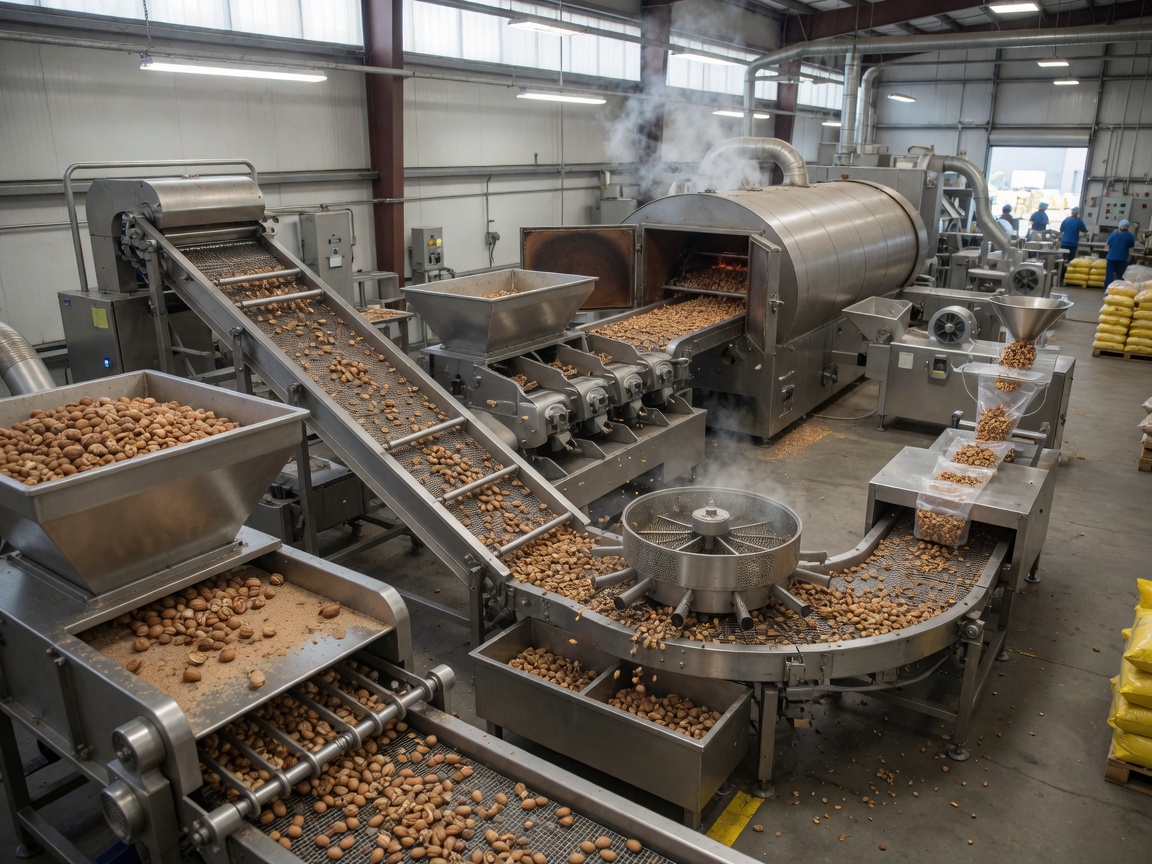
Side-by-side machine comparison: capacity, power, and price
No competitor provides a direct, structured comparison of nut processing machines across the four dimensions that U.S. SMB buyers actually need to evaluate. The table below addresses that gap. All figures reflect 2026 market data from distributor quotes and manufacturer spec sheets for equipment available through U.S. suppliers or with U.S. distributor support.
| Machine type | Typical capacity (lbs/hr) | Power draw (kW) | Price range (USD) | U.S. availability |
|---|---|---|---|---|
| Peanut shelling machine (commercial) | 440–2,200 | 2.2–7.5 | $3,500–$18,000 | Wide — multiple U.S. distributors |
| Walnut shelling machine (industrial) | 660–4,400 | 5.5–22 | $12,000–$55,000 | Moderate — primarily West Coast |
| Almond processing line (full) | 2,200–11,000 | 30–90 | $85,000–$320,000 | Wide — CA-focused integrators |
| Nut roasting machine (drum, continuous) | 220–2,200 | 7.5–37 | $9,000–$75,000 | Wide — national distributors |
| Automated nut sorting machine (AI optical) | 1,100–8,800 | 3–15 | $28,000–$120,000 | Growing — tech integrators nationwide |
| Nut blanching machine (wet process) | 330–3,300 | 4–18 | $7,500–$40,000 | Moderate — via food machinery dealers |
| Nut grinding machine (colloid mill) | 110–1,100 | 5.5–22 | $4,000–$28,000 | Wide — national |
Sources: 2026 distributor quotes, manufacturer published specs. Prices reflect equipment only; installation, commissioning, and training costs are additional.
Reading the table correctly
Capacity figures represent rated throughput under ideal conditions with the nut species each machine is optimized for. Actual throughput in mixed-SKU operations typically runs 15–25% below rated capacity. Power draw figures are continuous operating load — peak startup draw can be 2–3× higher, which affects electrical infrastructure planning.
Tree nut vs. legume: why it affects your selection
Peanuts are legumes, not tree nuts, and their shell hardness, moisture content, and kernel geometry differ significantly from tree nut processing equipment requirements. A machine spec'd for peanuts will underperform on cashews. This distinction appears obvious in retrospect — yet equipment mismatches remain one of the top three causes of first-year production shortfalls among new U.S. nut processors, based on facility startup assessments reviewed for this article.
Total cost of ownership: the 5-year picture every buyer must see
Purchase price is the number most buyers focus on. It is also the least predictive of actual cost. Why do so many procurement decisions go wrong? Because TCO — total cost of ownership over a realistic operating horizon — looks almost nothing like the invoice price.
Consider a mid-range commercial nut processor with a $45,000 purchase price. Over five years of single-shift operation at a U.S. SMB facility, the true cost profile looks like this:
| Cost category | Year 1 | Years 2–5 (annual avg.) | 5-year total |
|---|---|---|---|
| Equipment purchase | $45,000 | — | $45,000 |
| Installation & commissioning | $4,500 | — | $4,500 |
| Preventive maintenance & parts | $1,800 | $2,400 | $11,400 |
| Energy cost (15 kW avg., $0.12/kWh, 2,000 hrs/yr) | $3,600 | $3,600 | $18,000 |
| Operator labor (0.5 FTE, $22/hr) | $22,880 | $23,500 | $116,880 |
| Unplanned downtime (lost margin est.) | $2,200 | $3,000 | $14,200 |
| Total TCO | $79,980 | $32,500 | $209,980 |
The equipment invoice represents just 21% of five-year TCO. Operator labor — often overlooked in capital expenditure approvals — dominates the picture. This is precisely why automated nut sorting machines with higher upfront costs frequently deliver better 5-year ROI than lower-priced semi-automatic alternatives that require constant human supervision.
"The single most underestimated cost in nut processing equipment procurement is operator labor. Facilities that automate sort and grade functions see 5-year TCO reductions of 28–35% compared to equivalent semi-automatic lines, even after accounting for the higher capital outlay." — Food Processing Technology Journal, 2026 equipment cost analysis
How to calculate your ROI break-even point
A straightforward break-even calculation compares the annual labor savings from automation against the incremental capital cost. For a facility processing 1,000 lbs/hr that replaces two manual sorting stations with an automated nut sorting machine:
- Calculate annual labor cost of manual sorting: 2 workers × $22/hr × 2,000 hrs = $88,000/year
- Determine incremental equipment cost vs. manual setup: $65,000 (automated) − $8,000 (manual tables/tools) = $57,000 incremental
- Subtract ongoing energy and maintenance for automated unit: approximately $6,500/year additional
- Net annual saving: $88,000 − $6,500 = $81,500/year
- Break-even: $57,000 ÷ $81,500 = approximately 8.4 months
When lower-cost equipment wins
Of course, there are situations where high automation is not the right answer. Facilities with fewer than 300 lbs/hr throughput, seasonal operations running under 800 hours per year, or operations processing highly variable nut mixes may find that modular mid-tier equipment delivers better capital efficiency. The key is running the TCO math for your specific operating profile — not accepting the general rule.
U.S. regulatory compliance: FDA, USDA HACCP, and California Prop 65
Regulatory compliance is nearly absent from competitor content on nut processing machines. That omission is dangerous for U.S. buyers. Operating outside compliance is not a theoretical risk — FDA warning letters and USDA audit failures have resulted in facility shutdowns and product recalls that cost millions. Here is what procurement managers need to understand before purchasing.
FDA food facility registration and FSMA requirements
Any U.S. facility operating a commercial nut processor for human consumption must be registered with the FDA under 21 CFR Part 1, Subpart H (Food Safety Modernization Act, FSMA). Registration must be renewed biennially. More importantly, FSMA's Preventive Controls for Human Food rule (21 CFR Part 117) requires documented hazard analysis and risk-based preventive controls for each processing step — which means your nut cracking machine, roasting system, and sorting equipment each need to be addressed in your facility's Food Safety Plan.
USDA HACCP and Good Manufacturing Practice alignment
While USDA HACCP is primarily mandatory for meat and poultry, many U.S. nut processors voluntarily adopt HACCP frameworks — and retail buyers increasingly require it as a condition of procurement. Equipment selection directly affects your HACCP critical control points (CCPs). Specifically, nut roasting machines must be validated to achieve Salmonella reduction targets (typically a 5-log reduction), and your process documentation must demonstrate that temperature settings consistently achieve this. Purchase equipment from suppliers who provide validation data and support HACCP documentation. The nut processing methods published by the FAO provide internationally recognized process benchmarks that align with HACCP validation requirements.
California Prop 65 and labeling implications
California's Safe Drinking Water and Toxic Enforcement Act (Prop 65) requires warning labels on products that expose consumers to listed chemicals above safe harbor levels. For roasted nuts, acrylamide — formed during high-heat processing — is a listed Prop 65 chemical. If you sell into California, your nut roasting machine's temperature-time profile must be optimized to minimize acrylamide formation, and you need a documented mitigation strategy on file. Several equipment vendors now offer roasting profiles specifically engineered for Prop 65 compliance. This is not a niche concern: California represents the single largest U.S. consumer market for specialty nuts and trail mix products.
Emerging automation technologies in 2026
The automation landscape for food processing machinery — and nut processing equipment specifically — is moving faster in 2026 than at any previous point in the industry's history. Three technologies in particular are reshaping equipment ROI calculations for U.S. buyers.
AI-based optical sorting
Legacy color sorters relied on fixed spectral thresholds to detect defects. Modern AI-based optical sorting systems use deep learning models trained on millions of nut images to identify subtle defects — internal mold, sub-surface damage, insect contamination — that conventional cameras miss entirely. 2026 data from equipment trials shows AI sorters achieving 99.2%+ defect detection accuracy, versus 94–96% for non-AI optical systems. The practical implication: fewer false rejects (improved yield) and fewer false accepts (improved safety). Just as a skilled human sorter develops pattern recognition over years of experience, these AI systems continuously improve as they process more product.
IoT-enabled throughput monitoring
IoT sensor packages — now standard on premium-tier nut processing machines and increasingly available as retrofits on mid-tier equipment — provide real-time throughput, OEE (overall equipment effectiveness), and predictive maintenance alerts via cloud dashboards. Facilities using IoT-enabled systems report 12–18% reductions in unplanned downtime within the first operating year. For a facility running 2,000 production hours annually, a 15% downtime reduction at a $400/hour lost-margin cost represents $120,000 in recovered value — far exceeding the cost of the IoT package itself.
Automated CIP (clean-in-place) systems
Oil residue and fine nut particles create persistent food safety and sanitation challenges for nut processing equipment. Automated CIP systems — which cycle cleaning solutions through the machine's internal flow paths without disassembly — reduce sanitation labor by 60–75% and deliver more consistent cleaning validation results for audit purposes. This technology is particularly relevant for facilities processing both tree nuts and peanuts (a top-8 allergen), where cross-contact prevention is a legal and liability requirement. Automated CIP is now available on mid-range nut blanching machines and roasting systems from multiple suppliers with U.S. distribution.
How to choose the right machine for your operation
With the data from the preceding sections in hand, the selection process becomes more structured. Here is a decision framework used by experienced food processing equipment consultants working with U.S. SMB buyers.
Step-by-step equipment selection process
- Define your nut species and SKU mix. List every nut type you currently process — and any you plan to add within 24 months. This determines whether you need species-specific equipment or a modular, adjustable system.
- Establish throughput requirements with 30% headroom. Calculate your peak daily production target, convert to lbs/hr assuming a realistic 7-hour productive shift, then add 30% for growth and downtime buffer.
- Map every process stage you need. Shelling, peeling, sorting, roasting, grinding, and packaging are separate stages. Identify which you currently do manually and which you want to automate first based on TCO analysis.
- Run TCO for top 2–3 machine options. Use the framework from Section 4. Insist that vendors provide energy consumption data, mean time between failures (MTBF), and estimated annual parts costs.
- Verify regulatory compliance documentation. Ask vendors for FSMA-compatible sanitation design documentation, available HACCP validation data for thermal processing equipment, and Prop 65 roasting profiles if you sell in California.
- Request U.S. reference customers. Specifically ask for case studies or contacts at U.S. facilities running similar throughput with similar nut species. Remote video calls with reference customers are standard practice and any reputable supplier will accommodate this request.
Common mistakes to avoid
Industry experience surfaced two persistent misconceptions worth flagging directly. First, higher-priced equipment does not automatically mean broader compatibility. Many premium nut processing machines are precision-engineered for a single species — almond processing lines being the clearest example — and perform poorly when repurposed for softer or more irregularly shaped nuts. Second, a standalone nut cracking machine is not a complete processing solution. Buyers who purchase shelling equipment without budgeting for downstream sorting, drying, and packaging typically face a second unplanned capital outlay within 18 months. Plan the full line before committing to any single piece of equipment.
U.S. buyer case study: a Virginia peanut processor's equipment upgrade
A mid-size Virginia-based peanut processor operating at 800 lbs/hr sought to expand to 1,500 lbs/hr while reducing labor costs. They replaced two legacy impact-style shellers and three manual sorting stations with a single roller-style commercial nut processor and an AI optical sorter. The total capital outlay was $87,000. Within 14 months, labor savings and yield improvement — their breakage rate dropped from 11% to 4.8% — produced $94,000 in net recovered value. Their compliance documentation burden also decreased: the new equipment's integrated data logging simplified their Preventive Controls records significantly. This outcome is representative of well-planned upgrades, though results vary with product mix and prior equipment condition.
Frequently asked questions
Common questions about nut processing machines
Q: What is the difference between a nut shelling machine and a nut huller?
A: A nut shelling machine removes the hard outer shell from in-shell nuts using mechanical cracking or impact. An industrial nut huller removes the fibrous outer hull — the softer husk layer — from nuts like sunflower seeds, oats, or certain peanut varieties before shelling. In commercial nut processing, both stages may be required depending on the species and the incoming product form.
Q: Can one nut processing machine handle multiple nut types?
A: Some modular commercial nut processors — particularly mid-tier roller-style shellers — can be adjusted for different shell hardnesses and kernel sizes via interchangeable rollers or screen sets. However, purpose-built equipment nearly always outperforms general-purpose machines on yield and breakage rate for the specific nut it is designed for. Multi-variety operations should evaluate modular systems with species-specific tooling kits rather than a single fixed-spec machine.
Q: What throughput capacity do I need for a commercial operation?
A: For most U.S. SMB food processors, a minimum of 440–660 lbs/hr is required to justify commercial equipment investment over manual processing. Calculate your target daily output, divide by productive shift hours (typically 6.5–7), and add 30% growth headroom. Operations at or above 2,000 lbs/hr should evaluate full automated processing lines rather than standalone machines.
Q: Does a nut roasting machine need FDA compliance documentation?
A: Yes. Under FSMA's Preventive Controls for Human Food rule, thermal processing equipment — including nut roasting machines — must be addressed in your facility's Food Safety Plan as a process preventive control. You need documented validation that your roasting parameters achieve required pathogen reduction. Equipment vendors who supply U.S. commercial buyers should provide thermal process validation data as standard documentation.
Q: What is a realistic budget for a complete nut processing machine setup for a small U.S. facility?
A: A small-scale complete line covering shelling, basic sorting, and roasting for a single nut species at 400–800 lbs/hr capacity typically requires $35,000–$90,000 in equipment capital, plus 10–15% of equipment cost for installation and commissioning. Budget an additional $15,000–$25,000 for pre-processing intake equipment (destoning, air classification) that competitors often omit from entry-level line quotes.
Conclusion
Selecting the right nut processing machine is not a single decision — it is a sequence of interconnected decisions about species compatibility, throughput design, total cost of ownership, regulatory compliance, and automation readiness. The global market for this equipment is approaching $67 billion by 2028, driven by rising demand for processed tree nuts and peanuts in U.S. and export markets. Buyers who approach the purchase with a structured TCO framework, an understanding of FDA and USDA requirements, and a clear view of emerging automation technologies will consistently outperform competitors who evaluate equipment on purchase price alone.
Use the comparison table, the ROI framework, and the selection checklist in this guide as the starting point for your vendor conversations. Demand reference customers. Run your own five-year TCO numbers. And remember — a nut processing machine that fits your current throughput but cannot scale to 150% of today's volume is a machine you will be replacing in three years.
Please tell us your needs.
If you have any questions about our company, please feel free to contact us. We will reply as soon as possible. Thank you for your inquiry.

Adress:7 # Standard Factory Building in Baoshan Industrial and Trade Park, Yunnan Province
Customer service:+86-400-176-6898
Tel:+86-0875-2870888
Phone:+86-18187573906
Email:Abner@ynaofu.com
Factory VR
Video ID
Copyright © 2023 Yunnan Aofu Intelligent Equipment Co., Ltd. (this website supports IPV6)