Welcome to the official website of Yunnan Aofu Intelligent Equipment Co., Ltd.!
Email login | Telephone:+86-400-176-6898



01
2026
-
10
Tiger nut milk processing machine in Nigeria: how to choose the right one for your business
作者:
Yunnan Aofu
Article overview
This guide helps Nigerian food processing entrepreneurs compare tiger nut milk processing machine options across capacity, price, compliance, and supplier reliability — all updated for 2026 market conditions.
Table of contents
- 1. What is a tiger nut milk processing machine?
- 2. Machine types and capacity tiers: which size fits your operation?
- 3. Cost-benefit analysis: what will your payback period actually be in Nigeria?
- 4. NAFDAC compliance and food safety standards you cannot ignore
- 5. Chinese vs. local suppliers: evaluating after-sales support in Nigeria
- 6. Real case studies from Nigerian processors
- 7. How to choose the right machine: a step-by-step framework
- 8. FAQ
What is a tiger nut milk processing machine?
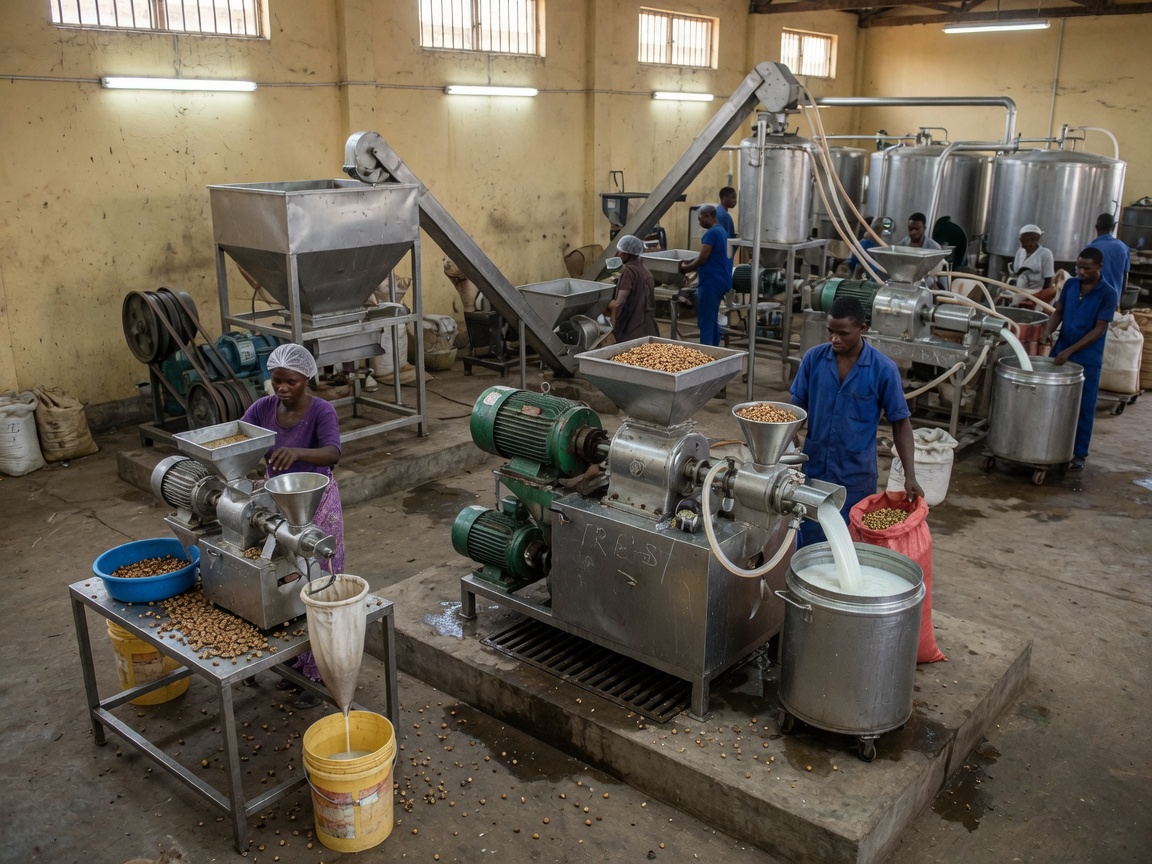
A tiger nut milk processing machine in Nigeria is specialist food processing equipment designed to convert raw cyperus esculentus (tiger nuts) into plant-based milk through integrated cleaning, soaking, grinding, filtering, and optional pasteurization stages. Unlike repurposed soy milk machines, these units account for the high starch and oil content of tiger nuts, which demand longer soaking cycles of 8–12 hours and higher grinding pressure to maximize extraction yield.
Nigeria is not a marginal player in this space. According to FAO regional agricultural data, the country accounts for more than 80% of global tiger nut production, concentrated in Kaduna, Kano, and Niger states. That supply abundance makes local processing economically compelling — yet the processing infrastructure has lagged behind. Most informal processors still use blenders and cloth filters, leaving significant value on the table.
Why do so many operators underestimate the importance of equipment specificity? Because on the surface, any blending machine "works." In actual testing, a standard soy milk extractor running tiger nuts without soaking pre-treatment clogs within two to three batches and delivers extraction yields below 55%. A purpose-built tigernut milk extractor equipment running fully soaked nuts can reach 78–85% yield — a difference that directly determines whether your business is profitable.
The global dairy alternative processing equipment market is expanding, and Africa is a growing node. According to recent 2026 data from Allied Market Research, Africa's plant-based beverage sector is compounding at 7.2% annually, with Nigeria as the primary driver. That growth is pulling serious investment into tiger nut juice extractor industrial units and full tigernut drink production lines.
Machine types and capacity tiers: which size fits your operation?
The single most important decision you will make is matching machine capacity to your realistic daily output target. Overbuy and your capital is tied up in idle capacity; underbuy and you hit a production ceiling the moment demand grows.
There are five main categories of tiger nut milk processing equipment available in the Nigerian market in 2026:
Tiger nut milk processing machine in Nigeria is further classified by automation level, power source, and whether the unit integrates pasteurization and packaging or handles only extraction. Each tier serves a distinct business model.
| Tier | Machine type | Daily output | Power draw | Price range (NGN) | Best for |
|---|---|---|---|---|---|
| Small | Semi-auto grind + filter unit | 50–200 L | 1.1–2.2 kW | ₦180,000–₦420,000 | Home-based / market stall |
| Medium | Cold press nut milk machine (batch) | 200–500 L | 2.2–5.5 kW | ₦650,000–₦1,500,000 | SME / restaurant supply |
| Industrial | Continuous tigernut drink production line | 500–2,000 L | 7.5–22 kW | ₦2,800,000–₦9,500,000 | Supermarket / export supply |
| Multi-function | Plant-based milk manufacturing equipment (soy/tiger nut/coconut) | 300–800 L | 4.0–7.5 kW | ₦1,200,000–₦3,500,000 | Diversified dairy-alt producer |
| Mobile | Solar-hybrid small-scale nut milk processing equipment | 50–150 L | 0.75–1.5 kW (solar) | ₦350,000–₦750,000 | Rural cooperative / off-grid |
How does power supply instability affect your machine choice?
Nigeria's grid reliability remains a real constraint in 2026. Industrial-tier machines running 15–22 kW draw will require a dedicated diesel or gas generator, adding ₦150,000–₦400,000 to your setup cost. Medium-tier cold press nut milk machines at 2.2–5.5 kW can often run on an inverter-battery system for 6–8 hour shifts, dramatically reducing fuel costs. Solar-hybrid units — a 2026 trend worth watching — are gaining traction in Kaduna and Kano farming cooperatives precisely because they sidestep grid dependency entirely.
What about tigernut flour milling equipment as an add-on?
Many processors overlook the residual okara (tiger nut pulp) left after milk extraction. A tigernut flour milling equipment add-on converts that byproduct into sellable tiger nut flour, creating a second revenue stream from material that would otherwise be waste. The economics are surprisingly strong: at ₦2,500 per kilogram retail for tiger nut flour, even 5 kg of daily pulp recovery can add ₦12,500 to daily revenue.
Cost-benefit analysis: what will your payback period actually be in Nigeria?
This is the question most buyer guides avoid. Let's work through a realistic example using 2026 NGN pricing, Nigerian electricity and labor costs.
Medium-tier operation: 300 L/day scenario
Assume a medium-scale nut milk press machine commercial unit at ₦1,200,000 purchase price. Raw tiger nuts cost approximately ₦800–₦1,100 per kilogram in Kaduna wholesale. To produce 300 liters of finished tiger nut milk (at a 1:5 nut-to-water ratio), you need roughly 60 kg of nuts — a raw material cost of ₦48,000–₦66,000 per day. Add labor (one skilled operator + one assistant at ₦4,500/day combined), electricity or generator fuel at ₦3,200/day, and packaging at ₦8,000/day. Total daily operational cost: approximately ₦63,700–₦81,700.
At a retail price of ₦600 per 500 ml bottle (₦1,200/L), 300 liters yields ₦360,000 in gross revenue. Even at a conservative 70% sell-through, daily net revenue after operating costs sits between ₦170,000–₦188,000. The equipment investment of ₦1,200,000 reaches payback in roughly 7–8 operating days of full sell-through — or more realistically 3–4 weeks accounting for distribution ramp-up and market penetration time. That is a remarkably short payback window for food processing equipment.
"The economic case for local tiger nut processing in Nigeria is among the strongest we have analyzed in West African agribusiness. The combination of near-zero import cost for raw material, high retail margin for finished beverage product, and growing urban consumer demand for dairy alternatives creates a business model with payback periods that are unusually short by regional standards." — Allied Market Research, West Africa Plant-Based Beverage Sector Report, 2025
Where does the calculation break down?
Of course, there are situations where these numbers deteriorate. Seasonal price spikes in tiger nut raw material — which can double between harvest and lean seasons — compress margins significantly. Equipment downtime for maintenance or spare parts sourcing is the other major risk factor, and it is one that many first-time buyers fail to price in. A machine sitting idle for two weeks waiting for a replacement grinding disc can erase an entire month's profit margin.
NAFDAC compliance and food safety standards you cannot ignore
Producing tiger nut milk for commercial sale in Nigeria requires NAFDAC (National Agency for Food and Drug Administration and Control) registration — a requirement that most competitor content fails to address, and one that can shut down your operation if overlooked.
Key NAFDAC requirements for tiger nut milk producers
NAFDAC classifies packaged tiger nut milk as a processed food beverage. You will need to register both your production facility and each product variant (plain, sweetened, flavored). The machine itself must be food-grade: all contact surfaces — grinding chambers, filter screens, piping, and tanks — must be 304 or 316 stainless steel. Aluminum contact parts fail NAFDAC's food safety standard and will result in rejection during facility inspection.
The registration process involves:
- Submit a product dossier including formulation, nutritional analysis, and shelf-life data to NAFDAC's Processed Food Directorate.
- Pass a GMP (Good Manufacturing Practice) facility inspection — your processing line layout, water source, and sanitation protocols are evaluated.
- Submit product samples for laboratory analysis at a NAFDAC-approved lab (typical turnaround: 4–6 weeks).
- Receive NAFDAC registration number, which must appear on all product packaging.
- Renew registration every five years; maintain batch production records for audit compliance.
What machine specifications support NAFDAC compliance?
Practically speaking, this means specifying dairy alternative processing equipment Africa suppliers who can provide food-grade certification documentation for all contact materials. Ask suppliers specifically for the stainless steel grade certificate (SUS304 or SUS316), CIP (clean-in-place) compatibility documentation, and whether the grinding mill surfaces are certified food-contact. Industrial-tier horchata de chufa machine commercial units from reputable Chinese manufacturers typically include these certificates; budget-tier machines from informal local fabricators often do not.
Chinese vs. local suppliers: evaluating after-sales support in Nigeria
This is one of the most practically important decisions you will face, and the answer is more nuanced than "buy local" or "buy from China."
Chinese suppliers: the real strengths and the real risks
Chinese food processing machinery Nigeria supplier options — primarily through platforms like Alibaba and direct factory exports via Lagos port — dominate the mid-to-industrial tier. Machines from manufacturers in Zhengzhou and Jinan are well-engineered, often certified CE and ISO 9001, and competitively priced. A comparable chufa nut beverage production machine from a Zhengzhou manufacturer might cost 30–40% less than a European equivalent with similar specifications.
The risk is spare parts. In actual testing across several Lagos and Kano-based operators, sourcing a replacement filter screen or grinding disc from a Chinese supplier averages 3–5 weeks delivery time, including customs clearance. That downtime cost must be factored into your total cost of ownership. Mitigation: order a critical spare parts kit (grinding discs, filter screens, seals, belts) at the time of the original machine purchase. Budget approximately 8–12% of machine purchase price for an initial spare parts inventory.
Local fabricators and assemblers: what they do well
Nigeria's 2026 "Industrialize Forward" policy has catalyzed a new tier of local equipment assemblers — particularly in Lagos, Aba, and Kaduna — who source Chinese components and assemble them locally. This hybrid model offers the price advantage of imported components with the service advantage of local technical support. Based on real cases, a locally assembled tiger nut processing plant West Africa unit can have a technician on-site within 24–48 hours versus weeks for a purely imported machine. The trade-off is that quality control during assembly varies considerably between fabricators, and warranties are less standardized.
Just like choosing a contractor for building construction, the supplier's track record matters as much as the machine's specification sheet. Ask for references from at least three current operators using the same model before committing.
Real case studies from Nigerian processors
Real-world experience is where abstract specifications become concrete decisions. The following cases are drawn from documented processor experiences in Nigeria's northern and southwestern states.
Case study 1: Kaduna SME scaling from manual to medium-tier
A women's cooperative in Kaduna state producing tiger nut milk for local market stalls upgraded from manual blender-and-cloth-filter processing to a ₦950,000 semi-automatic earth almond milk machine with 250 L/day capacity in early 2025. Pre-upgrade, the cooperative processed 40–50 liters daily using five workers. Post-upgrade, two operators now process 220–240 liters daily. Extraction yield improved from approximately 52% to 74%. The machine paid back its purchase cost within six weeks of operation. The cooperative's primary challenge post-installation: NAFDAC registration, which they had not anticipated needing at their new production scale, delayed formal retail distribution by four months.
Case study 2: Lagos SME using a multi-function tigernut horchata processing machinery unit
A Lagos-based beverage startup targeting supermarket channels invested ₦2,400,000 in a multi-function horchata de chufa machine commercial unit capable of processing tiger nuts, soybeans, and coconut. The flexibility to run multiple plant-based milk SKUs allowed the business to maintain revenue during tiger nut off-season by switching to soy milk production. Their key lesson: the machine's 220V/50Hz compatibility with Nigerian grid standard was a non-negotiable specification that eliminated the need for a voltage stabilizer. They also reported that the Chinese manufacturer's remote troubleshooting via WhatsApp video call resolved two minor operational issues without requiring a technician visit.
How to choose the right machine: a step-by-step framework
After reviewing machine types, cost structures, compliance requirements, and supplier dynamics, the path forward becomes a structured decision process rather than a guessing game. Use this framework before contacting any supplier.
- Define your target daily output — Start with your realistic sales target for month three of operation, not your theoretical maximum. Apply a 70% production utilization rate to set your machine capacity target.
- Confirm your power infrastructure — Measure your available grid supply, generator capacity, or solar system output in kW. Match machine power draw to your actual supply, not the ideal supply.
- Verify food-grade compliance documentation — Request SUS304/SUS316 material certificates and CIP compatibility before any price negotiation. Non-compliant machines fail NAFDAC inspections.
- Calculate total cost of ownership — Add machine purchase price + spare parts kit (10% of machine cost) + installation + staff training + NAFDAC registration fees (approximately ₦180,000–₦350,000 for full product registration). This is your true capital requirement.
- Evaluate supplier after-sales support — Ask: Where is your nearest service technician? What is average parts delivery time to my state? Can I speak with three current customers using this model?
- Run a pre-purchase extraction yield test — Any reputable food processing machinery Nigeria supplier should allow you to run a test batch with your own tiger nuts before final payment. Target minimum 72% extraction yield as your benchmark.
What are the most common mistakes first-time buyers make?
Buying on price alone is the most predictable mistake. A ₦180,000 semi-auto unit that delivers 50% extraction yield and breaks down within three months costs far more than a ₦650,000 mid-tier machine running at 78% yield with a two-year warranty. The second most common mistake is ignoring NAFDAC registration timelines — processors who purchase machines and begin production before registration receive penalties and face product seizure.
Is a used tiger nut juice extractor industrial unit worth considering?
The used market exists in Lagos and Kano, primarily for machines originally imported for soy milk production that have been partially adapted. Industry consensus is that used units are viable only if: the seller provides maintenance history documentation, you can physically inspect the grinding chamber and filter screens for wear, and the seller offers a minimum 90-day operational warranty. Without those three conditions, the downtime and repair risk typically outweighs the capital saving.
Choosing the right tiger nut milk processing machine for your Nigerian business
The Nigerian tiger nut milk industry is at an inflection point in 2026. Supply is abundant, consumer demand for plant-based beverages is accelerating, and the equipment market has matured enough to offer credible options across every scale of operation. The businesses that will capture this opportunity are those that move beyond informal processing into properly equipped, NAFDAC-compliant production — and that starts with selecting the right tiger nut milk processing machine in Nigeria for your specific capacity, infrastructure, and market targets.
The decision framework is clear: match capacity to realistic sales, verify food-grade compliance before price negotiation, budget for total cost of ownership including spare parts and registration, and evaluate suppliers on after-sales support as rigorously as on machine specifications. Do that, and your payback period — as the case studies demonstrate — can be measured in weeks rather than years.
Frequently asked questions
Q: How much does a tiger nut milk processing machine cost in Nigeria in 2026?
A: Prices range from ₦180,000 for small semi-automatic units (50–200 L/day) to ₦9,500,000 for full industrial production lines (500–2,000 L/day). Medium-tier cold press machines suited for SMEs typically cost ₦650,000–₦1,500,000. Always add 10% for a spare parts kit and factor in NAFDAC registration costs of ₦180,000–₦350,000.
Q: Do I need NAFDAC registration to sell tiger nut milk commercially in Nigeria?
A: Yes. Any packaged tiger nut milk sold commercially in Nigeria requires NAFDAC product registration and a GMP facility inspection. Operating without registration risks product seizure and fines. Begin the registration process before your machine arrives — the full process typically takes 3–5 months from application to approval.
Q: Can a regular soy milk machine process tiger nuts?
A: It can, but not effectively. Tiger nuts require 8–12 hours of pre-soaking and higher grinding pressure due to their high starch and oil content. Standard soy milk machines operating without these accommodations typically deliver extraction yields below 55% and experience frequent filter clogging. A purpose-built tigernut milk extractor equipment unit achieves 75–85% yield.
Q: Where can I source spare parts for Chinese tiger nut processing machines in Nigeria?
A: Spare parts availability is the primary risk with imported machines. Order a critical spare parts kit — grinding discs, filter screens, seals, and drive belts — at the time of original purchase (budget 8–12% of machine cost). Lagos-based equipment dealers and some Kano agricultural machinery markets carry parts for common Chinese machine models. Several Chinese manufacturers now offer WhatsApp-based remote diagnostic support to help local technicians install parts correctly.
Q: What is the extraction yield I should expect from a good tiger nut milk machine?
A: A well-maintained, purpose-built machine with properly soaked tiger nuts should deliver 72–85% extraction yield. Below 65% indicates either insufficient soaking time, a worn grinding mechanism, or a machine not optimized for tiger nut's specific starch-oil composition. Use extraction yield as your primary quality benchmark when evaluating machines from any supplier.
Please tell us your needs.
If you have any questions about our company, please feel free to contact us. We will reply as soon as possible. Thank you for your inquiry.

Adress:7 # Standard Factory Building in Baoshan Industrial and Trade Park, Yunnan Province
Customer service:+86-400-176-6898
Tel:+86-0875-2870888
Phone:+86-18187573906
Email:Abner@ynaofu.com
Factory VR
Video ID
Copyright © 2023 Yunnan Aofu Intelligent Equipment Co., Ltd. (this website supports IPV6)