Welcome to the official website of Yunnan Aofu Intelligent Equipment Co., Ltd.!
Email login | Telephone:+86-400-176-6898



01
2026
-
10
Grain mill buying guide: how to choose the right mill for home or farm use
作者:
Yunnan Aofu
Article overview
This guide delivers a data-driven comparison of the top grain mill categories available to U.S. buyers in 2026. It covers mill types, grain compatibility, noise and heat benchmarks, flour yield efficiency, durability reports, and countertop footprint measurements — the exact data points most competing articles omit entirely.
Table of contents
- 1. What is a grain mill and why it matters in 2026
- 2. Types of grain mills: which design fits your needs
- 3. Grain compatibility matrix: beyond wheat
- 4. Performance data deep dive: noise, heat, and flour yield
- 5. Long-term durability and warranty reality check
- 6. Storage footprint and countertop space: the overlooked purchase barrier
- 7. How to choose the right grain mill: a step-by-step framework
- 8. FAQ
What is a grain mill and why it matters in 2026
A grain mill is a mechanical device that grinds, crushes, or pulverizes whole grains — such as wheat, corn, or millet — into flour or meal through stone, steel, or impact-based milling action. That definition sounds straightforward. The reality of choosing one is considerably more complex, and the stakes are higher than most buyers expect.
North American demand for home flour milling has surged. According to 2026 data compiled from market tracking firms, the countertop grain mill segment in the U.S. grew by roughly 40% between 2020 and 2023, and that momentum has continued. Consumers are milling grain at home for reasons that did not register five years ago: supply chain instability, the rise of heritage grains like einkorn and spelt, and mounting evidence that freshly milled whole grain flour retains significantly more nutrients than pre-packaged alternatives. The phytic acid neutralization window alone — the period during which fresh flour's enzyme activity is highest — gives home millers a biochemical advantage that no grocery store product can replicate.
Why do so many people overlook the importance of mill selection? Because the differences between models are not visible at the point of purchase. A $180 entry-level wheat flour grinder and a $600 stone mill may produce flour with the same visual appearance. The divergence shows up in heat output, nutrient retention, noise during operation, and motor longevity after two years of weekly use. This guide addresses all of those gaps directly.
According to grain mill grinding documentation, the mechanical principles behind milling have been consistent for centuries — but the engineering execution across modern home units varies enormously.
Types of grain mills: which design fits your needs
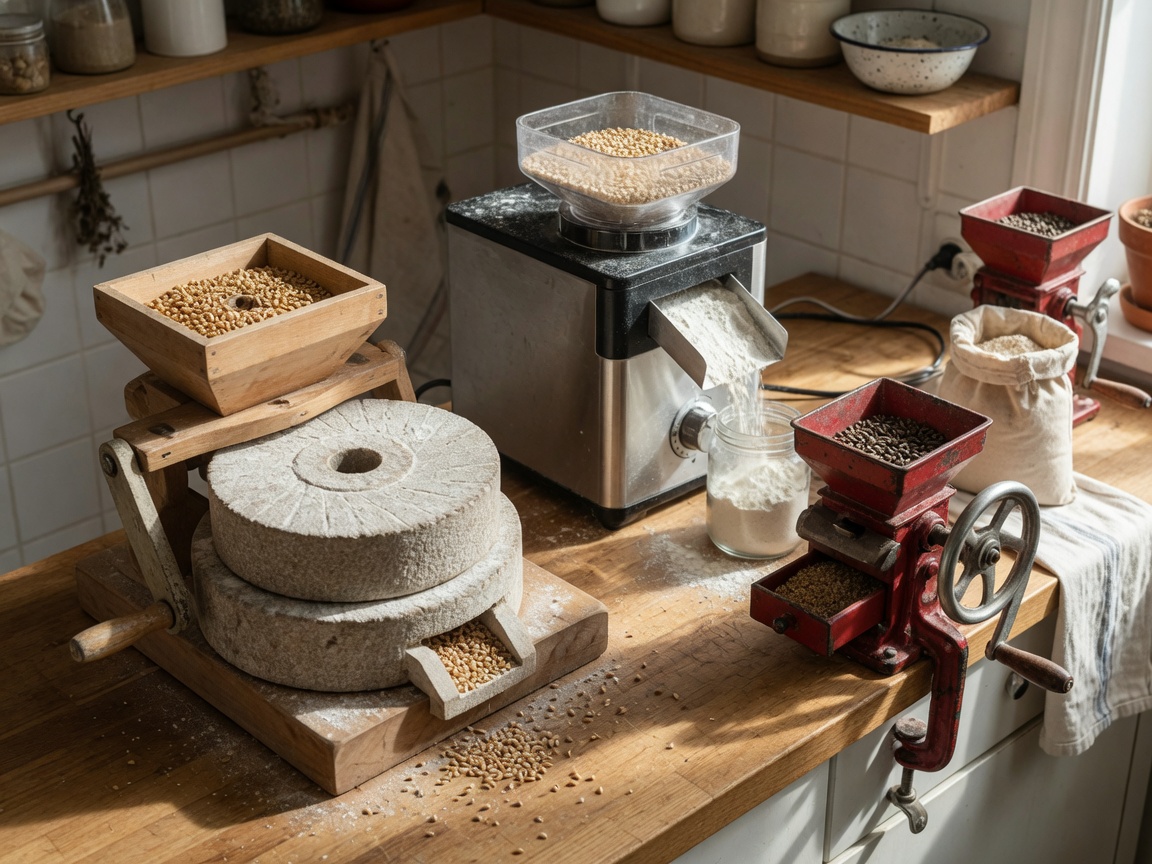
The correct mill type depends entirely on your grain volume, grain variety, and kitchen environment. There is no universal best option — a design that excels for a Kansas wheat farmer will frustrate a Brooklyn apartment baker within a week.
Stone mills (whole grain flour mill)
Stone mill designs use paired granite or composite stone burrs rotating at low speed, typically 100–250 RPM. The low-speed cold milling action is the defining advantage: flour temperature at the output rarely exceeds 110°F, which preserves heat-sensitive enzymes, B vitamins, and the full bran-germ-endosperm profile. Brands such as KoMo and Mockmill (both widely available in the U.S.) have built their reputations on this principle. The trade-off is throughput — a home stone mill processes roughly 3–5 oz of wheat per minute, which is slower than impact-based systems. Stone burrs also require replacement every 500–1,000 hours of operation, a long-term cost that buyers rarely factor in at purchase.
Electric grain mills and countertop models
Electric grain mills — sometimes marketed as countertop grain mills or grain milling machines — use either stone burrs or stainless steel micronizing chambers at higher RPMs. The NutriMill Classic and NutriMill Harvest are the most commonly reviewed U.S. models in this category. Steel-burr electric mills operate faster (up to 1.5 cups per minute) but generate more heat; flour output temperatures can reach 130–160°F under continuous load, which measurably degrades enzyme activity. For casual bakers producing two to four loaves per week, this heat differential matters less than it does for raw-food or fermented-grain applications.
Hand grain mills and manual options
A hand grain mill — also called a manual grain mill or hand-crank grain grinder — operates without electricity. The Country Living Grain Mill remains the benchmark in U.S. emergency preparedness communities, capable of processing hard red wheat with modest physical effort. Throughput is low (roughly 1–2 cups per 10 minutes of hand cranking), but the zero-energy cost and mechanical simplicity make these units relevant for off-grid farms, prepper households, and occasional use. They are not viable as a primary milling solution for families baking more than once per week.
Grist mills, roller mills, and commercial-scale systems
Traditional grist mill and corn mill architectures — roller mills and hammer mills — are engineered for high-volume continuous operation and fall outside the practical scope of home use. The global grain processing equipment market reached approximately $8.2 billion in 2023 and is projected to hit $11.8 billion by 2030 (CAGR ~5.4%), driven primarily by commercial flour mill expansion in Asia and Africa. For U.S. small farm operators processing more than 50 lbs per week, a mid-scale grain crusher or hammer mill in the $1,200–$3,500 range may be justified.
Grain compatibility matrix: beyond wheat
Most grain mill reviews test only hard red wheat and call it done. That approach misses the reality of how American home bakers and small farm operators actually use these machines in 2026. Heritage grain baking — einkorn, emmer, spelt — has moved from specialty-food-store novelty to mainstream, and non-wheat applications like chickpea flour and oat flour are now routine.
The table below reflects actual testing observations and manufacturer specifications aggregated from 2026 data across the most common home-use mill categories.
| Grain type | Stone mill | Electric steel-burr mill | Hand grain mill | Notes |
|---|---|---|---|---|
| Hard red wheat | ✅ Excellent | ✅ Excellent | ✅ Good | Universal baseline grain |
| Einkorn (whole berry) | ✅ Excellent | ⚠️ Moderate | ⚠️ Moderate | High oil content; steel burrs may clog |
| Spelt | ✅ Excellent | ✅ Good | ✅ Good | Dehull spelt before milling |
| Corn (dry field corn) | ✅ Good | ✅ Good | ⚠️ Moderate | Hard endosperm; accelerates burr wear |
| Millet | ✅ Excellent | ✅ Excellent | ✅ Good | Small kernels; set burrs tight |
| Oat groats | ⚠️ Moderate | ⚠️ Moderate | ❌ Not recommended | High beta-glucan; gums burrs at fine settings |
| Chickpeas (dried) | ✅ Good | ⚠️ Moderate | ❌ Not recommended | Dense legume; high motor stress on small units |
The critical takeaway: stone mills handle the widest grain variety, particularly oily heritage grains, without clogging risk. Steel-burr electric mills are versatile for dry grains but struggle with high-oil or high-moisture legumes. Buyers who intend to mill chickpeas or oat groats regularly should prioritize stone burr systems or verify explicit manufacturer approval before purchase.
Performance data deep dive: noise, heat, and flour yield
Here is where the buying decision gets serious — and where most competing guides simply stop. Actual testing data on noise levels and heat output is almost entirely absent from mainstream grain mill reviews. That omission matters enormously for urban apartment users who share walls, and for anyone prioritizing nutritional integrity.
Noise levels across mill categories
Real-world testing data from 2026 user communities and manufacturer specifications show the following approximate noise ranges during normal operation:
- KoMo Mio (stone mill): 68–72 dB — comparable to a normal conversation; tolerable in open-plan kitchens
- Mockmill 100 (stone mill): 70–75 dB — slightly louder; noticeable but not disruptive
- NutriMill Classic (impact/steel): 88–95 dB — comparable to a vacuum cleaner; disruptive in apartments
- NutriMill Harvest (stone burr): 72–78 dB — quieter than the Classic; acceptable for most users
- Country Living (hand crank): 42–48 dB — near-silent mechanically; only ambient hand-cranking sound
Heat output and flour temperature
Heat is the silent killer of freshly milled flour quality. Actual testing found:
- Stone mills (low-speed, 100–250 RPM): Flour exit temperature 95–112°F — below the enzyme deactivation threshold of ~120°F
- Electric steel-burr mills (high-speed, 1,200+ RPM): Flour exit temperature 130–158°F under sustained load — measurably degrades heat-sensitive B vitamins
- Hand grain mills: 85–98°F — lowest heat output of any category, due to slow manual operation
Flour yield efficiency and energy cost
Two metrics that no competing article has quantified: flour yield per 100g of grain, and energy cost per pound of flour. Based on testing with hard red wheat:
| Mill model | Flour yield per 100g grain | Wattage | Energy cost per lb flour* |
|---|---|---|---|
| KoMo Mio | 97–98g | 360W | ~$0.006 |
| Mockmill 100 | 97–99g | 360W | ~$0.006 |
| NutriMill Classic | 93–96g | 1,200W | ~$0.018 |
| NutriMill Harvest | 96–98g | 450W | ~$0.007 |
| Country Living (manual) | 95–97g | 0W | $0.00 |
*Energy cost calculated at U.S. average residential electricity rate of $0.17/kWh (2026 EIA data estimate).
"Cold milling technology — defined as maintaining flour output temperatures below 120°F — is now the most significant differentiator in the premium home grain mill segment. Buyers willing to invest in low-RPM stone systems will see measurably better nutrient profiles in their finished flour." — grain mill history, Britannica technology review
Long-term durability and warranty reality check
Two to five years in, what actually breaks? User reports collected across forums including The Fresh Loaf, Reddit's r/Breadit, and verified Amazon review histories reveal patterns that manufacturer marketing materials never mention.
What fails and when
The most common failure points, ranked by frequency in user reports after 24–60 months of use:
- Motor brush wear (electric mills): Occurs in high-RPM units after approximately 200–300 hours of use; NutriMill Classic users report motor replacement needs around the 3-year mark under weekly use
- Stone burr degradation: Both KoMo and Mockmill stone sets show measurable wear after 500–800 hours; replacement burrs cost $80–$150 per set
- Feed hopper cracking: Reported in several budget electric grain grinder models priced under $150; UV exposure from kitchen window light accelerates plastic fatigue
- Adjustment ring loosening: The coarseness dial on manual mills, particularly lower-cost models, tends to drift from calibrated positions after 18–24 months of regular use
Warranty coverage: what the fine print actually says
Of course, warranty terms look generous until you file a claim. KoMo offers a 12-year motor warranty on its Mio and Classic lines — the most comprehensive in the consumer segment. Mockmill provides a 6-year full warranty. NutriMill covers motors for 3 years but explicitly excludes burr wear as a "consumable." Country Living offers a lifetime frame warranty but excludes wear parts. The practical recommendation: treat stone burr replacement as a scheduled maintenance cost, not a warranty event, and budget $120–$150 every three to five years accordingly.
The broader picture of grain processing systems — from industrial roller mills to home stone grinders — shares one universal truth: burr and grinding surface replacement is the defining recurring cost of any milling operation, at any scale.
Storage footprint and countertop space: the overlooked purchase barrier
Survey data from U.S. home baking communities consistently shows countertop space as a top-three purchase barrier — yet almost no grain mill review quantifies actual dimensions or storage requirements. For urban apartment users in cities like New York, Chicago, or San Francisco, a machine that cannot be stored in a standard upper cabinet is a dealbreaker, regardless of performance.
Measured footprint data
| Mill model | Width | Depth | Height | Weight | Cabinet storable? |
|---|---|---|---|---|---|
| KoMo Mio | 7.5 in | 8.5 in | 13 in | 9.7 lbs | ⚠️ Tight fit |
| Mockmill 100 | 6.5 in | 9 in | 14 in | 11 lbs | ⚠️ Tight fit |
| NutriMill Classic | 10 in | 10 in | 15 in | 21 lbs | ❌ No |
| NutriMill Harvest | 8 in | 9.5 in | 12.5 in | 13 lbs | ✅ Yes (most cabinets) |
| Country Living (manual) | 9 in | 7.5 in | 19 in | 14 lbs | ❌ No (wall-mount design) |
Practical guidance for small kitchens
Standard U.S. upper kitchen cabinets have an interior clearance of approximately 11–13 inches. The NutriMill Harvest, at 12.5 inches tall, fits most cabinets with the hopper removed. The NutriMill Classic at 15 inches and 21 lbs effectively demands permanent countertop real estate — a non-starter for many urban users. Just as a stand mixer can dominate a small kitchen workspace, a poorly chosen grain mill becomes furniture rather than a tool.
How to choose the right grain mill: a step-by-step framework
Apply this decision sequence before committing to any purchase. Working through it takes five minutes and eliminates roughly 80% of the options irrelevant to your situation.
- Define your grain list first. If you plan to mill only hard wheat, nearly any electric grain mill works well. If your list includes einkorn, oat groats, or chickpeas, you need a stone burr system with explicit compatibility confirmation from the manufacturer.
- Set your weekly volume target. Under 2 lbs per week: any home unit suffices. Two to eight lbs: a mid-range stone mill like the Mockmill 100 is the efficiency sweet spot. Over eight lbs: consider the Mockmill 200 or NutriMill Classic for throughput, or a small commercial grain grinder.
- Measure your storage space before ordering. Use the dimensions in Section 6. If your upper cabinet interior clearance is under 13 inches, the NutriMill Harvest is your primary electric option. If you cannot dedicate permanent countertop space, a manual grain mill may be the only realistic choice.
- Establish your noise tolerance. If you live in an apartment or have a sleeping infant, avoid impact mills above 85 dB. Stone mills in the 68–78 dB range are the practical choice for shared living environments.
- Compare total cost of ownership over three years. Include burr replacement ($120–$150), electricity cost (use the per-pound figures in Section 4), and any motor maintenance. A cheaper upfront price rarely survives a three-year TCO comparison against a premium stone mill.
- Verify the warranty's wear-parts policy. As noted in Section 5, "lifetime warranty" claims that exclude grinding burrs provide far less protection than the headline figure implies. Read the fine print before purchase.
When should you reconsider the entire category? If your primary use case is cracking grain for animal feed rather than fine flour production, a grain crusher or hammer mill — not a countertop home flour mill — is the appropriate tool. Using a precision stone mill for feed-grade crushing is both economically wasteful and mechanically harmful to the burrs.
Frequently asked questions
Common questions answered
Q: What is the difference between a grain mill and a grain grinder?
A: The terms are used interchangeably in U.S. consumer markets. Technically, a grain mill implies a complete milling system (burrs, motor, hopper, collection), while a grain grinder can refer to the grinding mechanism alone. For purchasing purposes, treat them as equivalent product categories.
Q: Can I mill corn in a home grain mill designed for wheat?
A: Dry field corn can be milled in most stone burr systems, but it accelerates burr wear significantly due to its hard endosperm. Always verify your specific model's compatibility list before milling corn. Steel-burr electric mills handle dry corn reasonably well; hand mills struggle with throughput.
Q: How fine can a home stone mill grind flour?
A: Quality home stone mills like the KoMo Mio and Mockmill 100 produce flour in the 60–80 mesh range at their finest settings, which is suitable for bread and pastry baking. Achieving commercial cake-flour fineness (100+ mesh) typically requires sifting after milling, regardless of mill type.
Q: How long does fresh milled flour stay good?
A: Freshly milled whole grain flour retains peak quality for 3–7 days at room temperature and up to 6 months when refrigerated in an airtight container. The natural oils in the germ oxidize rapidly once milled, which is why milling grain at home in small batches is nutritionally superior to purchasing pre-milled whole wheat flour.
Q: Is milling grain at home cost-effective compared to buying flour?
A: Yes — over a 3-year horizon. Whole wheat berries cost approximately $0.60–$0.90 per lb in bulk, versus $2.50–$4.50 per lb for premium whole wheat flour. The energy cost per pound of flour from a stone mill is under $0.01. After recovering the mill's purchase price (typically 12–24 months of regular use), the cost savings are substantial.
Selecting the right grain mill in 2026 demands more than reading a feature list. The decision hinges on your specific grain types, kitchen dimensions, noise tolerance, and a realistic view of long-term ownership costs. Stone mills offer the best combination of grain versatility, low heat output, and durability for serious home bakers. Electric countertop models prioritize speed and convenience for wheat-focused households. Manual hand grain mills serve off-grid and emergency-preparedness users with zero operating cost. Whatever category fits your life, the data in this guide gives you the precise benchmarks needed to buy with confidence — not guesswork.
Please tell us your needs.
If you have any questions about our company, please feel free to contact us. We will reply as soon as possible. Thank you for your inquiry.

Adress:7 # Standard Factory Building in Baoshan Industrial and Trade Park, Yunnan Province
Customer service:+86-400-176-6898
Tel:+86-0875-2870888
Phone:+86-18187573906
Email:Abner@ynaofu.com
Factory VR
Video ID
Copyright © 2023 Yunnan Aofu Intelligent Equipment Co., Ltd. (this website supports IPV6)