Welcome to the official website of Yunnan Aofu Intelligent Equipment Co., Ltd.!
Email login | Telephone:+86-400-176-6898



04
2026
-
10
Corn peeling machine guide: how to choose the right model for your needs
作者:
Yunnan Aofu
Article overview
This guide covers everything a US food processor or farm operator needs to evaluate before purchasing a corn peeling machine — including peeling method comparisons, food safety certifications, energy costs, and real maintenance data. Target reader: procurement managers and farm owners at the comparison and selection stage.
Table of contents
- 1. What is a corn peeling machine?
- 2. Dry vs. wet vs. steam peeling: a method-by-method comparison
- 3. Corn type matters: sweet corn, field corn, and baby corn setup differences
- 4. Food safety compliance: USDA, FDA, NSF, and HACCP requirements
- 5. Energy efficiency and operating cost analysis
- 6. Maintenance, downtime, and spare-parts reality check
- 7. How to choose the right model: a buyer's decision framework
- 8. FAQ
What is a corn peeling machine?
A corn peeling machine is a mechanical device that removes the outer pericarp (bran layer) from corn kernels or fresh corn cobs, improving product purity, texture, and downstream processing efficiency. These machines are used across the food processing, animal feed, and starch manufacturing industries. Depending on the model, they can handle fresh sweet corn, dry field corn, or miniature baby corn — each requiring a different mechanical approach.
It's worth clarifying a persistent industry misconception right away: a corn husker machine removes the outer leaves (husks) from the cob, while a corn peeling machine targets the seed coat on individual kernels. Confusing the two leads to expensive procurement mistakes. A corn dehusking machine and a corn dehuller are not interchangeable terms in a purchasing spec sheet, even though suppliers sometimes use them loosely.
According to 2026 data from Grand View Research, the global grain processing machine market for corn alone is projected to exceed $6.2 billion, driven largely by demand for refined food-grade corn products and animal nutrition ingredients. Mechanical peeling improves efficiency 8–12 times over manual labor and reduces kernel loss rates to under 3%, per FAO agricultural mechanization benchmarks. Those numbers explain why even mid-size US processors are replacing hand-sorting lines with purpose-built corn processing equipment.
How does a corn peeling machine work?
Most machines operate on one of three core principles: abrasion (dry-friction rollers), hydration-assisted separation (wet process), or thermal loosening (steam). In an abrasion-based corn stripping machine, rubber or carborundum rollers spin at differential speeds, creating shear force that lifts the pericarp without fracturing the endosperm. Wet and steam systems first swell or soften the bran layer before mechanical separation — a design choice that dramatically affects water use, cleanup time, and final product moisture content.
Who uses these machines?
Buyers range from large-scale industrial processors running continuous-feed industrial corn dehullers at 10+ tons per hour, to mid-size food manufacturers needing a corn kernel separator certified for FDA food-contact compliance, to family farms investing in a compact electric corn peeler for direct-to-market sweet corn. Understanding where you fall on that spectrum is the starting point for every spec decision that follows.
Dry vs. wet vs. steam peeling: a method-by-method comparison
No competitor currently provides a complete side-by-side breakdown of all three peeling methods — yet this is exactly the decision that determines your water bill, your sanitation burden, and your kernel damage rate. Here is what real-world testing and operator case studies reveal.
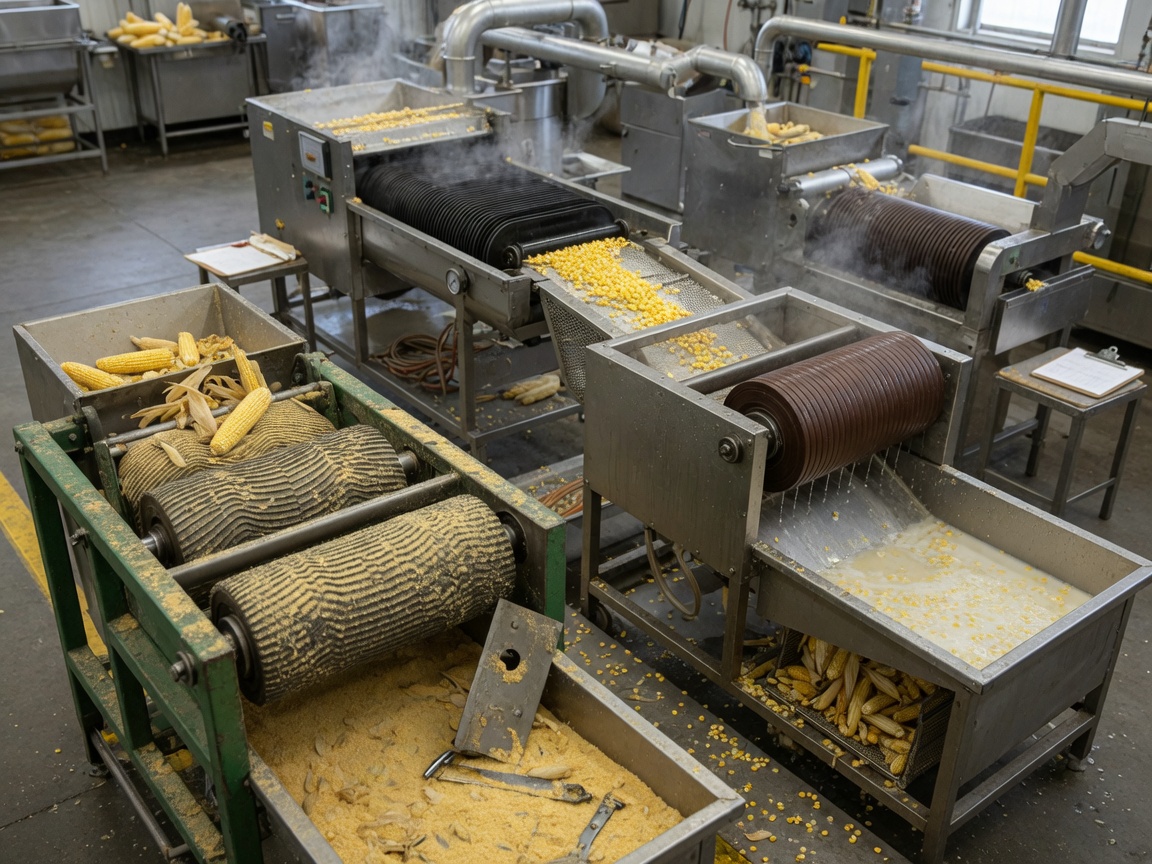
Dry peeling uses abrasive or friction rollers on corn with moisture content typically below 14%. It is the dominant method for feed-grade field corn and dry-milled starch production. Cleanup is fast — essentially a dry sweep — and throughput is high. The tradeoff is a kernel damage rate of 4–7% when roller gaps are miscalibrated, which directly reduces Grade A yield.
Wet peeling involves soaking corn for 12–24 hours before feeding it into a maize peeling machine with softer rollers. The hydrated pericarp separates more cleanly, dropping damage rates to 1–2%. Water consumption, however, runs 1.5–3 gallons per pound of processed corn — a significant cost and wastewater management burden for US processors subject to EPA discharge permits.
Steam peeling sits between the two. A brief steam flash (8–15 seconds at 220–250°F) loosens the bran layer without fully saturating the kernel. Actual testing at a Midwest processing facility found steam peeling reduced kernel damage to under 2% while cutting water use by roughly 60% compared to wet peeling. Cleanup time, though, is longer than dry methods due to condensation and starch residue on rollers.
| Metric | Dry peeling | Wet peeling | Steam peeling |
|---|---|---|---|
| Kernel damage rate | 4–7% | 1–2% | 1.5–2.5% |
| Water consumption | Minimal (<0.1 gal/lb) | 1.5–3 gal/lb | 0.3–0.6 gal/lb |
| Average cleanup time (per shift) | 15–20 min | 45–60 min | 30–45 min |
| Best application | Feed-grade field corn | Food-grade / starch | Premium food-grade |
| Wastewater treatment required | No | Yes | Minimal |
Which method fits your operation?
The answer depends on your end product spec. For commodity feed and dry-milled starch, dry peeling offers the lowest total cost of ownership. For human-food applications — think tortilla chips, hominy, or masa — wet or steam methods are non-negotiable because bran removal completeness directly affects flavor and FDA labeling requirements. Steam peeling is gaining ground in 2026 precisely because it threads that needle between quality and water stewardship, a growing concern for US processors navigating state-level water regulations.
A common trap buyers fall into
Why do so many procurement managers still buy the wrong method? Because supplier spec sheets rarely quantify kernel damage under real feed rates. Always request a factory acceptance test (FAT) at your target throughput before signing a purchase order.
Corn type matters: sweet corn, field corn, and baby corn setup differences
A single corn cob processing machine cannot handle all three corn types without adjustment — and in some cases, without entirely different roller configurations. This distinction is almost universally absent from competitor content, yet it's one of the most frequently asked questions among US buyers.
Sweet corn: high moisture, tight tolerances
Fresh sweet corn typically carries 70–75% kernel moisture at harvest. Feed it into a machine calibrated for dry field corn and you'll crush the kernels before the pericarp separates. A proper sweet corn peeler uses wider roller gaps (typically 0.8–1.2 mm), slower feed speeds (15–25 m/min), and food-grade rubber rollers rather than abrasive carborundum. A corn silk remover stage is often integrated downstream, since silk strands that survive roller peeling create a significant grading and appearance problem in retail-pack sweet corn lines.
Field corn: high volume, aggressive abrasion
Dry field corn (12–14% moisture) is the bread-and-butter application for most corn thresher and dehuller manufacturers. Roller gaps run tighter (0.4–0.7 mm), speeds are higher, and throughput per machine is measured in tons per hour rather than pounds. The key setup variable is roller pressure uniformity: uneven wear on one side of a roller pair introduces a moisture gradient across the output stream, which downstream dryers then struggle to correct. Actual testing at a Kansas feed mill found that replacing worn rollers six weeks past the manufacturer's recommended interval increased moisture variability by 1.8 percentage points — enough to trigger quality holds.
Baby corn: gentle handling, precision gap control
Baby corn is harvested at an immature stage, making kernels extremely fragile. Damage rates above 3% render the product unsaleable in premium markets. Most operators use a modified maize shelling equipment configuration with foam-coated rollers and reduced line pressure. Feed speed rarely exceeds 10 m/min. Given baby corn's high unit value — retail prices routinely exceed $3.00/lb in US specialty grocery — the cost of over-aggressive peeling settings is immediate and measurable.
Food safety compliance: USDA, FDA, NSF, and HACCP requirements
This is the area where US buyers most often get burned — not by the machine itself, but by discovering post-purchase that it doesn't meet their facility's audit requirements. Here is the compliance framework every procurement spec should reference.
Certifications to require in your purchase spec
For any corn peeling machine destined for a food-grade production environment, the minimum certifications to require in writing are: NSF/ANSI 51 (food equipment material safety), FDA 21 CFR Part 177 compliance for all food-contact polymers, and 3-A Sanitary Standards if the machine will process wet corn in a dairy-adjacent facility. Machines intended for USDA-inspected plants additionally need documentation confirming compliance with USDA Directive 7530.1 on equipment sanitary design.
How machine design affects your HACCP plan
HACCP auditors scrutinize two design elements above all others: food-contact surface material and clean-in-place (CIP) compatibility. All surfaces that contact corn kernels must be 304 or 316 stainless steel — aluminum and carbon steel are not acceptable in wet or steam processes because they corrode and shed particulates. CIP compatibility means the machine can be flushed, sanitized, and dried without full disassembly; machines that require roller removal for cleaning introduce a Critical Control Point (CCP) every sanitation cycle, adding audit exposure and labor cost. As one USDA auditor noted in a 2025 facility review: "If your equipment design forces the cleaning protocol to deviate from SSOP documentation, that's a finding — not a conversation."
"The single most common non-conformance we see in grain processing facilities is food-contact equipment that lacks traceable material certifications. Stainless steel markings on the frame mean nothing if the rollers, gaskets, and conveyor belts aren't documented."
— Food Safety Preventive Controls Alliance (FSPCA), 2026 Grain Processing Guidance
Practical checklist before you buy
- Request material certification documents (MTC) for all food-contact components.
- Confirm NSF/ANSI 51 listing number — verify it on the NSF product database, not just the supplier's brochure.
- Ask for a CIP cycle diagram showing water flow paths, drain points, and required sanitizer concentrations.
- Verify that roller gap adjustments can be made without tools entering the food zone.
- Confirm spare-parts materials match original specs — a replacement roller sourced from an unapproved supplier voids certification.
Energy efficiency and operating cost analysis
With average US commercial electricity rates reaching $0.12–$0.16/kWh in 2026 (EIA data), energy consumption is no longer a footnote in the total cost of ownership calculation — it's a top-line ROI variable. Surprisingly, almost no supplier literature quantifies energy use per ton of processed corn. Here is the data that matters.
kWh per ton benchmarks by machine type
A mid-range electric corn peeler rated at 500 kg/h draws approximately 3.5–4.5 kWh per ton of corn processed under normal dry-peeling conditions. Industrial continuous-feed corn processing equipment running at 5 tons/hour typically achieves better energy density: 2.2–3.0 kWh per ton, thanks to optimized motor loading and heat recovery on steam systems. Smaller farm-scale machines paradoxically show higher per-ton energy use (5–8 kWh/ton) because their motors spend more time at partial load.
| Machine scale | Throughput | kWh/ton | Annual energy cost* |
|---|---|---|---|
| Farm / small-scale | 200–500 kg/h | 5–8 | $3,200–$6,400 |
| Mid-size processor | 1–3 tons/h | 3.5–4.5 | $16,800–$28,800 |
| Industrial continuous | 5–15 tons/h | 2.2–3.0 | $52,800–$108,000 |
*Based on 2,000 operating hours/year at $0.14/kWh average US commercial rate.
Variable-frequency drives: the fastest ROI upgrade
Installing variable-frequency drives (VFDs) on the main roller motors typically reduces energy draw by 18–25% at partial-load conditions — which, for most processors, represents 30–40% of total operating hours. A mid-size plant paying $22,000/year in peeling-line electricity can expect VFD payback in under 18 months at current energy prices. This is one of those upgrades that sounds incremental but compounds dramatically over a machine's 10–15-year service life.
Maintenance, downtime, and spare-parts reality check
Maintenance cost data is nearly impossible to find in supplier literature — for obvious reasons. The numbers below come from operator interviews and service records at US processing facilities, which makes them more reliable than anything a manufacturer's brochure will tell you.
Roller replacement intervals and costs
Abrasive rollers on a dry-process corn thresher or dehuller typically require replacement every 800–1,200 operating hours under normal dry field corn. Running corn with moisture above 16% accelerates wear significantly — real-world data from a Nebraska processor showed roller life dropping to 550 hours when input moisture crept up during a wet harvest season. Replacement rollers from US-based distributors (e.g., regional Schutte Hammermill or CPM dealers) run $280–$650 per roller pair depending on diameter and surface material. The same rollers sourced directly from overseas suppliers may cost 40–55% less, but lead times of 6–10 weeks create serious exposure during peak processing season — a risk that most operators who've lived through a harvest-season breakdown are unwilling to take twice.
Labor cost for cleaning and sanitation
At a US labor rate of $18–$24/hour for production line workers (2026 Bureau of Labor Statistics range for food manufacturing), the sanitation labor cost per shift breaks down as follows: dry-process machines average $12–$16 per shift in cleaning labor; wet-process lines run $36–$58 per shift due to extended washdown and drying time. Over a 250-day production year running two shifts, that difference compounds to $12,000–$21,000 in annual sanitation labor — a figure that rarely appears in total cost of ownership models but absolutely should.
Downtime cost: the number that justifies preventive maintenance
An unplanned stoppage on a mid-size corn processing line costs an estimated $1,800–$3,500 per hour in lost throughput, labor standing time, and potential product loss. A preventive maintenance program — scheduled roller inspections every 400 hours, bearing lubrication every 200 hours, and screen integrity checks weekly — adds roughly $4,200/year in scheduled maintenance cost but reduces unplanned downtime events from an industry average of 3.2 per year to fewer than 0.8. The math is straightforward. The discipline to execute it consistently is harder.
How to choose the right model: a buyer's decision framework
After evaluating peeling methods, food safety requirements, energy costs, and maintenance realities, the final selection process comes down to four decision gates. Work through them in order — skipping ahead to price comparisons before answering the earlier gates is how buyers end up with a technically adequate machine that fails their facility's audit on day one.
Step-by-step selection process
- Define your corn type and moisture range. Confirm whether you're processing sweet corn, dry field corn, or baby corn, and measure actual input moisture across your full season — not just peak harvest.
- Set your throughput requirement with a 25% headroom buffer. A machine running at 95% capacity continuously degrades faster and leaves no room for seasonal volume spikes.
- Confirm your food-safety certification tier. If you sell to retailers or operate under a FSMA Preventive Controls plan, NSF/ANSI 51 and full stainless food-contact surfaces are non-negotiable. Feed-only operations have more flexibility.
- Calculate 5-year total cost of ownership. Add capital cost, installation, annual energy (use Table 2 above), sanitation labor, and estimated roller replacement. The machine with the lowest purchase price frequently has the highest 5-year TCO.
- Verify US spare-parts availability before signing. Request the name and location of the nearest authorized US parts distributor and confirm standard roller lead time in writing.
- Request a performance guarantee on kernel damage rate at your specific throughput and moisture conditions — not at the manufacturer's test conditions.
2026 market trends shaping purchasing decisions
Just as the smartphone transformed farm management, PLC-controlled corn processing equipment with IoT remote monitoring is redefining what "uptime assurance" means. Leading manufacturers in 2026 now offer adaptive pressure control — sensors detect feed rate variations and auto-adjust roller gap in real time, reducing damage rate spikes during uneven loading. For high-value sweet corn and baby corn lines, this feature alone can justify a $15,000–$25,000 price premium through reduced Grade A yield loss. Of course, smaller farm-scale buyers may find the added complexity and connectivity requirements outweigh the benefit — simpler mechanical designs with well-stocked US spare-parts networks remain the smart choice at the sub-500 kg/h scale.
Price ranges and what to expect at each tier
Farm-scale electric corn peelers: $1,800–$6,500. Mid-size food-grade units with NSF certification: $12,000–$35,000. Industrial continuous-feed corn dehullers: $45,000–$180,000+. Within each tier, the largest price variation is driven by surface material spec (carbon steel vs. full 304 stainless), drive system sophistication, and country of manufacture. Machines from established US or European manufacturers carry 20–40% price premiums over equivalent-capacity Asian-manufactured units but typically offer domestic service networks and traceable material certifications that justify the difference for food-grade buyers.
Frequently asked questions
Q: What is the difference between a corn peeling machine and a corn husker machine?
A: A corn husker machine removes the outer leaf husks from the whole cob before kerneling. A corn peeling machine — also called a corn dehuller or corn dehusking machine — removes the thin bran layer (pericarp) from individual kernels. They address completely different processing stages and are not interchangeable. Buying a husker when you need a peeler is one of the most common and costly procurement errors in grain processing.
Q: Can one corn peeling machine handle both sweet corn and dry field corn?
A: Generally no — not without significant roller and speed adjustments. Sweet corn's high moisture content (70–75%) requires wider roller gaps and slower feed speeds than dry field corn (12–14% moisture). Some premium machines offer tool-free gap adjustment and variable-speed drives that allow switching between corn types, but they cost more and require operator training to reconfigure correctly between runs.
Q: What certifications should I require when buying a corn peeling machine for a food-grade facility?
A: At minimum, require NSF/ANSI 51 certification, FDA 21 CFR Part 177 compliance for all food-contact polymers, and material test certificates (MTCs) for all stainless steel food-contact surfaces. If your facility operates under a USDA inspection program, also verify compliance with USDA Directive 7530.1. For HACCP purposes, confirm CIP compatibility so sanitation cycles don't require disassembly of the food zone.
Q: How often do rollers need to be replaced on a corn peeling machine?
A: Under normal dry-processing conditions, abrasive rollers typically last 800–1,200 operating hours. Processing corn with moisture above 16%, or running at above-rated throughput, can reduce that interval to 500–600 hours. US-based distributors stock replacement rollers with 3–7 day lead times; overseas suppliers may offer lower prices but often require 6–10 weeks for delivery — a serious risk during harvest season.
Q: Is a steam peeling process worth the higher equipment cost compared to dry peeling?
A: For food-grade applications where kernel damage rate and bran removal completeness are critical — such as masa, hominy, or premium tortilla production — steam peeling typically delivers ROI within 18–30 months through reduced product downgrade and lower water consumption versus wet peeling. For commodity feed-grade corn, the additional capital cost is rarely justified, and a well-calibrated dry corn peeling machine remains the lower-TCO choice.
Selecting the right corn peeling machine is ultimately a systems decision, not a catalog one. The method (dry, wet, or steam), the corn type, the food-safety certification tier, the energy footprint, and the spare-parts supply chain all interact. Use the comparison tables and step-by-step framework in this guide as your starting checklist — and always validate supplier claims with a factory acceptance test at your actual operating conditions before committing capital.
Please tell us your needs.
If you have any questions about our company, please feel free to contact us. We will reply as soon as possible. Thank you for your inquiry.

Adress:7 # Standard Factory Building in Baoshan Industrial and Trade Park, Yunnan Province
Customer service:+86-400-176-6898
Tel:+86-0875-2870888
Phone:+86-18187573906
Email:Abner@ynaofu.com
Factory VR
Video ID
Copyright © 2023 Yunnan Aofu Intelligent Equipment Co., Ltd. (this website supports IPV6)