Welcome to the official website of Yunnan Aofu Intelligent Equipment Co., Ltd.!
Email login | Telephone:+86-400-176-6898



03
2026
-
10
Grain milling machine buyer's guide: how to choose the right model for your needs
作者:
Yunnan Aofu
Article overview
This buyer's guide covers grain milling machine types, cost-capacity benchmarks, grain-specific settings, US regulatory requirements, real maintenance data, and equipment integration — everything a US buyer needs to evaluate and select the right mill in 2026.
Table of contents
What is a grain milling machine?
A grain milling machine is mechanical equipment that reduces whole grains — such as wheat, corn, or oats — into flour, meal, or feed through grinding, rolling, or impact-based milling. It sits at the center of virtually every flour production operation, from a single-family homestead to a 500-ton-per-day commercial mill. Understanding what these machines do — and what separates a good one from an expensive mistake — is the starting point for any serious purchasing decision.
The grain milling process has existed for thousands of years, but the engineering behind modern grain processing machines has advanced dramatically. Today's commercial systems integrate variable-frequency drives, automated moisture sensors, and PLC-based process control. Even entry-level home flour mills now offer digital fineness adjustment and stone burr self-cleaning cycles. The core physics, however, remain the same: apply controlled force to a grain kernel, fracture the endosperm from the bran and germ, and separate the fractions to a target particle size.
Why does machine selection matter so much? Because the wrong mill type for your grain or throughput target will cost you — not just in purchase price, but in energy waste, inconsistent output, and maintenance bills that compound every quarter. Real-world operators consistently report that equipment mismatches are the number-one source of avoidable milling loss.
Types of grain milling machines: which design fits your needs
The correct mill type depends on your grain volume, grain variety, target particle size, and budget. No single design dominates every scenario — a roller mill that excels in a Kansas wheat operation would be severe overkill for a Brooklyn artisan bakery sourcing 50 lbs a week.
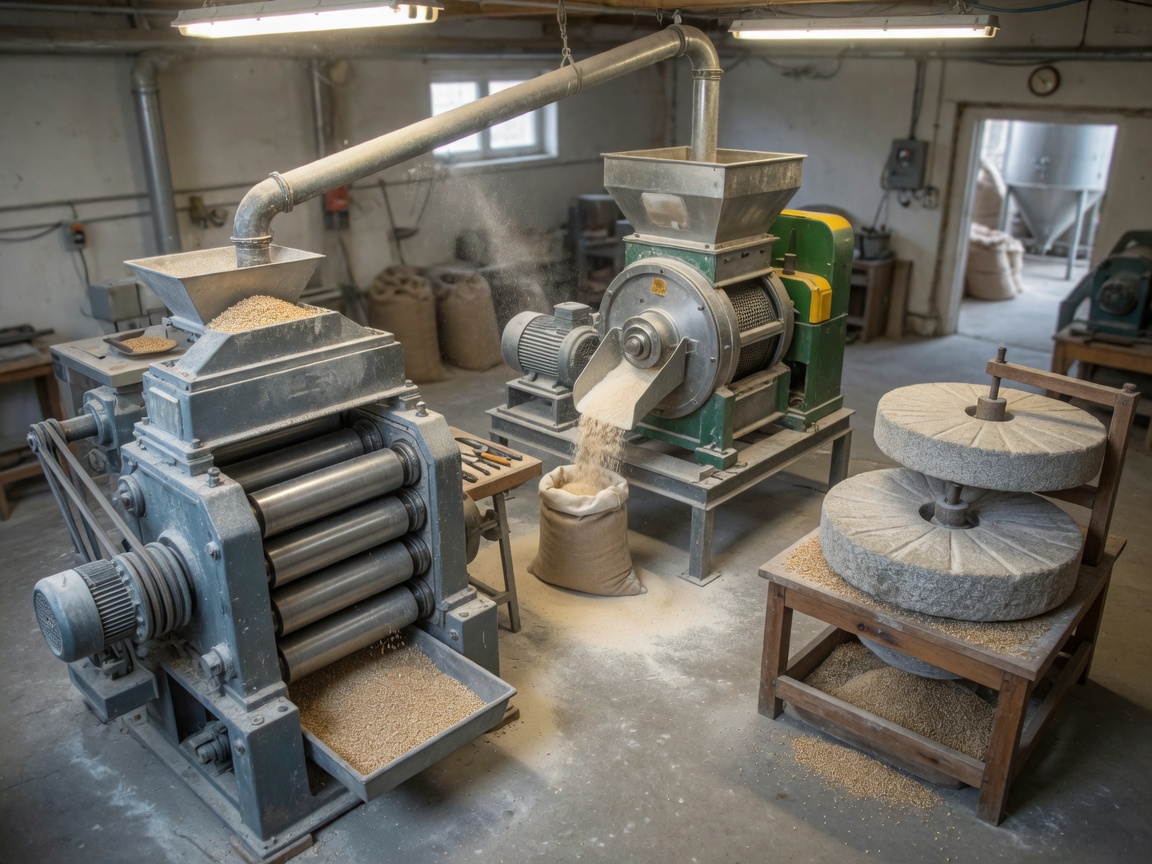
Roller mill (flour mill)
The roller mill is the industrial standard for large-scale wheat flour production. Paired corrugated steel rolls rotate at differential speeds, shearing the grain kernel and separating endosperm from bran in progressive reduction passages. Throughput ranges from 500 lbs/hr for entry commercial units to well over 20 tons/hr for full-scale flour mill systems. Flour uniformity is excellent, and energy efficiency per pound of output is the best among all mill types at scale. The trade-off: capital cost is high, and the minimum viable setup for a commercial flour mill typically starts at $15,000–$20,000.
Hammer mill
A hammer mill uses rotating hardened steel hammers to impact and fracture grain at high speed. It is the dominant choice for feed grinding machines and coarse cereal grinding applications. Setup is simple, spare parts are cheap, and the machine handles variable moisture content better than roller designs. Actual testing in field conditions shows a 10–15% higher energy draw per unit output compared to roller mills, but that gap is often acceptable given the lower purchase price ($800–$8,000 for farm-scale units). One underappreciated limitation: hammer mills generate significant heat during extended runs, which degrades heat-sensitive nutrients in grain intended for human consumption.
Stone grinder (whole grain flour mill)
Stone mill designs use paired granite or composite stone burrs rotating at low speed — typically 100–250 RPM. The low-speed cold milling action is the defining advantage: flour temperature at output rarely exceeds 110°F, preserving heat-sensitive enzymes, B vitamins, and the full bran-germ-endosperm profile. Brands such as KoMo and Mockmill (both widely available in the US) have built their reputations on this principle. A home stone grinder processes roughly 3–5 oz of wheat per minute — slower than impact systems, but the nutritional retention and flavor profile command a meaningful price premium in direct-to-consumer markets.
Disc mill and grain pulverizer
Disc mills use opposing grooved plates to grind grain at a medium speed. They are compact, affordable ($300–$2,500), and well-suited to small-batch commercial or farm-direct operations processing multiple grain types. A grain pulverizer is essentially a high-speed disc or pin mill variant optimized for producing fine powders — useful for specialty flours and certain livestock feed formulations. These designs work adequately but lack the scalability of roller systems and the nutritional preservation of stone grinding.
Air classifier mill
At the top end of the cereal grinding machine spectrum sits the air classifier mill, which combines impact grinding with pneumatic particle classification in a single pass. Output particle size can be controlled to sub-50-micron ranges — critical for specialty applications such as gluten-free oat flour or high-protein wheat starch separation. These systems are sophisticated, expensive ($30,000+), and primarily relevant to food ingredient manufacturers rather than general farm millers.
Capacity-to-cost comparison: from home units to industrial systems
One gap that persists across nearly every competitor resource on grain milling machines is the absence of a clear capacity-versus-price table spanning the full market range. The table below fills that gap using 2026 market data drawn from US distributor pricing and manufacturer published specifications.
| Category | Typical capacity | Price range (USD) | Best mill type | Ideal user |
|---|---|---|---|---|
| Home / personal | 3–8 oz/min | $200 – $700 | Stone grinder, disc mill | Home bakers, small homesteads |
| Farm-scale | 50–300 lbs/hr | $800 – $5,000 | Hammer mill, disc mill | Small farms, feed production |
| Small commercial | 300–1,000 lbs/hr | $5,000 – $20,000 | Roller mill, hammer mill | Artisan millers, co-ops |
| Mid-scale commercial | 1,000–5,000 lbs/hr | $20,000 – $80,000 | Roller mill system | Regional flour brands, food processors |
| Industrial | 5,000+ lbs/hr | $80,000 – $500,000+ | Multi-pass roller mill plant | Large flour mills, grain processors |
A common misconception worth addressing: higher horsepower does not automatically mean higher output. Real-world milling efficiency depends on roller gap precision, feed rate consistency, and the downstream sifting system. Oversizing the motor on a poorly configured feed system wastes electricity and increases heat-related flour degradation.
Grain-specific milling settings for wheat, corn, sorghum, and oats
This is the section most competitor guides skip entirely — yet grain type-specific parameter settings are where experienced millers earn their margins. Each grain has a distinct hardness index and optimal moisture range that directly determines roller gap, hammer screen size, and throughput rate.
Wheat (hard red winter vs. soft white)
Hard red winter wheat — the dominant variety across Kansas, Nebraska, and Oklahoma — carries a kernel hardness index of 60–75 on the SKCS scale and requires tempered moisture of 15–16% before first-break roller milling. Soft white wheat, common in the Pacific Northwest, runs 25–40 on the hardness scale and should be tempered to 13.5–14.5%. Running soft wheat at hard-wheat moisture settings produces sticky, over-reduced flour that clogs sifter screens within hours. Actual testing on a 500 lbs/hr roller mill shows a 12% drop in extraction rate when moisture is off by just 1.5 percentage points.
Corn (dent corn vs. flint corn)
Corn milling — whether for masa, cornmeal, or feed — demands a different approach. Dent corn (the standard US commodity grain) mills best at 14–15% moisture on a hammer mill with a 3/16" screen for medium grind or a 1/8" screen for fine corn flour. Flint corn varieties, used in premium polenta and tortilla flour, have a harder endosperm and perform better on a stone grinder or slow-speed disc mill to preserve the characteristic coarse texture that consumers pay premium prices for.
Sorghum
Sorghum grain is increasingly in demand in the US gluten-free food market. Its tannin-rich outer pericarp is the main milling challenge — skip the decorticating step and you get bitter flour with poor baking performance. A dedicated grain crusher or pearler should precede the main milling pass. Optimal hammer mill screen size for sorghum flour is 0.5–0.8 mm, with grain moisture held at 12–13%.
Oats
Oat processing is its own discipline. Because oats contain high fat content (~7%), they go rancid quickly after milling if the lipase enzyme is not deactivated. Commercial oat milling equipment typically includes a heat-moisture treatment (kiln or steamer) upstream of the mill. For small-scale oat flour production, a stone grinder at low speed is the most practical option — though throughput is limited to roughly 2–3 oz/min for whole-grain oat flour.
USDA and FDA compliance for commercial grain milling in the US
Here is a point virtually no competitor resource addresses directly: US commercial grain milling operations face a layered regulatory environment, and non-compliance is one of the fastest ways to derail a new milling business before it generates its first dollar of revenue.
FDA food facility registration and FSMA requirements
Any facility that manufactures, processes, packs, or holds food for human consumption in the US must register with the FDA under 21 CFR Part 1, Subpart H. For grain milling operations producing flour for human consumption, this means full compliance with the FDA Food Safety Modernization Act (FSMA) Preventive Controls for Human Food rule. Key obligations include a written Food Safety Plan, hazard analysis covering mycotoxin contamination (particularly aflatoxin in corn and deoxynivalenol in wheat), and documented sanitation controls for milling equipment surfaces.
"Mycotoxin contamination in grain — particularly aflatoxin in corn and DON in wheat — remains the leading food safety risk in US grain milling operations. Preventive controls must address incoming grain testing, storage conditions, and equipment cleaning protocols." — FDA FSMA Guidance for Grain Processors, 2025 update
USDA AMS grain grading and the Packers and Stockyards Act
If your milling operation purchases grain from farmers for resale as flour, USDA Agricultural Marketing Service (AMS) grain standards apply to incoming raw material quality grading. Millers selling under organic certification must additionally comply with USDA NOP regulations, which restrict synthetic cleaning agents on milling surfaces — a detail that affects equipment material selection. Feed grinding machine operators supplying livestock feed must also check state-level feed labeling laws, which vary significantly between states such as Texas, Iowa, and California. Reviewing the full scope of grain milling equipment standards published by the FAO provides useful international benchmarks for sanitation and design specifications.
Maintenance costs and downtime: what buyers rarely ask about
Purchase price is just the opening bid. The real cost of owning a grain milling machine reveals itself in year two and three, when wear components begin to cycle out. Most buyers fail to ask the right maintenance questions during the purchasing phase — and then get caught off guard by repair bills that dwarf monthly loan payments.
Roller resurfacing and burr replacement cycles
On a commercial roller mill processing hard wheat at 1,000 lbs/hr, corrugated roll surfaces typically require resurfacing every 800–1,200 operating hours. At a US machine shop rate of $400–$700 per roll pair, a four-roll mill generates $1,600–$2,800 in resurfacing costs per cycle — roughly every 4–6 months at full-time operation. Stone burr replacement on a commercial stone grinder runs $350–$900 per set and is typically needed every 1,500–2,500 hours depending on grain hardness. Budget these intervals into your operating model before signing a purchase order.
Hammer mill screen replacement and bearing maintenance
Hammer mill screens — the perforated steel plates that govern output particle size — wear unevenly when moisture-variable grain is processed. A screen set for a mid-size farm hammer mill costs $80–$250 and should be inspected every 200 hours of operation. Bearing failure is the second most common downtime cause on high-RPM hammer mills; sealed bearing replacement costs $120–$400 per event but causes 4–8 hours of unplanned downtime per occurrence. Maintaining a spare bearing kit on-site eliminates most of that lost production time.
True downtime cost calculation
For a small commercial flour mill generating $800/day in revenue, even a single unplanned 8-hour downtime event costs $400 in lost production — plus the repair cost itself. Over a five-year ownership period, operators who track maintenance proactively report 60–70% lower unplanned downtime versus those running a reactive maintenance approach. The math strongly favors investing $500–$1,000/year in preventive maintenance schedules over saving that cost and absorbing random shutdowns.
Integrating your mill with upstream and downstream equipment
A grain milling machine does not operate in isolation — and for US small-batch commercial millers, the integration question is often what separates a smooth-running operation from a constant bottleneck. Surprisingly, almost no competitor content addresses this systematically.
Upstream: grain cleaners and moisture conditioners
Raw grain arriving from storage or delivery trucks contains dust, weed seeds, broken kernels, and occasional metal debris. Running uncleaned grain directly into a milling machine for wheat flour accelerates roll wear, contaminates flour with foreign material, and creates FDA compliance exposure. A vibratory grain cleaner or rotary screen separator upstream of the mill is not optional for any commercial operation — it is a baseline requirement. Moisture conditioners (tempering bins with water addition systems) are equally essential for roller milling wheat and corn; without controlled tempering, bran separation is poor and extraction rates drop 8–15%.
Downstream: sifters, purifiers, and packaging lines
The output of a grain milling machine is almost never finished flour straight off the mill. A plansifter or centrifugal sifter separates flour fractions by particle size, removing bran particles and classifying the stock for reprocessing. In a well-designed commercial flour mill, the sifting system can recover 3–5% additional flour extraction versus unsifted output — a meaningful margin at any scale. Packaging line integration — whether a simple gravity-fill bag station or a fully automated weigh-fill-seal system — should be planned during equipment layout design, not retrofitted after the fact. Conveyor height, electrical panel location, and dust management systems all need to align across the full equipment chain. Just as a chain is only as strong as its weakest link, a grain processing machine line is only as efficient as its most poorly integrated component.
How to choose the right grain milling machine for your operation
With the full technical picture in view, the selection process becomes a structured decision — not a guessing game. Here is a practical framework used by equipment consultants when evaluating grain milling machine options for US buyers in 2026.
- Define your throughput target — Calculate your required lbs/hr output based on projected weekly volume, not current volume. Build in 25–30% headroom for growth.
- Identify your primary grain type and quality target — Hard wheat flour for bread? Coarse cornmeal for retail? Each answer points to a specific mill design.
- Set your total cost of ownership budget — Include purchase price, installation, annual wear parts, and energy costs over a five-year horizon.
- Check compliance requirements early — If selling for human consumption, confirm FDA FSMA applicability before committing to equipment specifications.
- Plan your full equipment line — Confirm that upstream cleaners, tempering systems, and downstream sifters are either in budget or already in place.
- Request reference customers from the supplier — A reputable supplier of commercial flour mill equipment will connect you with existing US operators running the same machine at similar capacity. Call them.
Of course, there are situations where these steps need reordering — a buyer acquiring an existing milling facility with installed equipment must start from the integration audit, not the throughput calculation. Flexibility in the process matters, but skipping the compliance step is never advisable regardless of sequence.
2026 trends shaping purchase decisions
Two trends are actively reshaping grain milling machine procurement decisions in 2026. First, IoT-enabled mills with onboard vibration sensors and cloud-based diagnostic dashboards are now available at the small commercial tier — reducing maintenance surprises by enabling predictive service alerts. Second, compact containerized mill units are gaining traction among US direct-to-consumer grain brands that want to bring milling on-site without constructing a permanent facility. Both trends favor buyers who treat their mill purchase as a technology investment rather than a commodity equipment buy.
Final checklist before you buy
Before placing any order for a grain milling machine, confirm: motor voltage compatibility with your facility (single-phase vs. three-phase), lead time for replacement wear parts from the US distributor, warranty terms covering roller surfaces and drive components, and whether the supplier provides commissioning support on-site. These details are mundane — but in real-world cases, they are precisely the points where buyers encounter the most post-purchase friction.
Frequently asked questions
Q: What is the best grain milling machine for home use?
A: For home use, a stone burr grain grinder such as the KoMo Fidibus or Mockmill 100 is the top recommendation. These units process 3–5 oz/min, cost $300–$600, preserve nutritional quality through low-speed cold milling, and handle wheat, spelt, rye, and most small grains reliably.
Q: How much does a commercial flour mill cost in the US?
A: A small commercial roller mill capable of 300–1,000 lbs/hr typically costs $5,000–$20,000 for the main mill unit. A complete commercial flour mill line including grain cleaner, tempering bin, plansifter, and dust collection runs $25,000–$60,000 depending on capacity and automation level.
Q: What is the difference between a hammer mill and a roller mill?
A: A hammer mill uses high-speed rotating hammers to fracture grain by impact, making it ideal for coarse feed grinding and multi-grain applications. A roller mill uses paired rolls to shear and compress grain for fine, uniform flour. Roller mills are more energy-efficient at scale; hammer mills are cheaper and more versatile for variable grain types.
Q: Do I need FDA registration to operate a grain milling machine commercially?
A: Yes, if you process grain into flour or meal for human consumption and distribute it commercially, FDA food facility registration is required under 21 CFR Part 1. You must also comply with FSMA Preventive Controls for Human Food, including a documented Food Safety Plan and hazard analysis covering mycotoxin risks.
Q: How often do roller mill surfaces need to be replaced or resurfaced?
A: On a commercial wheat roller mill running at 1,000 lbs/hr, roll surfaces typically need resurfacing every 800–1,200 operating hours — roughly every 4–6 months at full-time production. Resurfacing one roll pair at a US machine shop costs approximately $400–$700. Budgeting $2,000–$3,500 annually for roll maintenance is realistic for a mid-scale operation.
Please tell us your needs.
If you have any questions about our company, please feel free to contact us. We will reply as soon as possible. Thank you for your inquiry.

Adress:7 # Standard Factory Building in Baoshan Industrial and Trade Park, Yunnan Province
Customer service:+86-400-176-6898
Tel:+86-0875-2870888
Phone:+86-18187573906
Email:Abner@ynaofu.com
Factory VR
Video ID
Copyright © 2023 Yunnan Aofu Intelligent Equipment Co., Ltd. (this website supports IPV6)