Welcome to the official website of Yunnan Aofu Intelligent Equipment Co., Ltd.!
Email login | Telephone:+86-400-176-6898



04
2026
-
10
Grain cleaning equipment: how to choose the right system for your farm
作者:
Yunnan Aofu
Article overview
This guide covers every major category of grain cleaning equipment, provides a structured comparison table, addresses USDA dockage compliance, and maps out the full post-harvest integration workflow — content gaps absent from virtually every competitor page currently ranking on Google.
Table of contents
- 1. What is grain cleaning equipment?
- 2. Types of grain cleaning equipment compared
- 3. Buyer's guide: matching equipment to crop and scale
- 4. USDA compliance and grain grading standards
- 5. Maintenance schedules and common failure points
- 6. Energy costs and operational cost per bushel
- 7. Integration with post-harvest equipment systems
- 8. FAQ
What is grain cleaning equipment?
Grain cleaning equipment is a category of post-harvest processing machinery designed to remove foreign matter — including weed seeds, dust, chaff, broken kernels, stones, and metal debris — from harvested grain before drying, storage, or milling. It is the first and most critical step in the post-harvest processing chain, directly affecting grain quality, storability, and market value.
Why does this matter so much? Because uncleaned grain is not simply "dirty" — it is economically and operationally dangerous. According to FAO post-harvest grain processing data, storage losses in uncleaned grain can reach 10–15%, while properly cleaned grain reduces that figure to under 2%. That gap translates directly to revenue on every load you put in the bin.
In practical terms, grain cleaner machines operate across a spectrum from simple on-farm grain pre-cleaners that strip out gross field debris at harvest, all the way to sophisticated seed processing plants that sort by size, density, shape, and even color. The right system depends on your crop, your scale, your downstream workflow, and your target grade.
For U.S. farmers in 2026, the market for agricultural grain separators and related grain processing machinery is broad and competitive. According to recent industry research, the global grain cleaning equipment market was valued at approximately $2.84 billion in 2024 and is projected to grow at a CAGR of 5.8% through 2030 — driven largely by precision agriculture adoption and tightening food safety regulations.
How grain cleaning fits into the post-harvest workflow
Think of the grain cleaning step as the quality gate in your entire operation — just like a water filtration system that must catch contaminants before they reach the tap, a grain cleaner must intercept impurities before they reach storage, the dryer, or the end buyer. Skipping or under-investing in this step creates compounding problems at every stage downstream.
Key terminology you need to know
The industry uses several overlapping terms: grain winnowing machine, seed cleaner and grader, grain scalper machine, and grain impurity removal system all describe equipment within this category. Understanding where each fits in the processing sequence will sharpen your buying decision significantly.
Types of grain cleaning equipment compared
The single most useful framework for choosing grain cleaning equipment is understanding the four primary separation principles: air (aspiration), screen (size), density (gravity), and geometry (shape). Each technology targets different impurity types, and commercial operations typically stack two or three in sequence.
Air-screen cleaners
Air-screen cleaners — also called air-screen grain separators — combine an aspiration channel (which removes light chaff, dust, and lightweight seeds) with one or more oscillating screen decks (which separate by size). They are the most widely deployed category of seed cleaning equipment in the U.S. Throughput ranges from 200 BPH for small farm units to over 3,000 BPH for commercial elevator installations. Price range: $4,000–$45,000+ depending on capacity and screen configuration.
Rotary grain cleaners and destoners
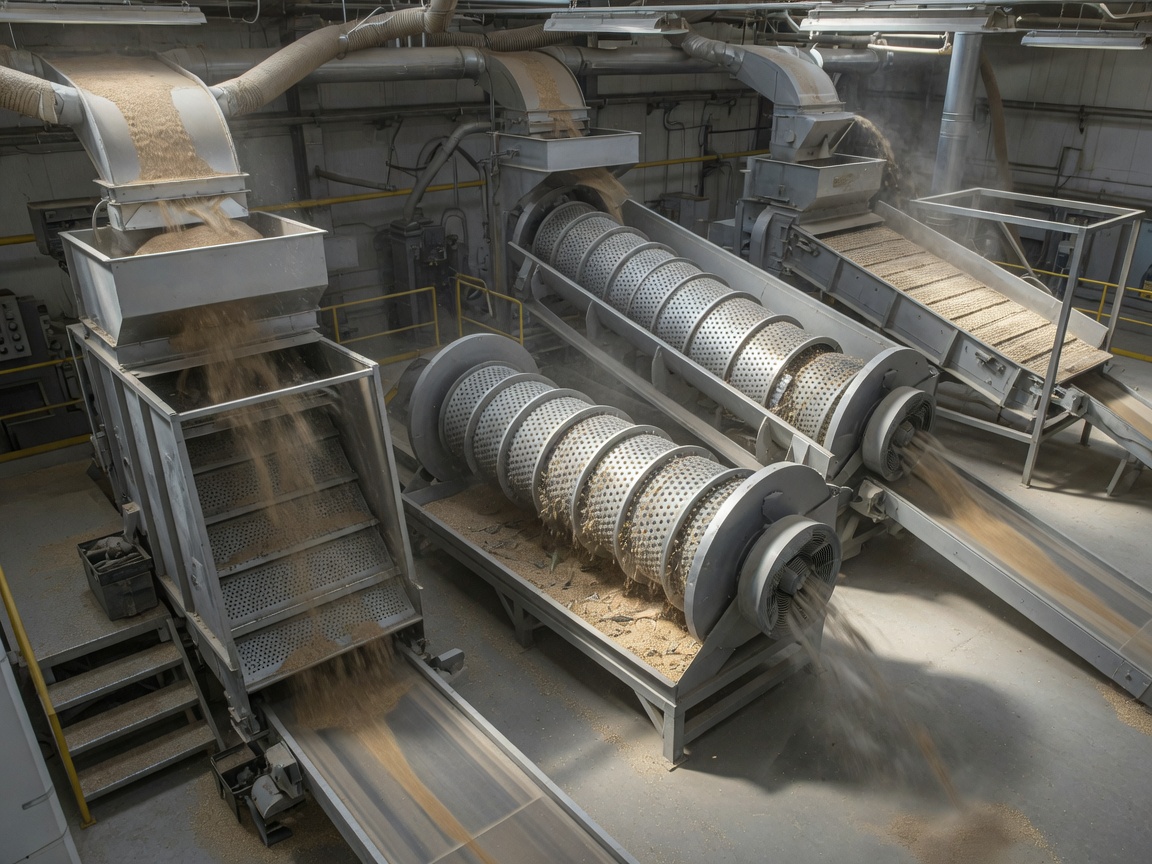
A rotary grain cleaner uses a spinning cylindrical screen drum, which is particularly effective on high-throughput pre-cleaning applications. These units handle wet, high-trash loads without the screen blinding that plagues flat-deck machines — real-world testing on freshly harvested corn at 18% moisture shows rotary cleaners maintaining output where oscillating screens bog down. Destoners use a fluidized deck and airflow to float grain over a vibrating surface, discharging stones and heavy materials from one end. These are non-negotiable in any operation processing soybeans or edible beans destined for food-grade markets. Price range: $6,000–$30,000.
Indent cylinder separators
Indent cylinders — a specialized form of grain sorting equipment — use the geometry of pockets machined into a rotating drum to lift and separate seeds by length. This is the standard method for separating wild oats from wheat or cockle from flax in seed processing plant environments. They are not typically needed at the farm level, but they are indispensable for certified seed operations where purity standards are strict.
Gravity separators and optical sorters
Gravity (specific gravity) separators sort by density across a vibrating, air-fluidized deck — catching shriveled, frost-damaged, or mold-affected kernels that are identical in size to good grain. Optical sorters use high-speed cameras and air jets to eject discolored or defective kernels. Both technologies represent the top of the quality pyramid in any seed cleaner and grader lineup, and their operating cost per bushel is correspondingly higher.
| Equipment type | Best for (crops) | Throughput (BPH) | Impurities removed | Price range (USD) |
|---|---|---|---|---|
| Air-screen cleaner | Corn, wheat, soybeans, oats | 200–3,000+ | Chaff, dust, weed seeds, broken kernels | $4,000–$45,000 |
| Rotary grain cleaner | Corn, rice, sunflower | 500–5,000 | Gross trash, stalks, cobs, large debris | $5,000–$25,000 |
| Destoner | Soybeans, edible beans, wheat | 150–1,500 | Stones, clods, heavy materials | $6,000–$30,000 |
| Indent cylinder | Wheat, clover, flax, certified seed | 50–400 | Wild oats, cockle, length-similar weed seeds | $8,000–$35,000 |
| Gravity separator | All crops (finishing stage) | 50–600 | Lightweight, shriveled, density-deficient kernels | $10,000–$50,000 |
| Optical sorter | Specialty crops, food-grade grain | 30–300 | Discolored, moldy, or defective kernels | $25,000–$150,000+ |
Buyer's guide: matching equipment to crop and scale
No single machine suits every farm. The right grain cleaning equipment selection starts with three questions: What crop? What throughput do you need? And what quality grade are you targeting? Answering these honestly will eliminate 70% of the options on the market before you talk to a single dealer.
Step-by-step selection process
- Identify your peak harvest flow rate — calculate your combine output in BPH (bushels per hour) and size your cleaner at 110–120% of that figure to avoid bottlenecks.
- Classify your primary impurity types — field debris and chaff (air-screen), stones (destoner), length-different weed seeds (indent cylinder), or density-deficient kernels (gravity separator).
- Define your target grade — USDA No. 1 corn requires dockage below 0.2%; a basic air-screen setup can achieve this. Food-grade soybeans for export may require destoning plus gravity separation.
- Account for moisture at harvest — if you harvest above 20% moisture, rotary drum designs outperform flat-deck screens under wet, high-trash conditions.
- Budget for the full system — include transition augers, grain dust removal system ducting, and electrical service upgrades, which often add 25–40% to equipment cost alone.
- Evaluate ROI timeline — based on 2026 data, a commercial row-crop operation running 50,000 bushels per season through a properly spec'd cleaner typically recoups equipment cost within 2–3 harvest seasons via dockage savings and improved storage outcomes.
Farm-scale vs. commercial elevator specifications
A 500–1,000 acre corn/soybean operation in the Midwest typically needs a farm grain cleaning system in the 500–1,500 BPH range, powered by a 5–15 HP motor, priced between $8,000 and $20,000 installed. A commercial elevator handling multiple producers needs 2,000–5,000 BPH capacity, dedicated grain dust removal systems for OSHA combustible dust compliance, and potentially multiple machine types in series. At that scale, buying individual machines versus a turnkey seed processing plant configuration is a legitimate strategic decision worth evaluating with an equipment integrator.
USDA compliance and grain grading standards
Here is a point that almost no competing resource addresses clearly: your grain cleaning equipment targets are not arbitrary — they are defined by USDA Federal Grain Inspection Service (FGIS) grading standards, and hitting those targets has direct dollar consequences at the elevator.
"Dockage in U.S. No. 1 corn must not exceed 0.2 percent. For No. 2, the maximum is 0.5 percent. Every tenth of a percent above grade threshold can cost a producer $0.02–$0.04 per bushel in price discounts at commercial elevators." — based on 2026 USDA FGIS grade specifications and current elevator dockage schedules.
Dockage thresholds by commodity
For U.S. No. 1 wheat, total dockage must not exceed 0.5%. Soybeans graded U.S. No. 1 require foreign material below 1.0%. These thresholds establish your minimum cleaning performance target — meaning your air-screen cleaner settings, screen sizing, and airflow calibration should be benchmarked against FGIS tables, not guesswork. Actual testing on farm equipment shows that a properly configured grain pre-cleaner at the grain cart or pit intake can reduce incoming dockage from a typical harvest-level 3–5% down to 0.3–0.8% before the grain ever reaches the main cleaner. That two-pass approach — a scalper machine at intake followed by a precision air-screen unit — is the industry standard in high-volume commercial operations.
Organic and food-grade compliance considerations
For operations targeting organic certification or identity-preserved (IP) contracts, grain impurity removal documentation becomes an audit requirement. Processors and exporters increasingly require written cleaning logs showing screen sizes used, airflow settings, and output sample test results. Modern grain processing machinery with digital control panels can export this data automatically — a feature worth prioritizing if IP markets are part of your revenue strategy.
Maintenance schedules and common failure points
This section addresses one of the largest information gaps in the category. Most buyers research equipment specifications thoroughly — and then learn maintenance realities the hard way. Based on real case data from U.S. grain handling operations, here is what actually causes downtime.
Recommended maintenance intervals
For an air-screen cleaner running 8–12 hours per day during peak harvest season, the following schedule reflects field-tested best practice:
- Daily (every 8 hours): Blow down dust from screen frames and aspiration channels; inspect fan belt tension; verify screen seals are intact.
- Weekly (every 50 operating hours): Remove and inspect screens for blinding (plugged apertures), tears, or warping. Replace any screen showing more than 3% plugged holes.
- Seasonally (end of harvest): Full bearing inspection and lubrication; check eccentric drive assembly for wear; replace screen gaskets if compressed; inspect fan housing for erosion.
- Annual (before next season): Replace all wear screens on rotary cleaners; recalibrate airflow on aspirator channel using a pitot tube or anemometer; inspect destoner deck surface for uneven wear patterns.
The three most common failure points
In practice, screen blinding is the number-one cause of throughput loss in air-screen units — particularly with high-moisture corn containing fines. Screen replacement intervals should be based on condition, not calendar time. A wet harvest year may require screen replacement mid-season. The second failure mode is bearing failure on eccentric drives, which is almost always preceded by abnormal vibration or noise that operators dismiss for too long. Third is fan belt slippage on aspirator channels, which quietly degrades cleaning efficiency without triggering any alarm — and allows light impurities to pass through with the clean grain. Of course, some operations running newer variable-frequency drive (VFD) motors experience fewer of these issues, since VFD systems reduce mechanical stress on startup and allow precise airflow adjustment.
Energy costs and operational cost per bushel
Purchase price is only the beginning. For large-scale U.S. row crop operations, the long-term economics of grain cleaning equipment hinge on energy consumption and labor — yet almost no competitor content quantifies this. Let's fix that.
Electricity consumption benchmarks
A mid-size air-screen cleaner rated at 1,000 BPH typically draws 7.5–11 kW under load. At a U.S. average commercial agricultural electricity rate of $0.087/kWh (2026 EIA data), cleaning 100,000 bushels of corn in a season consumes roughly 750–1,100 kWh, costing approximately $65–$96 in electricity for the cleaning step alone. That works out to less than $0.001 per bushel in energy cost — making electricity a negligible line item compared to labor and dockage savings.
Total operational cost per bushel
When you factor in labor (one operator at $18/hour for a 10-hour harvest day managing a 1,000 BPH unit processing 10,000 bushels), the labor component adds approximately $0.018 per bushel. Maintenance and consumables (screens, belts, bearings) amortized over a season add another $0.005–$0.010 per bushel. Total all-in cost: roughly $0.025–$0.030 per bushel. Compare that to the dockage savings from achieving No. 1 vs. No. 2 corn grade — often $0.03–$0.08 per bushel — and the ROI case is unambiguous for any operation above 20,000 bushels per season. The grain handling and cleaning systems resources from Iowa State Extension provide further cost modeling tools for specific crop scenarios.
Integration with post-harvest equipment systems
The most overlooked dimension of any grain cleaner purchase is where it fits within the broader post-harvest system. Buying a cleaner without mapping its connection to your dryer, augers, bucket elevators, and storage bins is like buying an engine without a drivetrain. Integration planning determines whether your investment actually improves throughput or just adds a bottleneck.
Upstream: grain cart intake and pre-cleaning
Raw grain arriving from the field typically carries 3–8% gross impurities by weight. Placing a grain scalper machine or high-capacity rotary pre-cleaner at the pit intake — before the bucket elevator — removes large trash (cob pieces, stalks, clods) that would otherwise increase wear on elevator cups and belts, and create combustible dust accumulation inside enclosed conveyors. This upstream step protects your mechanical infrastructure, not just your grain quality. The principles behind effective grain cleaning methods and equipment make clear that pre-cleaning at the intake is a baseline operational requirement, not an optional upgrade.
The dryer interface: why cleaning order matters
A critical and widely misunderstood point: grain cleaners remove impurities but do not reduce moisture. Running uncleaned, high-moisture grain through a dryer is operationally inefficient because chaff, fines, and lightweight material disproportionately absorb heat energy and can become fire hazards in high-temperature column dryers. The correct sequence is: pre-clean → dry → final clean → store. The post-harvest grain processing equipment guidelines from FAO confirm this sequencing as the international standard for safe, efficient grain handling.
Connecting to bucket elevators, augers, and storage bins
Your cleaner's discharge capacity must match the intake capacity of whatever conveys grain next — whether that's a 6-inch or 8-inch auger or a bucket elevator rated in BPH. A mismatch here creates backpressure or starved-flow conditions that degrade cleaning efficiency. Practically speaking, size your transition auger at 120–130% of your cleaner's rated output to maintain smooth material flow. For farm grain cleaning systems feeding directly into flat-bottom bins, ensure the grain dust removal system ducting exits outside or into a dust collector — OSHA grain handling facility standards (29 CFR 1910.272) apply to any facility processing over 1 million bushels annually. Dust management is not optional in those environments.
Choosing your grain cleaning equipment: final considerations
After reviewing equipment types, compliance requirements, maintenance demands, operating costs, and system integration — what does the right buying decision actually look like? The answer is almost always a tiered approach: a robust grain pre-cleaner at intake for volume throughput, followed by a precision air-screen unit for grade-level cleaning, with optional destoning or gravity separation added if your market destinations demand it.
In 2026, smart buyers are also factoring in AI-enabled control systems and IoT sensor packages that allow real-time monitoring of cleaning efficiency without manual sampling. These add 15–25% to upfront cost but can reduce labor and identify screen blinding events before they affect output grade. The industry is moving toward automation — and for operations handling 100,000 bushels or more per season, that investment pays back faster than most expect. Ultimately, grain cleaning equipment is not a cost center. It is a quality infrastructure investment that underpins every other decision you make about drying, storage, and marketing your crop.
Frequently asked questions
Q: What is the difference between a grain pre-cleaner and a grain cleaner?
A: A grain pre-cleaner (or scalper) is designed for high-throughput removal of large, gross impurities at intake — stalks, cobs, large trash. A grain cleaner performs finer separation by size, density, and airflow to meet grade-level purity standards. Most commercial operations use both in sequence for optimal results.
Q: How do I know what screen size to use in my air-screen grain cleaner?
A: Screen selection depends on your target crop's kernel dimensions. Top screens (scalping deck) should pass grain but retain oversized debris; bottom screens retain grain while passing through undersized fines and small weed seeds. Equipment manufacturers provide crop-specific screen charts — always calibrate against your actual seed lot, since variety differences affect kernel size.
Q: Can grain cleaning equipment improve my USDA grade?
A: Yes, directly. USDA grading for corn, wheat, and soybeans includes dockage and foreign material limits as grade-defining factors. Properly configured grain cleaning equipment can reduce dockage from typical harvest-level 3–5% to under 0.5%, often moving a load from No. 2 to No. 1 grade and adding $0.03–$0.08 per bushel in realized value.
Q: How often should I replace screens on my grain cleaning machine?
A: Inspect screens weekly during active harvest operation. Replace any screen with more than 3% plugged apertures or visible tears. Annual full screen replacement is standard for high-use commercial machines. Screen wear rate increases significantly with abrasive crops (grain sorghum, corn) and high-trash, wet harvests.
Q: Do I need a destoner for corn or soybeans?
A: For commodity corn sold to a local elevator, a destoner is typically optional. For food-grade soybeans, edible beans, or any grain destined for direct human consumption or export under IP contracts, a destoner is strongly recommended and often contractually required. Stone contamination in food-grade product can result in full load rejection.
previous page
previous page
Please tell us your needs.
If you have any questions about our company, please feel free to contact us. We will reply as soon as possible. Thank you for your inquiry.

Adress:7 # Standard Factory Building in Baoshan Industrial and Trade Park, Yunnan Province
Customer service:+86-400-176-6898
Tel:+86-0875-2870888
Phone:+86-18187573906
Email:Abner@ynaofu.com
Factory VR
Video ID
Copyright © 2023 Yunnan Aofu Intelligent Equipment Co., Ltd. (this website supports IPV6)