Welcome to the official website of Yunnan Aofu Intelligent Equipment Co., Ltd.!
Email login | Telephone:+86-400-176-6898



03
2026
-
10
Food machinery buyer's guide: types, features, and how to choose the right equipment
作者:
Yunnan Aofu
Article overview
This guide covers food machinery types, compliance requirements, TCO analysis, brand comparisons, and automation trends — targeting U.S. food manufacturers with 50–500 employees who are actively evaluating equipment suppliers in 2026.
Table of contents
- 1. What is food machinery? Core definition and scope
- 2. Major categories of food machinery explained
- 3. Total cost of ownership: the numbers most buyers miss
- 4. FDA, USDA, and NSF compliance — what to verify before you buy
- 5. Brand comparison: GEA vs. JBT vs. Bühler vs. Heat and Control
- 6. Industry 4.0 and automation in food processing
- 7. How to choose the right food machinery for your operation
- 8. FAQ
What is food machinery? Core definition and scope
Food machinery is the collective term for industrial equipment used to process, transform, package, inspect, and transport food products across the full production chain — from raw agricultural input to shelf-ready output. The category spans hundreds of distinct machine types, unified by one requirement: all contact surfaces and operational parameters must meet food-grade safety standards.
Why do so many procurement managers end up with the wrong equipment? Often, it comes down to treating food machinery as a single, undifferentiated category. In reality, the engineering requirements for a dairy pasteurizer are entirely different from those of an industrial food grinder or a food extrusion machinery line. The materials, tolerances, cleaning protocols, and compliance pathways diverge dramatically.
According to recent 2026 data from Grand View Research, the global food machinery market was valued at approximately $111.8 billion and is projected to reach $172 billion by 2030, representing a CAGR of roughly 6.4%. The U.S. market remains the single largest national segment, driven by continuous investment in food manufacturing machinery modernization and regulatory-driven equipment upgrades. For a broader context on the sector, see this food processing equipment overview.
Why the definition matters for procurement
A clear definitional scope prevents budget misallocation. Food production equipment purchased under a vague brief frequently underperforms because the buyer conflated processing capacity with packaging throughput, or assumed a single platform could handle both ambient and cold-chain operations. Real purchasing clarity starts with knowing exactly which sub-category you need.
Scope: what food machinery does and does not include
Food machinery covers washing and sorting systems, cutting and grinding lines, mixing and blending equipment, thermal processing units, food packaging machines, conveyor and transfer systems, and inline inspection technology. It does not typically include raw agricultural harvesting equipment or post-distribution retail refrigeration units, though the line blurs in vertically integrated operations.
Major categories of food machinery explained
The most practical way to navigate the equipment landscape is by production function. Each category below represents a distinct engineering discipline with its own compliance framework, maintenance profile, and supplier ecosystem.
Processing and transformation equipment
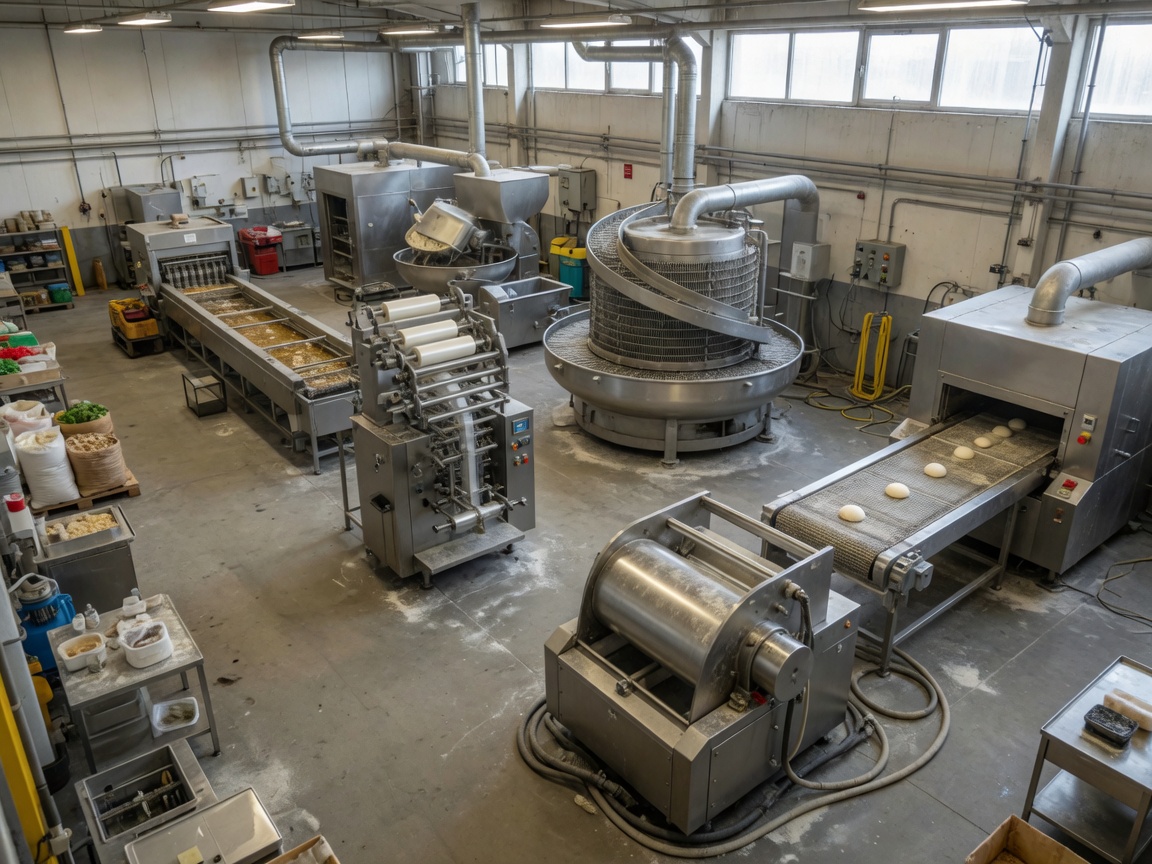
Industrial food processing machines in this group include food chopper and food grinder machines, planetary mixers, food mixing equipment, and food extrusion machinery. Throughput for industrial grinders typically ranges from 500 kg to 8 tons per hour. USDA FSIS regulations govern all meat-contact surfaces. Extrusion lines — common in snack, pet food, and pasta manufacturing — require precise temperature and pressure control, and the dies and barrels must be fabricated from 316L stainless steel at minimum.
Packaging and sealing systems
Food filling and sealing machines, vacuum packaging units, labeling systems, and automated palletizers all fall here. This segment has absorbed the most automation investment over the past three years. A mid-sized U.S. beverage manufacturer in Colorado — operating with roughly 120 employees — reduced labor costs by 31% after transitioning from semi-automatic to fully automated food packaging machines with integrated vision inspection. The key procurement variable is format flexibility: can the machine handle multiple SKU sizes without a full changeover?
Conveying and material handling
Food conveyor systems are the connective tissue of any production floor. Sanitary food processing equipment in this category must support clean-in-place (CIP) protocols, which means open-frame belt conveyors with minimal horizontal surfaces to prevent pooling. Incline conveyors, spiral freezer conveyors, and vibratory feeders each serve specific transfer roles. Buyers frequently underestimate conveyor integration costs — field experience shows that belt conveyor installation and integration can add 15–25% to the quoted unit price.
Inspection and quality control equipment
Metal detectors and X-ray foreign object detection systems are now standard in most FSMA-compliant U.S. facilities. Optical sorters, checkweighers, and vision systems round out the inline QC stack. These are not optional — FSMA's Preventive Controls rule effectively mandates a documented hazard analysis that, in most cases, will identify foreign object contamination as a significant risk requiring a control measure.
| Machine category | Representative equipment | Typical throughput (industrial) | Key compliance note |
|---|---|---|---|
| Washing & sorting | Bubble washer, optical sorter | 2–15 tons/hr | FDA 21 CFR Part 117 sanitation |
| Cutting & grinding | Food grinder, dicer, slicer | 500 kg–8 tons/hr | USDA FSIS for meat-contact surfaces |
| Mixing & blending | Planetary mixer, ribbon blender | 200 kg–5 tons/batch | 3-A Sanitary Standards |
| Packaging | Filling machine, vacuum sealer, labeler | 20–400 units/min | NSF/ANSI 2 certification |
| Conveyors | Belt conveyor, spiral conveyor | Variable by line speed | CIP-compatible, open-frame design |
| Inspection | Metal detector, X-ray system | Up to 600 units/min | FSMA Preventive Controls rule |
Total cost of ownership: the numbers most buyers miss
Purchase price is only the first chapter of the cost story. In actual practice, the initial capital outlay for commercial kitchen equipment or industrial lines typically represents just 35–45% of the total 10-year spend. The rest is distributed across installation, energy, labor, maintenance, and end-of-life disposal.
TCO breakdown by cost category
Based on real-world data aggregated from mid-sized U.S. food manufacturers, here is how costs distribute over a 10-year horizon for a representative automated food processing system (e.g., a 2-ton/hr continuous mixing and filling line valued at $480,000 at purchase):
| Cost category | Estimated 10-year cost | % of TCO | Key cost driver |
|---|---|---|---|
| Purchase price | $480,000 | 38% | Spec level, automation degree |
| Installation & commissioning | $72,000 | 6% | Site prep, electrical, CIP hookup |
| Energy consumption | $130,000 | 10% | Motor efficiency class, run hours |
| Preventive maintenance | $145,000 | 11% | Parts availability, service contract |
| Unplanned downtime losses | $220,000 | 17% | MTBF, spare parts lead time |
| Regulatory compliance upgrades | $95,000 | 7% | FSMA rule revisions, state rules |
| End-of-life / disposal | $32,000 | 3% | Scrap value offset, removal labor |
| Total 10-year TCO | $1,259,000 | 100% |
Notice that unplanned downtime — not maintenance — is actually the second-largest cost category. This is why predictive maintenance and IoT-enabled monitoring, discussed in Section 6, deliver such a strong ROI case. A machine that costs $60,000 less at purchase but has a 30% higher downtime rate will consistently lose money over a 5-year horizon.
Energy costs deserve more attention
Industrial food grinders, mixers, and thermal processing units are among the highest energy consumers on the floor. Specifying IE4 or IE5 premium-efficiency motors adds roughly 8–12% to motor cost but reduces energy spend by 15–22% annually at full load. Over 10 years, that delta is rarely trivial. Of course, if a line runs at 40% capacity, the savings shrink proportionally — which is exactly why oversized equipment is a hidden cost trap.
FDA, USDA, and NSF compliance — what to verify before you buy
Compliance documentation is where many equipment purchases stall or, worse, proceed without adequate verification. The regulatory landscape in the U.S. involves three principal authorities, each with distinct scope and enforcement mechanisms. For detailed regulatory guidance, refer to the official food equipment regulatory guidance published by the FDA.
The three certification bodies and what they actually cover
FDA (21 CFR Part 117) governs sanitary facility and equipment design for all human food manufacturers. It does not certify individual machines — rather, it sets design principles (smooth, cleanable surfaces; no crevices; corrosion-resistant materials) that equipment must meet. USDA FSIS authority applies specifically to meat and poultry processing; equipment used in FSIS-inspected plants must appear on the approved equipment list or receive prior approval. NSF International (NSF/ANSI 2 and NSF/ANSI 51) certifies that food-zone equipment and materials meet sanitary design requirements — this is a third-party certification that provides concrete, auditable proof of compliance.
A practical compliance verification checklist
- Confirm all food-contact surfaces are 304 or 316L stainless steel (or FDA-approved polymer) — request the material certification sheet (MTC).
- Verify NSF/ANSI 2 or 3-A Sanitary Standards certification — check the NSF product and service listings database directly, not just the supplier's brochure.
- For meat/poultry applications, confirm USDA FSIS acceptance — review the FSIS equipment approval database before procurement.
- Confirm CIP/COP compatibility — request documented cleaning validation data at your operating temperatures and chemical concentrations.
- Ask for IP (ingress protection) ratings on all electrical enclosures — IP65 minimum for wash-down zones; IP69K for high-pressure environments.
- Review the supplier's Declaration of Conformity for FSMA Preventive Controls alignment, specifically for equipment used as a process control measure.
"Sanitary equipment design is not optional — it is the foundation of a FSMA-compliant preventive controls plan. Buyers who treat NSF certification as a nice-to-have will face costly retrofits or production shutdowns during FDA inspections."
— Food Safety Preventive Controls Alliance (FSPCA), 2026 training guidance
Brand comparison: GEA vs. JBT vs. Bühler vs. Heat and Control
Head-to-head brand comparisons are almost entirely absent from competitor content — yet they are exactly what procurement managers at mid-sized U.S. facilities need. The table below compares four dominant suppliers across the dimensions that matter most for a 50–500 employee operation.
| Criteria | GEA Group | JBT Corporation | Bühler Group | Heat and Control |
|---|---|---|---|---|
| Primary strength | Dairy, beverage, pharma-adjacent | Protein / poultry processing | Grain, milling, extrusion | Snack food, seasoning, coating |
| U.S. service network | Strong (30+ U.S. locations) | Strong (HQ in Chicago, IL) | Moderate (U.S. hub in Plymouth, MN) | Strong (Hayward, CA HQ) |
| NSF/USDA compliance | NSF certified, 3-A compliant lines | USDA-accepted for protein | NSF, EU-compliant | NSF/ANSI 2 certified |
| IoT / smart monitoring | GEA OptiPartner platform | JBT iOPS remote monitoring | Bühler Insights platform | Developing (limited rollout) |
| Best fit: mid-market (50–500 emp.) | Moderate — pricing skews enterprise | Good — modular line options | Good for grain/snack processors | Excellent — built for mid-market |
| Typical lead time (U.S.) | 16–28 weeks | 12–20 weeks | 18–30 weeks | 10–18 weeks |
The pattern here is instructive. Heat and Control consistently wins on lead time and mid-market fit; JBT dominates protein and poultry lines; GEA and Bühler offer deep IoT integration but carry higher total price points that are difficult to justify below $5M in annual equipment spend. None of these brands is universally superior — the right choice depends on your product category, throughput, and compliance environment.
What mid-sized manufacturers should prioritize
For facilities in the 50–500 employee range, the most underweighted evaluation criterion is local service response time. A premium brand that requires a 10-day wait for a field technician will cost more in downtime losses than the price premium was ever worth. Request references from U.S. customers of comparable size — and ask specifically about average response time for unplanned service calls.
Industry 4.0 and automation in food processing
The phrase "food industry automation" gets used loosely. Let us be precise: in 2026, meaningful automation means not just replacing manual labor with machines, but connecting those machines to data systems that enable real-time decisions. Automated food processing systems without data integration are, in practice, just expensive standalone equipment.
IoT-enabled monitoring: a real implementation case
A mid-sized meat processor in Kansas City, Missouri — approximately 200 employees, two production shifts — implemented vibration and temperature sensors on their primary industrial food grinder line in 2025. Within six months, the predictive maintenance system flagged bearing wear on a critical gearbox 11 days before projected failure. The planned replacement cost $4,200 in parts and 6 hours of downtime. The unplanned failure it prevented was estimated at $38,000 in lost production and emergency labor. That is a 9:1 return on the sensor investment alone. Just like a check-engine light prevents a catastrophic engine failure, IoT sensors on food machinery convert surprise breakdowns into scheduled maintenance events.
Smart sensor integration: what to specify
When evaluating automated food processing systems, ask suppliers for OPC-UA protocol compatibility — this is the industrial standard that allows sensors to communicate with SCADA systems and ERP platforms without proprietary lock-in. Also verify whether the machine's PLC (programmable logic controller) supports remote firmware updates, which is increasingly required for FSMA record-keeping and traceability software integration.
For a deeper technical perspective on automation engineering in this sector, the peer-reviewed literature is valuable — see food machinery engineering topics for recent research on sensor integration and process control.
Sustainability as a 2026 procurement criterion
Industry consensus is shifting: energy efficiency is no longer a secondary specification. Major U.S. food retailers now require Scope 3 emissions reporting from their supplier base, which creates upstream pressure on manufacturers to document equipment energy consumption. Specifying IE4/IE5 motors, closed-loop water recycling on food conveyor systems, and low-waste food packaging machines is no longer just good practice — it is increasingly a condition of key customer contracts.
How to choose the right food machinery for your operation
Selection frameworks vary by operation size, but for mid-sized U.S. manufacturers, the following process has proven most reliable based on documented procurement outcomes across multiple facility types.
A step-by-step selection process
- Define your product parameters — viscosity, temperature sensitivity, allergen risk, and regulatory category (FDA vs. USDA-inspected). These constraints immediately eliminate 60–70% of the market.
- Establish throughput at peak demand, not average demand — size for your 95th-percentile production day, not your mean. Undersized food production equipment creates bottlenecks that are expensive to resolve post-installation.
- Build a TCO model before requesting quotes — use the framework from Section 3. A supplier quoting a 20% lower purchase price who cannot provide local service within 24 hours is almost certainly more expensive over 5 years.
- Verify compliance documentation independently — use the NSF product database and FSIS equipment lists directly, not supplier-provided summaries.
- Request a Factory Acceptance Test (FAT) — for any line exceeding $150,000, a witnessed FAT at the supplier's facility before shipment is standard practice and protects against costly site-level surprises.
- Negotiate a spare parts package and service SLA — minimum: 4-hour remote response, 24-hour on-site response, 10-year parts availability guarantee for critical wear components.
Common selection mistakes and how to avoid them
The industry has well-known pitfalls. Specifying a general-purpose food mixing equipment platform for a high-viscosity confectionery application — instead of a dedicated high-shear mixer — is a classic error that results in inconsistent product quality and accelerated wear. Similarly, treating food grade equipment certification as equivalent across all certifying bodies creates compliance gaps. NSF/ANSI 2 is not interchangeable with 3-A Sanitary Standards; each applies to different equipment categories. When in doubt, require both and let the supplier demonstrate compliance.
Choosing the right food machinery ultimately comes down to matching engineering specifications to operational reality — not to a catalog page. The time invested in a rigorous evaluation process will reliably return more value than any negotiated discount on purchase price.
Frequently asked questions
Common questions answered
Q: What certifications should food machinery have for a U.S. facility?
A: At minimum, look for NSF/ANSI 2 or 3-A Sanitary Standards certification for food-zone equipment. Meat and poultry processing equipment must appear on the USDA FSIS approved equipment list. For all facilities under FSMA jurisdiction, equipment used as a preventive control measure must be documented in your food safety plan with supporting sanitary design evidence.
Q: How much does industrial food processing equipment cost?
A: Entry-level commercial units start around $5,000–$25,000. Mid-range industrial food processing machines — suitable for 50–500 employee operations — typically range from $80,000 to $600,000 per line. Full automated systems with integration, installation, and commissioning can exceed $1.5M. Always model TCO over 5–10 years, not just purchase price.
Q: What is the difference between food grade equipment and standard industrial equipment?
A: Food grade equipment uses materials approved for direct food contact (typically 304/316L stainless steel or FDA-compliant polymers), features crevice-free welds, and is designed to support CIP or COP sanitation. Standard industrial equipment may use coated carbon steel or lubricants that are not food-safe, making it unsuitable and legally non-compliant for food manufacturing environments.
Q: How long does food machinery typically last?
A: With proper preventive maintenance, most sanitary food processing equipment has a useful service life of 12–20 years. High-wear components such as blades, belts, and seals require more frequent replacement. IoT-enabled predictive maintenance programs can extend effective equipment life by 15–25% by catching degradation early.
Q: Can one supplier provide all types of food machinery?
A: Rarely, and trying to force single-supplier coverage usually means accepting compromised specifications in secondary categories. Best practice for mid-sized manufacturers is a primary OEM for core processing equipment and specialized suppliers for packaging, inspection, and conveyors — with a systems integrator managing line-level compatibility and automation protocols.
Please tell us your needs.
If you have any questions about our company, please feel free to contact us. We will reply as soon as possible. Thank you for your inquiry.

Adress:7 # Standard Factory Building in Baoshan Industrial and Trade Park, Yunnan Province
Customer service:+86-400-176-6898
Tel:+86-0875-2870888
Phone:+86-18187573906
Email:Abner@ynaofu.com
Factory VR
Video ID
Copyright © 2023 Yunnan Aofu Intelligent Equipment Co., Ltd. (this website supports IPV6)